
RAC-310 · Lesson 11 of 12 · 17 min
Commercial service practices: maintenance, records and energy
Meera signed a service agreement with Northfield before the store opened, and Dana asked Theo to draft the preventive maintenance schedule that went with it. "Every contractor promises maintenance," she said. "What the customer is really buying is fewer emergencies, less product loss, lower bills and records that hold up when an inspector or an insurer asks. Write the schedule so it delivers those, and so the technician who does it next year knows exactly what to check." Theo started with the manufacturers' maintenance instructions for every piece of equipment, Northfield's own checklists, and the store's opening hours.
This lesson covers the work that keeps commercial refrigeration running between failures: preventive maintenance and how often to do it, the records that go with it, energy checks and audits, and how commercial service calls are run and reported. Most of it applies equally to a single restaurant and to a chain of stores.
Preventive, predictive and reactive work
Reactive maintenance fixes things when they break. It is unavoidable, but in commercial refrigeration it is expensive, because failures happen at night, on weekends and on the hottest days, and they cost product as well as parts and overtime. Preventive maintenance, or PM, does planned tasks at set intervals to stop failures happening: cleaning condensers, changing filters, checking belts, tightening electrical connections. Predictive maintenance uses measurements and trends to find developing problems before they cause failures: rising compressor amps, a slowly falling receiver level, discharge temperatures creeping up or a megohm reading trending down, as RAC-130 described. A good maintenance program uses all three, with the rack controller's data doing much of the predictive work.
What goes into a PM schedule
A PM schedule lists every piece of equipment, every task, how often it is done and what is recorded. The intervals come from the manufacturers' instructions, adjusted for the site: a condenser beside a kitchen exhaust or a row of cottonwood trees needs cleaning far more often than one on a clean roof.
| Interval | Typical tasks |
|---|---|
| Monthly | Check case and walk-in temperatures against controller readings; clean self-contained condensers in kitchens; check door gaskets, closers and heaters; check drains; review alarms and the rack controller's logs |
| Quarterly | Clean case coils, return grilles and drain pans; check fan motors; check rack oil levels, oil separator and filter-drier pressure drop; leak inspection of the machine room and walk-ins; check refrigerant detectors |
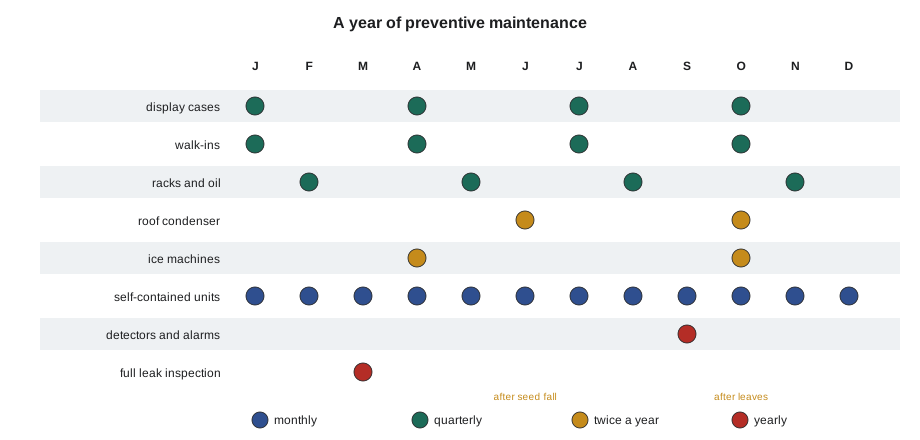
| Twice a year | Clean rooftop condensers before summer and after leaf and seed season; check heat reclaim operation before the heating season; clean and sanitize ice machines; check defrost heaters and terminations; test alarms end to end |
| Yearly | Full leak inspection of the whole system; calibrate or bump test detectors as specified; check electrical connections and contactors; megohm test compressors; check relief valves and safety controls; review energy use |
The schedule should also say what is not included, such as repairs, refrigerant, case cleaning that store staff do, and parts beyond a stated value, so the customer is not surprised. Theo's draft listed each fixture by its circuit number from the rack controller, so the PM record, the controller's alarms and the service invoices all used the same names.
How often is often enough?
Maintenance intervals are a trade-off. Cleaning a condenser every month costs labour; cleaning it once a year costs energy and risks high-pressure trips and compressor damage on the hottest days. The script below estimates the yearly cost of cleaning Harvest Lane's rooftop condenser at different intervals, with a simple model in which the extra compressor energy grows steadily as the coil fouls and falls back to zero when it is cleaned.
# How often to clean the rooftop condenser: cleaning cost against the energy lost to fouling (illustrative)
RACK_KWH = 190000          # kWh per year for both racks with a clean condenser
PRICE = 0.13               # dollars per kWh
PENALTY = 0.012            # extra compressor energy per month since the last cleaning (fraction)
VISIT = 450.0              # dollars per condenser cleaning, labour and materials

best = None
for months in (1, 2, 3, 4, 6, 12):
    visits = 12 / months
    avg_penalty = PENALTY * months / 2              # fouling grows from zero to PENALTY * months
    energy_cost = RACK_KWH * avg_penalty * PRICE
    total = visits * VISIT + energy_cost
    print(f"clean every {months:2d} months: {visits:4.1f} visits ${visits * VISIT:6.0f}, "
          f"extra energy ${energy_cost:6.0f}, total ${total:6.0f} per year")
    if best is None or total < best[1]:
        best = (months, total)
print(f"lowest total cost: clean every {best[0]} months (cottonwood season and kitchen exhaust nearby can shorten this)")clean every 1 months: 12.0 visits $ 5400, extra energy $ 148, total $ 5548 per year clean every 2 months: 6.0 visits $ 2700, extra energy $ 296, total $ 2996 per year clean every 3 months: 4.0 visits $ 1800, extra energy $ 445, total $ 2245 per year clean every 4 months: 3.0 visits $ 1350, extra energy $ 593, total $ 1943 per year clean every 6 months: 2.0 visits $ 900, extra energy $ 889, total $ 1789 per year clean every 12 months: 1.0 visits $ 450, extra energy $ 1778, total $ 2228 per year lowest total cost: clean every 6 months (cottonwood season and kitchen exhaust nearby can shorten this)
On energy alone, cleaning every four to six months gives the lowest total cost for this condenser, which is roughly what the manufacturer recommended. The model leaves out two things that push toward more frequent cleaning: a fouled condenser on a hot day can trip the rack on high pressure and lose product, and running at high head pressure shortens compressor life. It also leaves out site events, such as the week the cottonwood trees beside the store's parking lot shed their seed fluff, which can blanket a condenser in days. Theo's schedule cleaned the condenser in early June, after the seed fall, and again in October after the leaves, with a check in between.
Records that work
Commercial service records serve several readers. The customer wants to know what was done and what it cost. The next technician needs to know what was found, what was changed and what to watch. Regulators and auditors need refrigerant records. Insurers and health inspectors may need temperature and alarm records after a loss. Good records are specific: not "checked system, OK" but "MT rack suction −7.2 °C (19 °F) saturated, discharge 31 °C (88 °F) saturated, receiver 38 % at 4 °C (39 °F) outdoors, oil levels normal on all four compressors". They record readings, not opinions, so later trends can be seen.
- Every visit: date, time on and off site, technician, equipment worked on, readings taken, work done, parts used, refrigerant added or recovered by weight and cylinder, and recommendations.
- Refrigerant: each addition and recovery, with the system, refrigerant type, amount, reason and leak test results, as the regulations require.
- Temperatures: controller logs and any manual readings, especially around failures.
- Recommendations: what should be done, why, how urgent and roughly what it would cost, so the customer can decide.
Many contractors now use service software on a phone or tablet, with checklists for each type of equipment, photos and the customer's signature. The software is only as good as what goes into it. A technician who learns to take and record good readings on every call builds a history that makes every later call faster.
Energy checks and audits
Refrigeration is usually the largest electrical load in a grocery store, often around half of its electricity use. Technicians are well placed to find energy waste, because they see the equipment and its controls more often than anyone else. An energy check during maintenance looks for things such as these.
- Head pressure higher than the floating head setting should give, from a dirty condenser, a failed fan, a stuck heat reclaim valve or a minimum set too high.
- Suction pressure lower than needed, from a setpoint set low to cover one warm fixture whose real problem is elsewhere.
- Defrosts more frequent or longer than needed, or heaters running outside defrost.
- Anti-sweat heaters on all the time because the control has been bypassed.
- Night covers not used, case lights on all night, walk-in doors propped open.
- Compressors running in hot weather with failed condenser fans, or short cycling.
An energy audit goes further, usually led by an energy engineer or a utility program, measuring the store's energy use and estimating the savings from changes such as doors on open cases, LED lighting, electronically commutated fan motors, floating head and suction, and controls upgrades. Utilities in many areas offer incentives for these projects, and technicians often install them. Lesson 5 showed how large the savings from doors on cases can be; lesson 8 showed the savings from floating head pressure.
Running a commercial service call
A commercial service call follows a pattern that respects the customer's business. Check in with the manager or the person who called, and ask what happened, when it started and what product is at risk. Look at the controller's alarms and logs before touching anything. Protect product first: if a case or walk-in is failing, help the staff move product to other refrigeration while you work, and record the times and temperatures. Diagnose with the method from earlier courses: what should be happening, what is happening, and what is different. Explain the problem and the options clearly, including the cost and time of each, and get authorization before major work. After the repair, confirm the fixture is pulling down, check that alarms are back in normal state and record everything. Before leaving, tell the manager what was done and what to watch for.
Some calls are about the customer's own staff: product stocked over load lines, doors propped open, grilles blocked, a case unplugged for cleaning and not plugged back in. Handle these with tact. Show the staff what the problem was and why it matters, in plain terms, and put it in the report so the manager knows. Customers value a technician who helps them avoid the next call.
Safety on commercial jobs
Commercial jobs add hazards to the ones covered in earlier courses. Store floors are public spaces, so tools, ladders and open panels must be barricaded from customers. Roof work on condensers needs fall protection near edges and skylights, and safe access. Machine rooms need refrigerant awareness, as lesson 7 described. Walk-in freezers need the precautions of lesson 3. Cleaning chemicals for coils and ice machines have safety data sheets that must be read. And many stores require their own sign-in, permits for hot work such as brazing and fire watch, and coordination with their own staff. The customer's rules are in addition to Northfield's and the law's, never instead of them.
Daily checks by store staff
A refrigeration contractor visits a store once a month or less; the staff are there every day. Many problems are cheapest to catch before a technician is ever called, and Theo's maintenance plan included a one-page card for the Harvest Lane department managers. Twice a day, read and record each case and walk-in temperature from its display or thermometer, and call if any is above its limit. Keep product inside the load lines and the return grilles clear. Close walk-in doors and check that their closers work. Pull the night covers down at closing and up at opening. Report any ice on coils or floors, any door that fogs or will not seal, and any unusual noise. Wash the washable condenser filters on the self-contained units weekly, and keep the ice scoop in its holder. The card used the same fixture names as the rack controller, so a manager could tell the on-call technician exactly which case was warm. Meera's staff were not refrigeration experts, and they did not need to be; they needed to know what normal looked like and when to call.
Common mistakes
MistakeWriting "checked, OK" in a service report.
InsteadRecord actual readings and observations so trends can be seen.
MistakeSetting PM intervals only from the calendar.
InsteadAdjust intervals for site conditions such as kitchen exhaust, trees and dust.
MistakeLowering a rack's suction setpoint to cure one warm case.
InsteadFind the warm case's own problem; a low setpoint wastes energy on every fixture.
MistakeLeaving a store floor work area unprotected.
InsteadBarricade tools, ladders and open panels from customers.
MistakeStarting a major repair without authorization.
InsteadExplain the options and costs and get approval first.
Summary and key terms
- Commercial maintenance combines preventive, predictive and reactive work.
- A PM schedule lists every item, task, interval and record, adjusted for site conditions.
- Intervals balance labour against energy, failures and product risk.
- Records should contain readings, refrigerant quantities and clear recommendations.
- Technicians can find much of a store's refrigeration energy waste during routine visits.
- Commercial calls protect product first, respect the business and end with a clear report.
- Preventive maintenance
- Planned tasks at set intervals that prevent failures.
- Predictive maintenance
- Using measurements and trends to find problems before they cause failures.
- Reactive maintenance
- Repairing equipment after it fails.
- Service agreement
- A contract that sets the maintenance, response times and coverage a contractor provides.
- Energy audit
- A study that measures energy use and estimates savings from improvements.
- PM schedule
- A list of maintenance tasks, intervals and records for each piece of equipment.
Practice problems
Work each problem on paper first, then reveal the answer to check.
Name two pieces of rack controller data that support predictive maintenance.
Show answer
The receiver level trend and compressor amps or discharge temperature trends; also alarm histories.
Why might a condenser need cleaning more often than the manufacturer's interval?
Show answer
Site conditions such as kitchen exhaust, trees shedding seeds or leaves, or dust.
A technician lowers a rack's suction setpoint so one warm case holds temperature. Why is this poor practice?
Show answer
It wastes energy on every fixture and hides the warm case's real problem.
What should be done first on a call for a failing walk-in full of product?
Show answer
Protect the product, with the staff, and record times and temperatures.
Lesson quiz · 5 questions
Score 60% or more to complete this lesson.
Create a free account to save your progress, take quizzes and earn a certificate.