
RAC-310 · Lesson 10 of 12 · 17 min
Leak management and refrigerant monitoring in stores
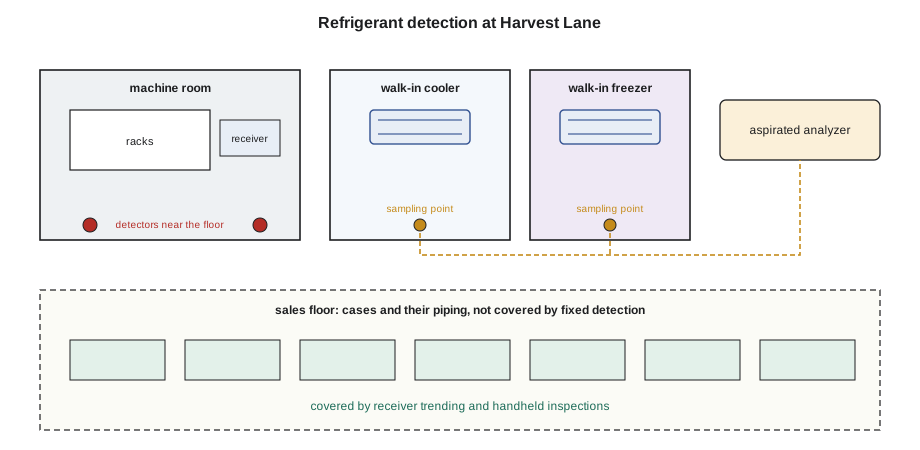
Harvest Lane had been open for nine weeks when Theo, reviewing the rack controller's data from the office as part of Northfield's monthly report, noticed that the medium-temperature rack's receiver level had been drifting down. No alarm had gone off; the refrigerant detectors in the machine room and walk-ins read zero. He showed Dana the trend. "That's a leak," she said, "and it's somewhere the detectors can't see. Bring the handheld and the case piping drawings." Two days later Theo found it, under the bottom tub of a produce case: the liquid line had been run across the sharp edge of the case's steel base without a grommet, and the case's vibration had worn a pinhole through the copper.
Large commercial systems leak more than any other kind of refrigeration. They have long pipe runs through stores, hundreds of joints and valves, vibrating compressors, and fixtures that are moved, cleaned and bumped every day. Industry studies have often found grocery systems losing somewhere around 15 to 25 % of their charge a year, and some far more. This lesson covers where stores leak, how leaks are found, how refrigerant monitoring works, and what the rules require of the people who service these systems.
Where stores leak
Leaks are not spread evenly through a system. Experience from thousands of stores shows the same places again and again.
- Mechanical joints: flare nuts, threaded fittings, Schrader valve cores and the caps that should seal them, flanged valves and their gaskets.
- Valve stems and packings: service valves, ball valves and EPRs, especially those that are operated often.
- Vibration: small tubes at compressors, transducer lines, oil lines and gauge lines that crack from fatigue, and pipes that rub on supports, case bases or each other.
- Case coils and tubing: corrosion from cleaning chemicals, salt from meat and seafood, and formicary corrosion, a pitting attack on copper by organic acids in some building environments.
- Relief valves: a valve that has lifted once may not reseat completely and can weep refrigerant continuously.
- Damage: carts, forklifts, shelving installers and other trades drilling or cutting into lines.
Brazed joints made well rarely leak. Mechanical joints, vibration and corrosion cause most leaks, so designs that use fewer mechanical joints, support pipes properly and protect them where they pass through case bases leak less. Installation quality matters as much as design: the Harvest Lane leak came from a missing grommet that a few seconds of care would have prevented.
Finding leaks: the receiver trend
On a rack, as lesson 7 explained, the receiver level reflects the total charge. A slow leak shows up as a gradual fall in the receiver level at similar outdoor and load conditions. The rack controller logs the level, and comparing readings taken at the same time of day, typically in the small hours when the store is closed and loads are steady, removes most of the daily variation. A correction for outdoor temperature removes much of the rest. The script below takes two weeks of 3 a.m. readings from Harvest Lane's medium-temperature rack, corrects them for the outdoor temperature using a factor estimated for this rack, fits a straight line and converts the slope into refrigerant lost per day. Then it annualizes the leak rate from the refrigerant added after the repair.
# Finding a slow leak from the rack controller's receiver level log, then annualizing the leak rate
# Daily 3 a.m. receiver readings (% full) with the outdoor temperature at the time (illustrative log)
log = [(1, 38.0, 4), (2, 37.6, 2), (3, 38.4, 7), (4, 36.9, 1), (5, 37.2, 3), (6, 36.4, 2), (7, 36.8, 6),
       (8, 35.9, 3), (9, 35.4, 1), (10, 36.1, 7), (11, 35.0, 4), (12, 34.6, 3), (13, 34.9, 6), (14, 34.0, 2)]
# remove the weather effect: about 0.5 % of receiver level per K of outdoor temperature on this rack
CORR = 0.5
REF_T = 4.0
adj = [(d, lvl - CORR * (t - REF_T)) for d, lvl, t in log]
n = len(adj)
mx = sum(d for d, _ in adj) / n
my = sum(v for _, v in adj) / n
slope = sum((d - mx) * (v - my) for d, v in adj) / sum((d - mx) ** 2 for d, _ in adj)
KG_PER_PCT = 1.6                         # kg of R-448A per % of receiver level on this rack
print(f"weather-corrected trend: {slope:+.2f} % per day = {slope * KG_PER_PCT:+.2f} kg per day")

# annualizing after the repair: refrigerant added and days since the last addition
FULL_CHARGE = 180.0                      # kg, medium-temperature rack
added, days = 7.5, 75
rate = added / FULL_CHARGE * 365 / days * 100
print(f"added {added} kg after {days} days: annualized leak rate {rate:.1f} % of the full charge")weather-corrected trend: -0.32 % per day = -0.52 kg per day added 7.5 kg after 75 days: annualized leak rate 20.3 % of the full charge
The trend showed the rack losing about 0.5 kg (1.1 lb) a day, which is about 190 kg (410 lb) a year if left alone, more than the whole medium-temperature charge. After the pinhole was repaired, Raj added 7.5 kg (16.5 lb) to restore the receiver level. Because the system had been charged at start-up 75 days earlier, the annualized leak rate came to just over 20 %. Theo learned that this number is not just a statistic: as the next section explains, it is what the regulations use to decide what must happen next, and it goes in the system's records.
Receiver trending catches slow leaks wherever they are in the system, but it is slow. A fast leak, such as a broken pipe, empties the receiver within hours and is caught by low receiver level alarms, case temperature alarms and, if it is in a monitored space, refrigerant detectors.
Fixed refrigerant detectors
Refrigerant detectors sample the air for refrigerant and alarm above set concentrations. They serve two different purposes, and it helps to keep them apart.
- Safety detection: required by the refrigeration safety code in machinery rooms and, for some refrigerants and charges, in occupied spaces. It protects people from oxygen displacement, toxic decomposition products or flammable concentrations, and it starts ventilation and alarms at the levels the code sets.
- Leak detection: an environmental and economic measure. It is set to alarm at much lower concentrations so leaks are found early, and it may cover places such as walk-ins, case areas and ceiling spaces where safety detection is not required.
Detectors use several technologies. Infrared sensors, also called non-dispersive infrared or NDIR, measure how much infrared light the refrigerant absorbs at a characteristic wavelength; they are accurate and stable and are common in machine rooms. Heated semiconductor sensors change electrical resistance when refrigerant reaches a heated metal oxide surface; they are cheaper and sensitive, but can respond to other gases such as cleaning chemicals. Aspirated systems draw air through tubing from many sampling points to one central analyzer, scanning each point in turn, which covers a whole store with one sensor.
Where to sample matters as much as which sensor. HFC refrigerants are heavier than air and collect near the floor, so sensors and sampling points for them are placed low, commonly about 300 mm (about 12 in) above the floor, near likely leak sources and away from doors and supply air that would dilute a leak. Walk-ins with their evaporators and valves, the machine room around the compressors and receiver, and ceiling spaces with valves are the usual places. Detectors need regular calibration or bump testing with a known gas, as the manufacturer specifies; a detector that has not been tested is not known to work.
Leak inspections
Periodic leak inspections, walking the whole system with a handheld detector, find the leaks that fixed detectors and receiver trending miss or cannot locate. A good inspection follows a route through every part of the system: machine room, rooftop condenser, walk-ins, every case circuit, ceiling spaces and pipe runs. The technician moves the detector's probe slowly, about 25 to 50 mm (1 to 2 in) per second, close to joints and valves, and below them, because the refrigerant sinks. Air movement from case fans, store diffusers and outdoor wind disperses leaks, so cases may need their fans stopped briefly and outdoor equipment checked on calm days. Suspected leaks are confirmed with bubble solution, which also pinpoints the exact spot.
Every inspection, every leak found and every repair is recorded: date, location, method, repair made, refrigerant added and a follow-up verification. The records serve the regulations, but they also show patterns. A store that leaks repeatedly at the same type of fitting needs those fittings changed throughout; a store whose leaks are all in case tubs needs its case piping protected.
What the rules require
In Canada, refrigerant leak rules are set mainly by the provinces. In Ontario, O. Reg. 463/10, which RAC-120 covered in detail, requires leak testing when systems are serviced and when they have been charged, prohibits charging a system known to leak until it is repaired, sets requirements for leak tests and records, and requires reporting of certain releases. The federal Halocarbon Regulations apply to systems on federal lands and federally regulated facilities. Some store chains also follow voluntary programs that set leak rate targets and require regular inspections. For a store such as Harvest Lane, Northfield keeps the service log, leak test records and refrigerant records the provincial rules require, and makes them available to the owner and to inspectors.
The rules in both countries change and differ by jurisdiction, so commercial technicians keep up with the current versions, usually through their employer, their trade association or refresher training. The technician who adds refrigerant is the one who must record it accurately; estimating or leaving it out undermines every calculation that depends on it.
Repairs that last
Fixing a leak properly means removing its cause as well as sealing the hole. A vibration crack needs the tube supported or a vibration eliminator added, not just a new joint. A rub-through needs the pipe moved, sleeved or grommeted. A leaking flare may be better replaced with a brazed joint. A corroded coil may need replacing with one that has a protective coating. After the repair, the system is pressure tested where the repair allows, evacuated if it was opened, recharged by weight where possible, and the repair verified with a detector or bubble test after the system has run. At Harvest Lane, the produce case's liquid line was rerouted with a grommet, and Theo walked every other case base on the sales floor with the installers to check for the same mistake. He found two more lines resting on sharp edges before they had worn through.
Preventing leaks at installation
The cheapest leak is the one that never happens. Most of the leak-prone details in a store are decided during installation, and Northfield's installation standard for Harvest Lane addressed them directly. Every new section of piping was pressure tested with dry nitrogen at the test pressure the design and the safety code specify, and held for a standing test long enough to reveal small leaks, with the readings corrected for temperature as RAC-210 showed. Flare nuts were tightened to the manufacturer's torque with a torque wrench, not by feel. Every Schrader valve had its sealing cap installed, because the cap's seal is part of the leak-tightness of the valve. Pipes were supported at the intervals the design specified, with cushioned clamps where they could vibrate, and vibration eliminators were fitted at the compressors. Wherever a pipe passed through a case base, a wall or a floor, it was sleeved or grommeted. These details take minutes during installation and save hours of leak searching, and kilograms of refrigerant, for the life of the store.
Common mistakes
MistakeWaiting for a refrigerant alarm to reveal a sales floor leak.
InsteadTrend the receiver level; fixed detectors often do not cover the sales floor.
MistakePlacing HFC detectors near the ceiling.
InsteadMount them low, near likely leak sources, away from diluting air.
MistakeSealing a vibration crack without stopping the vibration.
InsteadSupport the tube or add a vibration eliminator.
MistakeRecording refrigerant additions as estimates.
InsteadWeigh and record every addition accurately.
MistakeSkipping the follow-up verification after a repair.
InsteadVerify the repair after the system has run, and record it.
Summary and key terms
- Stores leak mostly at mechanical joints, valve stems, vibrating tubes, corroded coils and damaged pipes.
- Receiver level trending at similar conditions finds slow leaks anywhere in a rack system.
- Fixed detectors serve safety and leak detection; HFC sensors are mounted low near likely sources.
- Handheld inspections follow a route through the whole system and are confirmed with bubble solution.
- Leak repair rules in both countries require repairs, verification and accurate records; in the US the commercial refrigeration threshold is 20 %.
- Lasting repairs remove the cause of the leak, not just the hole.
- Receiver trending
- Tracking a rack's receiver level over time at similar conditions to detect leaks.
- NDIR sensor
- An infrared refrigerant sensor that measures absorption at a characteristic wavelength.
- Aspirated detection
- A system that draws air from many sampling points to one analyzer.
- Bump test
- A quick check that a detector responds to a known gas.
- Formicary corrosion
- Pitting corrosion of copper tubing caused by organic acids.
- Annualized leak rate
- The refrigerant added, as a fraction of full charge, scaled to a year from the time since the last addition.
- Verification test
- A test confirming that a leak repair has succeeded.
Practice problems
Work each problem on paper first, then reveal the answer to check.
A rack's receiver level falls slowly over weeks while all fixed detectors read zero. Where is the leak most likely?
Show answer
Somewhere not covered by fixed detection, such as the sales floor cases or their piping.
Why are HFC detector sensors mounted near the floor?
Show answer
HFCs are heavier than air and collect low.
9.0 kg of refrigerant is added to a 180 kg rack 90 days after the last addition. What is the annualized leak rate?
Show answer
9.0 ÷ 180 × 365 ÷ 90 ≈ 20.3 %.
A tube at a compressor has cracked from vibration. What else must the repair include?
Show answer
Support for the tube or a vibration eliminator so it does not crack again.
Lesson quiz · 5 questions
Score 60% or more to complete this lesson.
Create a free account to save your progress, take quizzes and earn a certificate.