
PRIN-101 · Lesson 9 of 12 · 29 min
People, the project context and tailoring
Two of the five integrated elements of PRINCE2 7, people and project context, were made explicit for the first time in the seventh edition. They address a long-standing criticism of earlier editions: that PRINCE2 described processes and documents well but said little about the humans who actually deliver projects or about how the method should change from one environment to another. This lesson gives an overview of both elements, introduces the guidance on digital and data management, and shows how tailoring brings everything together. PRIN-120 studies people and context in depth, and PRIN-150 returns to tailoring.
Why people became an integrated element
Projects are delivered by people, for people, and they change what people do. A project can have an excellent plan and still fail because the team does not trust one another, the sponsor communicates poorly, users resist a new system or a supplier relationship turns adversarial. PRINCE2 7 places people at the centre of the method and describes several areas that project managers and boards must pay attention to:
- Leading successful change: projects create change, and the people affected need to understand, accept and adopt it for benefits to be realized.
- Leadership: the behaviours of the board, project manager and team managers shape how the project works, from setting direction to supporting the team.
- Culture: organizational and team culture influences decision-making, risk appetite and openness about problems.
- Teams and relationships: a project brings together people who may not have worked together before, often from different organizations and with different incentives.
- Communication: effective, two-way communication with the team, stakeholders and those affected by change.
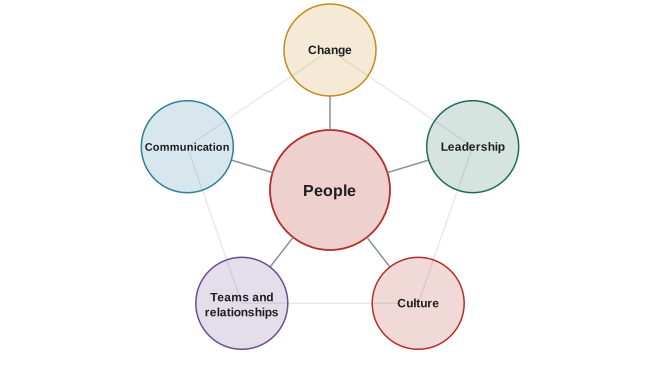
For the exam, you should be able to explain why people matter to project success and how the people element connects to the principles and practices. For example, the principle of defined roles, responsibilities and relationships depends on people actually working well in those roles, and the organizing practice now explicitly covers relationships and communication.
Worked problem
Spotting a people problem
A project to introduce a new scheduling system for nurses is on time and on budget, and the system passed all quality tests. Three months after go-live, half of the wards are still using paper rosters. Which aspect of PRINCE2 7 was likely neglected, and what might have helped?
Show solution
- The outputs were delivered, but the outcomes (changed ways of working) and benefits did not follow.
- This points to leading successful change within the people element.
- Engaging ward managers early, involving nurses in design and testing, and planning training and support as products could have helped.
- The business case practice also matters: benefits must be owned and tracked after handover.
Answer: Change management for the people affected was neglected; involving users and planning adoption would have helped realize benefits.
The project context
The project context is the environment in which the project operates. It includes the organization or organizations involved, their policies and governance, the commercial relationships, the relationship to any programme or portfolio, the delivery approach, the scale and complexity of the project, the regulatory environment, and expectations about sustainability. Context determines how PRINCE2 should be tailored. PRINCE2 7 discusses several common contexts:
| Context | Why it matters | Tailoring example |
|---|---|---|
| Commercial customer and supplier | Different organizations have different business cases and contracts | Align stage boundaries with contract milestones |
| Multi-organization | Several organizations share decision-making | Agree a board structure that represents each |
| Part of a programme | Programme management sets direction and tolerances | Use programme templates; the programme may own benefits |
| Agile delivery | Work is done in short iterations | Fix time and cost, flex scope; use agile reporting |
| Simple or small project | Low risk and few people | Combine roles and simplify products |
| Highly regulated environment | External approvals and audits are required | Build regulatory approvals into stage plans and quality criteria |
Digital and data management
PRINCE2 7 also gives guidance on managing digital and data aspects of projects. Most project information now lives in digital tools, and many projects deliver digital products or rely on data. The guidance encourages projects to think about how project information is created, stored, shared and protected, how data quality affects decisions, and how automation and analytics can support project management. It also recognizes risks such as poor data quality, information overload and security or privacy breaches.
In Canada, data management on projects must respect privacy law: the federal Personal Information Protection and Electronic Documents Act (PIPEDA) for many private-sector organizations, the federal Privacy Act for federal institutions, provincial public-sector privacy laws and, in Quebec, the modernized private-sector law often called Law 25. Projects that collect or move personal information may need a privacy impact assessment, which becomes a product to plan and quality-check.
Tailoring: bringing it together
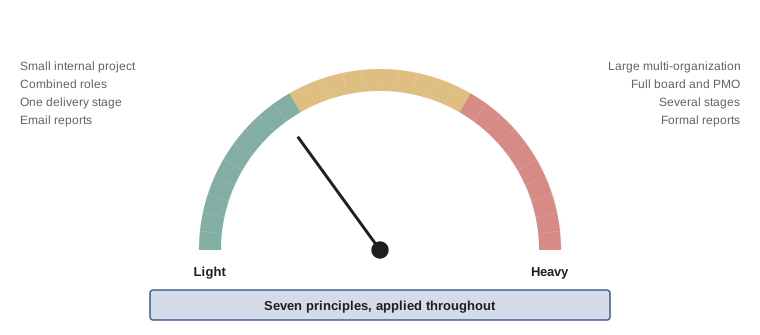
Tailoring is the seventh principle, but it is also the thread that connects the people and context elements to the rest of the method. To tailor well, you look at the context and the people involved and then adapt the practices, processes, roles, management products and terminology, while keeping all seven principles. The manual encourages tailoring at the level of the organization, for example through a standard approach for all projects of a certain type, and at the level of each project, recorded in the PID.
| What can be tailored | Examples |
|---|---|
| Processes | Combine starting up and initiating; one delivery stage only |
| Practices | Simple risk checklist instead of a full register; light quality reviews |
| Roles | Combine executive and senior user; project manager also acts as team manager |
| Management products | Merge the project brief and PID; use a dashboard as the highlight report |
| Terminology | Use the organization's terms, such as gate instead of stage boundary |
| Reporting frequency | Weekly email instead of formal fortnightly report |
Worked problem
Tailoring for a multi-organization project
Three municipalities are jointly procuring a shared emergency dispatch system from a private supplier. Each municipality will contribute funds and users. How might PRINCE2 be tailored?
Show solution
- Context: multi-organization and commercial, with public accountability.
- Roles: a board with an executive appointed by agreement among the municipalities, a senior user role shared by representatives of each municipality's dispatch centre, and the supplier's account director as senior supplier.
- Business case: a joint business case showing each municipality's costs and benefits, plus the supplier's own business case kept separately.
- Stages: align stage boundaries with council approval dates and contract milestones.
- People: plan communication and change management for dispatchers in all three centres.
- Data: plan a privacy impact assessment and data-sharing agreement as products.
Answer: Shared board roles, a joint business case, stages aligned to council and contract decisions, and explicit change, communication and data products.
Tailoring is where experience shows. A new practitioner tends either to apply everything in the manual, burying a small project in paperwork, or to drop parts of the method without thinking about which principle they support. A skilled practitioner asks what level of control this project needs, given its context and people, and adjusts accordingly.
Common tailoring mistakes
Three patterns cause trouble. The first is "PRINCE2 in name only", where an organization claims to use the method but has no real business case reviews, no board decisions at stage boundaries and no tolerances. The second is excessive bureaucracy, where every template is filled in regardless of value. The third is inconsistent tailoring, where decisions are made silently and different people have different ideas about how the project is being run. Recording tailoring decisions in the PID and reviewing them at stage boundaries addresses all three.
Leadership styles across the project
PRINCE2 7 recognizes that each management level needs a different kind of leadership. The project board provides direction and sponsorship: it sets the vision, makes timely decisions, secures resources and champions the change in the wider organization. The project manager leads day to day: building a team, creating clarity about priorities, resolving conflict, keeping stakeholders informed and protecting the team from unnecessary disruption. Team managers lead specialists, often with a strong focus on coaching, problem-solving and quality. Good leaders at every level adapt their style to the situation, being more directive in a crisis and more facilitative when the team has the expertise to solve a problem itself.
Culture interacts with leadership. In an organization where bad news is punished, forecasts drift optimistic and exceptions arrive late, undermining manage by exception. In a culture of openness, people raise risks and issues early, and tolerances work as intended. Project managers cannot change an organization's culture alone, but they can shape the culture of their own project by rewarding early warnings, running honest lessons sessions and modelling the behaviour they want.
Communication and stakeholder engagement
Communication in PRINCE2 7 is planned through a communication management approach developed during initiation. It identifies stakeholders, their interests and influence, the information each needs, the frequency and channel of communication and who is responsible. Effective project communication is two-way: it listens as well as broadcasts, and it adapts the message to the audience. Senior executives may need a one-page dashboard, end users may need demonstrations and training, and suppliers may need detailed technical updates. The approach should be reviewed at each stage boundary, because stakeholders, their concerns and the project itself change over time.
Worked problem
Mapping stakeholders by interest and influence
For a project to relocate a regional office, a project manager lists four stakeholders: the regional vice-president (high influence, high interest), office staff (low influence individually, high interest), the building landlord (moderate influence, moderate interest) and corporate finance (high influence, low interest). Suggest a communication emphasis for each.
Show solution
- Regional vice-president: manage closely with regular personal briefings and early involvement in decisions.
- Office staff: keep well informed with frequent updates, consultation on workspace design and support through the move.
- Landlord: keep satisfied with timely, formal communication on lease and fit-out matters.
- Corporate finance: keep satisfied with concise reports on budget and cash flow at agreed intervals.
Answer: Close engagement with the vice-president, frequent two-way communication with staff, formal updates to the landlord and concise financial reporting to finance.
Taken together, people, context and tailoring are what make PRINCE2 7 feel less like a rulebook and more like a way of thinking. The principles provide stable anchors; the practices and processes provide structure; and an understanding of the people and the environment tells you how much of that structure each project actually needs. Practitioner questions that ask whether a tailoring choice is appropriate are really testing whether you can hold all three in mind at once.
When you review a tailoring decision, ask which principle it supports, which people it affects and whether the context still justifies it; if you cannot answer, the decision probably needs revisiting.
Common mistakes
MistakeTreating people as outside the scope of the method.
InsteadRecognize people as an integrated element at the heart of PRINCE2 7.
MistakeAssuming outputs automatically produce benefits.
InsteadPlan for change and adoption by the people affected.
MistakeTailoring away a principle.
InsteadTailor processes, practices, roles and products, never the principles.
MistakeTailoring silently.
InsteadRecord tailoring decisions in the PID and review them.
MistakeIgnoring data and privacy until late in the project.
InsteadPlan data management and privacy products from initiation.
Summary and key terms
- People and project context became explicit integrated elements in PRINCE2 7.
- The people element covers change, leadership, culture, teams and relationships, and communication.
- Neglecting people can deliver outputs without the outcomes and benefits that justify a project.
- The project context includes commercial, multi-organization, programme, agile, scale and regulatory factors.
- PRINCE2 7 gives guidance on digital and data management, including information quality and protection.
- Tailoring adapts processes, practices, roles, products and terminology, but never the principles.
- Record tailoring decisions in the PID and review them at stage boundaries.
- People element
- The integrated element covering the human side of projects.
- Project context
- The environment in which a project operates.
- Change management
- Helping people affected by a project understand and adopt the change.
- Culture
- Shared values and behaviours that shape how an organization works.
- Stakeholder
- Any person or group who can affect or is affected by the project.
- Multi-organization project
- A project directed and funded by several organizations.
- Programme
- A temporary structure coordinating related projects to deliver strategic outcomes.
- Digital and data management
- Guidance on how project information and data are handled.
- Privacy impact assessment
- An assessment of how a project affects personal information.
- PRINCE2 in name only
- Claiming to use the method without applying its principles.
Practice problems
Work each problem on paper first, then reveal the answer to check.
Which two integrated elements were made explicit in PRINCE2 7?
Show answer
People and project context.
Name three areas of the people element.
Show answer
For example change, leadership and communication.
A system is delivered but not used. What does that suggest?
Show answer
Change management for people affected was neglected.
Give two examples of project context.
Show answer
For example commercial and part of a programme.
What usually stays fixed in an agile context?
Show answer
Time and cost.
Name three things that can be tailored.
Show answer
For example processes, roles and management products.
What cannot be tailored away?
Show answer
The seven principles.
Where are tailoring decisions recorded?
Show answer
In the project initiation documentation.
What is PRINCE2 in name only?
Show answer
Claiming to use PRINCE2 without applying its principles.
Give one data risk the digital guidance recognizes.
Show answer
For example poor data quality or a privacy breach.
Lesson quiz · 5 questions
Score 60% or more to complete this lesson.
Create a free account to save your progress, take quizzes and earn a certificate.