
PRIN-101 · Lesson 5 of 12 · 28 min
The Practitioner exam: prerequisites, open book and scenarios
The Practitioner exam is where PRINCE2 certification becomes demanding. Foundation asks whether you know the method; Practitioner asks whether you can apply and tailor it to a realistic project. You work through a scenario, decide what PRINCE2 would recommend in specific situations and justify choices about roles, products, tolerances and processes, with the official manual open in front of you. This lesson explains who can sit the exam, how it is structured and scored, how to use the manual well and how to budget your time.
Who can sit Practitioner
Practitioner requires a valid prerequisite certification. At the time of writing, PeopleCert and accredited providers listed the following as acceptable:
- PRINCE2 7 (PRINCE2 Project Management) Foundation.
- PRINCE2 sixth-edition Foundation or Practitioner.
- PMI's Project Management Professional (PMP) or Certified Associate in Project Management (CAPM).
- The UK Association for Project Management's Project Management Qualification (PMQ) or Project Professional Qualification (PPQ).
- IPMA Level A, B, C or D certification from the International Project Management Association.
The list can change, and PeopleCert may ask you to provide evidence of your prerequisite when you book, so check the current eligibility rules and have a copy of your certificate ready. The acceptance of the PMP and IPMA certificates is important for North American candidates: an experienced PMP holder can go straight to Practitioner, although most still benefit from studying the Foundation material because PRINCE2 vocabulary and roles differ from PMI's.
In Canada, the IPMA route is available through IPMA Canada, the national association that certifies project managers at levels A to D, and some Canadian candidates hold IPMA certification instead of, or as well as, the PMP. Either is listed as an acceptable prerequisite, but confirm that your certificate is current and that PeopleCert accepts it at the time you book.
The format at a glance
| Feature | Practitioner exam |
|---|---|
| Marks | 70 marks from objective-test questions based on a scenario |
| Time | 150 minutes (2 hours 30 minutes) |
| Pass mark | 42 marks (60 %) |
| Materials | Open book: the official printed manual, Managing Successful Projects with PRINCE2 (7th edition), only |
| Prerequisites | A valid accepted certification (see above) |
| Delivery | Online with remote proctoring, or at an accredited provider |
| Negative marking | None |
As with Foundation, candidates taking the exam in a second language have often been allowed extra time, commonly 25 %, which would extend 150 minutes to about 188; check the current policy when you book.
The scenario and the questions
The exam is built around a scenario: a description of a fictional organization and project, such as a company relocating its head office or a council introducing a new waste-collection service. Additional information may be given for particular questions. You are expected to read the scenario carefully, understand the roles, constraints and context, and apply PRINCE2 to it.
Questions use objective-test formats that a computer can mark. Depending on the paper, these can include classic multiple choice with one correct answer, multiple response where you choose two correct answers, matching items from one list with another, and sequencing steps into the right order. A typical question might ask which action the project manager should take in a given situation, which management product should record a particular piece of information, which statement correctly applies a principle to the scenario, or whether a proposed tailoring of the method is appropriate and why.
The key skill is applying the method to the facts given, not your own experience of how things are done at work. If the scenario says the executive has delegated certain change decisions to a change authority, your answer should respect that, even if your own organization would do it differently.
Using the manual well
Open book does not mean easy. You do not have time to look up every answer, and the manual is long. The candidates who use it best have prepared it in advance and know where things are. The rules at the time of writing allowed the official printed hard copy of the manual, with handwritten notes, highlighting and tabs added to it, but not loose sheets, sticky notes that could be removed, printed summaries or other books. Online candidates must show the manual to the proctor. Confirm the current rules before exam day.
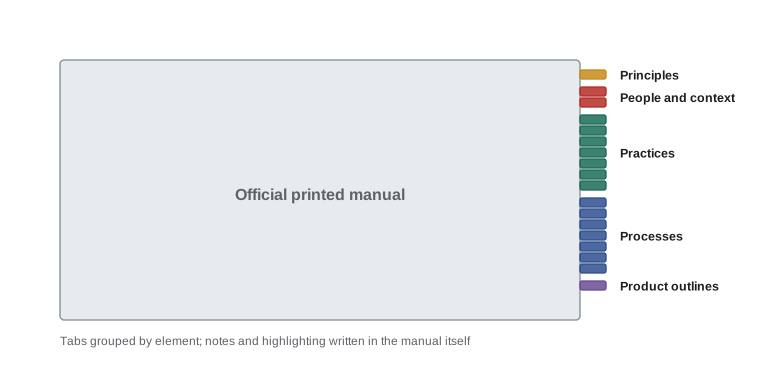
Useful preparation includes:
- Tabs for each practice and process, and for the management product outlines in the appendix, which list the purpose and composition of each product.
- Highlighting key tables, such as the responsibilities of each role in each practice.
- Brief margin notes linking related sections, for example noting on the tolerance section where exception reports and exception plans are described.
- Practice in finding sections under time pressure using sample papers.
Managing your time
With 150 minutes for 70 marks, you have just over two minutes per mark. That sounds generous, but reading the scenario and checking the manual eat time quickly.
Worked problem
A Practitioner time budget
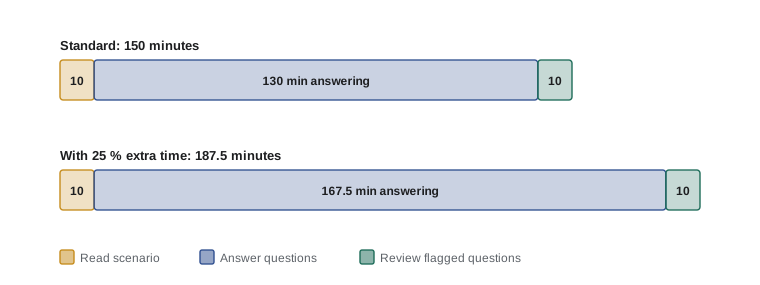
Lena plans to spend 10 minutes reading the scenario at the start and wants 10 minutes at the end to review flagged questions. How much time per mark does she have for the rest of the paper? What if she has 25 % extra time?
Show solution
- Time for answering: 150 − 10 − 10 = 130 minutes.
- Per mark: 130 / 70 ≈ 1.86 minutes, or about 1 minute 51 seconds.
- With extra time the total is 150 × 1.25 = 187.5 minutes; minus 20 gives 167.5 minutes.
- Per mark: 167.5 / 70 ≈ 2.39 minutes.
Answer: About 1 minute 51 seconds per mark normally, or about 2 minutes 24 seconds with extra time.
A practical rule is to answer what you know first using the scenario alone, look up only what you need, and never spend more than about four minutes on a single mark. Flag hard questions and return to them.
Applying the method: a scenario-style example
Many Practitioner questions involve tolerances, because manage by exception is central to how PRINCE2 controls a project. The example below, written for this course, shows the kind of reasoning required.
Worked problem
Is this an exception?
In a scenario, the project board has set the current stage a budget of 240,000 with a cost tolerance of plus or minus 5 %, and a finish date of 30 June with a time tolerance of plus 2 weeks. Midway through the stage, the project manager forecasts a stage cost of 249,000 and completion on 9 July. What should the project manager do according to PRINCE2?
Show solution
- Cost tolerance: 5 % of 240,000 = 12,000, so the range is 228,000 to 252,000.
- Forecast cost 249,000 is within tolerance.
- Time tolerance: up to 2 weeks after 30 June, so up to 14 July.
- Forecast finish 9 July is within tolerance.
- Both forecasts are within tolerance, so the project manager handles the situation within the stage, records it and reports it in the regular highlight report, rather than raising an exception.
Answer: No exception: the project manager takes corrective action within delegated authority and reports progress normally.
If the forecast had been 255,000 or a finish date of 20 July, the project manager would raise an exception to the project board, which might ask for an exception plan. Lesson 7 introduces tolerances and Lesson 8 shows where this happens in the processes.
Results, validity and what Practitioner shows
As with Foundation, online candidates usually see a provisional result soon after finishing, followed by the certificate. Under PeopleCert's current policy, Practitioner certification is renewed every three years, through CPD with PeopleCert Plus, another exam in the suite or a re-sit, as Lesson 11 explains. Practitioner shows that you can apply and tailor PRINCE2 to a scenario. Many employers treat it as the more meaningful credential for project manager roles in organizations that use the method, while still looking for real project experience.
Reading the scenario efficiently
A disciplined first read saves time later. On the first pass, identify the organization and its business, the purpose of the project, the people named and the roles they hold, the stage the project has reached, any tolerances or constraints, and anything unusual such as a commercial supplier, an agile team or a programme above the project. Some candidates sketch a quick organization chart on scrap paper if the exam rules provide it, showing the executive, senior user, senior supplier, project manager and team managers. When a question gives additional information, read it as an update to the scenario that applies only to that question unless told otherwise.
Next, read each question stem carefully before looking at the options. Ask which part of the method it is testing: a principle, a practice, a process, a role or a product. That tells you where in the manual to look if you need to check. Finally, read all options before choosing. Practitioner distractors are often partly correct, for example an action that would be right for the project board but wrong for the project manager, or a product that records the information but is not the one PRINCE2 recommends.
Worked problem
Spotting a role error in an option
A scenario question asks what the project manager should do when a team manager forecasts that a work package will finish five days late, within the stage time tolerance. One option says "The project manager should ask the project board to approve a revised stage plan." Is that appropriate?
Show solution
- The delay is within stage tolerance, so the board has delegated authority to the project manager.
- The project manager can take corrective action, such as adjusting the work package or the schedule within the stage.
- Asking the board to approve a revised stage plan would be appropriate only if stage tolerance were forecast to be exceeded.
Answer: No: the action belongs to an exception situation. The project manager should handle the delay within delegated authority and report it.
One more point is worth stressing. Practitioner rewards precise use of PRINCE2 vocabulary and role boundaries. Many wrong options describe something sensible that a different role should do, or that belongs in a different process. As you practise, ask of every option: who should do this, in which process, using which product, and is it within their delegated authority? Answering those four questions systematically will eliminate most distractors.
Practising with timed sample papers is the only reliable way to discover whether your manual preparation and pacing plan really work, so schedule at least two full timed papers before the real exam.
Common mistakes
MistakeTreating open book as permission not to study.
InsteadLearn the method thoroughly and use the manual only to confirm details.
MistakeBringing loose notes or a printed summary.
InsteadUse only the permitted official printed manual with notes written in it.
MistakeAnswering from your own organization's practice.
InsteadApply PRINCE2 to the facts in the scenario.
MistakeRaising an exception whenever a forecast changes.
InsteadEscalate only when a forecast exceeds the agreed tolerance.
MistakeSpending ten minutes on one hard mark.
InsteadFlag it, move on and return if time allows.
Summary and key terms
- Practitioner requires an accepted prerequisite such as PRINCE2 Foundation, PMP, CAPM, PMQ, PPQ or IPMA A to D.
- At the time of writing it had 70 marks in 150 minutes with a pass mark of 42 (60 %).
- It is open book with the official printed manual only.
- Questions are objective-test items based on a scenario and test application and tailoring.
- Prepare the manual with tabs, highlighting and margin notes, and practise finding sections.
- Budget roughly two minutes per mark and flag hard questions.
- Practitioner is renewed every three years under PeopleCert's current policy.
- Practitioner
- The PRINCE2 certification level that tests application and tailoring.
- Prerequisite
- A certification required before sitting an exam.
- Open book
- An exam in which permitted reference material may be used.
- Scenario
- A fictional project description on which exam questions are based.
- Objective test
- A question format with answers that can be marked automatically.
- Multiple response
- A question requiring more than one correct option.
- Tolerance
- The permissible deviation from a plan target before escalation is needed.
- Exception
- A situation where a forecast exceeds agreed tolerance.
- Highlight report
- A regular progress report from the project manager to the project board.
- Exception plan
- A plan prepared to replace the current plan after an exception.
Practice problems
Work each problem on paper first, then reveal the answer to check.
Name four accepted Practitioner prerequisites.
Show answer
For example PRINCE2 7 Foundation, PMP, CAPM and IPMA Level C.
How many marks and minutes does Practitioner have?
Show answer
70 marks in 150 minutes.
What is the pass mark?
Show answer
42 marks, or 60 %.
What reference may be used?
Show answer
The official printed PRINCE2 7 manual only.
Average minutes per mark with no reading or review time?
Show answer
About 2.14.
Total time with 25 % extra?
Show answer
187.5 minutes.
Stage budget 300,000 with ±4 % tolerance. What is the upper limit?
Show answer
312,000.
Is a forecast of 305,000 an exception in that case?
Show answer
No; it is within tolerance.
What should you base answers on: the scenario or your own workplace?
Show answer
The scenario and the PRINCE2 manual.
Name two objective-test formats used in Practitioner.
Show answer
For example multiple choice and matching.
Lesson quiz · 5 questions
Score 60% or more to complete this lesson.
Create a free account to save your progress, take quizzes and earn a certificate.