
PRIN-101 · Lesson 11 of 12 · 32 min
Costs, renewal and choosing a route
Certification is an investment of money and time, and PRINCE2 certificates now need renewing. This lesson explains what goes into the cost of PRINCE2 certification, how to compare routes, how PeopleCert's three-year renewal policy works and how to judge whether certification is worth it for you. Prices and policies change often and vary by country and provider, so treat every figure here as an illustration of the reasoning, and confirm current prices and rules with PeopleCert and your chosen provider before you commit.
What certification costs
The total cost of PRINCE2 certification has several parts:
- Exam fees: the price of the Foundation and Practitioner exams, bought directly or as part of a course.
- Training: accredited courses, e-learning or self-study materials.
- The official manual: required in printed form for the open-book Practitioner exam; a digital copy is often included with exam purchases.
- Retake insurance: an optional add-on that reduces the cost of a resit.
- Membership: PeopleCert Plus, if you choose to renew through CPD.
- Your time: study hours and any time away from work, which often matter more than the fees.
Canadian candidates typically see PRINCE2 prices quoted in Canadian dollars by resellers, although some exam fees are set in other currencies and converted. At the time of writing, market prices suggested very roughly C$600 to C$900 for a Foundation exam alone, C$1,500 to C$2,500 for accredited Foundation training with an exam, and C$3,000 to C$4,500 for a combined Foundation and Practitioner course with both exams, with live virtual courses usually cheaper than classroom ones. These ranges are illustrative only; prices vary widely between providers, and sales are common. Remember to add GST or HST where it applies.
| Route | What it includes | Main cost drivers |
|---|---|---|
| Self-study Foundation | Exam voucher, manual, practice questions | Exam fee; your study time |
| Accredited e-learning Foundation | Course access, exam, often manual | Course price; access period |
| Live virtual Foundation and Practitioner | Trainer-led sessions, both exams, manual | Course price; days away from work |
| Classroom combined course | Five days of training, both exams, manual | Course price; travel; a full week away |
| Practitioner only (with PMP or other prerequisite) | Practitioner training or exam, manual | Exam or course price; manual |
Worked problem
Comparing total costs
Option 1: self-study Foundation exam at 750 plus a printed manual at 120, then Practitioner e-learning with exam at 1,400. Option 2: a combined live virtual course at 2,600 including both exams and the manual. Self-study needs 40 hours of extra study compared with the course, and the candidate values her time at 30 per hour. Which option costs less overall?
Show solution
- Option 1 fees: 750 + 120 + 1,400 = 2,270.
- Option 1 time cost: 40 × 30 = 1,200; total 3,470.
- Option 2 fees: 2,600, with no extra study time counted; total 2,600.
- Option 2 is cheaper once time is valued, although option 1 has lower cash outlay.
Answer: Option 2 costs about 2,600 in total against 3,470 for option 1 when time is valued; option 1 is cheaper only in cash terms.
Retake insurance and failing well
Many providers offer retake insurance, often under the name Take2, which allows a resit at little or no extra cost within a set period if you fail. Whether it is worth buying depends on its price and your chance of failing. A quick expected-value calculation helps.
Worked problem
Is retake insurance worth it?
Retake insurance costs 90. A full-price resit would cost 650. You estimate a 15 % chance of failing on the first attempt. Is the insurance worth buying on expected value alone?
Show solution
- Expected cost of a resit without insurance: 0.15 × 650 = 97.50.
- Cost of insurance: 90.
- The insurance is slightly cheaper than the expected resit cost, and it also removes the risk of a large unexpected expense.
Answer: Yes, marginally: 90 against an expected 97.50. If your chance of failing were 10 %, the expected cost would be 65 and the insurance would be worth it only for peace of mind.
How renewal works
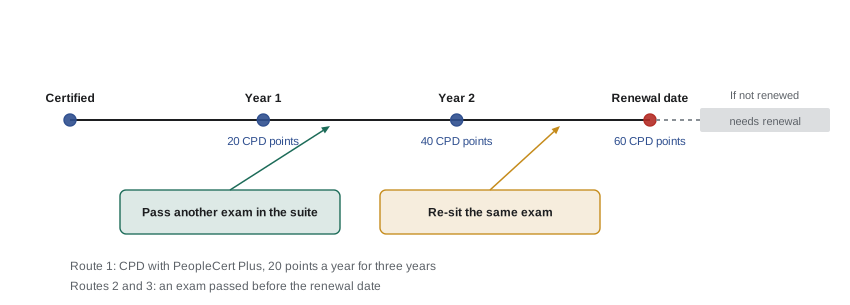
Under PeopleCert's current policy, PRINCE2 certifications need to be renewed every three years from the original certification date. The policy covers PRINCE2 Project Management (fifth, sixth and seventh editions), PRINCE2 Agile and the other PRINCE2 family products. There are three ways to renew:
- Join PeopleCert Plus and log CPD points: at the time of writing, 20 CPD points a year over three consecutive years, 60 in total, earned through everyday professional activities such as training, reading, mentoring, conferences and work-based learning. No exam is needed.
- Pass another certification in the same product suite before your renewal date. One new certification renews all your certifications in that suite.
- Re-sit the same exam, which renews that certification and resets its renewal date.
If you do nothing, your certifications stay on PeopleCert's register and verification service, but they are marked as outdated and needing renewal. Employers checking the register will see that.
Worked problem
Planning renewal
Kofi passed PRINCE2 Project Management Practitioner on 1 February 2026. He plans to take PRINCE2 Agile Foundation in about two years. Alternatively, he could join PeopleCert Plus and log CPD. When is his renewal date, and which route renews both his Practitioner and any future suite certificate?
Show solution
- Renewal date: three years from 1 February 2026, which is 1 February 2029.
- If he passes PRINCE2 Agile Foundation before 1 February 2029, that renews all his PRINCE2 suite certifications under the current policy.
- If he chooses CPD instead, he must log 20 points a year in each of the three years: 2026–27, 2027–28 and 2028–29.
Answer: His renewal date is 1 February 2029. Passing PRINCE2 Agile Foundation before then renews his PRINCE2 certifications; CPD would require 20 points in each year.
Because policies can change, note your renewal date in your calendar now and check PeopleCert's current rules a year before it arrives.
Is certification worth it?
Certification is worth it when it opens doors, improves your work or both. Evidence about salary premiums for PRINCE2 is mixed and usually comes from surveys run by training companies, which have an interest in the results and cannot separate the effect of the certificate from the experience and commitment of people who earn it. A more useful approach is to estimate your own costs and plausible benefits, and to treat the result as a rough guide rather than a forecast.
Worked problem
A simple payback estimate
Rania expects her total cost of certification, including fees, the manual and the value of her study time, to be 3,200. She believes the certificate will help her move into a role paying about 4,000 more per year after tax, but she thinks there is only a 50 % chance that it makes the difference. What is the expected annual benefit, and the simple payback period?
Show solution
- Expected annual benefit: 0.50 × 4,000 = 2,000.
- Simple payback: 3,200 / 2,000 = 1.6 years.
- If her employer pays the fees and she counts only her time (say 1,200), payback falls to 1,200 / 2,000 = 0.6 years.
Answer: Expected benefit is about 2,000 a year and payback about 1.6 years, or well under a year if her employer pays the fees.
Employer funding and tax
Many employers pay for PRINCE2 training and exams, especially when the organization uses the method or bids for contracts that require it. Ask early, because training budgets are often allocated at the start of a financial year, and check whether the employer requires you to repay costs if you leave within a certain period.
In Canada, employer-paid training that mainly benefits the employer is generally not a taxable benefit to the employee. If you pay yourself, tax relief is limited: the federal tuition tax credit and the Canada Training Credit apply only to eligible fees paid to qualifying educational institutions or for certain occupational skills courses, so many commercial PRINCE2 courses and exams will not qualify. Check the Canada Revenue Agency's current rules and keep receipts.
Logging CPD that counts
If you choose the CPD route, plan activities that genuinely develop you rather than simply collecting points. Under PeopleCert's scheme, CPD can come from many everyday professional activities, such as attending training or webinars, reading books and articles on project management, mentoring colleagues, presenting at events, studying for other qualifications and learning on the job. Keep brief notes of what you did, when, how long it took and what you learned, because a short reflection is more useful to you and more convincing if your record is ever reviewed. Spreading activities across the year avoids a rush before each annual deadline.
| Activity | Example | What to record |
|---|---|---|
| Formal learning | A one-day course on agile governance | Date, provider, hours, key learning |
| Self-directed reading | A book on benefits management | Title, hours, how you applied it |
| Giving back | Mentoring a new project coordinator | Sessions, hours, topics covered |
| Work-based learning | Tailoring PRINCE2 for a new project type | Project, decisions made, lessons |
| Events | A project management conference | Sessions attended, hours, ideas to use |
Choosing between renewal routes
Which renewal route is best depends on your plans. If you intend to add PRINCE2 Agile or a programme management certification anyway, passing it before your renewal date renews everything in the suite and adds a new credential, which is often the most efficient choice. If you have no further exam planned but stay active in project management, CPD through PeopleCert Plus fits naturally around your work, though it requires paid membership and steady logging over three years. Re-sitting the same exam is the least attractive option for most people, because it costs an exam fee and adds no new credential, but it can make sense if your knowledge has lapsed and you want a structured refresher.
Worked problem
Comparing renewal costs
Over three years, PeopleCert Plus membership would cost 3 × 70 = 210 (illustrative), and Sara estimates that CPD logging takes about 2 hours a year of administration. Alternatively, she could take PRINCE2 Agile Foundation for an exam fee of 600 plus 20 hours of study. She values her time at 35 per hour. Which route costs less?
Show solution
- CPD route: 210 + (3 × 2 × 35) = 210 + 210 = 420.
- Exam route: 600 + (20 × 35) = 600 + 700 = 1,300.
- The CPD route is cheaper, but the exam route adds a new credential that may have value of its own.
Answer: CPD costs about 420 and the exam about 1,300; the choice depends on whether the extra credential is worth the difference.
Whatever route you choose, keep copies of every certificate, receipt and CPD record in one place.
Common mistakes
MistakeComparing only course prices.
InsteadInclude the manual, retake insurance, membership and your time.
MistakeForgetting the renewal date.
InsteadRecord it when you pass and plan a renewal route early.
MistakeAssuming CPD can be logged all at once in year three.
InsteadUnder the current policy, log 20 points in each of three consecutive years.
MistakeTrusting salary surveys from training companies uncritically.
InsteadEstimate your own costs and plausible benefits.
MistakeAssuming all certification costs are tax deductible.
InsteadCheck the current rules in your country or ask an adviser.
Summary and key terms
- Total cost includes exams, training, the manual, retake insurance, membership and your time.
- Prices vary widely by country, provider and format; confirm current prices before booking.
- Retake insurance is worth buying when its price is close to or below the expected cost of a resit.
- PRINCE2 certifications are renewed every three years under PeopleCert's current policy.
- Renewal routes: CPD through PeopleCert Plus (20 points a year), another exam in the suite, or a re-sit.
- Unrenewed certificates stay on the register but are marked as needing renewal.
- Judge value with your own costs and benefits, and ask about employer funding early.
- Exam voucher
- A prepaid right to sit an exam.
- Take2
- A common name for retake insurance offered with PeopleCert exams.
- Expected value
- The average result weighted by probability.
- PeopleCert Plus
- PeopleCert's membership scheme, including CPD logging.
- CPD point
- A unit recording continuing professional development activity.
- Renewal date
- Three years from the original certification date under the current policy.
- Product suite
- A group of related certifications renewed together.
- Simple payback
- Cost divided by annual benefit.
- Opportunity cost
- The value of what you give up, such as time, to do something.
- Educational assistance
- Employer support for an employee's education or training.
Practice problems
Work each problem on paper first, then reveal the answer to check.
Name four components of certification cost.
Show answer
For example exam fees, training, the manual and your time.
Total of fees 800, 150 and 1,300?
Show answer
2,250.
Value of 30 study hours at 40 per hour?
Show answer
1,200.
Expected resit cost with a 20 % failure chance and a 600 resit?
Show answer
120.
How often must PRINCE2 certifications be renewed under the current policy?
Show answer
Every three years.
How many CPD points a year does PeopleCert Plus renewal require?
Show answer
20.
What happens if you do not renew?
Show answer
Certificates stay on the register but are marked as needing renewal.
Renewal date for a certificate dated 15 September 2025?
Show answer
15 September 2028.
Payback for a cost of 2,400 and an expected benefit of 1,600 a year?
Show answer
1.5 years.
Why treat training-company salary surveys with caution?
Show answer
They have an interest in the results and cannot isolate the certificate's effect.
Lesson quiz · 5 questions
Score 60% or more to complete this lesson.
Create a free account to save your progress, take quizzes and earn a certificate.