
PMP-101 · Lesson 6 of 12 · 31 min
The People and Process domains at a glance
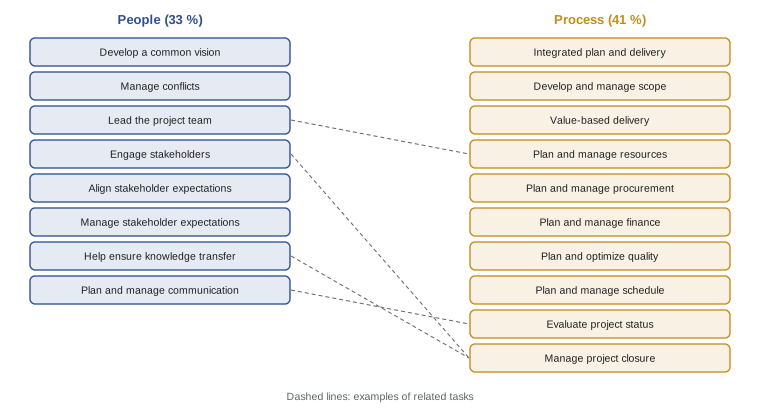
Together, the People and Process domains account for roughly three-quarters of the 2026 PMP exam: about 33 % and 41 % of scored questions respectively. This lesson gives a map of the tasks in each domain as listed in PMI's outline at the time of writing, explains in plain language what each task involves, shows how tasks appear differently in predictive, agile and hybrid settings, and points to the later courses in this program that teach each area in depth. The aim is orientation: by the end you should be able to recognize which task a scenario is testing and know where to study it. The tasks below are paraphrased summaries written for this course, not PMI's full wording; read the outline itself for the official text.
The People domain
The People domain covers the human side of project leadership: building a shared vision, leading the team, resolving conflict, engaging and aligning stakeholders, transferring knowledge and communicating. At the time of writing, PMI's 2026 outline listed eight People tasks:
| Task (as named by PMI) | What it involves in practice | Studied in |
|---|---|---|
| Develop a common vision | Helping the team and stakeholders understand and commit to the project's purpose, goals and value | PMP-120 |
| Manage conflicts | Recognizing sources of conflict, choosing resolution approaches and protecting relationships | PMP-121 |
| Lead the project team | Setting direction, motivating, coaching, empowering and supporting the team | PMP-120 |
| Engage stakeholders | Identifying stakeholders, analysing their interests and involving them appropriately | PMP-121 |
| Align stakeholder expectations | Building agreement on objectives, scope, success criteria and trade-offs | PMP-121 |
| Manage stakeholder expectations | Monitoring and adjusting expectations as the project evolves | PMP-121 |
| Help ensure knowledge transfer | Capturing and sharing knowledge within and beyond the project | PMP-120, PMP-131 |
| Plan and manage communication | Deciding who needs what information, when and how, and keeping it flowing | PMP-121 |
People questions in different approaches
People tasks look different depending on the approach. In a predictive project, stakeholder engagement may involve a formal stakeholder register, a communications management plan and scheduled steering committee meetings. In an agile team, it may involve a product owner who represents stakeholders, sprint reviews where stakeholders see working increments, and information radiators such as task boards. In a hybrid project, you might use a formal governance structure for funding and milestones while teams work in iterations. Leadership questions in agile settings often reward servant leadership: removing impediments, facilitating rather than directing, and empowering self-organizing teams. In predictive settings, the project manager typically has more direct authority over planning, but the exam still favours collaborative, respectful leadership over command and control.
Worked problem
Recognizing a People task
A scenario says: Two senior engineers disagree publicly in a team meeting about the design approach, and other team members have stopped contributing ideas. The project is using two-week iterations. Which task is being tested, and what kind of response does the exam usually reward?
Show solution
- The core issue is a disagreement between team members affecting team dynamics, which points to the task manage conflicts, with links to lead the project team.
- The iterations indicate an agile or hybrid context, where the leader acts as a facilitator and servant leader.
- The exam usually rewards addressing the conflict promptly and privately or in a facilitated discussion, understanding the source (technical disagreement, not personal), and helping the team reach a decision, for example through a time-boxed spike or agreed decision criteria.
- Responses such as escalating to a manager immediately, ignoring the issue or imposing a decision without discussion are usually weaker.
Answer: The task is manage conflicts within team leadership; the better answer is to facilitate a prompt, respectful resolution focused on the technical disagreement, empowering the team to decide.
The Process domain
The Process domain covers the technical side of planning and delivering projects: integrated planning, scope, value delivery, resources, procurement, finance, quality, schedule, status and closure. At the time of writing, PMI's outline listed ten Process tasks:
| Task (as named by PMI) | What it involves in practice | Studied in |
|---|---|---|
| Develop an integrated project management plan and plan delivery | Combining plans for scope, schedule, cost, quality, risk and other areas into a coherent approach | PMP-130, PMP-131 |
| Develop and manage project scope | Defining requirements, scope and backlog, and controlling scope changes | PMP-130, PMP-140 |
| Help ensure value-based delivery | Prioritizing work that delivers value and measuring benefits | PMP-140, PMP-150 |
| Plan and manage resources | Estimating, acquiring and managing people, equipment and materials | PMP-130 |
| Plan and manage procurement | Make-or-buy decisions, contracts, selecting and managing suppliers | PMP-131 |
| Plan and manage finance | Estimating costs, budgets, funding and financial tracking | PMP-130 |
| Plan and optimize quality of products/deliverables | Setting quality standards, preventing defects and verifying deliverables | PMP-131 |
| Plan and manage schedule | Sequencing, estimating durations, building and controlling schedules or release plans | PMP-130, PMP-140 |
| Evaluate project status | Measuring progress and performance and reporting it | PMP-130, PMP-140 |
| Manage project closure | Closing phases or projects, transitions and lessons learned | PMP-131 |
Process questions in different approaches
Process tasks are where approaches differ most visibly. Scope in a predictive project is defined early and controlled through a change control process; in agile, scope lives in a prioritized product backlog refined continuously with the product owner. Schedules in predictive projects are built with work breakdown structures, networks and critical paths; in agile, the team commits to iteration goals and uses velocity or flow metrics to forecast releases. Status in predictive projects may be measured with earned value; in agile, with burndown or burnup charts, cumulative flow diagrams and working product demonstrated at reviews. Hybrid projects mix these: for example, a fixed regulatory milestone and contract, with iterative development of software components. Exam questions often test whether you can choose the tool or practice that fits the situation, rather than applying one approach everywhere.
| Area | Predictive practice | Adaptive practice |
|---|---|---|
| Scope | Scope statement, WBS, change control | Product backlog, refinement, product owner |
| Schedule | Network diagram, critical path | Iterations, release planning, velocity |
| Cost | Bottom-up estimates, cost baseline | Fixed team cost per iteration, value-based funding |
| Status | Earned value, variance reports | Burndown and burnup charts, reviews |
| Quality | Quality plan, inspections, audits | Definition of done, continuous testing |
| Closure | Formal acceptance, contract closure | Increment acceptance, retrospectives |
Calculations in the Process domain
Although the PMP is mainly a judgement exam, some questions involve calculations, most often in scheduling and finance: critical path and float, earned value metrics such as schedule and cost variance and the performance indices SPI and CPI, estimate at completion, and simple expected value. The number of calculation questions varies by exam form and is usually small, but they are relatively easy marks if you practise them. PMP-130 covers these in detail. A quick reminder of the most common earned value relationships:
Here \(EV\) is earned value, \(AC\) actual cost, \(PV\) planned value and \(BAC\) the budget at completion. A CPI below 1 means the project is over budget for the work done; an SPI below 1 means it is behind schedule.
Worked problem
A quick earned value check
A project has a budget at completion of 400,000. At the status date, planned value is 180,000, earned value is 160,000 and actual cost is 200,000. Calculate CPI, SPI and a simple estimate at completion, and interpret them.
Show solution
- CPI = EV / AC = 160,000 / 200,000 = 0.80.
- SPI = EV / PV = 160,000 / 180,000 ≈ 0.89.
- EAC = BAC / CPI = 400,000 / 0.80 = 500,000.
- The project is over budget (spending 1.25 for every 1 of value earned) and behind schedule; if performance continues, it will cost about 500,000.
Answer: CPI 0.80, SPI about 0.89, EAC about 500,000: over budget and behind schedule.
Linking People and Process
In real projects, People and Process are inseparable: a schedule only works if the team commits to it, and stakeholder alignment depends on clear scope and status information. Exam scenarios often combine them. A question about a delayed deliverable may really be about a team member who needs coaching; a question about a conflict may really be about unclear requirements. When you read a scenario, ask what the root cause is and which task best addresses it, rather than reacting to the most visible symptom. This habit, practised throughout the later courses, is one of the most important exam skills.
Reading a People scenario
People questions often describe a tension between individuals or groups and ask how the project leader should respond. The details matter. Is the conflict about task priorities, technical approach, resources, personalities or values? Is it within the team, between the team and a stakeholder, or between stakeholders? Has anything already been tried? Strong answers usually involve understanding the cause before acting, speaking directly with those involved, encouraging collaboration and problem solving, and escalating only when the issue exceeds the leader's authority or has resisted reasonable efforts. Answers that avoid the problem, impose a solution without listening, or publicly blame someone are rarely best.
Questions about team development often draw on models of how teams form and mature, on servant leadership, and on psychological safety. A newly formed team needs clear goals, roles and working agreements; a team in conflict needs facilitation; a high-performing team needs autonomy and protection from interruptions. In agile settings, the project leader's role shifts from directing to enabling: removing impediments, coaching, facilitating ceremonies and shielding the team so it can self-organize.
Reading a Process scenario
Process questions frequently present a deviation, such as a delay, a cost overrun, a quality problem or a scope dispute, and ask what to do next. In predictive projects, the usual sequence is to assess the variance against the baseline, identify the cause, evaluate options and their impacts, and, if a change to the baseline is needed, submit it through change control. In adaptive projects, the response is more likely to involve the product owner reprioritizing the backlog, the team adjusting its plan at the next iteration, or the issue being discussed at a review or retrospective.
Knowing a handful of measures helps interpret these scenarios. Schedule variance, cost variance and the performance indices tell you whether a predictive project is ahead or behind and over or under budget. Velocity, burndown and burnup charts tell you how an agile team is progressing toward its goals. Cumulative flow diagrams show bottlenecks in flow-based work. The exam is less concerned with calculating these precisely than with what they imply and what the leader should do about it.
Interpreting earned value results
When CPI and SPI are both below 1, the project is over budget and behind schedule; when both are above 1, it is under budget and ahead of schedule. Mixed results are common: a project that has added resources to catch up may show SPI improving while CPI falls. The estimate at completion based on CPI assumes that current cost performance continues; other formulas assume that future work proceeds at the budgeted rate or reflect both cost and schedule performance. On the exam, choose the formula that fits the assumption described in the scenario, and remember that a forecast is a basis for action: the leader should analyse causes and consider corrective options, not simply report the number.
Linking People and Process
Many real problems span both domains. A schedule slip may be caused by unclear roles, a struggling team member or a stakeholder who delays approvals. A quality problem may reflect inadequate training or a team that does not feel safe raising concerns. When a scenario presents a process symptom, look for a people cause, and vice versa; the best answer often addresses the underlying cause rather than the symptom.
Worked problem
A people-and-process scenario
A hybrid project to replace a billing system has an SPI of 0.85. Investigation shows that the business analyst assigned to the data-migration stream is also supporting month-end close and is available only half the planned time. What should the project leader do first?
Show solution
- Identify the domains: a Process symptom (schedule slippage) with a People and resource cause.
- Assess the cause and its impact on the critical path or release plan.
- Discuss with the analyst and their functional manager to understand the competing demand and explore options.
- Options include negotiating dedicated time, adding or reassigning resources, resequencing work, or proposing a schedule change through governance.
- Avoid simply reporting the SPI to the sponsor without analysis or pressuring the analyst to work longer hours.
Answer: Analyse the resource conflict with the analyst and functional manager and evaluate options, escalating or proposing a change only if the conflict cannot be resolved within the project leader authority.
| Measure | Formula or reading | What a poor result suggests |
|---|---|---|
| Schedule variance | SV = EV − PV | Negative: behind schedule |
| Cost variance | CV = EV − AC | Negative: over budget |
| Velocity | Story points completed per iteration | Falling: capacity or impediment problem |
| Burndown | Work remaining over time | Above ideal line: behind plan |
| Cumulative flow | Items per stage over time | Widening band: bottleneck |
Tasks in agile and hybrid contexts
Every task in People and Process can be tested in any approach. Take plan and manage scope: in a predictive project it involves a scope statement, a work breakdown structure and baseline control; in an agile project it involves a product vision, a backlog refined continuously, and acceptance criteria and a definition of done; in a hybrid project it may combine a contractually fixed set of deliverables with iterative development of the details. When you study a task, write a short paragraph for each approach. If you cannot, that is a gap to close before the exam, since roughly 60 % of questions involve adaptive or hybrid settings.
Common mistakes
MistakeStudying People as soft skills that need no preparation.
InsteadLearn specific practices for leadership, conflict and engagement.
MistakeApplying predictive tools to agile scenarios.
InsteadMatch practices to the approach described.
MistakeReacting to the visible symptom in a scenario.
InsteadIdentify the root cause and the task being tested.
MistakeSkipping earned value practice.
InsteadPractise the common calculations for easy marks.
MistakeMemorizing task names only.
InsteadUnderstand what each task involves in practice.
Summary and key terms
- People (33 %) and Process (41 %) make up about three-quarters of the exam.
- People has eight tasks covering vision, conflict, team leadership, stakeholders, knowledge and communication.
- Process has ten tasks covering planning, scope, value, resources, procurement, finance, quality, schedule, status and closure.
- Practices differ between predictive, agile and hybrid approaches.
- Some questions require earned value and scheduling calculations.
- Scenarios often combine People and Process issues.
- Identify root causes and the task being tested.
- Servant leadership
- Leading by supporting and empowering the team.
- Stakeholder register
- Record of stakeholders and their interests.
- Product backlog
- Prioritized list of work for an agile product.
- Work breakdown structure
- Hierarchical decomposition of project scope.
- Critical path
- Longest path through a schedule network.
- Velocity
- Amount of work an agile team completes per iteration.
- Earned value
- Value of work actually completed.
- CPI
- Cost performance index, EV divided by AC.
- SPI
- Schedule performance index, EV divided by PV.
- Definition of done
- Agreed criteria for completed work in agile.
Practice problems
Work each problem on paper first, then reveal the answer to check.
How many tasks are in the People domain?
Show answer
Eight.
Name three People tasks.
Show answer
Common vision, manage conflicts, lead the team, engage stakeholders, align expectations, communication.
Name three Process tasks.
Show answer
Integrated plan, scope, value, resources, procurement, finance, quality, schedule, status, closure.
What leadership style does the exam often reward in agile settings?
Show answer
Servant leadership.
How is scope managed in agile?
Show answer
Through a prioritized product backlog.
CPI when EV = 90 and AC = 100?
Show answer
0.90.
SPI when EV = 90 and PV = 120?
Show answer
0.75.
EAC when BAC = 200 and CPI = 0.8?
Show answer
250.
Name an agile status tool.
Show answer
Burndown or burnup chart, cumulative flow diagram.
What should you look for in a scenario?
Show answer
The root cause and the task being tested.
Lesson quiz · 5 questions
Score 60% or more to complete this lesson.
Create a free account to save your progress, take quizzes and earn a certificate.