
PMP-101 · Lesson 10 of 12 · 30 min
Question types, scoring and results
Knowing the content is necessary but not sufficient: you also need to know how the exam asks about it and how your answers are turned into a result. The 2026 PMP exam introduced case-study sets and confirmed a range of interactive formats, and PMI reports results using performance ratings rather than a simple percentage. This lesson describes the question types as PMI listed them at the time of writing, explains how case studies and pretest items work, sets out how scoring and performance ratings are reported, offers a method for answering situational questions, and explains what to do after a fail. No real exam questions are reproduced here; the short examples are original illustrations written for this course.
The question types
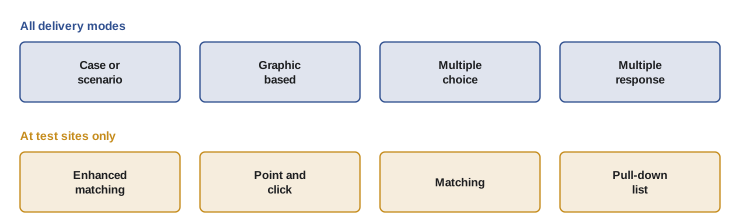
At the time of writing, PMI and exam-preparation providers described eight question formats. Four appear in every delivery mode and four appear only at test centres:
| Format | What you do | Delivery |
|---|---|---|
| Case or scenario based | Read a longer scenario with exhibits and answer a set of related questions | All modes |
| Graphic based | Interpret a chart, board, diagram or table to choose an answer | All modes |
| Multiple choice | Choose the single best answer from four options | All modes |
| Multiple response | Choose a stated number of correct answers from a list | All modes |
| Enhanced matching | Match items with richer interaction, such as ordering or grouping | Test centre only |
| Point and click (hotspot) | Click the correct area of an image or diagram | Test centre only |
| Matching | Drag items to their matching descriptions | Test centre only |
| Pull-down list | Complete statements by choosing from drop-down menus | Test centre only |
Multiple-choice questions remain the largest group. Multiple-response questions state how many answers to select, and at the time of writing PMI did not award partial credit for them, so every selected answer must be right. Practise with each format so that the interface does not slow you down on exam day.
Case studies
The case-study section opens the 2026 exam. Each case presents a project scenario, often with supporting material such as a stakeholder register extract, a schedule fragment, a burndown chart, an email thread or a risk log, followed by several questions that draw on it. The questions can come from any domain. Effective tactics include reading the questions first so you know what to look for, skimming the exhibits for structure before reading in detail, noting the approach and the project's current situation, and answering each question on its own merits, since an error in one need not carry into the next. Because the section closes at the first break, keep an eye on your checkpoint times.
Pretest items
Of the 180 questions, 10 are pretest items: new questions being trialled to collect performance data before they are used for scoring. They are mixed in randomly and look exactly like scored items, so you cannot identify them. Treat every question as if it counts.
How results are reported
PMI does not publish a fixed passing score or percentage. The passing standard is set through a psychometric process in which subject-matter experts judge how a minimally competent candidate would perform, and different exam forms are statistically equated so that the standard is the same whichever form you receive. Your overall result is pass or fail. The score report then gives a performance rating for each domain, using four levels:
| Rating | General meaning |
|---|---|
| Above Target | Performance exceeds the minimum standard for the domain |
| Target | Performance meets the minimum standard |
| Below Target | Performance is slightly below the standard |
| Needs Improvement | Performance is well below the standard |
Because the overall result combines all domains, it is possible to pass with one domain rated Below Target, and in principle to fail with one domain at Target. Online forums often quote supposed passing percentages; treat them with scepticism, since PMI does not release that figure and practice-exam percentages are only rough indicators.
Worked problem
Reading a score report
Marta failed her first attempt. Her report shows People: Target, Process: Above Target, Business Environment: Needs Improvement. How should she plan her retake?
Show solution
- Business Environment carries 26 % of the exam, about 44 scored questions, so weakness there has a large effect.
- Her Process strength suggests her predictive and planning knowledge is solid.
- She should devote most of her retake preparation, perhaps 50 to 60 % of study time, to governance, compliance, change, risk, organizational change and external environment tasks.
- She should keep People current with lighter practice and avoid neglecting Process entirely.
- Practice question results should be tracked by domain to confirm improvement before rebooking.
Answer: Concentrate on Business Environment tasks, maintain People and Process with lighter practice, and track domain-level practice scores before booking the retake.
Answering situational questions
Most PMP questions describe a situation and ask what the project leader should do, do first, or do next. A consistent method helps:
- Read the last sentence first to see exactly what is being asked: first, next, best, most likely, or least likely.
- Identify the approach (predictive, agile or hybrid) and the project phase.
- Identify the real problem, which may differ from the symptom described.
- Eliminate answers that are unethical, ignore the problem, escalate prematurely, act beyond authority or skip analysis.
- Among the remaining answers, choose the one that addresses the root cause in a collaborative, value-focused way consistent with the approach.
Worked problem
An original illustration
An agile team's velocity has fallen for three sprints, and two developers privately complain that the other team members are not reviewing code promptly. The team lead asks what the project leader should do first. Options: (A) report the drop to the sponsor, (B) facilitate a discussion of the issue at the next retrospective, (C) assign code reviews to specific people, (D) extend the sprint length.
Show solution
- The question asks what to do first, in an agile context.
- The real problem is a team working agreement or collaboration issue, not velocity itself.
- Option A escalates before the team has tried to resolve it; option C imposes a solution rather than empowering the team; option D changes the cadence without addressing the cause.
- Option B uses the team's own improvement mechanism and encourages self-organization.
Answer: B: raise it at the retrospective so the team can agree how to handle reviews.
Calculations on the exam
The 2026 exam, like its predecessor, emphasizes judgement over arithmetic, but some questions involve simple calculations or interpreting results: earned value indices (CPI, SPI), expected monetary value, critical path float, velocity forecasts, communication channels and return measures. An on-screen calculator is provided. Knowing what a result means, for example that a CPI below 1 indicates a cost overrun, is often more important than the arithmetic itself.
For example, a team of 8 people has \(8 \times 7 / 2 = 28\) communication channels; adding two people raises this to \(10 \times 9 / 2 = 45\).
If you do not pass
Failing is disappointing but common enough that PMI's rules plan for it. Within your one-year eligibility period you may retake the exam twice more, paying the re-examination fee each time. Use the score report to target weak domains, review your study materials and practice question history, and consider changing resources or study methods if your approach was not working. Many candidates pass on a second attempt after adjusting their preparation. Rebook only when your practice scores show consistent improvement, and leave enough time before your eligibility period ends.
Working through a graphic-based item
Graphic-based questions present a visual, such as a burndown chart, a Kanban board, a network diagram, a risk matrix or a stakeholder grid, and ask you to interpret it. Begin by understanding what the axes, columns or symbols represent before reading the question in detail. For a burndown chart, note the ideal line and the actual line: an actual line above the ideal shows work remaining is higher than planned, while a flat section suggests no completed work or scope added. For a Kanban board, look at work-in-progress limits and where items accumulate, since a column with many items and few leaving suggests a bottleneck. For a stakeholder grid, consider power and interest: those with high power and high interest usually need close management, while those with low power and low interest need monitoring.
Multiple-response strategy
Multiple-response items tell you how many answers to select. Treat each option as a true or false statement about the scenario, judge it independently, and then select the stated number of most defensible options. If you find more true statements than required, compare them: some may be true in general but less relevant to the specific situation. If you find fewer, reconsider the options you rejected, looking for ones that are reasonable even if not perfect.
Matching and ordering formats
Matching and enhanced matching items ask you to pair terms with definitions, activities with processes, or steps with their order. Start with the pairs you are most sure about, which reduces the remaining choices. For ordering items, identify the first and last steps first, then fill in the middle. Practise with the interface beforehand, so that dragging and dropping does not cost time on the day.
Why scores are not reported as percentages
Different exam forms contain different questions, some slightly harder than others. Reporting a raw percentage would be unfair to candidates who received a harder form. Psychometric equating places all forms on a common scale so that the same level of ability leads to the same result. The domain ratings tell you how you performed relative to the standard in each area, which is more useful for planning a retake than a raw percentage would be.
Learning from practice-question explanations
The same reasoning skills used in the exam can be built through practice. After answering a set, review each explanation and classify your errors. A content error means you did not know a concept; a reading error means you misread the question or missed a qualifier; a judgement error means you knew the concepts but chose an action that did not fit the situation, such as escalating too soon or acting without analysis. Each type needs a different remedy: more study for content errors, slower and more careful reading for reading errors, and more scenario practice with attention to explanations for judgement errors.
A note on ethics questions
Some questions test the code of ethics directly or indirectly: a vendor offers a gift, a colleague misreports progress, a sponsor asks you to hide a problem, or you discover a conflict of interest. The code emphasizes responsibility, respect, fairness and honesty. The best answers typically involve acting transparently, following organizational policy and the law, disclosing conflicts and reporting violations through proper channels, rather than ignoring the issue or taking matters into your own hands.
Worked problem
Classifying errors from a practice set
In a 50-question practice set, a candidate got 14 wrong: 5 because they did not know the concept, 4 because they missed the word first or not in the stem, and 5 because they chose to escalate or act alone when collaboration was expected. What does this suggest?
Show solution
- Score: 36 / 50 = 72 %.
- Content errors: 5 of 14, about 36 %, requiring targeted study of the concepts.
- Reading errors: 4 of 14, about 29 %, requiring slower reading of the stem.
- Judgement errors: 5 of 14, about 36 %, requiring scenario practice and attention to PMI values.
Answer: Errors are spread fairly evenly, so the candidate should combine concept review, careful reading and more scenario practice rather than only reading more.
| Error type | Sign | Remedy |
|---|---|---|
| Content | Did not recognize the concept | Targeted reading and notes |
| Reading | Missed a qualifier or misread the stem | Slow down; read the last sentence first |
| Judgement | Knew the concept but chose a poor action | Scenario practice; study explanations |
| Timing | Rushed final questions | Use checkpoints in simulations |
Interpreting practice scores
Practice-exam percentages are useful for tracking your own progress, but they do not translate directly into the real exam result. Question banks differ in difficulty and style; some are harder than the real exam, others easier. The most reliable signals are consistency across several full-length simulations from reputable providers, improvement in your weakest domains, and comfort with the timing. If you can explain why each correct answer is right and why the distractors are wrong, you are building the kind of understanding the exam rewards, whatever the percentage on a particular set.
Whatever the result, record what worked and what did not in your preparation while it is fresh; those notes will help you, or a colleague you later mentor, prepare more efficiently next time.
Common mistakes
MistakeBelieving forum claims about a fixed passing percentage.
InsteadPMI does not publish a passing score; aim for consistent strength.
MistakeIgnoring the test-centre-only formats when practising.
InsteadPractise all formats if you test at a centre.
MistakeSelecting too few or too many options in multiple-response items.
InsteadSelect exactly the stated number.
MistakeEscalating before analysing in situational questions.
InsteadAssess and act at the right level first.
MistakeRebooking immediately after a fail.
InsteadTarget weak domains and confirm improvement first.
Summary and key terms
- There are eight question formats; four are test-centre-only.
- Case studies open the exam with scenario sets and exhibits.
- Ten pretest items are unscored and indistinguishable.
- PMI does not publish a passing percentage.
- Domain ratings are Above Target, Target, Below Target and Needs Improvement.
- Situational questions reward analysis, collaboration and fitting the approach.
- After a fail, use the score report to target weaknesses before retaking.
- Multiple response
- Question requiring a stated number of correct answers.
- Hotspot
- Point-and-click question on an image.
- Case study
- Scenario with exhibits and related questions.
- Pretest item
- Unscored trial question.
- Performance rating
- Domain-level result category.
- Psychometric standard
- Statistically set passing level.
- Equating
- Adjusting for differences between exam forms.
- Situational question
- Question asking what a leader should do.
- Distractor
- Plausible but wrong answer option.
- Communication channels
- Number of paths between people, n(n−1)/2.
Practice problems
Work each problem on paper first, then reveal the answer to check.
How many question formats are there?
Show answer
Eight.
Name two test-centre-only formats.
Show answer
Enhanced matching, point and click, matching, pull-down list.
How many pretest items are there?
Show answer
Ten.
Does PMI publish a passing score?
Show answer
No.
List the four performance ratings.
Show answer
Above Target, Target, Below Target, Needs Improvement.
Communication channels for 6 people?
Show answer
15.
What does CPI below 1 mean?
Show answer
A cost overrun.
What should you read first in a long question?
Show answer
The last sentence.
Is there partial credit on multiple-response items?
Show answer
Not at the time of writing.
How many attempts remain after a first fail?
Show answer
Two within the eligibility year.
Lesson quiz · 5 questions
Score 60% or more to complete this lesson.
Create a free account to save your progress, take quizzes and earn a certificate.