
PMP-101 · Lesson 3 of 12 · 27 min
Eligibility in detail: education and experience
Many PMP journeys stall at the very first step because candidates misunderstand the eligibility rules: they count experience that does not qualify, double-count months spent on overlapping projects, describe their work in vague terms, or assume that a job title is enough. Others underestimate their experience and wait years longer than necessary. This lesson explains the education and experience requirements at the time of writing, how the 10-year window works, what counts as leading and directing projects, how to calculate non-overlapping months, and how to document experience so that it survives an audit. Lesson 4 covers the separate requirement for 35 hours of project management education.
The four eligibility pathways
PMI links the amount of project experience you need to your highest level of education. At the time of writing, the PMP exam content outline and PMI's website set out four pathways:
| Highest education | Months of leading and directing projects required |
|---|---|
| Secondary school (high school diploma or global equivalent) | 60 months (5 years) |
| Associate's degree, higher certificate or vocational program (roughly EQF level 5) | 48 months (4 years) |
| Bachelor's degree or higher (roughly EQF level 6 and above) | 36 months (3 years) |
| Bachelor's or postgraduate degree from a PMI GAC-accredited program | 24 months (2 years) |
In all pathways you also need 35 hours of project management education, or an active CAPM, as Lesson 4 explains. The references to EQF levels come from the European Qualifications Framework, which PMI uses to describe equivalent qualifications from different countries; in practice, a Canadian college diploma or a US associate's degree generally sits in the second pathway, and a bachelor's degree from a Canadian or US university in the third. If you studied abroad or hold an unusual qualification, PMI may ask for evidence of its level during an audit.
In Canada, common qualifications map roughly as follows: an Ontario Secondary School Diploma, Diplôme d'études secondaires or equivalent provincial diploma meets the secondary pathway; a two- or three-year college diploma (for example, an Ontario college diploma or a Quebec DEC technique) is typically treated as associate-level; and a bachelor's degree from a university is the third pathway. Applied degrees from colleges and polytechnics are generally bachelor-level. If in doubt, PMI's customer care can confirm how your credential is treated.
The 10-year window
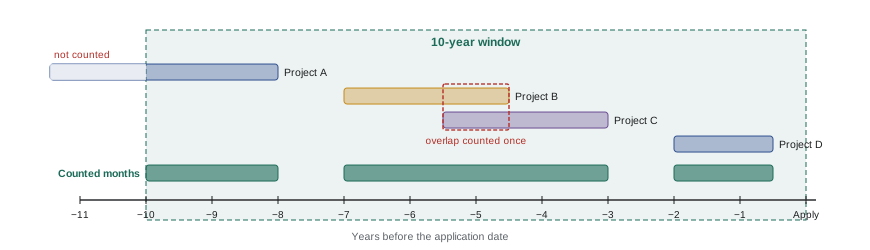
Your qualifying experience must have been gained within the 10 years before you apply. This window was expanded from eight years in the requirements that accompanied the 2026 exam. The window is a rolling one: on the day you submit your application, PMI looks back 10 years, and only experience within that period counts. Experience from 11 years ago does not count, even if it was substantial. If much of your relevant experience is old, apply sooner rather than later; if you are just short of the required months, more recent work will close the gap over time.
What counts as leading and directing projects
PMI's requirement is experience leading and directing projects in a professional setting. A project is a temporary endeavour to create a unique product, service or result: it has a defined start and end and a specific objective, as opposed to ongoing operations. Leading and directing means you were responsible for, or substantially contributed to, managing the work, not merely doing technical tasks within it. Qualifying activities typically include:
- Defining scope, requirements or a backlog, and agreeing objectives with sponsors and stakeholders.
- Planning and estimating: schedules, budgets, resources, risk responses, release plans.
- Leading a team or coordinating contributors, assigning work, removing impediments and resolving conflict.
- Managing stakeholders and communication, including status reporting and meetings.
- Monitoring progress, managing changes and issues, and taking corrective action.
- Closing projects or phases, handing over deliverables and capturing lessons learned.
You do not need the title project manager. Engineers who managed project packages, team leads who ran releases, Scrum Masters or product owners who led delivery, construction coordinators who managed subcontractors and schedules, and event managers who ran complex events can all qualify, provided the work was project-based and involved leadership. Agile experience counts as project experience. What does not count, according to PMI's outline, includes school projects, academic research, personal projects, and routine operational or purely administrative work, such as entering data into a schedule that someone else manages.
| Likely qualifies | Likely does not qualify |
|---|---|
| Leading a software release as Scrum Master or delivery lead | Writing code on a team without leading the work |
| Coordinating a construction phase, subcontractors and schedule | Routine site administration and filing |
| Running an office relocation with budget and team | Ongoing facilities maintenance |
| Managing a marketing campaign launch end to end | Posting content on a regular schedule |
| Leading an ERP implementation workstream | Operating the ERP system after go-live |
Non-overlapping months
Experience is counted in calendar months, and months during which you worked on more than one project at the same time count only once. If you led two projects from January to June in the same year, that period counts as six months, not twelve. This rule is a frequent cause of rejected or reduced applications. The simplest approach is to list every project with start and end months, place them on a timeline, and count the months covered by at least one project within the 10-year window.
Worked problem
Counting qualifying months
Priya has a bachelor's degree and is applying in October 2026, so her window runs from October 2016 to September 2026. She lists four projects: Project A, Mar 2015 to Feb 2017; Project B, Jan 2018 to Dec 2019; Project C, Jul 2019 to Jun 2021; Project D, Jan 2023 to Sep 2026. How many qualifying months does she have, and does she meet the requirement?
Show solution
- Project A: only Oct 2016 to Feb 2017 falls inside the window, which is 5 months.
- Projects B and C overlap from Jul 2019 to Dec 2019. Combined, they run continuously from Jan 2018 to Jun 2021, which is 42 months, not 24 + 24 = 48.
- Project D: Jan 2023 to Sep 2026 is 45 months.
- Total: 5 + 42 + 45 = 92 non-overlapping months.
- With a bachelor's degree she needs 36 months, so she exceeds the requirement comfortably and can choose her strongest projects to describe.
Answer: 92 non-overlapping months within the window, well above the 36 months required.
Gaps, part-time work and breaks
Gaps in experience, such as parental leave, study, illness or unemployment, do not disqualify you; they simply mean those months do not count. Part-time project leadership generally counts by calendar month rather than by hours, but your descriptions must show genuine responsibility for leading the work. Volunteer projects, for example organizing a charity event or leading a community initiative, may count if they were run professionally with real responsibilities, objectives and stakeholders; describe them carefully, since a reviewer must be convinced that they were projects you led, not casual help.
Writing experience descriptions
The application asks you to describe each project: the objective, your role, the outcome and the work you performed. Good descriptions are specific, use project management language naturally, and show leadership across the life of the project. A useful structure is: the objective and context of the project; your role and the size of the team or budget; what you did to plan, lead, monitor and close the work; and the outcome. Weak descriptions list technical tasks, use vague phrases such as helped with or was involved in, or read like a job description rather than a project. Write honestly: PMI can audit any application, and your supervisor or another contact may be asked to sign that your description is accurate.
Worked problem
Improving an experience description
Marcus wrote: I was involved in the new warehouse system project and helped with testing and training. Rewrite this to show leadership, assuming Marcus actually coordinated the testing and training workstream.
Show solution
- State the objective: Implement a new warehouse management system across three distribution centres to reduce picking errors.
- State the role: Workstream lead for testing and training, coordinating a team of six analysts and twelve super-users.
- Describe leadership work: Planned the test and training schedule with the project manager; defined acceptance criteria with operations managers; tracked defects and prioritized fixes with the vendor; managed training logistics and communications; reported weekly status and risks to the steering committee.
- State the outcome: Delivered training to 240 staff before go-live; the system launched on schedule and picking errors fell by about a third in the first quarter.
Answer: A specific description with objective, role, leadership activities across planning, execution and monitoring, and a measurable outcome, all of which Marcus can support if audited.
Preparing for a possible audit
Because any application can be selected for audit (Lesson 8), it is wise to prepare evidence before you apply: a copy of your degree or diploma, contact details for supervisors or managers who can confirm each project, and certificates for your project management education. If a former manager has left the organization, find another person who knew your role, such as a client, sponsor or colleague in a senior position. Contact them in advance and share your description, so that they are not surprised by a request to sign it. Keeping a simple project log as you work, with dates, roles and outcomes, makes future applications much easier.
Common eligibility scenarios
Several situations raise questions. Consultants who led many short engagements can combine them, counting months covered by at least one engagement. People in agile teams can count leadership roles such as Scrum Master or product owner when they involved leading delivery. Military and public service project experience counts when it involved leading projects. Experience gained abroad counts if it falls within the window. Internships rarely count unless the intern genuinely led project work. When in doubt, describe the work honestly and specifically and let PMI decide; misrepresenting experience can lead to rejection, revocation and a ban from PMI certifications under its ethics code.
Common eligibility scenarios
Several situations come up often enough to deserve a direct answer, always subject to PMI's current handbook. If you led projects as part of a role whose title was not project manager, such as engineer, analyst, coordinator or site supervisor, the work can still count if you led and directed project tasks; describe what you did, not your title. If your experience was gained as a consultant across many short engagements, list each engagement or group closely related ones, and count calendar months without double-counting overlaps. If you have a gap in employment, the gap simply contributes no months; the 10-year window still runs back from the application date. If part of your experience was in a volunteer role, such as organizing a community event or leading a non-profit initiative, it can count when it meets the definition of project work and someone can confirm it.
Candidates with qualifications from outside North America sometimes worry about how PMI will treat them. PMI's pathways are expressed in terms of secondary education, a four-year degree and accredited programs, and the handbook explains how equivalent credentials are assessed; if in doubt, describe the qualification accurately and be ready to provide documentation if audited.
Keeping an experience log going forward
If you are not yet eligible, start a simple log now. For each project, record the start and end months, the organization, your role, the sponsor or manager who could confirm it, the objective, the main deliverables and the outcome, and the tasks you led in each part of the life cycle. Updating the log every quarter takes a few minutes and avoids the difficult work of reconstructing years of experience from memory when you finally apply.
Checking your count before applying
Before submitting, list every project with start and end months on a single timeline, mark overlaps, and add the non-overlapping months. Then confirm that the earliest month you count falls within the 10-year window from your planned application date. If your total is only just above the threshold, consider waiting a month or two, or adding a project you had overlooked, so that a small correction during review does not leave you short.
Common mistakes
MistakeAdding months from overlapping projects.
InsteadCount calendar months covered by at least one project once.
MistakeCounting experience older than 10 years.
InsteadCount only the portion inside the 10-year window.
MistakeDescribing technical tasks instead of leadership.
InsteadShow planning, leading, monitoring and closing activities.
MistakeAssuming a job title is required.
InsteadDescribe the project leadership you actually performed.
MistakeWaiting until audit to find references.
InsteadLine up contacts and documents before applying.
Summary and key terms
- Required months depend on education: 60, 48, 36 or 24 with a GAC degree.
- Experience must fall within the 10 years before you apply.
- Leading and directing projects in a professional setting is what counts.
- School, research, personal and routine operational work do not count.
- Overlapping months count once; build a timeline to calculate.
- Specific, honest descriptions with outcomes strengthen applications.
- Prepare evidence and contacts before applying in case of audit.
- Eligibility pathway
- A combination of education and required experience.
- Leading and directing
- Managing project work, not only performing tasks.
- Project
- Temporary endeavour creating a unique product, service or result.
- Operations
- Ongoing, repetitive work that sustains the organization.
- 10-year window
- Period before application in which experience must fall.
- Non-overlapping months
- Calendar months counted once regardless of concurrent projects.
- EQF
- European Qualifications Framework used to compare education levels.
- GAC-accredited program
- Degree accredited by PMI's Global Accreditation Center.
- Experience description
- Summary of a project, your role and outcomes in the application.
- Audit
- PMI review requiring evidence of education and experience.
Practice problems
Work each problem on paper first, then reveal the answer to check.
Months required with a bachelor's degree?
Show answer
36 months.
Months required with a secondary diploma?
Show answer
60 months.
Months required with a GAC-accredited degree?
Show answer
24 months.
How far back can qualifying experience go?
Show answer
10 years before the application.
Two projects both run Jan–Jun; how many months count?
Show answer
6 months.
Does agile experience count?
Show answer
Yes, if it involved leading project work.
Name two types of work that do not count.
Show answer
School projects, research, personal projects, routine operations.
Do gaps in experience disqualify you?
Show answer
No, those months simply do not count.
What four elements make a strong description?
Show answer
Objective, role, leadership activities and outcome.
What happens if experience is misrepresented?
Show answer
Rejection or revocation and possible ethics sanctions.
Lesson quiz · 5 questions
Score 60% or more to complete this lesson.
Create a free account to save your progress, take quizzes and earn a certificate.