
PLB-310 · Lesson 8 of 12 · 21 min
Heat emitters: baseboard, panel radiators and fan coils
The back bedroom at the bungalow had always been cold, and now Grace could prove why. Her room-by-room calculation gave the room a design load of about 1.4 kW after air sealing. The single old cast iron radiator under the window, she worked out, could deliver only about 0.8 kW even with the old boiler's hottest water, and far less at the lower temperatures the heat pump would supply. "Emitters decide everything in a low-temperature system," she told Maya. "Today we learn how to work out what an emitter really puts out at the water temperature we plan to use."
A heat emitter transfers heat from the system water to a room. Choosing and sizing emitters is where the room-by-room load calculation from Lesson 2 becomes real equipment on the wall or under the floor. This lesson covers the common emitters, how their ratings work, how their output changes with water temperature, and how to size them for low-temperature systems.
How emitter output depends on temperature
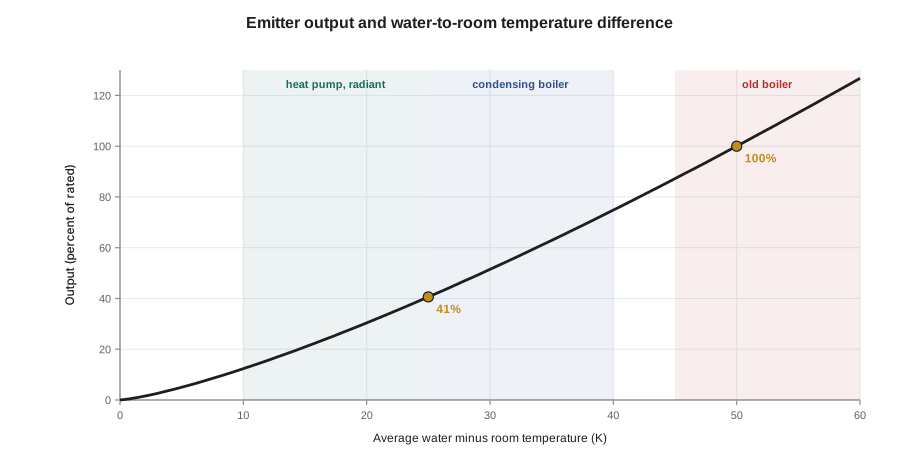
Every emitter's output depends on the difference between the average water temperature inside it and the room air temperature. The average water temperature is roughly halfway between the water entering and leaving. Output is not simply proportional to that difference; it rises a little faster, because convection gets stronger as the surface gets hotter. Manufacturers describe this with an exponent, usually about 1.3 for radiators and about 1.3 to 1.4 for baseboard:
Here Q_rated is the output at the manufacturer's rating condition, ΔT_rated is the difference between average water and room air at that condition, and n is the exponent. The equation shows how quickly output falls as water cools. A radiator rated with a 50 K difference between water and room, run with only a 25 K difference, delivers about 40 percent of its rated output, not 50 percent.
Fin-tube baseboard
Fin-tube baseboard is a copper tube with closely spaced aluminium fins inside a steel enclosure, mounted along an outside wall. Cool air enters at the bottom, warms as it rises through the fins and leaves at the top. Residential baseboard is typically rated around 550 to 600 W per metre at an average water temperature of 82 °C with the room at 18 °C, and around a third of that at an average of 45 °C. That steep drop is why baseboard sized for hot water struggles when the water temperature is lowered for a condensing boiler or heat pump, and why it often needs to be lengthened in a retrofit.
Baseboard needs free airflow. Furniture pushed against it, long drapes covering it or dented fins reduce its output sharply. The enclosure dampers, if fitted, should be open. Installers leave a gap at the floor for air to enter and keep the element level so air can be bled from it. Baseboard elements expand as they heat, so they hang on sliding hangers and need room at the ends to move, or they tick and creak as they warm.
Cast iron radiators
Cast iron radiators, standing or wall-hung, are found in older houses and are still made in some styles. They hold a lot of water and metal, so they heat and cool slowly and give gentle, even heat. Their output is traditionally rated in square feet of equivalent direct radiation (EDR), a unit inherited from steam heating that is still used in Canada and the United States alike. Tables published by heating trade groups list the EDR of common radiator sizes by height, number of columns and number of sections, so an installer can measure a radiator and look up its rating.
For hot water, a common rating is about 44 W per square foot of EDR when the average water temperature is 77 °C and the room is 18 °C. The back bedroom's radiator measures 18 square feet of EDR, so at that rating it delivers about 790 W, far below the room's 1.4 kW design load. That is why the room was always cold, even with the old oversized boiler.
Panel radiators
Steel panel radiators are flat panels of pressed steel with water channels, often with convector fins welded behind, made in many heights, lengths and thicknesses: a single panel, a single panel with fins, double panels with fins, and so on. They respond faster than cast iron, look clean and come with built-in valve bodies for thermostatic radiator valves. European manufacturers rate them to EN 442, most often at a condition of 75 °C supply, 65 °C return and 20 °C room, a 50 K difference between average water and room. At the lower temperatures used with heat pumps, their output must be corrected with the exponent equation.
Worked problem
Sizing a panel radiator for the back bedroom
The back bedroom needs 1.4 kW at the design condition. The heat pump will supply 50 °C water with an 8 K drop, so the average water temperature is 46 °C, and the room is held at 21 °C. The existing radiator (18 square feet of EDR, rated 44 W per square foot at a 59 K difference) will stay. What panel rating is needed?
Show solution
- Water-to-room difference: 46 − 21 = 25 K.
- Existing radiator: 18 × 44 = 792 W rated; at 25 K its output is 792 × (25 ÷ 59)^1.3 = 792 × 0.33 ≈ 260 W.
- Shortfall: 1,400 − 260 = 1,140 W.
- Panel rated at 50 K: at 25 K it gives (25 ÷ 50)^1.3 = 0.41 of its rating, so the rating needed is 1,140 ÷ 0.41 ≈ 2,800 W.
Answer: A double panel with fins rated about 2.8 kW at the EN 442 condition will heat the room alongside the old radiator. Grace chose one that fit under the second window, 600 mm high and about 1.4 m long.
# Emitter output at a different water temperature: Q = Q_rated x (dT / dT_rated) ** n
def output(q_rated, t_avg, t_room, dt_rated, n=1.3):
    return q_rated * max(0.0, (t_avg - t_room) / dt_rated) ** n

panel = 2800                   # W at the EN 442 condition (50 K)
old_rad = 18 * 44              # W at 77 C average water, 18 C room (59 K)
for supply in (35, 40, 45, 50, 55):
    avg = supply - 4           # 8 K drop, so the average is 4 K below supply
    total = output(panel, avg, 21, 50) + output(old_rad, avg, 21, 59)
print(f"supply {supply} C: back bedroom emitters give {total:5.0f} W (load at design 1400 W)")supply 35 C: back bedroom emitters give 424 W (load at design 1400 W) supply 40 C: back bedroom emitters give 719 W (load at design 1400 W) supply 45 C: back bedroom emitters give 1045 W (load at design 1400 W) supply 50 C: back bedroom emitters give 1397 W (load at design 1400 W) supply 55 C: back bedroom emitters give 1770 W (load at design 1400 W)
The output confirms the design and shows something more useful: on milder days, when the room needs far less than its design load, much cooler water will do. A supply of 40 °C covers more than half the design load, which outdoor reset control (Lesson 10) uses to keep the heat pump running efficiently through most of the season.
Fan coils
A fan coil is a finned water coil with a fan that blows room air across it. Because the fan forces convection, a fan coil delivers a lot of heat from a small cabinet and works well with low water temperatures, often 40 to 50 °C, making it a good partner for heat pumps. Kingsway's suites each have a ceiling-concealed fan coil with a multi-speed fan, fed from the risers, with a two-way control valve and a thermostat in the suite. Fan coils can also cool if they are supplied with chilled water and have a drain pan for condensate, which is why many buildings use four-pipe fan coils with separate heating and cooling coils, or two-pipe systems switched between seasons.
Fan coils need filters that are changed regularly, a fan that is quiet at the speeds people actually use, and an air vent at the coil. Their output depends on fan speed as well as water temperature, so a fan coil that seems weak may simply be running on low speed or have a clogged filter. Low-profile wall-mounted fan coils, sometimes called hydronic air handlers or low-temperature radiators, are popular in heat pump retrofits because they fit where a radiator was.
Other emitters
Kick-space heaters are small fan coils that fit under kitchen cabinets, where there is no wall space for a radiator. Towel warmers in bathrooms add a little heat and dry towels. Radiant ceiling and wall panels deliver heat mostly by radiation from a large warm surface. Radiant floors, the largest emitter of all, get their own lesson next.
| Emitter | Main heat transfer | Water temperature it suits | Strengths | Limits |
|---|---|---|---|---|
| Fin-tube baseboard | Natural convection | High | Low cost, long thin units | Output falls steeply at low temperatures; needs free airflow |
| Cast iron radiator | Radiation and convection | Medium to high | Durable, gentle even heat, high mass | Heavy, slow to respond |
| Panel radiator | Radiation and convection | Low to high | Compact, quick, TRV-ready | Must be oversized for heat pump temperatures |
| Fan coil | Forced convection | Low to medium | High output from small unit, can cool | Fan noise, filters, needs power |
| Radiant floor | Radiation | Low | Very comfortable, invisible | Slow response, limited by floor coverings |
Surveying existing radiators
Before any low-temperature retrofit, Grace surveys every existing emitter. For each room she records the radiator type, its height, the number of columns and sections, and its condition, then looks up its EDR in a radiator table. Baseboard is measured by the length of finned element, not the length of the enclosure, because enclosures often hide plain pipe at the ends. She compares each room's emitter output at the planned water temperature with the room's calculated load and marks every room that falls short.
In the bungalow, the survey showed that most rooms had generous radiators, because they had been sized for a leaky house with poor windows. After air sealing, the living room radiators could carry the room with water barely warmer than body temperature on a mild day. Only the back bedroom and the small bathroom fell short. The bathroom got a towel warmer that adds output and is welcome in its own right, and the back bedroom got the panel radiator worked out above.
The survey also notes problems that affect output: radiators painted with metallic paint, which reduces radiation slightly; radiator covers and shelves that block airflow; radiators that are cold at the top, which means trapped air; and radiators that are cold at the bottom, which can mean sludge. Each of these is cheaper to fix than replacing the emitter.
Valves and connections at the emitter
Each emitter in a two-pipe or manifold system needs a way to control and isolate it. Panel radiators usually have an integrated valve body for a thermostatic head on the supply and a lockshield valve on the return. The lockshield valve is set with a key or wrench to balance the radiator's flow, as Lesson 11 explains, and it also isolates the radiator for removal along with the supply valve. Cast iron radiators get a radiator valve on the supply and often a union elbow on the return.
Every emitter needs a manual air vent at its highest point, and the piping to it should allow air to rise to the vent rather than trap it in a dip. Connections are made so that the emitter can be removed without cutting pipe, and so that the piping expands without stressing the joints. PEX connections to panel radiators are common in retrofits because the flexible tubing can be fished through existing walls and floors without opening them up.
Common mistakes
MistakeUsing an emitter's rated output at a much lower water temperature.
InsteadCorrect the rating with the exponent equation for the actual average water temperature.
MistakeAssuming output halves when the temperature difference halves.
InsteadWith an exponent of about 1.3, output falls to about 40 percent.
MistakeBlocking baseboard with furniture or drapes.
InsteadKeep airflow paths clear at the bottom and top.
MistakeSizing replacement emitters to match the old ones.
InsteadSize each emitter from the room's calculated load at the planned water temperature.
MistakeBlaming the heat source when a fan coil is weak.
InsteadCheck the filter, fan speed and air in the coil first.
Summary and key terms
- Emitter output depends on the difference between average water temperature and room temperature, raised to an exponent near 1.3.
- Baseboard is convective and loses output quickly at low water temperatures.
- Cast iron radiators are rated in square feet of EDR and give gentle, high-mass heat.
- Panel radiators are rated to EN 442 and are corrected for lower temperatures.
- Fan coils give high output at low water temperatures and can also cool.
- Size each emitter from its room's load at the planned water temperature.
- Average water temperature
- The mean of the water temperatures entering and leaving an emitter.
- EDR
- Equivalent direct radiation: a traditional rating of radiator size, in square feet.
- Emitter exponent
- The power that describes how an emitter's output changes with temperature difference.
- Fin-tube baseboard
- A finned copper tube in an enclosure that heats mainly by natural convection.
- Panel radiator
- A flat steel radiator, often with convector fins, rated to EN 442.
- Fan coil
- A water coil with a fan that blows room air across it.
- Kick-space heater
- A small fan coil installed under cabinets.
Practice problems
Work each problem on paper first, then reveal the answer to check.
A panel rated 2,000 W at 50 K runs at 25 K. About what does it deliver?
Show answer
2,000 × (25 ÷ 50)^1.3 ≈ 810 W.
What is the average water temperature with 60 °C supply and 50 °C return?
Show answer
55 °C.
Why does baseboard lose so much output in a low-temperature retrofit?
Show answer
It is convective, and its output falls steeply as the water cools.
What unit is used for cast iron radiator ratings?
Show answer
Square feet of equivalent direct radiation (EDR).
Why do fan coils suit heat pumps?
Show answer
Forced convection gives good output at low water temperatures.
Name two things to check when a fan coil seems weak.
Show answer
The filter, the fan speed and air in the coil.
Lesson quiz · 5 questions
Score 60% or more to complete this lesson.
Create a free account to save your progress, take quizzes and earn a certificate.