
PLB-310 · Lesson 10 of 12 · 21 min
Controls: thermostats, outdoor reset and temperature difference
On a mild October morning, Grace stopped at the bungalow to set up the new system's controller with Maya. The heat pump was humming quietly outside, the radiators were barely warm to the touch, and every room was at its set temperature. "This is what good control looks like," Grace said. "The old system blasted 80-degree water through the radiators and shut off, over and over. This one sends just enough warmth, all the time. The secret is not a fancy thermostat. It is matching the water temperature to the weather." This lesson covers the controls that run hydronic systems: thermostats and zone controls, outdoor reset, temperature difference control of circulators, priority and staging, and how the pieces work together.
Thermostats and zone controls
A thermostat measures room temperature and calls for heat when the room is below its setting. The call is usually a low-voltage signal that closes a circuit. In a simple system, the thermostat's call starts the circulator and the heat source. In a zoned system, each thermostat opens its zone valve or starts its zone circulator through a zone control panel, a relay panel with terminals for each zone that also starts the heat source whenever any zone calls. End switches on zone valves tell the panel when a valve is fully open, so the circulator does not start against closed valves.
Programmable and smart thermostats change the setting by time of day or occupancy. Setbacks save energy with fast-responding emitters such as fan coils and baseboard. With a high-mass radiant slab, deep setbacks save little and cause long, uncomfortable recovery periods, so radiant zones are usually held at a steady setting or set back only slightly. Some smart thermostats learn how long a zone takes to recover and start early.
Thermostats should be on an inside wall, away from sunlight, drafts, lamps and the heat of appliances, at the height the code or design calls for. A thermostat in the wrong place controls the wrong temperature, and no amount of system tuning fixes that.
Aquastats and operating temperatures
An aquastat is a temperature control mounted on or in the boiler or a pipe. Old systems used a fixed high aquastat setting, keeping the boiler hot all the time, often around 80 °C, whatever the weather. That made sense for cast iron boilers that must not condense, but it wastes fuel and, for condensing boilers and heat pumps, throws away the efficiency they were bought for.
Outdoor reset
Outdoor reset control adjusts the supply water temperature to the outdoor temperature. On the coldest design day, the system needs its full design water temperature. On a mild day, the building loses much less heat, so cooler water heats it just as well, and the emitters run longer at a gentle output instead of cycling. The controller reads an outdoor sensor, usually mounted on a north wall out of the sun, and calculates the target supply temperature from a straight-line reset curve.
The reset curve is defined by two points. The design point pairs the design outdoor temperature with the design supply temperature: for the bungalow, −17 °C outdoors with 50 °C water. The starting point pairs the outdoor temperature at which the house needs no heat with a supply temperature just above room temperature, such as 20 °C outdoors with 20 °C water. Between them, the target supply temperature follows a straight line.
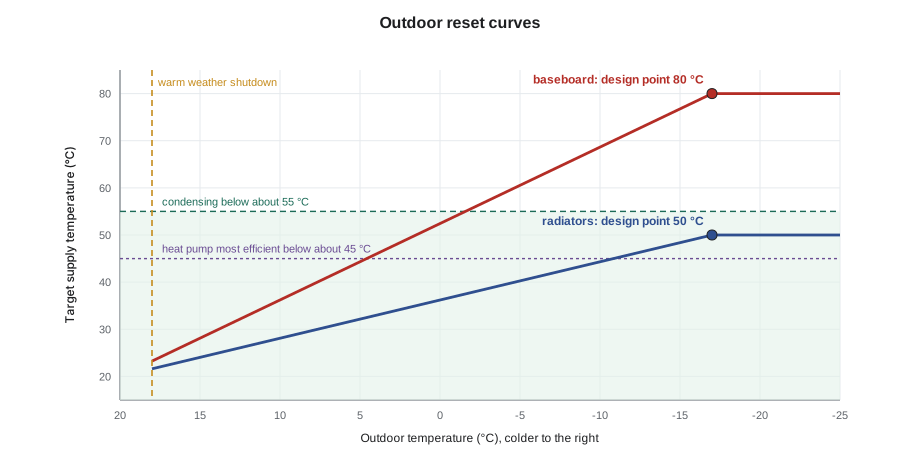
The slope of the curve depends on the emitters. A radiant floor might need only 35 °C at design, giving a very flat curve. Baseboard might need 80 °C at design, giving a steep one. Whatever the slope, outdoor reset keeps the water as cool as the building allows, which for a condensing boiler means more of the season below the dew point, and for a heat pump means a higher COP.
Worked problem
Setting the bungalow's reset curve
The bungalow's reset curve runs from 20 °C water at 20 °C outdoors to 50 °C water at −17 °C outdoors. What supply temperature does the controller target at 0 °C outdoors, and at 10 °C outdoors?
Show solution
- The curve spans 37 K outdoors (20 to −17 °C) and 30 K of water (20 to 50 °C), a slope of 30 ÷ 37 ≈ 0.81.
- At 0 °C: T = 20 + 0.81 × (20 − 0) = 20 + 16.2 = 36.2 °C.
- At 10 °C: T = 20 + 0.81 × (20 − 10) = 20 + 8.1 = 28.1 °C.
Answer: At freezing the system runs at about 36 °C, and on a cool autumn day at about 28 °C. The heat pump spends most of the season well below its design temperature, which is where its COP is highest.
# Outdoor reset curve: target supply temperature from outdoor temperature
def reset(t_out, design_out=-17, design_supply=50, start_out=20, start_supply=20, wws=18):
    if t_out >= wws:
        return None                         # warm weather shutdown
    frac = (start_out - t_out) / (start_out - design_out)
    return start_supply + (design_supply - start_supply) * min(frac, 1.0)

for t in (-25, -17, -10, 0, 5, 10, 15, 20):
    s = reset(t)
print(f"outdoor {t:4d} C -> " + ("heating off (warm weather shutdown)" if s is None else f"supply {s:4.1f} C"))outdoor -25 C -> supply 50.0 C outdoor -17 C -> supply 50.0 C outdoor -10 C -> supply 44.3 C outdoor 0 C -> supply 36.2 C outdoor 5 C -> supply 32.2 C outdoor 10 C -> supply 28.1 C outdoor 15 C -> supply 24.1 C outdoor 20 C -> heating off (warm weather shutdown)
The controller also has a warm weather shutdown: above a set outdoor temperature, here 18 °C, it stops space heating altogether while still allowing domestic hot water. And it caps the supply temperature at the design value, so a colder-than-design night does not send water hotter than the emitters and heat source are set up for.
Fine tuning is normal. If rooms run warm in mild weather and cold in severe weather, the curve is too flat; if the reverse, it is too steep. Many controllers add indoor feedback from a room sensor that nudges the curve up or down. Grace told the owners she would check the curve after the first cold snap and adjust it, which is part of commissioning a reset system.
Temperature difference control
Variable-speed circulators can be controlled by temperature difference instead of pressure. A ΔT-controlled circulator has sensors on the supply and return and changes speed to hold a set difference, such as 8 K. When the load is high, the return comes back cooler, the difference grows and the circulator speeds up; when the load drops, it slows down. Holding a set difference keeps the return water cool for the heat source and saves pumping energy.
ΔT control suits loops without zone valves, such as a boiler loop or a single-zone radiant manifold. Systems with many zone valves are usually better served by proportional pressure control, which responds to valves opening and closing, combined with a ΔT setting on the heat source's own circulator.
Priority, staging and system controllers
Domestic hot water priority tells the controller to divert the heat source to the indirect water heater whenever it calls, briefly stopping space heating. Because the water heater needs only a short burst, the rooms rarely notice, and the owners get hot water quickly. In the bungalow, the boiler heats the indirect tank while the heat pump keeps the buffer warm for the radiators.
Boiler staging controllers run multiple boilers or a hybrid system. At Kingsway, the boiler controller fires the lead boiler at low input first, modulates it up, then brings in the second boiler at low fire when the first reaches a set output, because two condensing boilers at low fire are more efficient than one at high fire. It rotates the lead boiler weekly. In the bungalow, the hybrid controller runs the heat pump first and starts the boiler only when the outdoor temperature falls below the changeover point or the buffer temperature falls behind its target.
Large buildings connect these controls to a building automation system (BAS), which collects temperatures, pressures, alarms and energy data from the whole plant. Kingsway's BAS logs every boiler start, every riser temperature and every pump speed, and it sends an alarm to the property manager's phone if a boiler locks out or a suite stays cold. For the service plumber, those logs are often the fastest way to see what a system was doing before it failed.
| Control | What it controls | Where it is used |
|---|---|---|
| Thermostat and zone panel | Starts zones and the heat source on a call for heat | Every zoned system |
| Aquastat | Holds boiler or pipe water at a fixed temperature | Older boilers, domestic hot water tanks |
| Outdoor reset controller | Sets supply temperature from outdoor temperature | Condensing boilers, heat pumps, mixing stations |
| ΔT circulator control | Varies pump speed to hold a supply-return difference | Boiler loops, single-zone circuits |
| Proportional pressure control | Varies pump speed as zone valves open and close | Zone valve and TRV systems |
| Staging controller | Sequences and rotates multiple heat sources | Multi-boiler plants, hybrid systems |
| Building automation system | Monitors and coordinates the whole plant | Large buildings |
Wiring and safety in controls
Control wiring for thermostats and zone valves is usually low voltage, supplied by a transformer in the zone panel, while circulators and boilers run on line voltage. Work on line-voltage wiring requires the appropriate electrical qualification or licence, and many jurisdictions require an electrical permit for new circuits. Plumbers commonly connect low-voltage thermostat and zone wiring and the factory-provided pump and valve connections that the manufacturer's instructions describe. Before working on any control, the power is switched off at the service switch and locked out, as TRD-101 taught; a zone panel can have more than one power source.
Thermostatic radiator valves
A thermostatic radiator valve, or TRV, is a self-contained control on a single radiator. Its head contains a wax or liquid element that expands as the room warms and closes the valve, then contracts and opens it as the room cools. TRVs give room-by-room control without wiring, which makes them popular in retrofits like the bungalow, where every bedroom can be set differently. The heads are numbered rather than marked in degrees, and each number corresponds roughly to a room temperature.
TRVs work best with outdoor reset. The reset curve does the coarse work, sending water warm enough for the weather, and the TRVs trim each room for sun, cooking or people. Because TRVs close independently, a system full of them needs a circulator that responds to closing valves, which is why proportional pressure control suits it, and a bypass or differential pressure arrangement if the circulator is a fixed-speed type.
Hybrid changeover settings
In the bungalow, the hybrid controller decides when the boiler takes over from the heat pump. Grace set a changeover outdoor temperature of −12 °C, below which the boiler carries the house, and a buffer tank lag setting: if the buffer stays more than 5 K below its reset target for 20 minutes, the boiler starts even in milder weather. A third setting locks out the boiler entirely above 0 °C, so a short defrost cycle or a door left open does not fire the boiler unnecessarily.
The changeover point is a balance between running cost and comfort. Set too high, the boiler runs on days when the heat pump could have carried the house more cheaply. Set too low, the heat pump struggles at its limit and the house falls behind. Grace planned to review the first winter's logs with the owners and move the setting if either problem showed up.
Common mistakes
MistakeLeaving a condensing boiler at a fixed high water temperature.
InsteadUse outdoor reset so the water is only as warm as the weather requires.
MistakeMounting the outdoor sensor in the sun or near a vent.
InsteadMount it on a shaded north wall away from exhausts and windows.
MistakeUsing deep night setbacks on a radiant slab.
InsteadHold radiant slabs steady or use only small setbacks.
MistakeSetting a reset curve once and never checking it.
InsteadCheck comfort in mild and cold weather and adjust the slope or use indoor feedback.
MistakeUsing ΔT pump control on a system full of zone valves.
InsteadUse proportional pressure for zone valve systems and ΔT on the heat source loop.
Summary and key terms
- Thermostats call for heat; zone panels open zones and start the heat source.
- Fixed high aquastat settings waste the efficiency of condensing boilers and heat pumps.
- Outdoor reset sets supply temperature on a straight line between a starting point and a design point.
- Reset curve slope depends on the emitters; warm weather shutdown stops heating in mild weather.
- ΔT control varies pump speed to hold a set supply-return difference.
- DHW priority, staging controllers and building automation coordinate the plant.
- Low-voltage control wiring is common plumbing work; line-voltage work needs the right qualification.
- Thermostat
- A device that senses room temperature and calls for heat.
- Zone control panel
- A relay panel that operates zone valves or circulators and starts the heat source.
- Aquastat
- A temperature control mounted on a boiler, tank or pipe.
- Outdoor reset
- Control that sets supply water temperature according to outdoor temperature.
- Reset curve
- The line relating outdoor temperature to target supply temperature.
- Warm weather shutdown
- The outdoor temperature above which space heating stops.
- Domestic hot water priority
- A control mode that diverts the heat source to the water heater when it calls.
Practice problems
Work each problem on paper first, then reveal the answer to check.
A reset curve runs from 20 °C water at 20 °C outdoors to 60 °C water at −20 °C outdoors. What is the target at 0 °C?
Show answer
20 + 40 × (20 ÷ 40) = 40 °C.
Why does outdoor reset raise a condensing boiler's efficiency?
Show answer
It keeps the water, and so the return, cooler for most of the season.
Where should an outdoor sensor be mounted?
Show answer
On a shaded north wall, away from exhausts, vents and windows.
Why are deep setbacks a poor idea on radiant slabs?
Show answer
The slab's mass makes recovery slow and uncomfortable, and savings are small.
What does domestic hot water priority do?
Show answer
Diverts the heat source to the water heater when it calls, briefly pausing space heating.
Which pump control suits a system with many zone valves?
Show answer
Proportional pressure control.
Lesson quiz · 5 questions
Score 60% or more to complete this lesson.
Create a free account to save your progress, take quizzes and earn a certificate.