
PLB-310 · Lesson 4 of 12 · 21 min
Heat pumps and other hydronic heat sources
Hana and Peter had a question Grace hears more every year: should they skip the gas boiler and install a heat pump instead? Their neighbour had put in an air-to-water heat pump the previous fall and talked about it constantly. Grace did not give a quick answer. "A heat pump can heat this house," she said, "but only if the radiators can do their job with cooler water, and only if we plan for the coldest nights. Let's work through it properly." This lesson explains how hydronic heat pumps work, what limits them, how they are combined with backup heat, and the other heat sources a hydronic system can use.
How a heat pump moves heat
A heat pump does not make heat from fuel. It moves heat from a cold place to a warm place, using electricity to drive a refrigeration cycle. A refrigerant evaporates in a coil outdoors, absorbing heat from the outdoor air even on cold days; a compressor raises its pressure and temperature; the hot refrigerant condenses in a heat exchanger, giving its heat to the hydronic water; and an expansion valve drops the pressure so the cycle can repeat. Because most of the delivered heat comes from outdoors, a heat pump delivers more heat than the electrical energy it uses.
The ratio of heat delivered to electricity used is the coefficient of performance (COP). A COP of 3 means three units of heat for each unit of electricity. An electric boiler, by comparison, has a COP of 1. The COP is not fixed: it depends on how far the heat pump has to lift the heat, from the outdoor air temperature up to the water temperature it produces. The bigger the lift, the lower the COP.
The right side of the equation is the ideal, or Carnot, limit, with temperatures in kelvin, multiplied by a factor η that real machines achieve, often around 0.4 to 0.5. The equation makes one point very clearly: lowering the water temperature the heat pump must produce raises its COP, just as lowering the return temperature raises a condensing boiler's efficiency. Low-temperature emitters suit both.
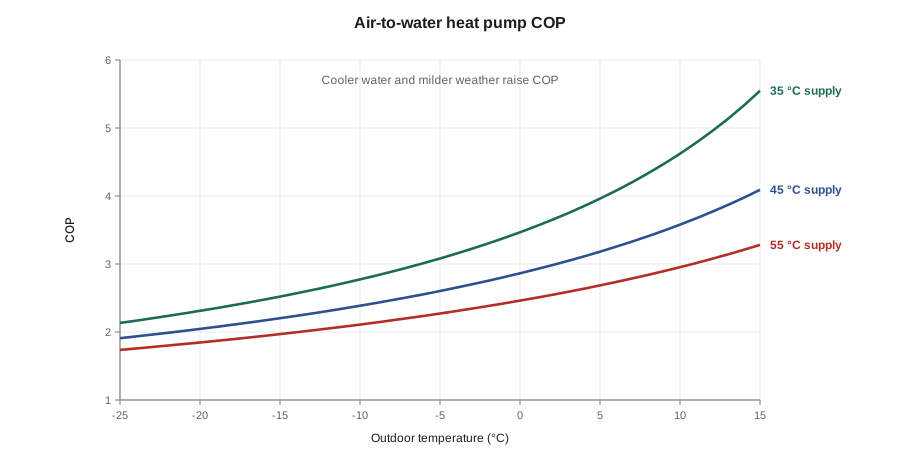
Capacity falls as it gets colder
An air-source heat pump also loses capacity as the outdoor temperature drops, just when the house needs the most heat. Modern cold-climate units with variable-speed compressors hold much of their capacity down to around −15 °C and keep running well below that, but their output and COP are lower. The temperature at which the heat pump's capacity equals the house's heat loss is the balance point. Below it, something else must supply the difference.
There are three common arrangements. A heat pump sized for the full design load needs no backup but is large, costly and oversized for most of the season. A heat pump sized for most of the season with an electric element as backup is simpler but runs the element on the coldest days. A hybrid system pairs the heat pump with a gas boiler, which takes over below a changeover temperature chosen for comfort and operating cost. Hybrid systems suit retrofits where the house's radiators need hotter water than the heat pump can efficiently produce on the coldest days.
Worked problem
Finding the balance point
After air sealing, the bungalow's design load is 10.4 kW at −17 °C outdoors and 22 °C indoors, and the house needs no heat above about 15 °C outdoors because of internal and solar gains. A cold-climate heat pump delivers about 9 kW at −8 °C and about 6.5 kW at −17 °C, varying roughly in a straight line between. Where is the balance point?
Show solution
- House load falls in a straight line from 10.4 kW at −17 °C to zero at 15 °C: load = 10.4 × (15 − T) ÷ 32.
- Heat pump capacity: 6.5 kW at −17 °C rising 2.5 kW over 9 K, about 0.28 kW per K.
- At −8 °C: load = 10.4 × 23 ÷ 32 = 7.5 kW; capacity 9.0 kW, so the heat pump has spare capacity.
- At −12 °C: load = 10.4 × 27 ÷ 32 = 8.8 kW; capacity 6.5 + 0.28 × 5 = 7.9 kW, so the heat pump falls short.
- Solving where the lines cross gives about −10.5 °C.
Answer: The balance point is about −10.5 °C. Below it the backup supplies the rest, up to about 3.9 kW on the design night. In Hamilton that is only a small fraction of the heating season's hours, so the heat pump supplies most of the year's heat.
# Balance point: where heat pump capacity equals house heat loss
def load_kw(t):        # house loss, zero at 15 C, 10.4 kW at -17 C
    return max(0.0, 10.4 * (15 - t) / 32)
def hp_kw(t):          # heat pump capacity, straight line through the two rated points
    return 6.5 + (9.0 - 6.5) * (t + 17) / 9

for t in range(-20, 6, 5):
    short = max(0.0, load_kw(t) - hp_kw(t))
    print(f"{t:4d} C  load {load_kw(t):5.1f}  heat pump {hp_kw(t):5.1f}  backup {short:4.1f} kW")
lo, hi = -25.0, 10.0
for _ in range(50):
    mid = (lo + hi) / 2
    lo, hi = (mid, hi) if hp_kw(mid) < load_kw(mid) else (lo, mid)
print(f"balance point about {mid:.1f} C")-20 C load 11.4 heat pump 5.7 backup 5.7 kW -15 C load 9.8 heat pump 7.1 backup 2.7 kW -10 C load 8.1 heat pump 8.4 backup 0.0 kW -5 C load 6.5 heat pump 9.8 backup 0.0 kW 0 C load 4.9 heat pump 11.2 backup 0.0 kW 5 C load 3.2 heat pump 12.6 backup 0.0 kW balance point about -10.5 C
Water temperature is the deciding factor
Most air-to-water heat pumps produce water up to about 55 to 65 °C, but their COP is best below about 45 °C. The bungalow's cast iron radiators were sized decades ago for 80 °C water from an oversized boiler. Grace measured each radiator and estimated its output at lower water temperatures, as Lesson 8 shows. After air sealing, most rooms could be heated with 50 °C water on the design night, but the back bedroom needed more: Grace proposed adding a larger panel radiator there. With that change the whole house could run on 50 °C water at the design condition and much cooler water most of the season.
This is the general rule for any retrofit: find out the lowest water temperature the existing emitters can work with, then choose the heat source. Emitters, not the heat source, decide whether a low-temperature system will work.
Buffer tanks, defrost and minimum run time
Heat pumps need a minimum flow and a minimum run time, and air-source units periodically run a defrost cycle that briefly takes heat from the hydronic water to melt ice off the outdoor coil. A buffer tank, an insulated tank of system water between the heat pump and the zones, provides the volume that smooths these out. Without enough water volume, a heat pump serving small zones short cycles, and defrost can chill the zones. Manufacturers state a minimum system volume, and when the zones cannot guarantee it, a buffer tank is added. The buffer tank also acts as a hydraulic separator, letting the heat pump's circulator and the zone circulators work independently.
Refrigerant work and who does it
Monobloc air-to-water heat pumps keep all the refrigerant inside the factory-sealed outdoor unit; only water piping runs into the house, so the plumber can install the hydronic side without opening the refrigerant circuit. Split units have refrigerant lines between indoor and outdoor parts, and any work on the refrigerant circuit requires a refrigeration mechanic with the appropriate provincial authorization and an environmental awareness certificate for handling refrigerants. Canada, like many countries, is phasing down high-global-warming refrigerants, and newer units use lower-impact refrigerants, some of them mildly flammable, which brings its own handling rules.
The outdoor unit of an air-to-water monobloc contains water, so freeze protection matters. Manufacturers protect it with antifreeze in the loop, with freeze protection valves that dump water at near-freezing temperatures, or with a heat exchanger and glycol on the outdoor side only. The manufacturer's method must be followed exactly; a frozen outdoor unit is an expensive failure.
Other heat sources
Ground-source heat pumps, also called geothermal heat pumps, take heat from buried loops or wells instead of outdoor air. The ground stays at a steady temperature, so their COP is higher and steadier, but drilling or trenching the loop field costs much more. Water-to-water ground-source units pair naturally with radiant floors.
Solar thermal collectors heat a glycol loop that transfers heat to a storage tank, usually for domestic hot water with some space heating. Wood and pellet boilers serve rural houses with their own fuel supply and need large storage tanks to run efficiently. District energy systems deliver hot water from a central plant to many buildings through buried mains, with a heat exchanger in each building separating the district water from the building loop.
Domestic hot water is often part of the same plant. An indirect water heater is a storage tank with a coil heated by boiler water; the boiler treats it as a priority zone. A combi boiler heats domestic water on demand. Heat pumps heat domestic water in tanks with large coils, at lower temperatures, and periodically boost the tank higher to control Legionella bacteria, as PLB-130 discussed.
| Heat source | Typical supply temperature | Best emitters | Main consideration |
|---|---|---|---|
| Condensing boiler | 30 to 80 °C | Any, best with low-temperature emitters | Return water must be cool to condense |
| Non-condensing boiler | 60 to 82 °C | Baseboard, radiators | Protect from low return temperatures |
| Air-to-water heat pump | 30 to 55 °C | Radiant floors, panel radiators, fan coils | Capacity and COP fall in cold weather |
| Ground-source heat pump | 30 to 50 °C | Radiant floors, fan coils | High loop field cost, high steady COP |
| Solar thermal | Variable | Storage tank, radiant floors | Seasonal mismatch; needs storage |
The recommendation for the bungalow
Grace wrote up three options for Hana and Peter. The first was a condensing gas boiler alone, the lowest installed cost, with fuel use far below the old boiler's. The second was an air-to-water heat pump with an electric backup element, the lowest emissions but the highest cost to install, with the backup running on the coldest nights. The third was a hybrid: the heat pump for most of the season and a small condensing boiler for the coldest weather and as backup if the heat pump ever failed.
For each option she listed the installed cost, the expected yearly energy use, the space needed indoors and outside, the noise of the outdoor unit near the bedroom window, and the work needed on the electrical service, because a heat pump with a backup element can need a larger electrical panel. She did not tell the owners which to choose. She explained the trade-offs and pointed out the one decision that applied to every option: the radiator changes and air sealing made any heat source work better and cost less to run.
The owners chose the hybrid, with the heat pump as the main source and the boiler taking over below about the balance point. Grace noted that the boiler would also heat the domestic water through an indirect tank, while the heat pump handled space heating. The rest of this course follows that system as it is designed, installed and commissioned.
Kingsway, by contrast, kept its gas boilers. The building's engineer had studied heat pumps for the plant, but the existing fan coils were sized for warmer water and the roof had no room for the outdoor equipment. The engineer's report recommended reviewing the option again when the boilers reach the end of their life, a common conclusion in existing buildings.
Common mistakes
MistakeChoosing a heat pump before checking the emitters.
InsteadFind the lowest water temperature the emitters can use, then choose the heat source.
MistakeSizing a heat pump without considering cold-weather capacity.
InsteadUse the capacity at the design temperature and plan backup below the balance point.
MistakeConnecting a heat pump directly to small zones with little water volume.
InsteadProvide the manufacturer's minimum volume, often with a buffer tank.
MistakeOpening a refrigerant circuit without certification.
InsteadLeave refrigerant work to certified refrigeration workers; install the water side only.
MistakeIgnoring freeze protection on an outdoor monobloc.
InsteadFollow the manufacturer's freeze protection method exactly.
Summary and key terms
- A heat pump moves heat from outdoors into the water, delivering more heat than the electricity it uses.
- COP falls as the lift from outdoor temperature to water temperature grows.
- Air-source capacity falls in cold weather; the balance point is where capacity equals the load.
- Backup can be electric, a boiler in a hybrid system, or a heat pump sized for full load.
- Low water temperatures, set by the emitters, are essential for efficient heat pump operation.
- Buffer tanks provide minimum volume, smooth defrost and separate circulators.
- Other sources include ground-source heat pumps, solar thermal, wood and district energy.
- Heat pump
- A machine that uses a refrigeration cycle to move heat from a cooler place to a warmer one.
- Coefficient of performance (COP)
- Heat delivered divided by the electrical energy used.
- Balance point
- The outdoor temperature at which heat pump capacity equals the building's heat loss.
- Hybrid system
- A heating system that combines a heat pump with a fuel-fired boiler or furnace.
- Buffer tank
- An insulated tank of system water that adds volume and separates the heat source from the zones.
- Monobloc
- A heat pump with the whole refrigerant circuit sealed in one outdoor unit.
- Indirect water heater
- A domestic hot water tank heated by a coil carrying boiler or heat pump water.
Practice problems
Work each problem on paper first, then reveal the answer to check.
A heat pump delivers 9 kW using 3 kW of electricity. What is its COP?
Show answer
3.
Why does a lower supply water temperature raise a heat pump's COP?
Show answer
The temperature lift from outdoors to the water is smaller.
What is the balance point?
Show answer
The outdoor temperature where the heat pump's capacity equals the house's heat loss.
What does a buffer tank provide?
Show answer
System volume for minimum run time and defrost, and hydraulic separation.
Who works on the refrigerant circuit of a split heat pump?
Show answer
A refrigeration mechanic with the required authorization and refrigerant certificate.
What decides whether a low-temperature retrofit will work?
Show answer
Whether the emitters can heat the rooms with the lower water temperature.
Lesson quiz · 5 questions
Score 60% or more to complete this lesson.
Create a free account to save your progress, take quizzes and earn a certificate.