
PLB-310 · Lesson 1 of 12 · 22 min
How hydronic heating works
Maya's third-level block at Kingsway Tower started in the penthouse mechanical room, twelve storeys above Hamilton. The building's heat comes from two gas-fired condensing boilers that send warm water to a fan coil in every suite and to a heated concrete floor in the lobby and the ground-floor café. Luis Ferreira, the journeyperson who had mentored her since her first year, put his hand on a pipe the size of his wrist. "Everything we have done so far moved water to a tap or away from a drain," he said. "This system moves water in a circle and never uses it up. Its whole job is to carry heat from here to every room and come back for more."
Hydronic heating is the use of water, or a water and antifreeze mixture, to move heat from where it is produced to where it is wanted. It is one of the oldest and most comfortable ways to heat a building, and it is growing again because it pairs well with condensing boilers, heat pumps and radiant floors. This course follows Maya through two jobs: the Kingsway central plant, and a series of service calls with Grace Lin, Northbridge's service plumber, on a 1950s bungalow whose owners want to replace an old boiler. This first lesson sets out the parts of a hydronic system and the physics that every later lesson builds on.
The closed loop
A domestic water system is open: water enters from the main, passes through fixtures and leaves through the drain. A hydronic heating system is closed. The same water is filled once, treated, and then circulated for years. Because it is not replaced, it carries little fresh oxygen and few new minerals, which is why a properly filled and sealed system lasts a long time and why a system that keeps losing water and taking on fresh water corrodes and scales quickly.
Every closed hydronic system has the same basic parts. A heat source warms the water. A circulator, which is a small pump, pushes the water around the loop. Supply piping carries the warm water out, and return piping brings the cooler water back. Heat emitters, such as baseboard, radiators, fan coils or a heated floor, give up heat to the rooms. An expansion tank absorbs the change in water volume as the water heats and cools. Air removal devices take out the air that is dissolved in fill water. A pressure-reducing fill valve, a backflow preventer, a pressure relief valve and controls complete the system.
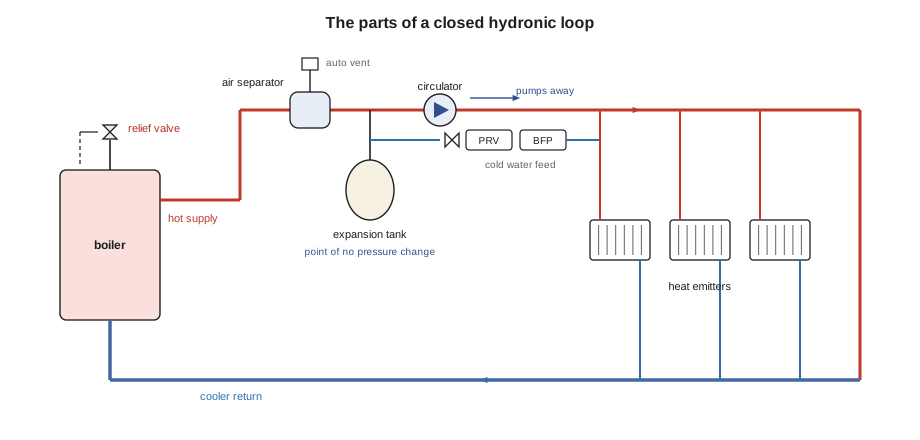
The figure shows the arrangement Luis wanted Maya to remember. The expansion tank, the fill connection and the air separator are all near the inlet of the circulator, and the circulator pumps away from them toward the emitters. Lesson 7 explains why that location matters: the place where the expansion tank connects is the one point in the loop whose pressure does not change when the circulator starts.
Water as a heat carrier
Water is an excellent heat carrier. Its specific heat, the energy needed to raise one kilogram by one degree Celsius, is about 4.19 kJ, higher than almost any other common liquid. A cubic metre of water carries over 3,000 times as much heat per degree as a cubic metre of air. That is why a 25 mm (1 in) pipe can deliver the same heat as a duct more than 300 mm (12 in) across, and why hydronic systems fit into tight spaces that ductwork never could.
The amount of heat a water stream delivers depends on how much water flows and how much it cools as it passes through the emitters. The temperature drop between supply and return is called the temperature difference, written ΔT and pronounced "delta T". The relationship is the most important equation in hydronics:
Here Q is the heat delivered, m-dot is the mass flow rate, c is the specific heat of the fluid and ΔT is the temperature drop. For water in SI units, the equation becomes a convenient working form: heat in kilowatts equals 4.19 times the flow in litres per second times the temperature drop in degrees Celsius. A flow of 0.24 L/s cooling by 11 °C delivers about 11 kW.
The equation can be turned around to find the flow needed for a given load. Most residential and light commercial systems are designed for a temperature drop of about 11 °C at the design condition, the coldest day the system is sized for. Radiant floors and heat pump systems often use smaller drops, around 6 to 8 °C, and some condensing boiler systems use larger ones, up to 20 °C or more, to keep the return water cool.
Worked problem
Flow for the bungalow
Grace's preliminary estimate for the bungalow's heating load is 14 kW at the design outdoor temperature. The existing cast iron radiators are to be kept, and the new system will be designed for an 11 °C drop. What flow is needed?
Show solution
- Start from Q = 4.19 × V × ΔT.
- Rearrange: V = Q ÷ (4.19 × ΔT) = 14 ÷ (4.19 × 11).
- V = 14 ÷ 46.1 = 0.30 L/s, about 18 litres per minute.
Answer: The system needs about 0.30 L/s. Halving the temperature drop would double the flow; doubling the drop would halve it.
# Flow needed for a heating load: Q = 4.19 x V x dT (kW, L/s, deg C)
def flow_lps(load_kw, dt_c):
    return load_kw / (4.19 * dt_c)

load = 14.0            # bungalow design load, kW
for dt in (6, 8, 11, 15, 20):
    v = flow_lps(load, dt)
print(f"dT {dt:2d} C -> {v:.2f} L/s ({v * 60:.1f} L/min)")dT 6 C -> 0.56 L/s (33.4 L/min) dT 8 C -> 0.42 L/s (25.1 L/min) dT 11 C -> 0.30 L/s (18.2 L/min) dT 15 C -> 0.22 L/s (13.4 L/min) dT 20 C -> 0.17 L/s (10.0 L/min)
The output shows the trade-off designers make every day. A small temperature drop needs a lot of flow, which means bigger pipes and more pumping energy but more even temperatures at the emitters. A large drop needs little flow and small pipes, but the emitters at the end of the loop see cooler water. The right drop depends on the heat source and emitters, and the rest of this course keeps returning to that choice.
How heat moves in a hydronic system
Heat moves in three ways, and a hydronic system uses all three. Conduction moves heat through solids, such as from hot water through a copper tube wall or from a buried tube up through a concrete slab. Convection moves heat by moving a fluid: the circulator moves water through the pipes, which is forced convection, and warm air rising from a baseboard element and drawing cooler air in at the floor is natural convection. Radiation moves heat directly from a warm surface to cooler surfaces it can see, without heating the air between them. A heated floor or a panel radiator delivers much of its heat by radiation, which is why people feel comfortable in a radiantly heated room at a lower air temperature.
Understanding which mode an emitter relies on explains its behaviour. A fin-tube baseboard is mostly convective, so it needs free air movement and its output falls quickly as the water cools. A heated slab is mostly radiant and has a large mass, so it responds slowly but evenly. A fan coil uses a fan to force convection, so it delivers a lot of heat from a small unit and works with cooler water than baseboard can.
Why hydronics, and where it is used
Hydronic systems are quiet, efficient and comfortable. Water carries heat so well that pipes are small and easily routed, and each room or zone can be controlled separately. Hydronic systems do not move dust around the house the way a forced-air system can. They also adapt to new heat sources: the same piping and emitters can be served by a gas boiler today and a heat pump in the future, if the emitters are sized for lower water temperatures.
Their limits are just as real. A hydronic system does not provide cooling or ventilation by itself, so a house with only radiators still needs separate equipment for those. The installed cost is often higher than forced air. Water in pipes can freeze in an unheated space if the system shuts down, which is why systems with piping in garages, ramps or exterior zones use antifreeze. Kingsway's parking ramp, for example, has a snow-melting slab filled with a propylene glycol mixture that will not freeze at the coldest temperatures Hamilton sees.
| System type | Typical heat source | Typical emitters | Where you will see it |
|---|---|---|---|
| Residential boiler system | Gas or oil boiler, combi boiler | Baseboard, radiators, radiant floor | Houses, older apartment buildings |
| Low-temperature system | Condensing boiler or air-to-water heat pump | Radiant floor, panel radiators, fan coils | New and retrofitted houses |
| Central plant | Multiple boilers, chillers in some buildings | Fan coils, air handler coils, radiant slabs | Apartment towers, schools, offices |
| Snow and ice melting | Boiler or heat pump through a heat exchanger | Tubing in pavement | Ramps, walkways, loading areas |
Codes and who does the work
In Ontario, hydronic heating systems are installed to CSA B214, the installation code for hydronic heating systems, now in its 2021 edition, together with the plumbing and building code requirements for any connection to the potable water system. Heat loss and equipment sizing for houses follow CSA F280, which the Ontario Building Code references. Gas-fired boilers are connected and started up under CSA B149.1 by a certified gas technician, and larger boilers and pressure vessels fall under the Technical Standards and Safety Authority's boilers and pressure vessels regulation. Maya's plumbing apprenticeship covers hydronic piping, but she does not do the gas work on the boilers without the right gas certificate.
Whatever the jurisdiction, the manufacturer's installation instructions are part of the requirements. A boiler or heat pump installed against its instructions can void its listing, its warranty and the approval that the inspector relies on.
Reading the plant schematic
Before Maya touched a valve, Luis gave her the mechanical drawings for the penthouse and asked her to trace the water. Hydronic schematics use a small set of symbols: a circle with a triangle for a circulator, two triangles point to point for a valve, a rectangle with a curved line for a heat exchanger or coil, and a vertical tank shape for the expansion tank. Supply piping is usually drawn as a solid line and return as a dashed line, and arrows show the direction of flow. Every circulator, valve and coil carries a tag, such as P-1 or HWC-3, that matches a schedule on the drawing listing its size, flow and head.
Maya traced the loop from the boilers through the primary circulators, across a pair of closely spaced tees, out through the secondary circulators to the risers that feed the suites, and back through the return header. She marked each place where the water changed direction, temperature or pressure, and wrote down the questions she could not answer: why the expansion tank was on the return header, why there were two circulators on each riser, and why the boilers had their own pumps. Luis smiled at the list. "Those are the right questions," he said. "By the end of this course you will answer every one of them."
Tracing the flow on paper first is a habit worth keeping. It shows where isolation valves, drains and air vents should be, which circulator serves which zone, and where a temperature or pressure reading would tell you the most when something goes wrong.
Common mistakes
MistakeThinking of a hydronic loop as an open water system.
InsteadTreat it as a sealed loop filled once; repeated fresh water brings oxygen and minerals that damage it.
MistakeChoosing a temperature drop without considering the emitters and heat source.
InsteadPick the drop to suit both: small for radiant and heat pumps, larger for condensing boilers with high-output emitters.
MistakeAssuming more flow always means more heat.
InsteadHeat depends on flow and temperature drop; past a point, more flow adds little output and more noise and pumping energy.
MistakePlacing the expansion tank anywhere convenient.
InsteadConnect it near the circulator inlet so the circulator pumps away from it.
MistakeForgetting freeze protection in unheated spaces.
InsteadUse antifreeze or keep the piping inside the heated envelope.
Summary and key terms
- A hydronic system is a closed loop that carries heat in water from a source to emitters.
- Its main parts are the heat source, circulator, piping, emitters, expansion tank, air removal, fill and relief valves, and controls.
- Heat delivered equals flow times specific heat times temperature drop: about 4.19 × L/s × °C for water in kilowatts.
- Small temperature drops need more flow; large drops need less flow but cooler water at the far emitters.
- Emitters deliver heat by conduction, convection and radiation in different proportions.
- CSA B214, CSA F280, CSA B149.1 and TSSA rules govern hydronic work in Ontario.
- Hydronic heating
- Heating that uses circulating water or a water and antifreeze mixture to carry heat.
- Closed loop
- A piping system that circulates the same fluid without opening to the atmosphere or to a drain.
- Temperature difference (ΔT)
- The drop in water temperature between the supply and the return.
- Specific heat
- The energy needed to raise a unit mass of a substance by one degree.
- Circulator
- A small pump that moves water around a hydronic loop.
- Heat emitter
- A device that gives up heat from the water to a room, such as baseboard, a radiator, a fan coil or a heated floor.
Practice problems
Work each problem on paper first, then reveal the answer to check.
Name four parts every closed hydronic system has.
Show answer
Any four of: heat source, circulator, supply and return piping, emitters, expansion tank, air removal, fill and relief valves, controls.
What flow carries 22 kW with an 11 °C drop?
Show answer
22 ÷ (4.19 × 11) = 0.48 L/s.
If the flow stays the same and the temperature drop doubles, what happens to the heat delivered?
Show answer
It doubles.
Which heat transfer mode does a heated floor rely on most?
Show answer
Radiation.
Why should a closed system not be topped up with fresh water often?
Show answer
Fresh water brings oxygen and minerals that cause corrosion and scale.
Which code governs hydronic installations in Ontario?
Show answer
CSA B214, the installation code for hydronic heating systems.
Lesson quiz · 5 questions
Score 60% or more to complete this lesson.
Create a free account to save your progress, take quizzes and earn a certificate.