
PLB-130 · Lesson 5 of 12 · 24 min
Water supply fixture units and peak demand
Maya added up the flow of every fixture on the riser diagram and got a number so large that the water service would have needed to be the size of a sewer. Luis laughed and told her that every apprentice does that once. Kingsway Tower has well over a hundred suites, each with a toilet, a lavatory, a tub or shower, a kitchen sink, a dishwasher and a washing machine. If every one of those fixtures opened at the same moment, the demand would be enormous. But they never do. At seven in the morning some people are showering, a few are filling kettles and the rest are still asleep or already gone. The art of sizing a water system is estimating how much water will really be used at the busiest moment.
This lesson explains water supply fixture units, the method plumbing codes use to turn a list of fixtures into a realistic peak demand, how the conversion from fixture units to flow works, and why newer methods are changing the numbers for modern buildings. Lesson 6 then uses that demand to size the pipes.
Why you cannot simply add the flows
Each fixture has a design flow rate: the flow it needs to work properly. A lavatory faucet might need a small flow, a shower somewhat more and a flush valve a great deal for a few seconds. The fixtures in one bathroom are used one or two at a time. Across a whole building, the chance that a large fraction of fixtures run at once is small, and it gets smaller as the number of fixtures grows. This idea is called diversity.
If pipes were sized for every fixture running at once, they would be several times too big. Oversized water pipes are not just expensive. Water moves slowly in them and sits longer between uses, which encourages stagnation and bacterial growth, and hot water takes longer to arrive. Undersized pipes are worse in a different way: pressure collapses at peak times. The goal is a realistic estimate of the peak.
The method used in North American plumbing codes for most of the last century was developed by Roy Hunter at the US National Bureau of Standards in the 1940s. Hunter used probability to estimate how many fixtures would be in use at once and expressed each fixture's load as a number of fixture units. The National Plumbing Code of Canada and the Ontario Building Code use fixture units based on this approach to size water piping.
What a fixture unit is
A water supply fixture unit, often written WSFU, is a number that represents a fixture's load on the water system. It combines how much water the fixture uses, how long it runs, and how often it is used. A fixture that uses a lot of water, runs for a long time or is used often gets more fixture units. A fixture unit is not a flow rate; it is a weighting. You add fixture units together, then convert the total to a flow using a curve or table.
Codes give separate values for private use, such as fixtures in a suite or a house, and public use, such as fixtures in an office, restaurant or school washroom. Public fixtures get more fixture units because they are used more often by more people. Codes also give separate values for cold and hot water, with a total for fixtures that use both. A shower, for example, has a cold value, a hot value and a total that is less than the sum of the two, because the shower never draws full cold and full hot flow at once.
Some codes also give a value for a bathroom group, a toilet, a lavatory and a tub or shower in one room. The bathroom group value is lower than the sum of the three fixtures, because one person rarely uses all three at the same moment.
| Fixture (private use) | Cold | Hot | Total |
|---|---|---|---|
| Lavatory | 0.5 | 0.5 | 0.7 |
| Water closet, flush tank | 2.2 | 0 | 2.2 |
| Bathtub or shower | 1.0 | 1.0 | 1.4 |
| Bathroom group | 2.7 | 1.5 | 3.6 |
| Kitchen sink | 1.0 | 1.0 | 1.4 |
| Dishwasher | 0 | 1.4 | 1.4 |
| Clothes washer | 1.0 | 1.0 | 1.4 |
| Hose bibb | 2.5 | 0 | 2.5 |
The values in the table are course practice values. The Ontario Building Code and the National Plumbing Code have their own fixture unit tables, with values that differ in places and with separate columns for private and public use. On real work, always take values from the adopted code.
Adding up a suite and a building
To find the load on any pipe, add up the fixture units of every fixture downstream of it, that is, every fixture the pipe feeds. A suite branch carries the suite's fixtures. A riser carries all the suites on it. The main in the parking ceiling carries all the risers. Because diversity increases with the number of fixtures, the flow per fixture unit falls as the total grows; that is built into the conversion curve.
Worked problem
Fixture units for a Kingsway suite and riser
A typical Kingsway two-bedroom suite has one bathroom group, a powder room with a toilet and a lavatory, a kitchen sink, a dishwasher and a clothes washer. Using the course practice values, find the total fixture units for the suite, and for a riser that serves the same suite on floors 6 to 12.
Show solution
- Bathroom group: 3.6.
- Powder room: water closet 2.2 plus lavatory 0.7 gives 2.9.
- Kitchen sink 1.4, dishwasher 1.4, clothes washer 1.4: 4.2.
- Suite total: \(3.6 + 2.9 + 4.2 = 10.7\) fixture units.
- Riser serving 7 floors: \(7 \times 10.7 = 74.9\), about 75 fixture units.
Answer: About 10.7 fixture units per suite and about 75 for the riser.
Separate totals are usually kept for cold and hot water, because the hot piping carries only the hot share and is sized separately. The cold riser in the example carries the cold values; the hot riser carries the hot values; the service and the main before the water heater carry the totals.
From fixture units to flow
The fixture unit total is converted to a peak flow, called the demand, using a curve or table in the code's sizing appendix. The curve rises quickly at first and then flattens, because each additional fixture adds less to the peak than the one before. Hunter's method has two curves: one for systems where most toilets have flush tanks, and one for systems dominated by flush valves. Flush valves draw a large flow for a few seconds, so at low fixture counts the flush valve curve gives a much higher demand.
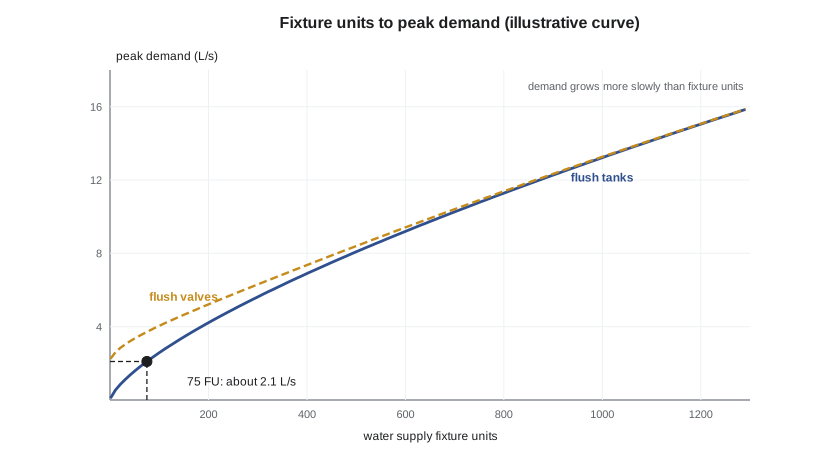
For this course, an illustrative curve close to the shape of the flush tank curve is used: demand in litres per second equals about 0.098 times the fixture units raised to the power 0.71. It is a teaching approximation, not a code curve, but it gives realistic numbers for practice. The program below uses it.
# Fixture units to peak demand with an illustrative curve (SI units)
UNITS = {"bathroom group": 3.6, "water closet": 2.2, "lavatory": 0.7,
         "kitchen sink": 1.4, "dishwasher": 1.4, "clothes washer": 1.4}

def demand_lps(fu):
    return 0.098 * fu ** 0.71          # illustrative curve, not a code table

suite = ["bathroom group", "water closet", "lavatory", "kitchen sink",
         "dishwasher", "clothes washer"]
fu_suite = sum(UNITS[f] for f in suite)
print(f"one suite: {fu_suite:.1f} fixture units -> {demand_lps(fu_suite):.2f} L/s")

for suites in (1, 7, 35, 110):
    fu = suites * fu_suite
    q = demand_lps(fu)
    print(f"{suites:3d} suites: {fu:6.1f} fixture units -> {q:5.2f} L/s"
f" ({q / suites:.3f} L/s per suite)")one suite: 10.7 fixture units -> 0.53 L/s 1 suites: 10.7 fixture units -> 0.53 L/s (0.527 L/s per suite) 7 suites: 74.9 fixture units -> 2.10 L/s (0.300 L/s per suite) 35 suites: 374.5 fixture units -> 6.58 L/s (0.188 L/s per suite) 110 suites: 1177.0 fixture units -> 14.84 L/s (0.135 L/s per suite)
The last column is the key result. One suite on its own needs a fair amount of flow for its size, because someone might run the shower and the washer at the same time. A hundred and ten suites together need only a small fraction of that per suite, because their peaks rarely line up. That is diversity at work, and it is why the building's water service is only a modest size.
Continuous flows
Fixture units handle fixtures that are used intermittently. Some loads run for long periods instead: irrigation systems, cooling tower make-up, process equipment, hose bibbs used for washing the parking garage, and some commercial dishwashers. For these, codes require the designer to add the flow directly in litres per second or gallons per minute to the demand from the fixture units, rather than converting it to fixture units. On Kingsway, the garage wash-down hose bibbs and the irrigation for the ground floor planters are added this way.
Why newer methods are changing the numbers
Hunter's curves were developed when toilets used far more water per flush, showers ran at much higher flows and households were larger. Modern fixtures use much less water. Studies over the last two decades found that Hunter's method often overestimates peak demand in modern homes and apartments, sometimes by a wide margin. The result is oversized pipes, slow-moving water, longer waits for hot water and more risk of stagnation.
In response, researchers developed newer probability methods based on measured water use in modern dwellings. One of these, sometimes called the water demand calculator, has been adopted as an alternative method in recent model plumbing codes in the United States. Canadian codes continue to use fixture units, and engineers may use newer methods where the authority having jurisdiction accepts them. On Kingsway, the engineer used the Ontario Building Code fixture unit method, as the code requires, and then checked the result against measured data from similar buildings.
For an apprentice, the practical lessons are the same either way: the drawings give pipe sizes based on the engineer's demand calculation, and changes on site, such as adding fixtures or moving them farther away, change the demand and the pressure loss. Any change should go back to the engineer.
Peak demand for the whole building
The building's total demand sizes the water service, the meter, the backflow preventer and the booster pumps. It is also the number the utility uses to decide what meter to supply and whether the street main can serve the building. The total fixture units for every fixture in the building, plus any continuous flows, give the peak domestic demand. Fire sprinkler demand is handled separately by the fire service.
Worked problem
Peak demand for Kingsway Tower
Kingsway has 110 suites at 10.7 fixture units each, plus 30 fixture units in the ground floor amenity rooms, plus continuous flows of 0.3 L/s for irrigation and garage hose bibbs. Using the illustrative curve, estimate the peak demand.
Show solution
- Fixture units: \(110 \times 10.7 + 30 = 1\,207\).
- Demand from fixture units: \(0.098 \times 1207^{0.71}\).
- \(1207^{0.71} = e^{0.71 \ln 1207} \approx e^{5.04} \approx 154\), so the demand is about \(0.098 \times 154 \approx 15.1\) L/s.
- Add continuous flows: \(15.1 + 0.3 = 15.4\) L/s.
Answer: About 15.4 L/s at peak, a small fraction of what the fixtures could draw if all opened at once.
Compare that with Maya's first attempt, which added the full flow of every fixture. The difference shows why fixture units exist, and why water services and mains for large buildings are much smaller than a simple sum would suggest.
Demand for hot water
Hot water piping is sized from the hot water fixture units in the same way. The water heaters themselves are sized differently, from the amount of hot water used over the peak hour or two, not the instantaneous flow. A building with large storage tanks can meet a short, sharp peak from storage and reheat between peaks; a building with instantaneous heaters must meet the peak flow directly. Lesson 7 covers hot water systems.
Common mistakes
MistakeAdding the full flow of every fixture to find the building's demand.
InsteadAdd fixture units and convert the total to demand with the code's curve or table.
MistakeAdding fixture units for continuous flows such as irrigation.
InsteadAdd continuous flows directly in flow units to the demand from fixture units.
MistakeUsing private fixture unit values for public washrooms.
InsteadUse the public values for fixtures in offices, schools, restaurants and other public spaces.
MistakeSizing hot and cold piping from the total fixture units.
InsteadUse the cold values for cold piping and the hot values for hot piping.
MistakeAdding fixtures on site without telling anyone.
InsteadReport changes to the engineer; added fixtures raise demand and pressure loss.
Summary and key terms
- Fixtures rarely all run at once, so peak demand is much less than the sum of fixture flows; this is diversity.
- A water supply fixture unit weights a fixture's load by its flow, duration and frequency of use.
- Codes give separate private and public values, and separate cold, hot and total values.
- Fixture units are added for every fixture downstream of a pipe and converted to demand with a curve or table.
- Continuous flows are added directly to the demand.
- Newer probability methods based on modern fixtures often predict lower demand than Hunter's curves and are accepted as alternatives in some codes.
- Water supply fixture unit
- A number representing a fixture's load on the water supply system, combining flow, duration and frequency of use.
- Diversity
- The fact that not all fixtures in a system are used at the same time.
- Demand
- The estimated peak flow that a pipe must carry.
- Bathroom group
- A water closet, lavatory and bathtub or shower in one room, given a combined fixture unit value.
- Continuous flow
- A load that runs for long periods and is added directly in flow units.
- Flush valve
- A valve that flushes a toilet or urinal directly from the supply pipe at a high flow for a few seconds.
Practice problems
Work each problem on paper first, then reveal the answer to check.
Why are water pipes not sized for every fixture running at once?
Show answer
Fixtures rarely run together, so the pipes would be oversized, costly and prone to stagnation.
What three things does a fixture unit combine?
Show answer
Flow, duration of use and frequency of use.
Why does a bathroom group have fewer fixture units than its three fixtures added together?
Show answer
One person rarely uses all three at once.
A riser serves 12 suites at 10.7 fixture units each. What is its load?
Show answer
128.4 fixture units.
Using the illustrative curve, about what is the demand for 100 fixture units?
Show answer
About 0.098 times 100 to the power 0.71, roughly 2.6 L/s.
How is irrigation added to the demand?
Show answer
As a continuous flow, directly in litres per second.
Lesson quiz · 5 questions
Score 60% or more to complete this lesson.
Create a free account to save your progress, take quizzes and earn a certificate.