
PLB-130 · Lesson 4 of 12 · 23 min
Flow, velocity and friction loss
Maya stood in the twelfth-floor model suite with a pressure gauge on the laundry tub faucet while Raj, the second-year apprentice, opened fixtures one by one. With everything closed the gauge read a healthy number. When Raj opened the shower, the needle dropped a little. When he opened the kitchen faucet and started the washing machine as well, it dropped further. Nothing was wrong with the system. The gauge was showing friction loss, the pressure that water gives up as it flows through pipe, fittings, valves and meters on its way to the fixtures.
Lesson 3 explained pressure with no flow and how pressure-reducing valves control it. This lesson is about what happens once water starts to move. Flow, velocity and friction are linked: the more water a pipe carries, the faster it moves and the more pressure it loses. Sizing a water system is mostly a matter of keeping that loss small enough that the farthest fixture still gets the pressure it needs, while keeping velocity low enough to avoid noise and erosion.
Flow rate and velocity
Flow rate is the volume of water passing a point in a given time. In Canada it is usually given in litres per second (L/s) or litres per minute (L/min). Velocity is how fast the water moves along the pipe, in metres per second (m/s). The two are linked by the area of the pipe's bore: flow equals area times velocity.
For a given flow, a smaller pipe has a smaller area, so the water must move faster. Doubling the diameter quadruples the area and cuts the velocity to a quarter. That is why velocity rises so quickly as pipes get smaller, and why undersized pipes are noisy.
Worked problem
Velocity in a suite branch
A 19 mm copper branch (inside diameter about 20 mm) carries 0.25 L/s to a shower and a lavatory running at once. What is the velocity?
Show solution
- Area: \(A = \pi (0.020)^2 / 4 \approx 0.000314\) m\(^2\).
- Flow in cubic metres per second: \(0.25\) L/s \(= 0.00025\) m\(^3\)/s.
- Velocity: \(v = Q / A = 0.00025 / 0.000314 \approx 0.80\) m/s.
Answer: About 0.8 m/s, comfortably below common velocity limits.
Why velocity is limited
High velocity causes three problems. It makes noise as water rushes through fittings and valves. It erodes the inside of copper pipe, especially just downstream of elbows and tees, until the wall wears through. And it makes water hammer worse, because the pressure surge when a valve closes is proportional to the velocity that is stopped. Common guidance, and many engineers' specifications, limit velocity in copper to about 2.4 m/s for cold water and about 1.5 m/s for hot water. Hot water is limited more strictly because erosion corrosion is faster at higher temperatures, and recirculating hot water flows all day.
Plastic pipe does not erode the same way, but noise and water hammer still limit velocity, and manufacturers publish their own limits. Where a velocity limit and a pressure limit both apply, the pipe must satisfy both: a pipe can have plenty of pressure to spare and still be too small because the water moves too fast.
Where friction comes from
Water flowing along a pipe rubs against the wall and against itself. That friction turns some of the water's pressure into a tiny amount of heat. The loss depends on four things:
- Flow rate. Friction loss rises roughly with the square of the flow, or a little less. Doubling the flow in the same pipe multiplies the loss by about 3.6.
- Diameter. Friction loss falls very steeply as the pipe gets bigger, roughly with the fifth power of the diameter. Going up one pipe size often cuts the loss by half or more.
- Length. Loss is proportional to length: twice as much pipe, twice as much loss.
- Roughness. Smooth pipe such as copper and plastic loses less than rough or old pipe. Scale and corrosion inside old galvanized steel pipe can multiply the loss many times.
Plumbers and engineers use friction loss charts or tables, published by pipe manufacturers and in engineering handbooks, that give the loss per unit length for each pipe size at each flow. Behind those charts is a formula. For water in building systems, the most common one is the Hazen-Williams formula.
The Hazen-Williams formula
The Hazen-Williams formula gives the head loss per metre of pipe from the flow, the inside diameter and a roughness coefficient called C. Higher C means smoother pipe. New copper and plastic are often given a C of about 140 to 150; designers commonly use 130 to 140 to allow for aging. In SI units, with Q in cubic metres per second and d in metres:
Multiply the head loss by 9.81 to get kilopascals per metre. The exponents tell the story: flow is raised to the power 1.852 and diameter to the power 4.87, which is why small changes in pipe size have such a large effect.
Nobody expects a plumber to work the formula on site; the charts do it for you. But understanding it explains the shape of every friction chart and lets you check a chart value quickly with a calculator or a short program like the one below.
# Friction loss and velocity in copper tube by Hazen-Williams (SI units)
import math

def loss_kpa_per_m(q_lps, d_mm, c=140):
    q = q_lps / 1000
    d = d_mm / 1000
    head = 10.67 * q ** 1.852 / (c ** 1.852 * d ** 4.87)   # m of water per m
    return head * 9.81

def velocity(q_lps, d_mm):
    return (q_lps / 1000) / (math.pi * (d_mm / 1000) ** 2 / 4)

# nominal size: approximate inside diameter of type L copper, mm
sizes = {"19 mm": 20.0, "25 mm": 26.0, "32 mm": 32.1, "38 mm": 38.2, "50 mm": 50.4}
for q in (0.3, 0.6, 1.2, 2.0):
    print(f"flow {q:3.1f} L/s")
    for name, d in sizes.items():
        v = velocity(q, d)
        if v > 3.5:
            continue
        mark = "" if v <= 2.4 else "  over 2.4 m/s"
print(f" {name:6s} {loss_kpa_per_m(q, d):6.2f} kPa/m {v:4.2f} m/s{mark}")flow 0.3 L/s 19 mm 0.62 kPa/m 0.95 m/s 25 mm 0.17 kPa/m 0.57 m/s 32 mm 0.06 kPa/m 0.37 m/s 38 mm 0.03 kPa/m 0.26 m/s 50 mm 0.01 kPa/m 0.15 m/s flow 0.6 L/s 19 mm 2.25 kPa/m 1.91 m/s 25 mm 0.63 kPa/m 1.13 m/s 32 mm 0.22 kPa/m 0.74 m/s 38 mm 0.10 kPa/m 0.52 m/s 50 mm 0.02 kPa/m 0.30 m/s flow 1.2 L/s 25 mm 2.26 kPa/m 2.26 m/s 32 mm 0.81 kPa/m 1.48 m/s 38 mm 0.35 kPa/m 1.05 m/s 50 mm 0.09 kPa/m 0.60 m/s flow 2.0 L/s 32 mm 2.09 kPa/m 2.47 m/s over 2.4 m/s 38 mm 0.90 kPa/m 1.75 m/s 50 mm 0.23 kPa/m 1.00 m/s
Look down each block of output. For every flow, the smallest pipe that can carry it has a high loss and a high velocity, and each step up in size cuts both sharply. Sizing is the art of choosing the smallest pipe that keeps both within limits.
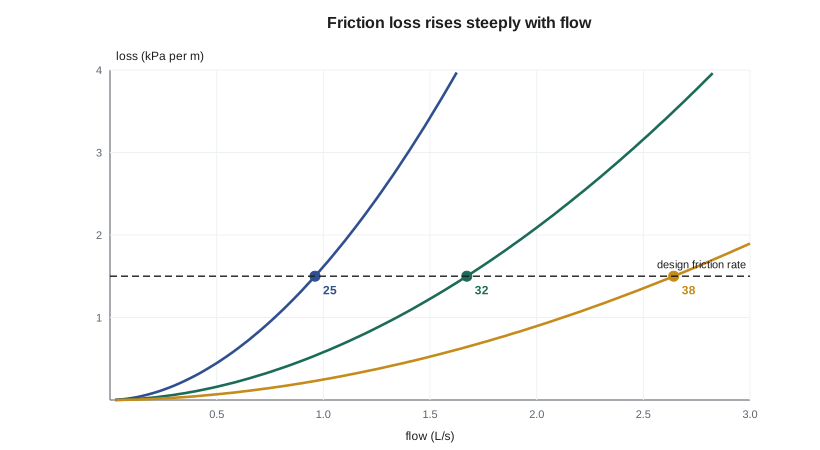
Fittings, valves and equivalent length
Straight pipe is only part of the story. Every elbow, tee, valve and reducer disturbs the flow and adds loss. There are two common ways to account for it.
- Equivalent length. Each fitting is given a length of straight pipe of the same size that would cause the same loss. A copper elbow might count as a short length of pipe, a tee taking the flow through its side branch as several times more, and a fully open ball valve as almost nothing. Add the equivalent lengths to the measured length and use the total in the friction calculation.
- A percentage allowance. For early sizing, many designers simply add a percentage, often around 50 percent, to the measured length of the longest run to cover fittings. They check the result in detail later if pressure is tight.
Equivalent lengths vary with size and fitting design, and manufacturers publish their own values. PLB-110 used approximate values to show the idea. The important habit is not the exact number but remembering that a run with many fittings loses much more than its measured length suggests. A branch through a manifold, ten elbows and a stop valve can easily have twice the loss of the straight pipe alone.
Devices cause larger, fixed losses that are read from the manufacturer's chart at the design flow, not estimated from length: meters, backflow preventers, strainers, pressure-reducing valves, water heaters and filters. These are often the biggest single losses in the system. A reduced pressure backflow assembly, for example, can take several times the loss of all the piping in a suite.
Pressure along a run
Put the pieces together and you can follow the pressure from the source to a fixture. Start with the static pressure at the source. Subtract the height the water must climb. Subtract the friction in each length of pipe, including the allowance for fittings. Subtract the loss through each device. What is left is the residual pressure at the fixture while water flows. If it is above the fixture's minimum, the run works; if not, something must change: a bigger pipe, a shorter route, a different device or more pressure at the source.
Worked problem
Residual pressure at a twelfth-floor shower
Kingsway's booster delivers 690 kPa. The shower is 37 m above the booster. At peak flow the friction in the mains and riser is 95 kPa, the suite submeter and manifold take 35 kPa, and the suite PEX branch to the shower takes 20 kPa. What residual pressure reaches the shower valve?
Show solution
- Height: \(37 \times 9.81 \approx 363\) kPa.
- Total losses: \(363 + 95 + 35 + 20 = 513\) kPa.
- Residual at the shower: \(690 - 513 = 177\) kPa.
- The pressure-balancing valve needs well under that, so the shower works at peak demand.
Answer: About 177 kPa flowing at the shower valve.
Pressure loss and pipe age
Friction charts assume clean pipe. Older systems tell a different story. Galvanized steel water pipe, common in buildings from the first half of the twentieth century, rusts and builds up scale on the inside until a pipe that started at 25 mm can have a bore the size of a pencil. Service calls for poor pressure in old houses often end with the plumber cutting out a piece of galvanized pipe and showing the owner the inside. Hard water deposits scale in hot water pipes and heaters, and fine sediment from the city mains settles in strainers and aerators.
Copper and plastic pipe stay much cleaner, which is one reason designers can use a higher C value for them. Even so, aerators and strainers need cleaning, and low pressure at a single fixture is far more often a clogged aerator, cartridge or supply stop than a problem with the piping. Grace's rule on service calls: check the end of the line first.
Measuring flow and pressure on site
Two simple tests tell a service plumber a lot. A static and flowing pressure reading, taken with a gauge on a hose bibb or laundry faucet, shows how much pressure the system has and how much it loses when water flows. A bucket test measures flow: time how long a fixture takes to fill a container of known volume and divide. If a shower fills a 10 litre bucket in 60 seconds, it delivers 10 L/min. In the United States, the same test is done with a gallon bucket.
Comparing the two tells you where to look. Good static pressure with a big drop when one fixture opens points to a restriction close to that fixture or an undersized line. Poor static pressure everywhere points back to the source: the utility, the PRV or the booster. Low flow from one fixture with good pressure nearby points to the fixture itself.
Common mistakes
MistakeSizing pipe for pressure only and ignoring velocity.
InsteadCheck velocity as well; a pipe can have pressure to spare and still be noisy or erode.
MistakeUsing measured length alone in friction calculations.
InsteadAdd equivalent lengths or a fittings allowance, and add the losses through meters, backflow preventers and other devices.
MistakeAssuming friction rises in proportion to flow.
InsteadFriction rises with roughly the square of the flow; doubling the flow multiplies the loss by about 3.6.
MistakeBlaming the piping for low flow at one fixture.
InsteadCheck the aerator, cartridge and stop valve first.
MistakeApplying friction charts for clean pipe to old galvanized systems.
InsteadExpect much higher losses in corroded pipe and test before relying on it.
Summary and key terms
- Flow equals area times velocity; a smaller pipe carrying the same flow moves water faster.
- Common guidance limits velocity in copper to about 2.4 m/s for cold water and 1.5 m/s for hot water.
- Friction loss rises with flow and length and falls very steeply as diameter increases.
- The Hazen-Williams formula and the friction charts built from it give loss per unit length from flow, diameter and roughness.
- Fittings add loss through equivalent length or a percentage allowance; devices add fixed losses from manufacturers' charts.
- Residual pressure at a fixture is source pressure minus height, friction and device losses.
- Flow rate
- The volume of water passing a point per unit time.
- Velocity
- The speed at which water moves along a pipe.
- Friction loss
- The pressure water loses as it flows through pipe, fittings and devices.
- Hazen-Williams formula
- An empirical formula that gives friction loss in water pipes from flow, diameter and a roughness coefficient C.
- Equivalent length
- The length of straight pipe that would cause the same loss as a fitting or valve.
- Erosion corrosion
- Wear of a pipe wall caused by high-velocity water, often just downstream of fittings.
Practice problems
Work each problem on paper first, then reveal the answer to check.
A pipe carries 0.5 L/s. If the diameter is doubled, what happens to the velocity?
Show answer
It falls to a quarter, because the area is four times as large.
Why is hot water velocity limited more strictly than cold?
Show answer
Erosion corrosion is faster at higher temperatures, and recirculated hot water flows all the time.
Roughly how does friction loss change if the flow doubles?
Show answer
It rises by about 3.6 times.
What two methods account for fitting losses?
Show answer
Equivalent lengths for each fitting, or a percentage allowance added to the measured length.
A shower fills a 10 L bucket in 50 seconds. What is its flow?
Show answer
12 L/min, or 0.2 L/s.
Name three devices whose losses are read from manufacturers' charts.
Show answer
Meters, backflow preventers and pressure-reducing valves; also strainers, filters and water heaters.
Lesson quiz · 5 questions
Score 60% or more to complete this lesson.
Create a free account to save your progress, take quizzes and earn a certificate.