
PLB-130 · Lesson 3 of 12 · 23 min
Pressure: static, residual and pressure-reducing valves
On a Tuesday morning, Grace Lin took a service call in an older six-storey building across town. A tenant on the ground floor complained that her new dishwasher's inlet hose had burst and that the faucets screamed when she opened them. Grace screwed a gauge onto the laundry tub faucet and read the pressure aloud. It was far above what the fixtures were built for. The building's pressure-reducing valve had failed, and every fixture on the lower floors was getting the full pressure from the street.
Pressure is the single most important number in a water supply system. Too little and fixtures starve; too much and they wear, leak, bang and burst. This lesson explains the difference between static and residual pressure, how utilities report pressure, the upper and lower limits the code sets, and how pressure-reducing valves keep a building inside those limits. Lesson 4 then looks at what happens to pressure as water flows through the pipes.
Pressure, head and the units plumbers use
Pressure is force per unit area. In Canada, plumbing pressure is measured in kilopascals (kPa); in older documents and on many gauges you will still see pounds per square inch (psi). One psi is about 6.9 kPa. Pressure can also be expressed as head, the height of a column of water that would produce that pressure. Each metre of water column produces about 9.81 kPa, so 100 kPa is a little more than 10 m of head.
Gauges normally read gauge pressure, which is the pressure above atmospheric. Absolute pressure is gauge pressure plus the pressure of the atmosphere. Plumbers almost always work in gauge pressure. The one place absolute pressure matters in this course is the sizing of expansion tanks in Lesson 9, where the gas in the tank behaves according to absolute pressure.
Static and residual pressure
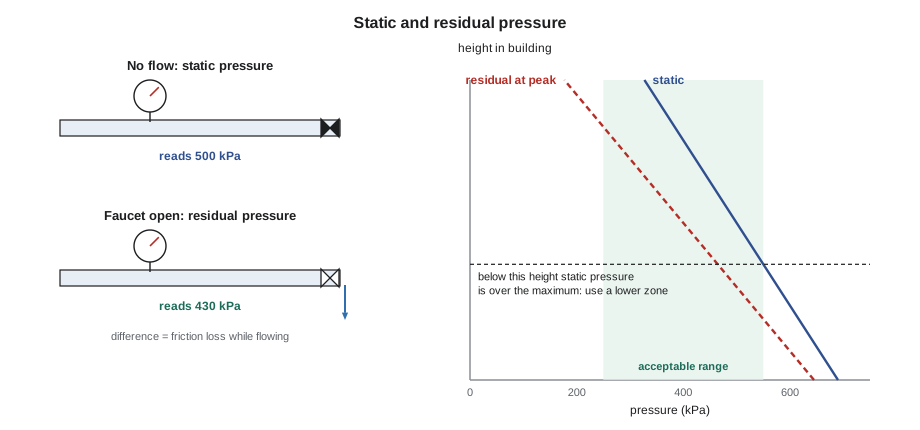
Static pressure is the pressure in the system when no water is flowing. It depends only on the pressure the utility supplies and the height of the point being measured. Residual pressure is the pressure that remains at a point while water is flowing. It is always lower than static pressure, because flowing water loses pressure to friction in the pipes, meter, valves and fittings on the way.
The difference matters because fixtures work while water flows. A shower valve does not care what the pressure is at three in the morning when nothing is running; it cares what the pressure is at seven in the morning when half the building is showering. Designers size systems so that the residual pressure at the farthest, highest fixture stays above that fixture's minimum while the building is at peak demand.
Utilities report pressure from hydrant flow tests. A crew opens one hydrant and measures the flow, while a gauge on a nearby hydrant records the static pressure before the test and the residual pressure during it. For Kingsway, the city's test on the street main reported a static pressure of about 500 kPa and a residual of about 430 kPa at a flow much larger than the building's domestic demand. The engineer uses those numbers, adjusted for the height difference to the meter room, as the starting point for the design.
Utility pressure also changes over the day and the seasons. It is often highest at night, when demand on the city system is low, and lowest on hot summer evenings when lawns are being watered. A good design uses the lowest expected pressure to check that fixtures get enough, and the highest expected pressure to check that nothing gets too much.
The upper limit
The National Plumbing Code and the Ontario Building Code limit the static pressure at fixtures to 550 kPa. Where the supply pressure could exceed that, a pressure-reducing valve must be installed to bring it down. Most designers aim much lower, typically between about 300 and 450 kPa at fixtures, because lower pressure reduces wear, noise, splashing and wasted water.
High pressure causes real damage. Faucet washers and cartridges wear out quickly, toilet fill valves hiss and fail, dishwasher and washing machine hoses burst, water heaters' relief valves drip, and pipes bang when valves close. High pressure also wastes water, because every open faucet delivers more flow than the user needs. In a tall building, the lower floors are the ones at risk, because they carry the weight of the water column above them as well as the pump or street pressure.
The lower limit
Each fixture needs a minimum pressure while water is flowing to work properly. A lavatory faucet works at a modest pressure, while flush valves, some thermostatic shower valves and certain appliances need considerably more. The fixture or valve manufacturer publishes the minimum, and the code sets a floor for common fixtures.
The Ontario Building Code and the National Plumbing Code require the system to be designed so that each fixture receives enough flow at an adequate pressure, and they rely on the manufacturer's data for fixtures with special needs. For Kingsway's suites, the engineer set a design minimum of 100 kPa flowing at the suite manifold, enough for the pressure-balancing shower valves, dishwashers and washers after the losses in the suite piping.
Low pressure has its own problems. Showers become weak and may switch temperature suddenly when someone else opens a tap, thermostatic valves may not operate, flush valves fail to clear the bowl, and appliances report errors. Very low pressure, or negative pressure caused by a main break, can also let contamination into the system through cross-connections. That is one reason backflow protection matters even in buildings that seem low risk.
How a pressure-reducing valve works
A pressure-reducing valve, or PRV, lowers a higher inlet pressure to a steady, lower outlet pressure no matter how the inlet pressure or the flow changes. The most common type for plumbing is direct-acting. Inside the valve, a spring pushes down on a diaphragm connected to the valve disc, holding the valve open. Outlet pressure pushes up on the underside of the diaphragm. When outlet pressure rises above the spring setting, it pushes the diaphragm up and closes the valve partly; when outlet pressure falls, the spring opens it again. Turning an adjusting screw changes the spring force and therefore the set pressure.
Large buildings often use pilot-operated PRVs, in which a small pilot valve senses outlet pressure and controls a larger main valve. Pilot-operated valves hold pressure more precisely over a wide range of flows, which is useful where demand swings from a trickle at night to a heavy morning peak.
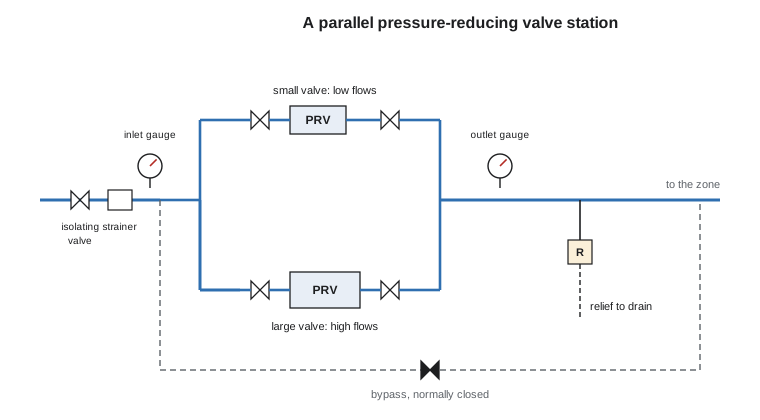
Every PRV has a little falloff: as flow increases, the outlet pressure drops slightly below the set point. Manufacturers publish the falloff at different flows, and the designer allows for it. A PRV that is too big for its flow may also chatter or hunt at low flows, because a small opening makes the disc unstable. That is why large buildings often install two PRVs in parallel, a small one for low flows and a large one for high flows, with the large one set slightly lower so it opens only when the small one cannot keep up.
Installing a pressure-reducing valve station
A PRV station is more than the valve. Whether it serves one house or half a building, it needs the parts that let it be serviced, checked and protected.
- Isolation valves on each side, so the PRV can be repaired or replaced without draining the system.
- A strainer ahead of the PRV. Debris on the seat stops the valve closing tightly, which lets outlet pressure creep up to inlet pressure when there is no flow. Many residential PRVs have a built-in strainer.
- Gauges on the inlet and outlet, so anyone can see at a glance whether the valve is doing its job.
- A union or flanges for removal, and enough space to reach the adjusting screw and pull the cartridge.
- Protection against PRV failure where the downstream system could be damaged. Large stations often include a relief valve on the outlet, set above the normal outlet pressure and piped to a drain, so a failed PRV does not expose the downstream system to full inlet pressure.
- Parallel valves on large stations, so one valve can be serviced while the other keeps the zone in water.
A PRV also creates a closed system. Once water passes through it, thermal expansion from a water heater cannot push back into the street, because the PRV acts much like a check valve. Lesson 9 explains how expansion tanks deal with that.
At Kingsway, the low-zone PRV station is in the lower parking level mechanical room, on the branch that leaves the booster discharge header. It has a 50 mm low-flow PRV and an 80 mm high-flow PRV in parallel, each with isolation valves, a common strainer, inlet and outlet gauges and an outlet relief valve piped to a floor drain. The small valve is set to 450 kPa and the large valve to 420 kPa.
Setting and checking a PRV
To set a PRV, open a fixture or a test valve downstream to create a small flow, which lets the valve settle, then close it and read the static outlet pressure. Loosen the lock nut on the adjusting screw and turn it, usually clockwise to raise pressure and counterclockwise to lower it, a little at a time. Open and close the fixture again after each adjustment and read the gauge with no flow. When the pressure is right, tighten the lock nut and record the setting on a tag on the valve.
Grace's service call shows how a failed PRV usually looks: the outlet gauge reads the same as the inlet gauge, or the outlet pressure creeps up overnight when nothing is flowing. The cause is often debris on the seat, a worn seat or disc, or a ruptured diaphragm. A gauge with a maximum-reading pointer, left on a hose bibb overnight, is a simple way to catch pressure creep. Repair kits are available for most valves, but many service plumbers replace residential PRVs outright because labour costs more than the valve.
Worked problem
Pressure on each floor of the low zone
Kingsway's low-zone PRV is set to 450 kPa static at the lower parking level. The highest fixture in the low zone is on floor 5, 16 m above the PRV, and the lowest is a hose bibb in the lower parking level, 2 m below it. What static pressures do these fixtures see?
Show solution
- Floor 5: \(450 - 16 \times 9.81 = 450 - 157 = 293\) kPa.
- Lower parking hose bibb: \(450 + 2 \times 9.81 = 450 + 20 = 470\) kPa.
- Both are below the 550 kPa limit, and the floor 5 pressure leaves room for friction while flowing.
Answer: About 293 kPa on floor 5 and 470 kPa at the lowest hose bibb, both within limits.
The program below checks every floor in both of Kingsway's zones. It flags any floor where the static pressure is above the code maximum or below a practical minimum. Try changing the booster setting or the PRV setting to see how the zones respond.
# Static pressure on every floor of a two-zone building (SI units)
G = 9.81                 # kPa per metre of water
BOOST = 690              # booster discharge at the lower parking level, kPa
PRV = 450                # low-zone PRV setting, kPa
EQUIP_ELEV = -3.0        # booster and PRV elevation, m (relative to grade)
MAX_STATIC, MIN_STATIC = 550, 250

LEVELS = [(f"floor {n}", (n - 1) * 3.0 + 1.0) for n in range(12, 0, -1)] + [("P1", -2.0), ("P2", -5.0)]

for name, elev in LEVELS:           # elev = fixture height relative to grade, m
    zone = "high" if name.startswith("floor") and int(name.split()[1]) >= 6 else "low"
    source = BOOST if zone == "high" else PRV
    p = source - G * (elev - EQUIP_ELEV)
    flag = "too high" if p > MAX_STATIC else ("too low" if p < MIN_STATIC else "ok")
print(f"{name:9s} {zone:4s} zone {p:5.0f} kPa {flag}")floor 12 high zone 327 kPa ok floor 11 high zone 356 kPa ok floor 10 high zone 386 kPa ok floor 9 high zone 415 kPa ok floor 8 high zone 445 kPa ok floor 7 high zone 474 kPa ok floor 6 high zone 504 kPa ok floor 5 low zone 293 kPa ok floor 4 low zone 322 kPa ok floor 3 low zone 352 kPa ok floor 2 low zone 381 kPa ok floor 1 low zone 411 kPa ok P1 low zone 440 kPa ok P2 low zone 470 kPa ok
Every floor comes out inside the limits. Now try setting the PRV much higher: the parking levels go over the maximum first, which is exactly what happened in Grace's building when its PRV failed.
Individual PRVs in suites and houses
Not every building has a central PRV station. In houses and small buildings on high-pressure streets, a single PRV is installed right after the meter. Some tall buildings, instead of a zone PRV station, put a small PRV at each suite on the lower floors. Each approach has trade-offs. A central station is easier to maintain and check, while suite PRVs fine-tune each suite but multiply the number of valves that can fail. Whatever the arrangement, every PRV needs access for service, and building operators need a record of where they all are.
Common mistakes
MistakeChecking only static pressure when sizing a system.
InsteadCheck residual pressure at the critical fixture during peak demand; fixtures work while water flows.
MistakeLeaving a PRV without gauges or isolation valves.
InsteadInstall gauges on both sides and isolation valves so the valve can be checked and serviced.
MistakeSetting a PRV with water flowing and reading the flowing pressure as the setting.
InsteadSet it with a brief flow to settle the valve, then read the static outlet pressure with nothing flowing.
MistakeAssuming a PRV that worked last year still works.
InsteadCheck outlet pressure regularly; debris and wear let outlet pressure creep up.
MistakeForgetting that a PRV creates a closed system.
InsteadProvide thermal expansion control downstream when there is a water heater.
Summary and key terms
- Static pressure is measured with no flow; residual pressure is what remains while water flows.
- Pressure changes by about 9.81 kPa for each metre of height.
- The National Plumbing Code and the Ontario Building Code limit static pressure at fixtures to 550 kPa; a PRV is required where supply pressure could exceed it.
- Each fixture needs a minimum flowing pressure, set by the code and the manufacturer.
- A PRV uses a spring and diaphragm or a pilot to hold a steady outlet pressure; large stations use parallel valves.
- PRV stations need isolation valves, a strainer, gauges, access and often a downstream relief valve.
- Static pressure
- The pressure in a water system when no water is flowing.
- Residual pressure
- The pressure remaining at a point while water is flowing.
- Head
- Pressure expressed as the height of a column of water that would produce it.
- Pressure-reducing valve
- A valve that lowers a higher inlet pressure to a steady, lower outlet pressure.
- Falloff
- The small drop in a pressure-reducing valve's outlet pressure as flow increases.
- Hydrant flow test
- A test that measures a water main's static pressure and its residual pressure at a known flow.
Practice problems
Work each problem on paper first, then reveal the answer to check.
What is the difference between static and residual pressure?
Show answer
Static is with no flow; residual is what remains while water flows.
How many kPa is 25 m of head?
Show answer
About 25 times 9.81, or 245 kPa.
What is the maximum static pressure at fixtures under the Ontario Building Code?
Show answer
550 kPa.
Why does a strainer go ahead of a PRV?
Show answer
Debris on the seat stops it closing tightly and lets outlet pressure creep up.
A PRV is set to 400 kPa. A fixture is 12 m above it. What static pressure does it see?
Show answer
About 400 minus 118, or 282 kPa.
Why do large PRV stations use two valves in parallel?
Show answer
A small valve controls low flows smoothly and a large one handles peak flows; one can be serviced while the other runs.
Lesson quiz · 5 questions
Score 60% or more to complete this lesson.
Create a free account to save your progress, take quizzes and earn a certificate.