
PLB-130 · Lesson 12 of 12 · 22 min
Flushing, disinfection and pressure testing
By late spring, Kingsway's water system was complete from the meter room to the twelfth floor. Every riser was in, every suite manifold connected, the booster and hot water plant started up. But nobody could drink from it yet. Before the city would let residents move in, Northbridge had to prove the system was tight, clean it out, disinfect it, show by laboratory test that the water was safe, and hand over records of all of it. Luis put Maya on the testing crew, and told her that this is the stage where a careless plumber can undo a year of good work in an afternoon.
This lesson covers the last steps before a water system goes into service: pressure testing the piping, flushing out debris, disinfecting the system, sampling the water, and the records and commissioning that complete the job. It ends with a review of the whole Kingsway water system, tying together everything in the course.
Why and when systems are tested
A pressure test proves that every joint holds. It is done before the piping is hidden, because a leak found after drywall and ceilings go up costs many times more to fix. On a building like Kingsway, testing happens in stages: the water service before backfilling, each riser and each floor's mains as they are completed, and each suite's piping before the walls are closed. The inspector usually witnesses the test or checks the test record before allowing the work to be covered.
Testing in sections also limits how much of the system is affected if something fails, and lets the crew find leaks while the piping is still open. Each section is isolated with valves, caps or test plugs rated for the test pressure, and anything that cannot take the test pressure is isolated or removed: water heaters, pressure-reducing valves, some appliance valves, mixing valves, pressure gauges with a low range and backflow preventers whose manufacturers limit test pressures.
Test pressures and media
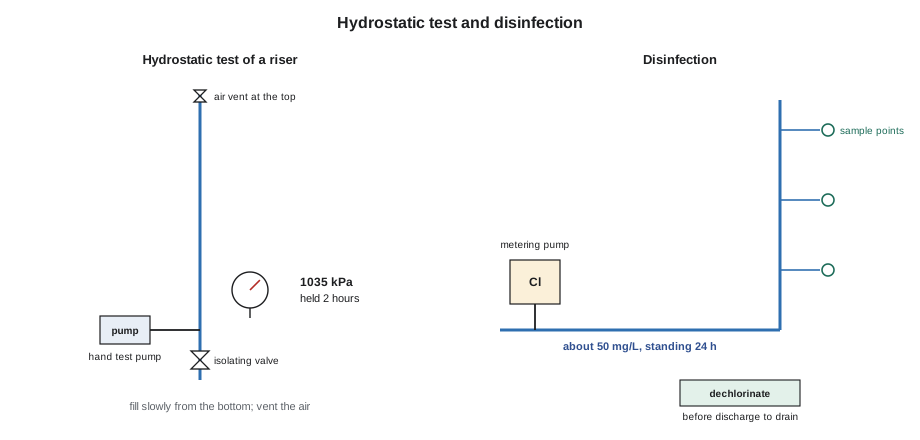
The Ontario Building Code requires the potable water system to pass either a water test, holding at least 1000 kPa for at least 1 hour without leakage, or an air test, holding at least 700 kPa for at least 2 hours without a drop in pressure. Project specifications often ask for more; Kingsway's specification calls for a hydrostatic test at 1035 kPa held for 2 hours, which meets the code and matches the engineer's practice. Always check the adopted edition of the code and the specification, and use whichever is stricter.
Water is the preferred test medium. Water is nearly incompressible, so a pressurized water system stores very little energy; if a joint fails, it leaks or sprays but does not explode. Compressed air stores a great deal of energy, and a failure under air test can turn a fitting or cap into a projectile. Many plastic pipe manufacturers prohibit air testing of their pipe altogether, because plastic can shatter under stored air pressure. Where air testing is allowed, follow the manufacturer's limits, keep people clear and release pressure slowly.
Water for testing must come from a potable source, because it stays in the pipes. In freezing weather, a water-filled system in an unheated building can freeze and split, which is one reason testing schedules depend on when the building is enclosed and heated.
Running a hydrostatic test
- Isolate the section and remove or isolate anything not rated for the test pressure.
- Fill slowly from the lowest point, with high points open to let air out. Trapped air makes the gauge drift and hides leaks, and it stores energy.
- Close the vents once water runs steadily from them, then raise the pressure with a test pump.
- Use a test gauge with a range of roughly one and a half to two times the test pressure, so the reading falls in the middle of the scale where it is most accurate. A gauge that reads near its limit is hard to read and easy to damage.
- Hold the pressure for the required time, then walk every joint looking and feeling for leaks. Watch the gauge.
- Record the test: date, section, pressure, start and end readings, duration, who performed it and who witnessed it.
Temperature affects the reading. A water-filled pipe that warms in the sun or in a heated building will show the pressure rising; one that cools overnight will show it falling, without any leak. That is why tests are run with the water at a steady temperature, and why a small drop on a cold morning should be investigated before it is blamed on a leak. A real leak shows a steady fall that continues, and usually a wet joint somewhere.
Flushing
Every new water system contains debris: sand and grit from the service trench, metal shavings and burrs, flux, thread sealant, bits of plastic, insects and dust. Flushing clears it out before the system is disinfected and put into use. The goal is to move water fast enough to carry debris out, so flushing works from the largest pipes near the source outward to the smallest, and from the bottom of the building up, opening outlets in sequence.
For mains and risers, a brisk velocity, commonly about 0.9 m/s or more, is the target. That means opening enough outlets at once to create the flow; one small faucet will not move debris out of a 75 mm main. Fixture aerators, cartridges and appliance screens should be removed or bypassed during flushing, then cleaned and replaced. Flushing continues until the water runs clear.
Disinfection
Flushing removes debris, but it does not kill bacteria that entered during construction. Disinfection does. The system is filled with water containing a high concentration of chlorine, which stands in the pipes long enough to kill bacteria, then is flushed out and replaced with normal drinking water. Samples are then tested in a laboratory to confirm the water is safe.
In Ontario, the procedure is set by the authority having jurisdiction and the project specification, and the city sets its own requirements for its mains, typically following AWWA C651 for mains and AWWA C652 for storage facilities. Building specifications commonly follow a similar pattern: fill the system with water at a chlorine concentration of about 50 mg/L, let it stand for 24 hours, check that a meaningful residual remains at the far outlets at the end of the contact time, flush until the chlorine is back to normal levels, then collect samples for bacteriological testing by an accredited laboratory. Kingsway's specification follows that pattern.
To disinfect a large system, the chlorine solution is injected at the start of the system with a metering pump while water flows out of the farthest outlets, until the chlorine at each outlet reaches the target concentration, measured with a test kit. Then every outlet is closed and the system stands. Smaller systems may be dosed by adding a measured amount of chlorine solution and filling. The dose is calculated from the volume of water in the piping and the strength of the chlorine solution.
Worked problem
Chlorine dose for a riser
A section of Kingsway's piping holds 1200 L. The target is 50 mg/L of chlorine, using sodium hypochlorite solution at 12 percent available chlorine (about 120 g per litre of solution). How much solution is needed?
Show solution
- Chlorine needed: \(1200 \text{ L} \times 50 \text{ mg/L} = 60\,000\) mg, or 60 g.
- Solution needed: \(60 / 120 = 0.5\) L.
- Add a margin, because some chlorine is used up reacting with residues in the pipe; then confirm the concentration at the outlets with a test kit.
Answer: About 0.5 L of 12 percent solution, plus a margin, confirmed by testing at the outlets.
# Chlorine solution needed to disinfect pipe sections (SI units)
import math

def pipe_litres(id_mm, length_m):
    return math.pi * (id_mm / 1000) ** 2 / 4 * length_m * 1000

TARGET = 50          # mg/L chlorine
STRENGTH = 120       # g of available chlorine per litre of solution (12 %)
MARGIN = 1.5         # extra for chlorine demand in new pipe

sections = [("high zone cold main, 75 mm", 74.8, 45),
            ("riser E, 32 mm", 32.1, 40),
            ("seven suites of PEX, 12 mm", 12.1, 7 * 60)]
total = 0
for name, d, length in sections:
    v = pipe_litres(d, length)
    total += v
    sol = v * TARGET / 1000 / STRENGTH * MARGIN
    print(f"{name:28s} {v:6.0f} L water  {sol * 1000:5.0f} mL solution")
print(f"total {total:.0f} L; solution about {total * TARGET / 1000 / STRENGTH * MARGIN:.2f} L")high zone cold main, 75 mm 198 L water 124 mL solution riser E, 32 mm 32 L water 20 mL solution seven suites of PEX, 12 mm 48 L water 30 mL solution total 278 L; solution about 0.17 L
Handling chlorine safely
Disinfection chemicals are hazardous. Concentrated sodium hypochlorite burns skin and eyes and gives off chlorine gas if it is mixed with acids, and toxic gases if mixed with ammonia-based cleaners. Follow the safety data sheet: wear chemical goggles and gloves, work with ventilation, keep it in labelled containers, and never mix it with other chemicals. Have an eyewash available where the solution is handled.
Highly chlorinated water must not be discharged carelessly. Many cities prohibit discharging it to storm sewers or the ground, because chlorine kills fish and other aquatic life, and some limit what can go to sanitary sewers. Water flushed out after disinfection is often dechlorinated first with a neutralizing chemical such as sodium thiosulfate or ascorbic acid. Check the local rules before you open a hose.
Sampling and the laboratory
After the chlorinated water has been flushed out and the chlorine has returned to normal drinking water levels, samples are taken from representative outlets, including the farthest and highest in each zone, and sent to an accredited laboratory. The lab tests for indicator bacteria, usually total coliforms and E. coli. Samples are collected in sterile bottles provided by the lab, from outlets with aerators removed, after a short run, without touching the inside of the bottle or cap, and delivered to the lab within the time it specifies, kept cool.
If any sample fails, the affected section is flushed and disinfected again and resampled. Only when every sample passes, and the inspector and the water utility are satisfied, can the system be put into service. On Kingsway, two samples from the high zone failed the first round, traced to a section that had been flushed before its aerators were removed. The section was redone, and the second round passed.
Commissioning and turnover
A tested, clean system still has to be set up to work properly. Commissioning is the process of adjusting, checking and documenting every part of the system so it performs as designed. For a water system, that includes:
- Setting the booster discharge pressure, testing each pump, the alternation, the low suction cutout and the bypass.
- Setting the pressure-reducing valves and confirming static pressures at the top and bottom of each zone.
- Setting the master mixing valve, checking delivered temperatures, and setting and checking shower valve limit stops.
- Balancing the recirculation system so every riser's return is hot.
- Checking expansion tank precharges, water hammer arresters, relief valve discharges and backflow preventer test results.
- Labelling valves and pipes, completing the valve chart, and handing over manuals, as-built drawings, test records and laboratory reports to the owner.
Commissioning records are not paperwork for its own sake. When something goes wrong years later, the operator and the next service plumber start from those records: what the PRVs were set to, what return temperatures were measured, where every valve is. Good records make the next repair faster and safer.
Kingsway's water system, start to finish
Maya finished the course where she began, with the riser diagram, but now every symbol meant something. Water enters from the city main through a tapped connection and a property line valve, runs below frost to the meter room, and passes the meter and the double check valve assembly. The booster pumps raise its pressure for the whole building, while the low zone steps down through its PRV station. Copper mains and risers, sized from fixture units and a pressure budget, carry it to suite manifolds, and PEX lines carry it to each fixture. The hot water plant stores water hot, a master mixing valve sends it out, a balanced recirculation loop keeps it hot, and limit stops keep showers safe. Arresters tame water hammer, expansion tanks absorb thermal expansion, valves in layers keep repairs small, and backflow protection, careful materials and flushing keep the water safe. Every part was tested, flushed, disinfected and recorded before the first resident turned on a tap.
Common mistakes
MistakeAir testing plastic pipe because it is quicker.
InsteadTest with water unless the code and the pipe manufacturer allow air, and then follow their limits.
MistakeLeaving water heaters, PRVs and low-range gauges in the section under test.
InsteadIsolate or remove anything not rated for the test pressure.
MistakeBlaming every small pressure drop on a leak.
InsteadAllow for temperature changes; look for a steady continuing fall and a wet joint.
MistakeFlushing with aerators and appliance screens in place.
InsteadRemove or bypass them during flushing, then clean and reinstall them.
MistakeDischarging chlorinated water to a storm drain.
InsteadFollow local rules and dechlorinate before discharge.
Summary and key terms
- Water systems are pressure tested in sections before the piping is concealed, with the inspector witnessing or reviewing the test.
- The Ontario Building Code calls for at least 1000 kPa of water for 1 hour or 700 kPa of air for 2 hours; specifications may ask for more.
- Water is the preferred test medium because it stores little energy; air tests are restricted and plastic pipe often may not be air tested.
- Flushing from the source outward at a brisk velocity clears debris before disinfection.
- Disinfection fills the system with strong chlorine solution for a set contact time, then flushes it out; laboratory samples confirm the water is safe.
- Commissioning sets pressures, temperatures and balance and produces the records the owner and future plumbers rely on.
- Hydrostatic test
- A pressure test using water to prove that piping is tight.
- Test gauge
- An accurate pressure gauge sized so the test pressure falls near the middle of its scale.
- Flushing
- Running water through a system at a brisk velocity to remove debris.
- Disinfection
- Killing bacteria in a water system, usually with a strong chlorine solution held for a set time.
- Bacteriological sample
- A water sample tested by a laboratory for indicator bacteria such as total coliforms and E. coli.
- Commissioning
- Adjusting, checking and documenting a system so it performs as designed.
Practice problems
Work each problem on paper first, then reveal the answer to check.
Why is a water system tested before it is concealed?
Show answer
Leaks are far cheaper to find and fix while the piping is open.
What water test does the Ontario Building Code require?
Show answer
At least 1000 kPa for at least 1 hour without leakage.
Why is water safer than air as a test medium?
Show answer
Water is nearly incompressible and stores little energy, so a failure does not explode.
A section holds 800 L. How much 12 percent sodium hypochlorite gives 50 mg/L, before any margin?
Show answer
40 g of chlorine, or about 0.33 L of solution.
What do laboratories usually test disinfection samples for?
Show answer
Total coliforms and E. coli.
Name three things checked during commissioning of a water system.
Show answer
Booster and PRV settings, mixing valve and limit stop temperatures, recirculation balance; also expansion tanks and backflow test results.
Lesson quiz · 5 questions
Score 60% or more to complete this lesson.
Create a free account to save your progress, take quizzes and earn a certificate.