
PLB-130 · Lesson 10 of 12 · 22 min
Valves, isolation and access
Six months after Kingsway opened, a resident on the ninth floor overfilled a bathtub, and a fitting under the tub spout started leaking into the suite below. The building operator needed to stop the water. If the only valve had been the one in the meter room, the whole building would have gone dry for the repair. Instead, the operator opened the suite's laundry closet door, closed the two quarter-turn valves on the manifold, and the leak stopped. The rest of the building never knew it happened. Grace Lin, who came to make the repair, pointed out to Maya afterwards that this is what good valve layout buys: small problems stay small.
This lesson covers the valves in a water distribution system: the types used on potable water, where codes require shutoff valves, how isolation is planned so repairs affect as few people as possible, and how valves are made accessible, labelled and kept working. Backflow preventers, PRVs and balancing valves were introduced in earlier lessons; this lesson concentrates on shutoff and control valves.
Valve types for potable water
PLB-110 introduced the main valve types. Here is how each is used in a building's water system.
- Ball valves are quarter-turn valves with a drilled ball that lines up with the pipe when open. Full-port ball valves have almost no pressure loss when open. They are the most common shutoff valve in modern buildings because they are compact, quick to operate and seal well. Their one drawback is that they can be closed quickly enough to cause water hammer.
- Gate valves raise and lower a wedge across the flow. They have low pressure loss when fully open but are slow to operate and are not meant for throttling. Older gate valves often seize or fail to seal after years without use. They are still common on large services and in utility work.
- Globe valves force the water through a seat and are good for throttling flow, but they have high pressure loss. They are used where flow needs adjusting, not as main shutoffs.
- Butterfly valves use a disc that rotates in the pipe. They are compact and economical in large sizes and are common on booster headers and large mains.
- Check valves let water flow in one direction only. Swing checks use a hinged disc; spring or silent checks close quickly with a spring, which reduces slamming on pump discharges.
- Stop valves at fixtures, often angle or straight stops under sinks and behind toilets, let a single fixture be shut off for repair.
Every valve, fitting and device in contact with drinking water must be approved for potable water and meet the lead-free limits described in PLB-110. Valves for hot water must be rated for the temperature. Valves on PEX or other plastic systems must suit the joining method, whether crimp, clamp, expansion or press.
Where codes require shutoff valves
The Ontario Building Code and the National Plumbing Code require shutoff valves at specific points so that the system can be controlled and parts of it isolated. Typical required locations include the water service where it enters the building, the supply to each water heater, the supply to each fixture or appliance in many cases, and branches serving separate dwelling units, so that one unit can be shut off without affecting the others. Check the adopted code for the exact list and exceptions.
The main shutoff is the most important valve in the building, and the one that matters most in an emergency. It must be easy to find and easy to reach. On Kingsway, the main domestic shutoff is the inlet valve of the meter setting, and a second valve on the booster suction header lets the pumps be isolated while the bypass keeps the low zone in water.
The water heater cold supply valve lets the heater be drained and replaced without shutting off the building's cold water. It must never be placed between the heater and its expansion tank or relief valve in a way that could isolate the heater from its safety devices while it is heating.
Planning isolation
Codes set minimums. Good designers go further and plan isolation in layers, so that any repair shuts off the smallest possible part of the system. On a tall residential building like Kingsway, the layers look like this:
- Building: the main shutoff at the meter room isolates everything.
- Equipment: valves on each side of the booster pumps, PRV stations, water heaters, mixing valves and recirculation pumps let each be serviced without shutting the building down.
- Zone: valves where each pressure zone leaves the mechanical room isolate the high zone or the low zone.
- Riser: a valve at the base of each riser, with a drain valve just above it, lets one riser be shut down and drained while the others stay in service.
- Suite: a pair of valves at each suite's manifold, one hot and one cold, isolates the suite.
- Fixture: a valve on each manifold outlet, or a stop at the fixture, isolates one fixture.
Each layer reduces how many people are affected by a repair. Without riser valves, a leak on the ninth floor of one riser would mean shutting down a whole zone. Without suite valves, it would mean shutting down every suite on that riser. Layered isolation costs a little more to install and saves a great deal of disruption over the life of the building.
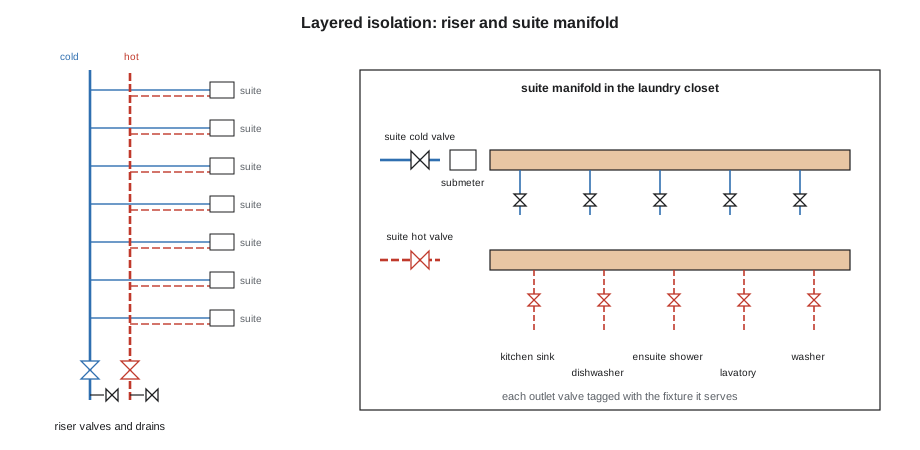
The program below shows the effect of each layer on Kingsway's high zone. For a leak at one fixture, it reports how many suites lose water depending on the nearest valve that can be closed.
# How many suites lose water when each isolation layer is used
FLOORS = range(6, 13)        # high zone floors
RISERS = 10                  # one riser pair per stack of suites
suites_per_riser = len(FLOORS)
zone_suites = RISERS * suites_per_riser

layers = [("main shutoff (whole building)", 110),
          ("high zone valve", zone_suites),
          ("riser valve", suites_per_riser),
          ("suite manifold valves", 1),
          ("fixture valve on the manifold", 0)]
for name, lost in layers:
    note = "fixture only" if lost == 0 else f"{lost} suite{'s' if lost != 1 else ''} without water"
print(f"{name:32s} -> {note}")main shutoff (whole building) -> 110 suites without water high zone valve -> 70 suites without water riser valve -> 7 suites without water suite manifold valves -> 1 suite without water fixture valve on the manifold -> fixture only
Draining and refilling
Isolating part of the system is only half the job; the plumber also needs to drain it, repair it and refill it. Drain valves at the low point of each isolated section let water out, usually through a hose to a floor drain. Air must be let in at a high point for the section to drain, which is often done by opening the highest fixture. When the section is refilled, the air must get out again, so the plumber opens fixtures at the top to vent it and refills slowly to avoid trapping air pockets or causing water hammer.
After any repair that opens the potable system, the section should be flushed. Where the work was extensive, or where the system could have been contaminated, it may need to be disinfected before it goes back into use, following the methods in Lesson 12 and any requirements of the local authority.
Access, labels and charts
A valve nobody can find or reach is no use in an emergency. Codes require shutoff valves to be accessible, which generally means they can be reached without removing permanent parts of the building, although they may be behind an access door. Valves in ceilings need access panels big enough to reach and operate them. Valves at riser bases in shafts need a clear path. Valves must not be buried in walls, behind cabinets or above fixed ceilings.
Labelling turns accessible valves into useful ones. Large buildings tag each valve with a number on a brass or plastic tag and keep a valve chart that lists each tag, its location, what it controls and its normal position. Pipes are labelled with their contents and flow direction at intervals and at every wall penetration. On Kingsway, the specification requires a framed valve chart in the mechanical room and an electronic copy in the operations and maintenance manuals, which Northbridge hands over at the end of the job.
Suite manifolds are labelled too. Each outlet valve carries a tag naming the fixture it serves, so a resident or operator can shut off the dishwasher or the ensuite shower without guessing. Maya spent a full day labelling manifolds on four floors, and she discovered the value of it almost immediately when an electrician drilled through a PEX line on the eighth floor and the operator shut off just that one line.
Pressure loss through valves
Valves cause pressure loss, which must be included in the sizing calculations. Manufacturers describe a valve's capacity with a flow coefficient. In US units this is Cv, the flow in gallons per minute that passes through the valve with a 1 psi pressure drop. In SI units it is Kv, the flow in cubic metres per hour that passes with a 1 bar (100 kPa) drop. The pressure drop at any other flow follows from the square of the flow.
Worked problem
Pressure drop through a suite valve
A suite manifold's cold shutoff valve has a Kv of 8. At peak suite flow the cold supply carries 0.55 L/s. What is the pressure drop?
Show solution
- Convert the flow: \(0.55\) L/s \(\times 3.6 = 1.98\) m\(^3\)/h.
- Ratio: \(1.98 / 8 = 0.2475\).
- Drop: \(0.2475^2 \approx 0.061\) bar, which is about 6 kPa.
Answer: About 6 kPa, small but part of the 35 kPa allowed for the suite submeter and manifold.
The same calculation applies to every device with a published flow coefficient, including strainers, check valves, backflow preventers and PRVs. A reduced-port ball valve or a partly closed gate valve has a much lower coefficient and a much larger loss, which is one reason full-port valves are specified on mains and risers.
Note the squared relationship: doubling the flow quadruples the pressure drop through a valve. A valve that seems fine at normal flow can become a serious restriction at peak flow, which is why devices are checked at the design peak, not at an average flow.
Keeping valves working
Valves that are never operated tend to seize. Gate valves are the worst, because scale and corrosion lock the stem or the wedge, and a valve forced closed after years can break off its stem or fail to seal. Building maintenance programs exercise important valves on a schedule, closing and opening them fully to keep them free. On Kingsway, the operations manual calls for exercising the riser and zone valves once a year.
When operating any valve, close it slowly, especially quarter-turn valves on large pipes, to avoid water hammer. Never use a cheater bar on a stuck valve handle; it is a quick way to break the valve and flood the room. If a valve will not close, find the next one upstream and report the failed valve.
Hose bibbs and wall hydrants deserve a mention. Outdoor hose bibbs in cold climates must be frost-free, with the valve seat inside the heated building, and they must drain when closed. They must also have a vacuum breaker, because a hose left in a bucket of soapy water or connected to a fertilizer sprayer is one of the most common cross-connections in any building. PLB-310 covers this in detail; Lesson 11 introduces it.
Common mistakes
MistakeInstalling a gate valve as the only shutoff on a heavily used branch.
InsteadUse full-port ball valves for shutoffs that will be operated often; keep gate valves for large services and lines that rarely change.
MistakeBurying valves behind finished walls or above fixed ceilings.
InsteadKeep every shutoff accessible, with access panels where needed.
MistakeSkipping riser and suite valves because the code minimum is met.
InsteadPlan isolation in layers so a repair affects as few people as possible.
MistakeLeaving valves untagged and charts unwritten.
InsteadTag valves, label pipes and provide a valve chart.
MistakeSlamming a quarter-turn valve shut on a large pipe.
InsteadClose valves slowly to avoid water hammer.
Summary and key terms
- Ball, gate, globe, butterfly and check valves each have their place in a water system; all must be approved for potable water and lead-free.
- Codes require shutoffs at the service, at water heaters, at many fixtures and appliances, and for each dwelling unit.
- Layered isolation, from building to zone, riser, suite and fixture, keeps repairs from affecting more people than necessary.
- Drain valves at low points, venting at high points and slow refilling make sections easy to drain and refill.
- Valves must be accessible, tagged and listed on a valve chart.
- Valve pressure drop follows the square of the flow and is calculated from the flow coefficient.
- Full-port ball valve
- A ball valve whose bore matches the pipe, giving almost no pressure loss when open.
- Main shutoff
- The valve that isolates the entire building's water supply.
- Riser valve
- A shutoff valve at the base of a riser that isolates that riser.
- Valve chart
- A list of tagged valves giving each one's location, what it controls and its normal position.
- Flow coefficient
- A valve's capacity, expressed as the flow it passes at a standard pressure drop.
- Exercising a valve
- Closing and reopening a valve on a schedule to keep it from seizing.
Practice problems
Work each problem on paper first, then reveal the answer to check.
Why are ball valves the most common shutoffs in new buildings?
Show answer
They are compact, quick to operate, seal well and have almost no loss when open.
Name three places codes typically require shutoff valves.
Show answer
The water service entry, each water heater supply and each dwelling unit; also many fixtures and appliances.
What is the purpose of a drain valve just above a riser valve?
Show answer
To drain the riser after it is isolated.
A valve has a Kv of 10 and carries 1.8 m³/h. What is the drop?
Show answer
(1.8 / 10) squared, about 0.032 bar or 3.2 kPa.
Why are important valves exercised once a year?
Show answer
To keep them from seizing so they work when needed.
What two features must an outdoor hose bibb have in a cold climate?
Show answer
Frost-free design with the seat inside the heated space, and a vacuum breaker.
Lesson quiz · 5 questions
Score 60% or more to complete this lesson.
Create a free account to save your progress, take quizzes and earn a certificate.