
PHYS-271 · Lesson 4 of 12 · 20 min
Relativistic energy and momentum
If time and space change between frames, momentum and energy must change too. Newton's momentum \(m\mathbf{v}\) is conserved in collisions in one inertial frame, but if we Lorentz-transform the velocities of the colliding particles into another frame, the total \(m\mathbf{v}\) is no longer conserved there. Since the principle of relativity requires conservation laws to hold in every inertial frame, the definitions must be changed. This lesson finds the relativistic momentum and energy, derives the most famous equation in physics, \(E = mc^2\), and applies the results to particle collisions, nuclear binding and the energy of the Sun. Along the way we meet the electronvolt, the natural unit for atoms and particles, and the idea that a particle can have energy and momentum but no mass.
Relativistic momentum
Consider a glancing collision between two identical balls, arranged so that in one frame they approach each other symmetrically. Requiring momentum to be conserved in that frame and in a frame moving along with one ball leads, after some algebra, to a unique definition that reduces to \(m\mathbf{v}\) at low speed:
Here \(m\) is the mass of the particle, the same in every frame. Older books called \(\gamma m\) the relativistic mass and said that mass increases with speed, but modern usage keeps \(m\) as a single invariant number and puts the \(\gamma\) into the momentum and energy. As \(v \to c\), \(\gamma \to \infty\) and the momentum grows without bound. A constant force \(F = dp/dt\) applied for a long time produces a momentum that grows linearly, but a speed that approaches \(c\) ever more slowly. This is the dynamical reason that no material object can be accelerated to the speed of light.
Relativistic energy
The work done by a force changes the kinetic energy, \(dK = F\,dx = (dp/dt)\,dx = v\,dp\). Integrating with \(p = \gamma m v\) from rest to speed \(v\) gives
For small speeds \(\gamma - 1 \approx \tfrac12 \beta^2 + \tfrac38 \beta^4\), so \(K \approx \tfrac12 m v^2 + \tfrac38 m v^4/c^2\): Newton's kinetic energy plus a small correction. Einstein noticed that the formula naturally splits as \(K = \gamma m c^2 - m c^2\), and proposed that \(\gamma m c^2\) is the total energy of the particle and \(m c^2\) its rest energy:
In a short paper in September 1905, titled Does the Inertia of a Body Depend upon Its Energy Content?, he argued that a body emitting light energy \(L\) loses mass \(L/c^2\). The rest energy is not just bookkeeping. It is a real store of energy that can be released when mass changes, in nuclear reactions, in particle annihilation and, in tiny amounts, even in chemistry. A kilogram of matter has a rest energy of \(9 \times 10^{16}\) J, about 25 terawatt-hours, roughly two weeks of all the electricity generated in Canada.
The energy–momentum relation
Squaring \(E = \gamma m c^2\) and \(pc = \gamma m v c\) and subtracting gives a relation free of the velocity:
This is the momentum-space version of the invariant interval. Energy and momentum transform between frames exactly as \(ct\) and \(x\) do, so \(E^2 - (pc)^2\) is the same in every frame and equals \((mc^2)^2\). The relation has two useful limits. When \(pc \ll mc^2\) the particle is slow and \(E \approx mc^2 + p^2/2m\). When \(pc \gg mc^2\) the particle is ultrarelativistic and \(E \approx pc\). The speed follows from \(\beta = pc/E\).
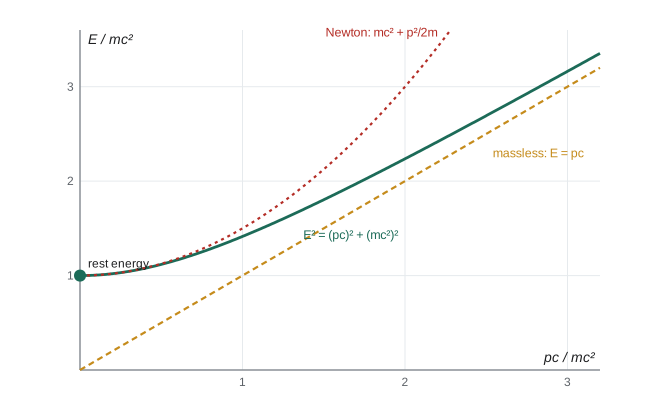
For \(m = 0\) the relation becomes \(E = pc\), and then \(\beta = pc/E = 1\): a massless particle must move at the speed of light, in every frame. The photon, lesson 6, is such a particle. It carries energy and momentum but has no rest frame and no rest energy.
The speed limit is visible in every particle accelerator. TRIUMF in Vancouver, home of one of the world's largest cyclotrons, accelerates protons to 520 MeV of kinetic energy, where \(\gamma = 1.55\) and the speed is \(0.76c\). Doubling the energy to about 1 GeV raises the speed only to \(0.88c\), and the protons of the Large Hadron Collider, with 7,000 times their rest energy, move at \(0.999\,999\,99c\). Above a few GeV, adding energy to a proton changes its momentum and energy almost in proportion but barely changes its speed. The cyclotron principle, in which particles circle at a fixed frequency in a magnetic field, stops working when \(\gamma\) rises appreciably above 1, because the orbital frequency \(eB/\gamma m\) falls as the particles gain energy; TRIUMF's cyclotron compensates by shaping its magnetic field, and higher-energy machines use synchrotrons whose fields rise as the particles speed up.
The electronvolt
Joules are inconveniently large for single particles. The electronvolt is the energy an electron gains when it is accelerated through a potential difference of one volt: \(1\ \mathrm{eV} = 1.602 \times 10^{-19}\ \mathrm{J}\). Chemical bonds are a few eV, visible photons are about 2 to 3 eV, X-rays are keV, nuclear processes are MeV, and particle accelerators reach GeV and TeV. Masses are quoted as rest energies: the electron is \(0.511\ \mathrm{MeV}/c^2\), the proton \(938.3\ \mathrm{MeV}/c^2\), the neutron \(939.6\ \mathrm{MeV}/c^2\). Momentum is quoted in \(\mathrm{MeV}/c\). With these units the factors of \(c\) take care of themselves: a proton with momentum \(1000\ \mathrm{MeV}/c\) has \(E = \sqrt{1000^2 + 938.3^2} = 1371\) MeV.
Conservation in collisions
In relativity, total energy and total momentum are conserved in every collision, elastic or not. Mass, however, is not conserved. When two lumps of clay collide and stick, their kinetic energy turns into heat, and the combined lump has a mass slightly larger than the sum of the original masses. The invariant mass of a system is defined by \(Mc^2 = \sqrt{E_{\text{tot}}^2 - (p_{\text{tot}} c)^2}\), and it equals the energy of the system in its centre-of-momentum frame divided by \(c^2\). It includes the kinetic and internal energy of the parts.
This matters for particle accelerators. In a fixed-target experiment, a beam particle strikes a particle at rest, and much of the beam's energy goes into moving the products forward rather than creating new mass. In a collider, two beams meet head-on, the centre-of-momentum frame is the laboratory, and all the energy is available. The program below compares the two for protons and computes the threshold for producing an antiproton, the experiment that won Emilio Segrè and Owen Chamberlain the 1959 Nobel Prize after they found antiprotons at Berkeley's Bevatron in 1955.
import math
mp = 938.272          # proton rest energy, MeV
def inv_mass_fixed(E_beam, m_beam=mp, m_target=mp):
    # E_beam is the total energy of the beam particle; target at rest
    p = math.sqrt(E_beam**2 - m_beam**2)
    E_tot = E_beam + m_target
    return math.sqrt(E_tot**2 - p**2)
def inv_mass_collider(E_each):
    return 2 * E_each       # equal and opposite momenta
# reaction p + p -> p + p + p + antiproton needs invariant mass 4 mp
need = 4 * mp
# fixed target: M^2 = 2 mp^2 + 2 mp E_beam  ->  E_beam = (M^2 - 2 mp^2) / (2 mp)
E_thr = (need**2 - 2 * mp**2) / (2 * mp)
print(f"antiproton threshold, fixed target: beam total energy {E_thr:.0f} MeV,"
      f" kinetic energy {(E_thr - mp) / 1000:.2f} GeV")
print(f"antiproton threshold, collider: each beam {need / 2:.0f} MeV total,"
      f" kinetic {(need / 2 - mp) / 1000:.3f} GeV")
for K in (6.0e3, 1.0e5, 6.8e6):           # beam kinetic energies in MeV
    E = K + mp
    print(f"beam kinetic {K / 1000:8.1f} GeV: fixed-target sqrt(s) = {inv_mass_fixed(E) / 1000:7.2f} GeV,"
f" collider sqrt(s) = {inv_mass_collider(E) / 1000:9.1f} GeV")antiproton threshold, fixed target: beam total energy 6568 MeV, kinetic energy 5.63 GeV antiproton threshold, collider: each beam 1877 MeV total, kinetic 0.938 GeV beam kinetic 6.0 GeV: fixed-target sqrt(s) = 3.84 GeV, collider sqrt(s) = 13.9 GeV beam kinetic 100.0 GeV: fixed-target sqrt(s) = 13.83 GeV, collider sqrt(s) = 201.9 GeV beam kinetic 6800.0 GeV: fixed-target sqrt(s) = 112.98 GeV, collider sqrt(s) = 13601.9 GeV
A fixed-target beam needs 5.6 GeV of kinetic energy to make an antiproton, six times the antiproton's rest energy. In a collider each beam needs only 0.94 GeV. At high energy the difference is dramatic: a 6.8 TeV beam on a fixed target gives only 113 GeV of collision energy, while two such beams colliding head-on, as at the Large Hadron Collider, give 13.6 TeV. That is why the frontier machines of particle physics, from the Tevatron at Fermilab near Chicago to the LHC near Geneva, have been colliders.
Mass defect and binding energy
A system held together by attractive forces has less energy than its separated parts, and therefore less mass. The difference is the binding energy. For the hydrogen atom it is 13.6 eV, a mass change of \(13.6/938{,}783{,}000\), about 1.4 parts in 100 million, far too small to weigh. For the deuteron, a proton and neutron bound by the strong force, it is 2.22 MeV, about 0.12% of the mass, easily measured. Nuclear binding energies are about a million times larger than chemical ones, which is why nuclear fuel is so concentrated, lesson 11.
The Sun shines by fusing hydrogen into helium. Four protons have a total rest energy of \(4 \times 938.27 = 3753.1\) MeV, while a helium-4 nucleus has 3727.4 MeV. After accounting for the two positrons and neutrinos produced, about 26.7 MeV is released per helium nucleus formed, 0.7% of the mass. The Sun's luminosity of \(3.83 \times 10^{26}\) W therefore corresponds to a mass loss of \(L/c^2 = 4.3 \times 10^9\) kg every second, about four million tonnes. It has been doing this for 4.6 billion years and has lost less than a thousandth of its mass.
c = 2.99792458e8
MeV = 1.602176634e-13      # joules per MeV
L_sun = 3.828e26            # W
dm_dt = L_sun / c**2
print(f"Sun's mass loss to radiation: {dm_dt:.3e} kg/s")
year = 3.156e7
lost = dm_dt * year * 4.6e9
print(f"lost in 4.6 billion years: {lost:.2e} kg = {lost / 1.989e30:.2e} of its mass")
# energy released per helium-4 formed from four protons
m_p, m_He4_nucleus, m_e = 938.272, 3727.379, 0.511
Q = 4 * m_p - m_He4_nucleus - 2 * m_e      # two positrons are created
Q_total = Q + 2 * 2 * m_e                    # positrons annihilate with two electrons
print(f"energy per helium-4: {Q_total:.2f} MeV (fraction of mass {Q_total / (4 * m_p) * 100:.2f}%)")
rate = L_sun / (Q_total * MeV)
print(f"helium nuclei formed per second: {rate:.2e}")
print(f"hydrogen consumed per second: {4 * rate * 1.6726e-27 / 1e9:.0f} million tonnes")Sun's mass loss to radiation: 4.259e+09 kg/s lost in 4.6 billion years: 6.18e+26 kg = 3.11e-04 of its mass energy per helium-4: 26.73 MeV (fraction of mass 0.71%) helium nuclei formed per second: 8.94e+37 hydrogen consumed per second: 598 million tonnes
The numbers in the output count the energy carried away by neutrinos as part of the 26.7 MeV, a small fraction that escapes the Sun directly. The Sun turns about 600 million tonnes of hydrogen into helium every second, and the missing four million tonnes leave as sunlight and neutrinos.
Worked problem
An electron from an accelerator
An electron is accelerated from rest through 1.00 MV. Find its kinetic energy, total energy, momentum and speed. Compare with the Newtonian speed.
Show solution
- Kinetic energy: \(K = eV = 1.00\) MeV.
- Total energy: \(E = K + mc^2 = 1.00 + 0.511 = 1.511\) MeV, so \(\gamma = 1.511/0.511 = 2.957\).
- Momentum: \(pc = \sqrt{E^2 - (mc^2)^2} = \sqrt{1.511^2 - 0.511^2} = 1.422\) MeV, so \(p = 1.422\ \mathrm{MeV}/c\).
- Speed: \(\beta = pc/E = 1.422/1.511 = 0.941\).
- Newton would give \(\tfrac12 mv^2 = 1.00\) MeV, so \(\beta = \sqrt{2 \times 1.00/0.511} = 1.98\), nearly twice the speed of light, which is impossible.
Answer: \(K = 1.00\) MeV, \(E = 1.511\) MeV, \(p = 1.42\ \mathrm{MeV}/c\), \(v = 0.941c\); the Newtonian formula fails badly once \(K\) is comparable to \(mc^2\).
Common mistakes
MistakeUsing \(\tfrac12 mv^2\) for kinetic energy at high speed.
InsteadUse \(K = (\gamma - 1)mc^2\); the Newtonian formula is accurate only when \(K \ll mc^2\).
MistakeSaying that mass is conserved in collisions.
InsteadEnergy and momentum are conserved; the invariant mass of a system includes its internal kinetic and binding energy.
MistakeThinking \(E = mc^2\) applies only to nuclear reactions.
InsteadIt applies to all energy changes; chemical and thermal mass changes are just too small to weigh.
MistakeTreating photons as having relativistic mass \(E/c^2\) that slows them down.
InsteadPhotons have zero mass, \(E = pc\), and always travel at \(c\).
Summary and key terms
- Relativistic momentum is \(\mathbf{p} = \gamma m\mathbf{v}\) and total energy is \(E = \gamma mc^2\), with rest energy \(mc^2\).
- Kinetic energy is \(K = (\gamma - 1)mc^2\), which reduces to \(\tfrac12 mv^2\) at low speed.
- \(E^2 = (pc)^2 + (mc^2)^2\) holds in every frame; massless particles have \(E = pc\) and move at \(c\).
- Energy and momentum are conserved; the invariant mass of a system includes its internal energy.
- Colliding beams make all their energy available for new particles; fixed targets waste most of it.
- Binding energy shows up as a mass defect; the Sun converts about four million tonnes of mass to energy each second.
- Rest energy
- \(mc^2\), the energy of a particle in its own rest frame.
- Electronvolt
- \(1.602 \times 10^{-19}\) J, the energy gained by an electron through one volt.
- Invariant mass
- \(\sqrt{E_{\text{tot}}^2 - (p_{\text{tot}}c)^2}/c^2\), the same in all frames.
- Binding energy
- The energy needed to separate a bound system into its parts.
- Ultrarelativistic
- The regime \(pc \gg mc^2\), where \(E \approx pc\).
Practice problems
Work each problem on paper first, then reveal the answer to check.
Find \(\gamma\), \(p\) and \(K\) for a proton moving at \(0.6c\).
Show answer
\(\gamma = 1.25\); \(K = 0.25 \times 938.3 = 234.6\) MeV; \(pc = \gamma m \beta c^2 = 1.25 \times 0.6 \times 938.3 = 703.7\) MeV.
What is the momentum of a 2.0 eV photon of red light?
Show answer
\(p = E/c = 2.0\ \mathrm{eV}/c = 1.07 \times 10^{-27}\ \mathrm{kg\,m/s}\).
An electron and a positron, both at rest, annihilate into two photons. What is each photon's energy?
Show answer
Total energy \(2 \times 0.511\) MeV shared equally, so 0.511 MeV each, travelling in opposite directions.
By how much does the mass of 1 kg of water increase when it is heated by 50 K?
Show answer
\(Q = 4186 \times 50 = 2.09 \times 10^5\) J, so \(\Delta m = Q/c^2 = 2.3 \times 10^{-12}\) kg.
Show that \(E^2 - (pc)^2 = (mc^2)^2\) using \(E = \gamma mc^2\) and \(p = \gamma mv\).
Show answer
\(\gamma^2 m^2 c^4 (1 - \beta^2) = m^2 c^4\), since \(\gamma^2 (1 - \beta^2) = 1\).
Lesson quiz · 5 questions
Score 60% or more to complete this lesson.
Create a free account to save your progress, take quizzes and earn a certificate.