
PHYS-271 · Lesson 11 of 12 · 24 min
The nucleus: binding energy, radioactivity and nuclear reactions
The nucleus holds more than 99.9% of an atom's mass in a volume about \(10^{-15}\) of the atom's. Its physics is governed by a new force, the strong nuclear force, and its energies are millions of electronvolts rather than the few electronvolts of chemistry. This lesson describes what nuclei are made of and how big they are, explains their binding energies with a simple model, derives the law of radioactive decay and applies it to dating, and introduces the fission and fusion reactions that generate electricity in reactors such as CANDU units in Ontario and the boiling water reactors at Monticello in Minnesota, power the Sun, and make the medical isotopes used in hospitals every day.
Protons, neutrons and nuclear size
Rutherford found the nucleus in 1911 and the proton in 1919, when he knocked hydrogen nuclei out of nitrogen with alpha particles. Nuclei could not be made of protons alone, because their charges are only about half their masses in proton units. In 1932 James Chadwick at Cambridge identified the missing component, the neutron, a neutral particle slightly heavier than the proton. A nucleus is labelled by its atomic number \(Z\), the number of protons, its neutron number \(N\), and its mass number \(A = Z + N\). Nuclei with the same \(Z\) but different \(N\) are isotopes of the same element: carbon-12 and carbon-14 both have six protons, with six and eight neutrons. Protons and neutrons together are called nucleons.
Electron scattering experiments, especially those of Robert Hofstadter at Stanford in the 1950s, showed that nuclei are roughly spheres of nearly constant density, with radius
where 1 fm, called a fermi, is \(10^{-15}\) m. The volume is proportional to \(A\), so every nucleus has about the same density, \(2.3 \times 10^{17}\ \mathrm{kg/m^3}\): a teaspoon of nuclear matter would weigh about a billion tonnes. Neutron stars are made of matter at roughly this density.
The strong force and binding energy
Protons in a nucleus repel each other with enormous electric forces: two protons 2 fm apart push apart with about 58 N, the weight of a 6 kg mass, acting on particles of \(10^{-27}\) kg. Something stronger must hold them. The strong nuclear force attracts nucleons to each other regardless of charge, with a strength about a hundred times that of the electric force at short range, but it falls to nothing beyond about 2 to 3 fm. It also becomes strongly repulsive below about 0.5 fm, which keeps nucleons from collapsing together. Hideki Yukawa explained its short range in 1935 by proposing that it is carried by a massive particle, the pion, found in 1947.
The binding energy \(B\) of a nucleus is the energy needed to pull it apart into separate protons and neutrons, and by lesson 4 it shows up as a mass defect:
In practice one uses atomic masses, with \(Z\) hydrogen atoms in place of \(Z\) protons so that the electron masses cancel. For helium-4, \(2 \times 1.007825 + 2 \times 1.008665 - 4.002603 = 0.030377\) u, and with \(1\ \mathrm{u} = 931.494\ \mathrm{MeV}/c^2\), \(B = 28.3\) MeV, or 7.07 MeV per nucleon. Compare the 13.6 eV binding of hydrogen's electron: nuclear binding is about a million times stronger, per particle, than atomic binding.
The binding energy curve
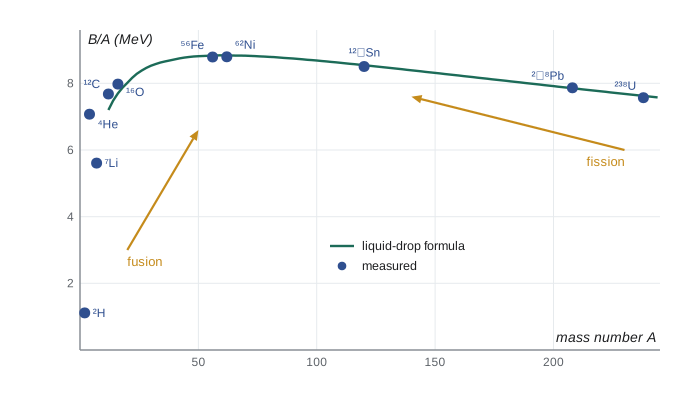
Plotting \(B/A\) against \(A\) gives the most important graph in nuclear physics. It rises steeply from deuterium (1.1 MeV per nucleon) through helium-4 (7.1 MeV), reaches a broad maximum of about 8.8 MeV near iron and nickel, \(A \approx 56\) to 62, and falls slowly to about 7.6 MeV for uranium. Light nuclei can release energy by joining together, fusion, and heavy nuclei by splitting apart, fission, because both move toward the peak.
Carl Friedrich von Weizsäcker in 1935 explained the shape of the curve with the liquid-drop model, which treats the nucleus as a drop of incompressible nuclear fluid. Each term in his semi-empirical mass formula has a physical reason.
The volume term \(a_V A\) says each nucleon is bound to its neighbours, like molecules in a liquid. The surface term subtracts for nucleons at the surface, which have fewer neighbours; it is relatively important for small nuclei and is why the curve rises at small \(A\). The Coulomb term accounts for the repulsion of every pair of protons, and grows faster than \(A\), which is why the curve falls at large \(A\) and why heavy nuclei need extra neutrons. The asymmetry term, from the exclusion principle, favours equal numbers of protons and neutrons. The pairing term \(\delta\) adds a little binding for even numbers of protons and of neutrons and subtracts for odd ones.
# semi-empirical mass formula (coefficients in MeV, a common fit)
aV, aS, aC, aA, aP = 15.75, 17.8, 0.711, 23.7, 11.18
def B_semf(A, Z):
    N = A - Z
    d = 0.0
    if Z % 2 == 0 and N % 2 == 0: d = aP / A**0.5
    elif Z % 2 == 1 and N % 2 == 1: d = -aP / A**0.5
    return aV * A - aS * A**(2/3) - aC * Z * (Z - 1) / A**(1/3) - aA * (A - 2 * Z)**2 / A + d
mH, mn, u = 1.00782503, 1.00866492, 931.49410     # atomic masses in u, MeV per u
measured = {("He", 4, 2): 4.00260325, ("C", 12, 6): 12.0, ("O", 16, 8): 15.99491462,
            ("Fe", 56, 26): 55.93493633, ("Ni", 62, 28): 61.92834537,
            ("Sn", 120, 50): 119.90220163, ("Pb", 208, 82): 207.9766525, ("U", 238, 92): 238.0507884}
print(f"{'nucleus':9s}{'B/A measured':>14s}{'B/A formula':>13s}")
for (sym, A, Z), M in measured.items():
    B = (Z * mH + (A - Z) * mn - M) * u
    print(f"{sym + '-' + str(A):9s}{B / A:14.3f}{B_semf(A, Z) / A:13.3f}")
# most stable Z for each A (the valley of stability), from dB/dZ = 0 ignoring pairing
for A in (16, 56, 120, 208, 238):
    Zbest = max(range(1, A), key=lambda Z: B_semf(A, Z))
print(f"A = {A:3d}: most bound Z = {Zbest} (N/Z = {(A - Zbest) / Zbest:.2f})")nucleus B/A measured B/A formula He-4 7.074 5.710 C-12 7.680 7.468 O-16 7.976 7.873 Fe-56 8.790 8.846 Ni-62 8.795 8.863 Sn-120 8.504 8.548 Pb-208 7.867 7.857 U-238 7.570 7.625 A = 16: most bound Z = 8 (N/Z = 1.00) A = 56: most bound Z = 26 (N/Z = 1.15) A = 120: most bound Z = 50 (N/Z = 1.40) A = 208: most bound Z = 82 (N/Z = 1.54) A = 238: most bound Z = 92 (N/Z = 1.59)
The formula fits the measured values to within a few tenths of an MeV per nucleon for nuclei beyond oxygen, with just five parameters, and it explains why stable heavy nuclei have about 1.5 neutrons per proton. It misses some details, notably extra stability at the magic numbers 2, 8, 20, 28, 50, 82 and 126, which Maria Goeppert Mayer and Hans Jensen explained in 1949 with the nuclear shell model, the nuclear counterpart of the atomic shells of lesson 10. Helium-4, oxygen-16 and lead-208 are doubly magic and especially tightly bound.
Radioactive decay
Unstable nuclei decay in three main ways, named by Rutherford in order of penetrating power. In alpha decay a nucleus emits a helium-4 nucleus, lowering \(Z\) by 2 and \(A\) by 4; the alphas are stopped by a sheet of paper or the outer layer of skin. In beta decay a neutron turns into a proton, emitting an electron and an antineutrino (beta minus), or a proton turns into a neutron, emitting a positron and a neutrino (beta plus); \(A\) is unchanged. Wolfgang Pauli proposed the neutrino in 1930 to account for missing energy in beta decay, and Clyde Cowan and Frederick Reines detected it at the Savannah River reactor in 1956. In gamma decay an excited nucleus drops to a lower energy state and emits a high-energy photon, as an excited atom emits light.
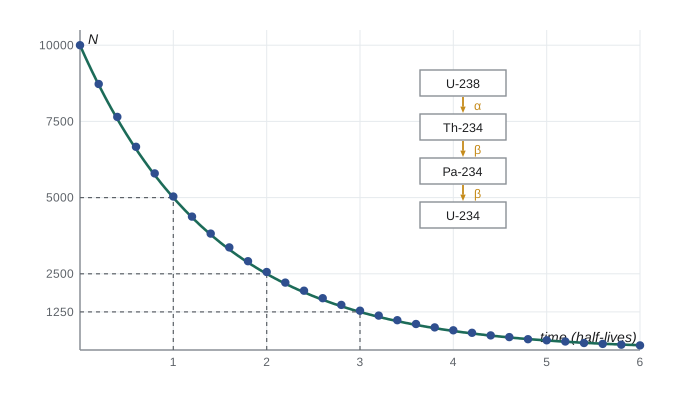
Decay is random. Each nucleus has a fixed probability \(\lambda\) per unit time of decaying, independent of its age, its chemical surroundings or the temperature. If there are \(N\) nuclei, the number decaying in time \(dt\) is \(\lambda N\,dt\), so
The half-life \(t_{1/2}\) is the time for half of any sample to decay; the mean lifetime \(\tau\) is 1.443 times longer. The activity \(\lambda N\) is measured in becquerels, decays per second. Half-lives range from \(10^{-22}\) s for some very unstable nuclei to \(2 \times 10^{24}\) years for tellurium-128, more than \(10^{14}\) times the age of the universe. The program below simulates decay nucleus by nucleus and compares the result with the exponential law.
import math, random
random.seed(14)
half_life = 5.0              # arbitrary units
lam = math.log(2) / half_life
dt = 0.1
p = 1 - math.exp(-lam * dt)  # probability of decay in one step
N = 10000
counts = [N]
for step in range(1, 301):
    N -= sum(1 for _ in range(N) if random.random() < p)
    counts.append(N)
for t in (0, 5, 10, 15, 20, 30):
    sim = counts[int(round(t / dt))]
    print(f"t = {t:4.1f}: simulated {sim:6d}, exponential law {10000 * math.exp(-lam * t):8.1f},"
          f" statistical spread about {math.sqrt(10000 * math.exp(-lam * t) * (1 - math.exp(-lam * t))):5.1f}")
# radiocarbon dating
t14 = 5730.0                  # half-life of carbon-14, years
for ratio in (0.80, 0.50, 0.25, 0.10):
    age = -t14 / math.log(2) * math.log(ratio)
print(f"carbon-14 at {ratio * 100:4.0f}% of the living level: age {age:8.0f} years")t = 0.0: simulated 10000, exponential law 10000.0, statistical spread about 0.0 t = 5.0: simulated 5038, exponential law 5000.0, statistical spread about 50.0 t = 10.0: simulated 2560, exponential law 2500.0, statistical spread about 43.3 t = 15.0: simulated 1291, exponential law 1250.0, statistical spread about 33.1 t = 20.0: simulated 648, exponential law 625.0, statistical spread about 24.2 t = 30.0: simulated 151, exponential law 156.3, statistical spread about 12.4 carbon-14 at 80% of the living level: age 1845 years carbon-14 at 50% of the living level: age 5730 years carbon-14 at 25% of the living level: age 11460 years carbon-14 at 10% of the living level: age 19035 years
Each simulated nucleus decays at random, yet the total follows the exponential law closely, with fluctuations of about \(\sqrt N\), the same statistics as counting photons or electrons. Willard Libby developed radiocarbon dating at the University of Chicago in 1949 and received the 1960 Nobel Prize in Chemistry. Cosmic rays make carbon-14 in the upper atmosphere at a nearly steady rate; living things take it in and keep the same ratio of carbon-14 to carbon-12 as the air, about 1.2 parts per trillion. When an organism dies the intake stops and the carbon-14 decays with a half-life of 5,730 years, so the remaining fraction gives the time since death. Calibrated against tree rings, the method dates organic remains back to about 50,000 years. Uranium-lead dating, using uranium-238 with its 4.47 billion year half-life, gives the 4.54 billion year age of the Earth.
Fission and nuclear power
In December 1938 Otto Hahn and Fritz Strassmann in Berlin found barium, a medium-weight element, among the products of uranium bombarded with neutrons. Lise Meitner, who had left Germany earlier that year, and her nephew Otto Frisch explained over the Christmas holidays in Sweden that the uranium nucleus had split in two, like a liquid drop stretched until it pinched apart, and they used the mass formula to estimate that about 200 MeV is released. Frisch named the process fission, after cell division. A fission of uranium-235 typically produces two fragments, two or three neutrons and about 200 MeV, most of it as kinetic energy of the fragments, which becomes heat.
In a power reactor the neutrons from each fission cause, on average, exactly one more fission, a steady chain reaction controlled by neutron-absorbing rods. The neutrons are slowed by a moderator, because slow neutrons are far more likely to cause fission in uranium-235. Canada's CANDU reactor, developed by Atomic Energy of Canada and Ontario Hydro and first operating commercially at Pickering in 1971, uses heavy water as moderator, which absorbs so few neutrons that the reactor can run on natural uranium without enrichment. Ontario's CANDU stations at Bruce, Pickering and Darlington supply over half of the province's electricity. Most American reactors, including Prairie Island and Monticello in Minnesota, use ordinary water as moderator and coolant and need uranium enriched to a few per hundred in uranium-235.
# Energy density of fission compared with burning coal, and one reactor's fuel use
MeV, u = 1.602176634e-13, 1.66053907e-27
E_fission = 200 * MeV                       # per uranium-235 nucleus
per_kg_U235 = E_fission / (235 * u)
coal = 24e6                                 # J/kg
print(f"fission of 1 kg of U-235: {per_kg_U235:.2e} J = {per_kg_U235 / 3.6e9:,.0f} MWh of heat")
print(f"ratio to burning coal: {per_kg_U235 / coal:,.0f}")
# a CANDU unit: 880 MW electric at 31% efficiency, natural uranium with 0.72% U-235
P_th = 880e6 / 0.31
fissions_per_s = P_th / E_fission
U235_per_day = fissions_per_s * 86400 * 235 * u
print(f"thermal power {P_th / 1e6:,.0f} MW needs {fissions_per_s:.2e} fissions per second")
print(f"U-235 equivalent fissioned per day: {U235_per_day:.2f} kg")
burnup = 7.5                                 # MW days of heat per kg of natural uranium, typical CANDU
print(f"natural uranium fuel used per day at {burnup} MWd/kg: {P_th / 1e6 / burnup:.0f} kg")
print(f"mass converted to energy per day: {P_th * 86400 / (2.998e8)**2 * 1000:.2f} g")fission of 1 kg of U-235: 8.21e+13 J = 22,810 MWh of heat ratio to burning coal: 3,421,466 thermal power 2,839 MW needs 8.86e+19 fissions per second U-235 equivalent fissioned per day: 2.99 kg natural uranium fuel used per day at 7.5 MWd/kg: 378 kg mass converted to energy per day: 2.73 g
Fission releases about three million times more energy per kilogram than burning coal, and a large reactor turns only a few grams of mass into energy each day. Because some of the fissions are of plutonium bred from uranium-238 during operation, a CANDU unit of this size uses roughly 380 kg of natural uranium a day, delivered as bundles of ceramic fuel pellets that are pushed through the reactor while it runs. The spent fuel contains radioactive fission products and must be stored safely; Canada's Nuclear Waste Management Organization selected a site near Ignace in northwestern Ontario in 2024 for a deep geological repository.
Fusion and the stars
At the other end of the curve, light nuclei release energy by fusing. In the Sun's core, at 15 million kelvin, protons fuse into helium through the proton–proton chain, releasing 26.7 MeV per helium nucleus, lesson 4; tunnelling through the Coulomb barrier, lesson 8, is what makes it possible at that temperature. Heavier stars make carbon, oxygen and every element up to iron in their cores, and elements beyond iron are built by neutron capture in red giants, in supernova explosions and in collisions of neutron stars, one of which was seen in both gravitational waves and light in 2017. The atoms of your body were made in stars.
On Earth, fusion power is the goal of large research projects. Magnetic confinement devices such as ITER, under construction in southern France, aim to heat a deuterium–tritium plasma to over 100 million kelvin. In December 2022 the National Ignition Facility in California, using 192 lasers to compress a tiny fuel capsule, released more fusion energy (3.15 MJ) than the laser energy delivered to the target (2.05 MJ) for the first time, and later shots have improved on this. Practical fusion power is still in development.
Medical isotopes
The most widely used medical isotope is technetium-99m, an excited state of technetium-99 that emits a 140 keV gamma ray with a half-life of 6 hours, ideal for imaging the heart, bones and other organs with a gamma camera. It is produced from molybdenum-99, half-life 66 hours, which for decades came mainly from fission in research reactors; Canada's NRU reactor at Chalk River supplied a large share of the world's needs until 2016. TRIUMF in Vancouver, Canada's particle accelerator centre, has developed ways of making technetium-99m directly with medical cyclotrons. Fluorine-18 for PET, lesson 6, is made in cyclotrons in hospitals, and cobalt-60, produced in CANDU reactors, sterilizes a large share of the world's single-use medical supplies with its gamma rays.
Worked problem
Dating a campfire
Charcoal from an ancient campfire has a carbon-14 activity of 0.081 Bq per gram of carbon, while living wood gives 0.231 Bq per gram. How old is the charcoal?
Show solution
- The ratio of activities is \(0.081/0.231 = 0.351\).
- From \(N/N_0 = e^{-\lambda t}\), \(t = -\ln(0.351)/\lambda\) with \(\lambda = \ln 2/5730\ \mathrm{yr}\).
- \(t = 5730 \times \ln(1/0.351)/\ln 2 = 5730 \times 1.047/0.693 = 8{,}660\) years.
Answer: About 8,700 years old, before calibration against tree rings.
Common mistakes
MistakeThinking a half-life means a sample is completely gone after two half-lives.
InsteadAfter two half-lives a quarter remains, after ten about a thousandth; decay never quite reaches zero.
MistakeExpecting heating or chemical reactions to change a half-life.
InsteadNuclear decay rates are set by the nucleus and are unaffected by ordinary temperatures or chemistry.
MistakeConfusing mass number \(A\) with atomic number \(Z\).
Instead\(Z\) counts protons and fixes the element; \(A\) counts all nucleons.
MistakeSaying both fission and fusion release energy for any nucleus.
InsteadOnly fusion of light nuclei and fission of heavy nuclei release energy, because both move toward the peak of the binding curve.
Summary and key terms
- Nuclei contain \(Z\) protons and \(N\) neutrons; their radius is about \(1.2\ \mathrm{fm}\, A^{1/3}\) and their density is nearly constant.
- The strong force binds nucleons at short range; binding energies are millions of electronvolts and appear as mass defects.
- Binding energy per nucleon peaks near iron at about 8.8 MeV; the liquid-drop formula explains the curve.
- Decay follows \(N = N_0 e^{-\lambda t}\) with half-life \(\ln 2/\lambda\); radiocarbon and uranium-lead dating use it.
- Fission of uranium-235 releases about 200 MeV and powers reactors such as CANDU; fusion powers the stars.
- Technetium-99m, fluorine-18 and cobalt-60 are essential isotopes in medicine.
- Isotope
- Nuclei with the same \(Z\) and different \(N\).
- Binding energy
- The energy needed to separate a nucleus into free nucleons.
- Half-life
- The time for half of a radioactive sample to decay.
- Fission
- The splitting of a heavy nucleus into two lighter ones.
- Fusion
- The joining of light nuclei into a heavier one.
Practice problems
Work each problem on paper first, then reveal the answer to check.
Estimate the radius of a uranium-238 nucleus.
Show answer
\(1.2 \times 238^{1/3} = 1.2 \times 6.20 = 7.4\) fm.
Find the binding energy of the deuteron from \(m_H = 1.007825\) u, \(m_n = 1.008665\) u, \(m_D = 2.014102\) u.
Show answer
\(\Delta m = 0.002388\) u, so \(B = 2.22\) MeV.
Cobalt-60 has a half-life of 5.27 years. What fraction of a hospital source remains after 10 years?
Show answer
\(2^{-10/5.27} = 0.268\), about 27%.
Write the beta-minus decay of carbon-14.
Show answer
\(^{14}\mathrm{C} \to {}^{14}\mathrm{N} + e^- + \bar\nu\); \(Z\) rises from 6 to 7.
Why does a heavy nucleus need more neutrons than protons to be stable?
Show answer
The Coulomb repulsion grows as \(Z^2\); extra neutrons add strong-force binding without adding repulsion.
Lesson quiz · 5 questions
Score 60% or more to complete this lesson.
Create a free account to save your progress, take quizzes and earn a certificate.