
PHYS-271 · Lesson 3 of 12 · 23 min
Special relativity II: Lorentz transformations, spacetime diagrams and paradoxes
Time dilation and length contraction are special cases. To handle any situation, such as events at different places and times, observers moving in different directions, or objects moving inside a moving frame, we need a general rule that converts the coordinates of an event from one inertial frame to another. That rule is the Lorentz transformation, named after Hendrik Lorentz, who wrote it down in 1904 as a mathematical trick for Maxwell's equations before Einstein showed in 1905 that it follows from the two postulates and describes real measurements. In 1908 Hermann Minkowski, who had taught Einstein mathematics in Zurich, recast the theory as the geometry of a four-dimensional spacetime, and his diagrams are still the clearest way to think about relativity. This lesson derives the transformation, draws spacetime diagrams, and uses them to resolve the famous paradoxes.
Events and coordinates
An event is something that happens at a definite place and time: a firecracker exploding, a light pulse leaving a mirror, a muon decaying. In a given inertial frame \(S\) an event has coordinates \((t, x, y, z)\). A second frame \(S'\) moves at speed \(v\) along the \(x\) axis of \(S\), with the origins coinciding at \(t = t' = 0\). The question is how \((t', x', y', z')\) are related to \((t, x, y, z)\).
Deriving the Lorentz transformation
Four requirements fix the answer. First, the transformation must be linear, because a free particle moving uniformly in one frame must move uniformly in the other, and because space and time are homogeneous: no event is special. Second, the origin of \(S'\), at \(x' = 0\), moves along \(x = vt\). Third, the reverse transformation must have the same form with \(v\) replaced by \(-v\), since neither frame is privileged. Fourth, a light pulse leaving the origin at \(t = 0\) travels at \(c\) in both frames.
Linearity and the second requirement give \(x' = \gamma (x - vt)\) for some factor \(\gamma\) that can depend only on \(v\). The third requirement gives \(x = \gamma (x' + vt')\) with the same \(\gamma\). Now send a light pulse along \(x\): it has \(x = ct\) and \(x' = ct'\). Substituting,
Multiplying these together and cancelling \(tt'\) gives \(c^2 = \gamma^2 (c^2 - v^2)\), so \(\gamma = 1/\sqrt{1 - v^2/c^2}\), the same Lorentz factor as in lesson 2. Eliminating \(x'\) between the two relations then gives \(t'\). The full transformation is
For \(v \ll c\), \(\gamma \to 1\) and the term \(vx/c^2\) becomes negligible, so we recover the Galilean rules \(x' = x - vt\) and \(t' = t\). The new ingredient is the \(vx/c^2\) term in the time: events at different places that are simultaneous in one frame are not simultaneous in another.
It is convenient to measure time in metres, writing \(ct\) instead of \(t\). Then the transformation becomes symmetric between space and time,
and the inverse is the same with \(\beta \to -\beta\).
The invariant interval
Different observers disagree about time intervals and distances, but there is a combination of them that every inertial observer agrees on. For two events separated by \(\Delta t\) and \(\Delta x\) (and \(\Delta y = \Delta z = 0\) for simplicity), define the spacetime interval
Substituting the Lorentz transformation shows that \((c\,\Delta t')^2 - \Delta x'^2 = \gamma^2 (1 - \beta^2) \big( (c\,\Delta t)^2 - \Delta x^2 \big) = \Delta s^2\). The interval plays the role that distance plays in ordinary geometry, except for the minus sign. If \(\Delta s^2 > 0\) the interval is timelike: some observer sees the two events at the same place, and \(\Delta s / c\) is the proper time between them. If \(\Delta s^2 < 0\) it is spacelike: some observer sees them as simultaneous, and no signal travelling at or below \(c\) can connect them. If \(\Delta s^2 = 0\) it is lightlike: only a light signal can connect them.
Spacetime diagrams
A spacetime diagram plots \(ct\) vertically and \(x\) horizontally. A particle at rest is a vertical line, its worldline. A particle moving at constant speed is a straight line tilted from the vertical, and a light ray is a line at 45 degrees. The two light rays through an event form its light cone. Events inside the upper half of the cone are in its future and can be influenced by it; events inside the lower half are in its past; events outside the cone are neither, and their time order depends on the observer.
The axes of the moving frame \(S'\) can be drawn on the same diagram. The \(ct'\) axis is the worldline of the origin of \(S'\), the line \(x = \beta\, ct\). The \(x'\) axis is the set of events with \(t' = 0\), which from the transformation is the line \(ct = \beta x\). Both axes tilt toward the 45-degree light line, like scissors closing, and the light line bisects them in both frames, which is the geometric statement of the second postulate.
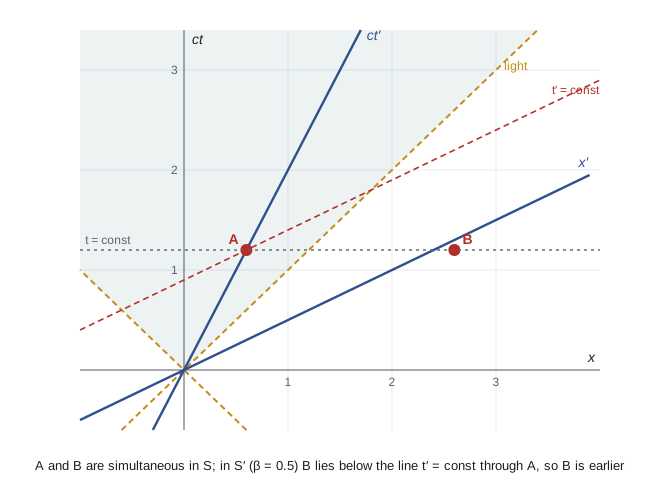
Lines of simultaneity in \(S'\) are parallel to the \(x'\) axis. Two events on the same horizontal line, simultaneous in \(S\), generally lie on different lines parallel to \(x'\), so an observer in \(S'\) sees them at different times. This relativity of simultaneity is the heart of special relativity, and nearly every paradox comes from forgetting it.
Computing with events
The program below applies the Lorentz transformation to a few events, checks that the interval is the same in both frames, and shows the change in time order for spacelike-separated events. Units are years and light-years, so \(c = 1\).
import math
def boost(t, x, beta):
    g = 1 / math.sqrt(1 - beta**2)
    return g * (t - beta * x), g * (x - beta * t)
def interval(e1, e2):
    dt, dx = e2[0] - e1[0], e2[1] - e1[1]
    return dt * dt - dx * dx
# events as (t, x) in years and light-years, frame S
events = {"A: flash at origin": (0.0, 0.0), "B: flash 4 ly away": (0.0, 4.0),
          "C: arrival of A's light": (4.0, 4.0), "D: later event": (5.0, 1.0)}
for beta in (0.5, -0.5):
    print(f"frame moving at beta = {beta:+.1f}")
    for name, (t, x) in events.items():
        tp, xp = boost(t, x, beta)
        print(f"  {name:26s} t = {t:5.2f}, x = {x:5.2f}  ->  t' = {tp:6.3f}, x' = {xp:6.3f}")
pairs = [("A: flash at origin", "B: flash 4 ly away"), ("A: flash at origin", "C: arrival of A's light"),
         ("A: flash at origin", "D: later event")]
for a, b in pairs:
    s2 = interval(events[a], events[b])
    p1 = boost(*events[a], 0.5); p2 = boost(*events[b], 0.5)
    kind = "timelike" if s2 > 1e-12 else ("spacelike" if s2 < -1e-12 else "lightlike")
print(f"interval {a[0]}{b[0]}: S gives {s2:7.3f}, S' gives {interval(p1, p2):7.3f} ({kind})")frame moving at beta = +0.5 A: flash at origin t = 0.00, x = 0.00 -> t' = 0.000, x' = 0.000 B: flash 4 ly away t = 0.00, x = 4.00 -> t' = -2.309, x' = 4.619 C: arrival of A's light t = 4.00, x = 4.00 -> t' = 2.309, x' = 2.309 D: later event t = 5.00, x = 1.00 -> t' = 5.196, x' = -1.732 frame moving at beta = -0.5 A: flash at origin t = 0.00, x = 0.00 -> t' = 0.000, x' = 0.000 B: flash 4 ly away t = 0.00, x = 4.00 -> t' = 2.309, x' = 4.619 C: arrival of A's light t = 4.00, x = 4.00 -> t' = 6.928, x' = 6.928 D: later event t = 5.00, x = 1.00 -> t' = 6.351, x' = 4.041 interval AB: S gives -16.000, S' gives -16.000 (spacelike) interval AC: S gives 0.000, S' gives 0.000 (lightlike) interval AD: S gives 24.000, S' gives 24.000 (timelike)
Events A and B are simultaneous in \(S\). In a frame moving at \(+0.5c\), B happens 2.31 years before A; in a frame moving at \(-0.5c\), 2.31 years after. Neither frame is wrong. Because A and B are separated by a spacelike interval, no signal can pass between them, so no causal paradox can arise from the disagreement. Events A and D, in contrast, are separated by a timelike interval, and every observer agrees that A comes first. The light signal from A to C has interval zero in every frame.
Adding velocities
Suppose an object moves at speed \(u'\) along \(x'\) in frame \(S'\). What is its speed \(u\) in \(S\)? Write its motion as \(x' = u' t'\) and apply the inverse transformation, \(x = \gamma (x' + v t')\) and \(t = \gamma (t' + v x'/c^2)\). Dividing,
For small speeds the denominator is close to 1 and the speeds add as Galileo said. But if \(u' = c\), then \(u = (c + v)/(1 + v/c) = c\): light moves at \(c\) in every frame, as the second postulate demands. Two speeds below \(c\) always combine to a speed below \(c\). A rocket moving at \(0.8c\) that fires a probe forward at \(0.8c\) relative to itself sees the probe recede at \(0.8c\), but on Earth the probe moves at \(1.6c/1.64 = 0.976c\), not \(1.6c\).
The cleanest way to see this is through the rapidity \(\phi\), defined by \(\beta = \tanh \phi\). Lorentz transformations along the same axis then combine by adding rapidities, \(\phi = \phi_1 + \phi_2\), just as rotations in a plane combine by adding angles. Since \(\tanh\) never exceeds 1, no finite sum of rapidities reaches the speed of light.
The twin paradox
Two twins are 20 years old. Ada stays on Earth; Ben flies to a star 4 light-years away at \(0.8c\) and immediately returns. By Earth clocks the trip takes 10 years, so Ada is 30 at the reunion. Ben's clock runs slow by \(\gamma = 5/3\), so he ages only 6 years and is 26. But from Ben's point of view, surely Ada was the one moving and should be younger? The answer is that the situation is not symmetric. Ada stays in one inertial frame throughout. Ben does not: he changes frames at the turnaround, and that is where the asymmetry lives.
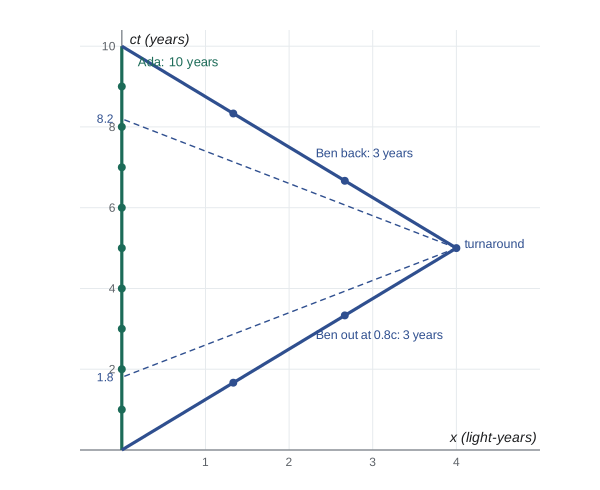
The spacetime diagram makes this clear. Proper time along a worldline is the sum of \(\sqrt{(c\,\Delta t)^2 - \Delta x^2}/c\) over its segments. For Ada's straight worldline that is 10 years. For each of Ben's legs it is \(\sqrt{5^2 - 4^2} = 3\) years, 6 in total. In spacetime geometry, the straight path between two events is the one with the longest proper time, the opposite of ordinary geometry, because of the minus sign in the interval. Ben's lines of simultaneity show what he thinks Ada's clock reads. Just before the turnaround he judges her to be at year 1.8 of the trip; just after, in his new frame, at year 8.2. The 6.4 years of Ada's life that seem to pass during his brief turnaround are the price of changing frames. Any acceleration, however brief, breaks the symmetry; the answer does not depend on the details of the turnaround.
import math
beta, d = 0.8, 4.0                  # speed and distance in light-years (c = 1)
g = 1 / math.sqrt(1 - beta**2)
t_turn = d / beta                    # Earth time of the turnaround
ada = 2 * t_turn
ben = 2 * math.sqrt(t_turn**2 - d**2)
print(f"gamma = {g:.4f}; Ada ages {ada:.2f} years, Ben ages {ben:.2f} years")
# what Ben, at the turnaround, regards as 'now' on Earth (x = 0):
# outbound frame: lines of constant t' have t - beta x = const; through (t_turn, d)
now_out = t_turn - beta * d
now_in = t_turn + beta * d          # inbound frame moves at -beta
print(f"Earth time Ben calls 'now' just before turning: {now_out:.2f} years")
print(f"Earth time Ben calls 'now' just after turning:  {now_in:.2f} years")
# Doppler check: each twin sends a signal every year of their own time
k_out = math.sqrt((1 - beta) / (1 + beta)); k_in = 1 / k_out
print(f"Doppler factor going out {k_out:.3f}, coming back {k_in:.3f}")
received_by_ben = (ben / 2) * k_out + (ben / 2) * k_in
print(f"signals from Ada counted by Ben: {received_by_ben:.1f} (= Ada's age gain)")gamma = 1.6667; Ada ages 10.00 years, Ben ages 6.00 years Earth time Ben calls 'now' just before turning: 1.80 years Earth time Ben calls 'now' just after turning: 8.20 years Doppler factor going out 0.333, coming back 3.000 signals from Ada counted by Ben: 10.0 (= Ada's age gain)
The last lines give a check that needs no simultaneity at all. If each twin sends a light signal on every birthday, Ben receives Ada's signals at a third of the rate on the way out, because of the relativistic Doppler effect, and at three times the rate on the way back. Over his 6 years he receives 1 + 9 = 10 signals, exactly Ada's ten birthdays. The twin effect has been confirmed directly: the muons in the CERN storage ring travelled in a circle, constantly accelerating, and came back younger than muons at rest.
The barn and the pole
A pole vaulter runs at \(\beta = 0.866\), so \(\gamma = 2\), carrying a pole 20 m long into a barn 10 m long with doors at both ends. In the barn frame the pole is contracted to 10 m and fits exactly; a farmer can close both doors at the same instant with the pole inside. In the runner's frame the barn is contracted to 5 m and the pole is 20 m, so it cannot possibly fit. Who is right? Both, because the two door closings are simultaneous in the barn frame but not in the runner's. In the runner's frame the front door closes first, when the front of the pole reaches it, and must open again to let the pole through before the back door closes behind the back of the pole. Nothing is ever crushed, because the events that the farmer calls simultaneous are, for the runner, separated in time.
Worked problem
When does the back door close for the runner?
In the barn frame the doors are at \(x = 0\) (back) and \(x = 10\) m (front) and both close at \(t = 0\), when the pole exactly fills the barn. Find the times of the closings in the runner's frame, moving at \(\beta = 0.866\).
Show solution
- Use \(ct' = \gamma(ct - \beta x)\) with \(\gamma = 2\).
- Back door: \(ct' = 2(0 - 0.866 \times 0) = 0\).
- Front door: \(ct' = 2(0 - 0.866 \times 10) = -17.3\) m, so it closes \(17.3/c = 58\) ns earlier.
- In the runner's frame the front door closes (and reopens) 58 ns before the back door closes; during that time the pole moves \(17.3 \times 0.866 = 15\) m, which is exactly the excess of its 20 m length over the contracted 5 m barn.
Answer: The front door closes 58 ns before the back door in the runner's frame, so the 20 m pole passes through a 5 m barn without ever being trapped.
Common mistakes
MistakeTreating simultaneity as absolute when resolving a paradox.
InsteadAlways ask whether two events are simultaneous in the frame you are using; most paradoxes dissolve once you do.
MistakeAdding relativistic speeds directly.
InsteadUse \(u = (u' + v)/(1 + u'v/c^2)\), or add rapidities.
MistakeSaying the twin paradox is resolved by general relativity.
InsteadSpecial relativity handles it fully; the asymmetry is the change of inertial frame, and proper time along each worldline gives the ages.
MistakeExpecting the straight worldline to have the shortest proper time.
InsteadThe minus sign in the interval reverses the usual rule: between two events, the inertial worldline has the longest proper time.
Summary and key terms
- The Lorentz transformation \(ct' = \gamma(ct - \beta x)\), \(x' = \gamma(x - \beta ct)\) follows from the two postulates.
- The interval \((c\Delta t)^2 - \Delta x^2\) is the same for all inertial observers; its sign classifies intervals as timelike, spacelike or lightlike.
- Spacetime diagrams show worldlines, light cones and the tilted axes of moving frames.
- Simultaneity is relative for spacelike-separated events, but the order of timelike events is absolute.
- Velocities combine as \(u = (u'+v)/(1+u'v/c^2)\); rapidities add.
- The travelling twin ages less because his worldline is bent; the barn and pole paradox is resolved by the relativity of simultaneity.
- Event
- Something happening at a definite place and time.
- Worldline
- The path of an object through spacetime.
- Light cone
- The set of events that light from a given event can reach, or that can send light to it.
- Spacetime interval
- \(\Delta s^2 = (c\Delta t)^2 - \Delta x^2\), invariant under Lorentz transformations.
- Rapidity
- \(\phi\) with \(\beta = \tanh\phi\); additive under successive boosts.
Practice problems
Work each problem on paper first, then reveal the answer to check.
Event P has \(ct = 5\) m, \(x = 3\) m in \(S\). Find its coordinates in a frame moving at \(\beta = 0.6\).
Show answer
\(\gamma = 1.25\); \(ct' = 1.25(5 - 1.8) = 4\) m and \(x' = 1.25(3 - 3) = 0\). The interval \(25 - 9 = 16 = 4^2\) checks.
Two spaceships approach Earth from opposite sides, each at \(0.9c\). How fast does one see the other approach?
Show answer
\(u = 1.8c/(1 + 0.81) = 0.9945c\).
Is it possible for event X to cause event Y if they are 3 light-years apart and 2 years apart in some frame?
Show answer
No: \(\Delta s^2 = 4 - 9 < 0\), a spacelike interval, so no signal at or below \(c\) can connect them.
In the twin example with \(\beta = 0.6\) and a star 3 light-years away, how much does each twin age?
Show answer
Earth time 10 years; each leg's proper time \(\sqrt{25 - 9} = 4\), so the traveller ages 8 years.
Show that light moving along \(x'\) at \(c\) in \(S'\) also moves at \(c\) in \(S\).
Show answer
\(u = (c + v)/(1 + v/c) = c(c + v)/(c + v) = c\).
Lesson quiz · 5 questions
Score 60% or more to complete this lesson.
Create a free account to save your progress, take quizzes and earn a certificate.