
PHYS-244 · Lesson 10 of 12 · 23 min
Non-inertial frames: centrifugal, Coriolis and the Foucault pendulum
We live on a rotating planet, ride in accelerating vehicles and design machines with spinning parts. It is often far easier to describe motion from the point of view of the rotating or accelerating frame than from an inertial one: the weather map is drawn on the turning Earth, and an engineer analysing a centrifuge rotor wants coordinates that turn with it. Newton's laws can be used in such frames if we add fictitious forces, terms that come not from any interaction but from the frame's own motion. This lesson derives them, measures their size on the Earth, and explains how Léon Foucault's pendulum demonstrated the Earth's rotation in 1851 without anyone looking at the sky.
Linearly accelerating frames
Suppose a frame accelerates at \(\mathbf A\) relative to an inertial frame, without rotating. A particle's position in the two frames differs by the frame's displacement, so its accelerations differ by \(\mathbf A\): \(\ddot{\mathbf r}_{\text{inertial}} = \ddot{\mathbf r} + \mathbf A\). Newton's law in the inertial frame, \(m\ddot{\mathbf r}_{\text{inertial}} = \mathbf F\), becomes
in the accelerating frame. The extra term \(-m\mathbf A\) acts like a uniform gravitational field pointing opposite to the frame's acceleration. In a car braking hard, you are pushed forward; in an elevator accelerating upward, you feel heavier. A pendulum hanging in an accelerating train settles at an angle \(\arctan(A/g)\) from vertical and swings about that tilted position with an effective gravity \(\sqrt{g^2 + A^2}\). In a freely falling frame, \(\mathbf A = \mathbf g\), and the fictitious force cancels gravity exactly: astronauts on the space station float not because gravity is absent (it is 90% of its surface value there) but because they and their station fall together. Einstein built general relativity on this equivalence between gravity and acceleration.
Rotating frames: the time derivative of a vector
Now let a frame rotate at angular velocity \(\boldsymbol\Omega\) relative to an inertial frame, with a common origin. A vector \(\mathbf Q\) fixed in the rotating frame changes, as seen from the inertial frame, at the rate \(\boldsymbol\Omega\times\mathbf Q\): each point of a rotating body moves perpendicular to both the axis and its position. A general vector changes for two reasons, its own change relative to the rotating frame and the rotation carrying it along, so
This operator identity is the whole basis of rotating-frame mechanics. Apply it to the position \(\mathbf r\): \(\mathbf v_{\text{in}} = \mathbf v + \boldsymbol\Omega\times\mathbf r\), where \(\mathbf v\) is the velocity seen in the rotating frame. Apply it again to \(\mathbf v_{\text{in}}\), assuming \(\boldsymbol\Omega\) is constant:
Multiplying by \(m\), setting \(m\mathbf a_{\text{in}} = \mathbf F\), and moving the extra terms to the right side gives Newton's law in the rotating frame:
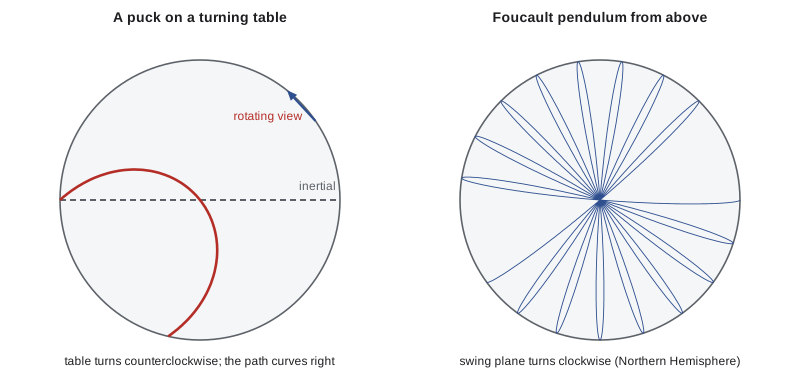
The last term is the centrifugal force. It points directly away from the rotation axis, with magnitude \(m\Omega^2\rho\), where \(\rho\) is the distance from the axis. The middle term is the Coriolis force, named for Gaspard-Gustave de Coriolis, who analysed it in an 1835 paper on the mechanics of rotating machinery. It acts only on bodies moving relative to the rotating frame, perpendicular to both their velocity and the axis, and it does no work because it is perpendicular to the velocity. If the rotation rate varies, a third fictitious force \(-m\dot{\boldsymbol\Omega}\times\mathbf r\), the Euler force, appears; you feel it when a merry-go-round starts up.
Effective gravity on the rotating Earth
The Earth rotates at \(\Omega = 2\pi/(86{,}164\ \mathrm{s}) = 7.29\times10^{-5}\ \mathrm{rad/s}\), once per sidereal day (one turn relative to the stars, about four minutes shorter than the 24-hour solar day). At latitude \(\lambda\), a point on the surface is \(\rho = R\cos\lambda\) from the axis, and the centrifugal acceleration \(\Omega^2R\cos\lambda\) reaches 0.034 m/s² at the equator. A plumb line hangs along the combination of true gravity and centrifugal force, the effective gravity \(\mathbf g_{\text{eff}} = \mathbf g - \boldsymbol\Omega\times(\boldsymbol\Omega\times\mathbf r)\). Its magnitude is 0.3% smaller at the equator than at the poles from this effect alone, and about 0.5% smaller in total, because the same rotation has flattened the Earth into an oblate shape, putting the equator 21 km further from the centre. The direction of a plumb line differs from a line to the Earth's centre by an angle that peaks at \(45^\circ\) latitude.
The Coriolis force on Earth
For motion near the surface, choose local axes with \(x\) east, \(y\) north and \(z\) up. The Earth's angular velocity then has components \(\boldsymbol\Omega = \Omega(0, \cos\lambda, \sin\lambda)\). The vertical component \(\Omega\sin\lambda\) deflects horizontal motion: in the Northern Hemisphere, anything moving horizontally is pushed to its right, with acceleration \(2\Omega\sin\lambda\,v\). The horizontal component \(\Omega\cos\lambda\) deflects vertical motion east or west. For a ball dropped from rest, the velocity is downward, and \(-2\boldsymbol\Omega\times\mathbf v\) points east. Integrating to first order in \(\Omega\), with \(v_z = -gt\), gives an eastward acceleration \(2\Omega\cos\lambda\,gt\) and an eastward displacement
The eastward drift has a simple interpretation in the inertial frame: the top of a tower is further from the axis than its base, so it moves eastward faster, and the falling ball keeps that extra speed. The program integrates the fall in the rotating frame and compares with the formula, and also computes the plumb-line deviation and the turning period of a Foucault pendulum.
import math

OMEGA = 2 * math.pi / 86164.1            # Earth's rotation rate (rad/s), one sidereal day
g0, R = 9.81, 6.371e6
places = [("Winnipeg", 49.90), ("Edmonton", 53.55), ("Equator", 0.0)]

for name, lat in places:
    lam = math.radians(lat)
    # plumb-line deviation from the centrifugal term (small-angle estimate)
    dev = OMEGA ** 2 * R * math.sin(lam) * math.cos(lam) / g0
    turn = f"{86164.1 / 3600 / math.sin(lam):6.2f} h" if lat else " never"
    print(f"{name:9s} lat {lat:5.2f}: plumb deviation {math.degrees(dev) * 60:5.2f} arcmin, Foucault turn {turn}")

# Drop a ball from rest 100 m up, integrating in Earth's rotating frame
# (x east, y north, z up). The centrifugal term is folded into g.
def drop(lat, h=100.0, dt=1e-4):
    lam = math.radians(lat)
    w = (0.0, OMEGA * math.cos(lam), OMEGA * math.sin(lam))
    r, v, t = [0.0, 0.0, h], [0.0, 0.0, 0.0], 0.0
    def acc(v):
        cx = w[1] * v[2] - w[2] * v[1]; cy = w[2] * v[0] - w[0] * v[2]; cz = w[0] * v[1] - w[1] * v[0]
        return (-2 * cx, -2 * cy, -g0 - 2 * cz)        # a = g - 2 w x v
    while r[2] > 0:
        a1 = acc(v); vm = [vi + 0.5 * dt * ai for vi, ai in zip(v, a1)]
        a2 = acc(vm)
        r = [ri + dt * vi for ri, vi in zip(r, vm)]; v = [vi + dt * ai for vi, ai in zip(v, a2)]; t += dt
    return r[0], t

for name, lat in places:
    east, t = drop(lat)
    formula = OMEGA * g0 * t ** 3 * math.cos(math.radians(lat)) / 3
print(f"{name:9s}: 100 m drop lands {east * 1000:5.2f} mm east (formula {formula * 1000:5.2f} mm)")Winnipeg lat 49.90: plumb deviation 5.85 arcmin, Foucault turn 31.29 h Edmonton lat 53.55: plumb deviation 5.67 arcmin, Foucault turn 29.76 h Equator lat 0.00: plumb deviation 0.00 arcmin, Foucault turn never Winnipeg : 100 m drop lands 14.14 mm east (formula 14.14 mm) Edmonton : 100 m drop lands 13.04 mm east (formula 13.04 mm) Equator : 100 m drop lands 21.95 mm east (formula 21.95 mm)
A ball dropped 100 m in Winnipeg lands 14.1 mm east of the point directly below its release; in Edmonton, further north, 13.0 mm; on the equator 22.0 mm. The numerical integration and the first-order formula agree to the printed precision, because the neglected terms are smaller by a further factor of \(\Omega t \approx 3\times10^{-4}\). Measuring such tiny deflections is hard, since air currents easily push a ball by more, but it was done in mine shafts in the nineteenth century, in agreement with the formula. The plumb-line deviation is about 6 minutes of arc in both cities, near its maximum because they are close to \(45^\circ\) latitude.
Weather, oceans and the size of the effect
The Coriolis acceleration \(2\Omega v\sin\lambda\) is small, about \(10^{-3}\ \mathrm{m/s^2}\) for a 10 m/s wind at mid-latitudes, but it acts steadily over hours and thousands of kilometres. Its importance is measured by the Rossby number \(\mathrm{Ro} = v/(fL)\), the ratio of inertial to Coriolis acceleration, where \(f = 2\Omega\sin\lambda\) is the Coriolis parameter and \(L\) the size of the motion. For a weather system with \(L = 1000\ \mathrm{km}\), \(\mathrm{Ro} \approx 0.1\), and the Coriolis force dominates: instead of flowing straight from high pressure to low, air is deflected until the Coriolis force balances the pressure gradient, and the wind blows along the isobars. That is why winds circle counterclockwise around a low-pressure centre in the Northern Hemisphere and clockwise in the Southern, and why the great ocean currents form basin-wide gyres. For water draining from a bathtub, with \(L\) of a few tens of centimetres and \(v\) of centimetres per second, \(\mathrm{Ro}\) is in the thousands; the direction of the swirl is set by how the water was disturbed, not by the hemisphere.
The Foucault pendulum
In 1851 Léon Foucault hung a 28 kg iron ball on a 67 m wire from the dome of the Panthéon in Paris and set it swinging. Over the following hours the plane of its swing turned slowly clockwise as seen from above. Nothing in the building pushed it; the floor and the Earth were turning underneath the pendulum. At the North Pole the swing plane would stay fixed relative to the stars while the Earth turned once beneath it every sidereal day. At latitude \(\lambda\) only the vertical component of the Earth's rotation matters for horizontal motion, so the swing plane turns at
To derive this, write the horizontal equations of motion of the bob for small swings, including the Coriolis force from the vertical component of \(\boldsymbol\Omega\): \(\ddot x = -\omega_0^2x + 2\Omega_z\dot y\), \(\ddot y = -\omega_0^2y - 2\Omega_z\dot x\), with \(\omega_0^2 = g/\ell\) and \(\Omega_z = \Omega\sin\lambda\). Combine them into one complex equation for \(w = x + iy\): \(\ddot w + 2i\Omega_z\dot w + \omega_0^2w = 0\). Trying \(w = e^{-i\Omega_zt}u\) and dropping the tiny term \(\Omega_z^2u\) gives \(\ddot u + \omega_0^2u = 0\): an ordinary pendulum swinging in a plane, multiplied by a rotation \(e^{-i\Omega_zt}\) that turns the plane clockwise at rate \(\Omega_z\).
In Winnipeg the swing plane makes a full turn in 31.3 hours, and in Edmonton in 29.8 hours. In Paris it is 31.8 hours, and at the equator the plane does not turn at all. Foucault pendulums hang in many science museums and universities; a long wire, a heavy bob and a careful start that avoids any sideways push are needed, because a small elliptical motion makes the plane turn on its own and can easily mask the effect.
Worked problem
Coriolis deflection of a long-range shot
A projectile travels north at an average horizontal speed of 800 m/s for 60 s at latitude \(50^\circ\) north. Estimate its sideways deflection.
Show solution
- The horizontal Coriolis acceleration is \(2\Omega\sin\lambda\,v = 2(7.29\times10^{-5})(0.766)(800) = 0.0894\ \mathrm{m/s^2}\), to the right (east).
- Constant acceleration over 60 s gives \(\tfrac12at^2 = \tfrac12(0.0894)(3600) = 161\ \mathrm{m}\).
Answer: About 160 m to the east, far too large to ignore for long-range artillery. Naval gunners in the First World War applied Coriolis corrections in their firing tables; a famous story, perhaps exaggerated, has British gunners off the Falkland Islands in 1914 missing because their tables assumed the Northern Hemisphere.
Centrifuges and artificial gravity
A centrifuge uses the centrifugal acceleration \(\Omega^2r\) of its rotating frame as a strong artificial gravity. A laboratory centrifuge at 15,000 rpm with a 10 cm radius produces about 25,000 times Earth's gravity, separating particles by density far faster than ordinary settling. A rotating space station could provide artificial gravity for its crew the same way. The Coriolis force sets a practical limit: a person turning their head or walking in a small, fast station feels strong Coriolis effects that cause motion sickness. Studies suggest keeping the spin below about 2 revolutions per minute, which for \(1g\) requires a radius of more than 200 m.
Common mistakes
MistakeIncluding centrifugal force when working in an inertial frame.
InsteadFictitious forces belong only in non-inertial frames; in an inertial frame, circular motion needs a real centripetal force.
MistakeUsing 24 hours for the Earth's rotation period in precise calculations.
InsteadThe rotation relative to the stars takes one sidereal day, 23 h 56 min 4 s.
MistakeThinking the Coriolis force changes a body's speed.
InsteadIt is perpendicular to the velocity and does no work.
MistakeExpecting the Coriolis force to decide the direction of a draining sink.
InsteadThe Rossby number there is in the thousands; the initial swirl dominates.
MistakeApplying \(T_F = 23.93\ \mathrm{h}\) at every latitude.
InsteadDivide by \(\sin\lambda\); only at the poles does the swing plane turn once per sidereal day.
Summary and key terms
- In a frame accelerating at \(\mathbf A\), add the fictitious force \(-m\mathbf A\); in free fall it cancels gravity.
- Rates of change in a rotating frame satisfy \((d\mathbf Q/dt)_{\text{in}} = (d\mathbf Q/dt)_{\text{rot}} + \boldsymbol\Omega\times\mathbf Q\).
- In a frame rotating at constant \(\boldsymbol\Omega\): \(m\mathbf a = \mathbf F - 2m\boldsymbol\Omega\times\mathbf v - m\boldsymbol\Omega\times(\boldsymbol\Omega\times\mathbf r)\).
- On Earth the centrifugal term reduces and tilts effective gravity; the Coriolis term deflects horizontal motion right in the Northern Hemisphere.
- A dropped body lands east by \(\tfrac13\Omega g\cos\lambda\,t^3\).
- A Foucault pendulum's swing plane turns at \(\Omega\sin\lambda\), once every \(23.93\ \mathrm{h}/\sin\lambda\).
- fictitious force
- A term added to Newton's law in a non-inertial frame, arising from the frame's motion rather than an interaction.
- centrifugal force
- The fictitious force m Omega squared rho directed away from the rotation axis in a rotating frame.
- Coriolis force
- The fictitious force minus 2m Omega cross v on a body moving in a rotating frame.
- sidereal day
- The Earth's rotation period relative to the stars, 23 h 56 min 4 s.
- Rossby number
- The ratio v over f L comparing inertial and Coriolis accelerations in large-scale flow.
- Foucault pendulum
- A long pendulum whose swing plane slowly turns, revealing the Earth's rotation.
Practice problems
Work each problem on paper first, then reveal the answer to check.
A truck accelerates at \(2.0\ \mathrm{m/s^2}\). At what angle does a pendulum hanging in the cab settle?
Show answer
\(\arctan(2.0/9.81) = 11.5^\circ\) from vertical, toward the back.
Find the Coriolis acceleration of a car driving north at 30 m/s at latitude \(45^\circ\).
Show answer
\(2(7.29\times10^{-5})(0.707)(30) = 3.1\times10^{-3}\ \mathrm{m/s^2}\), to the east.
How long does a Foucault pendulum at the South Pole take to turn once, and which way?
Show answer
One sidereal day, 23.93 h, counterclockwise as seen from above.
A space station of radius 100 m is to provide \(1g\) at its rim. Find its rotation rate in revolutions per minute.
Show answer
\(\Omega = \sqrt{9.81/100} = 0.313\ \mathrm{rad/s} = 3.0\ \mathrm{rpm}\).
A centrifuge spins at 12,000 rpm with a 7.0 cm radius. Find its acceleration in units of \(g\).
Show answer
\(\Omega = 1257\ \mathrm{rad/s}\); \(\Omega^2r = 1.11\times10^5\ \mathrm{m/s^2} \approx 11{,}300g\).
Estimate the Rossby number for a hurricane with winds of 50 m/s over a radius of 100 km at latitude \(20^\circ\).
Show answer
\(f = 2(7.29\times10^{-5})(0.342) = 5.0\times10^{-5}\ \mathrm{s^{-1}}\); \(\mathrm{Ro} = 50/(5.0\times10^{-5}\cdot10^5) = 10\). Near the eye inertial effects dominate, though the Coriolis force sets the spin direction as the storm forms.
Lesson quiz · 5 questions
Score 60% or more to complete this lesson.
Create a free account to save your progress, take quizzes and earn a certificate.