
PHYS-230 · Lesson 8 of 12 · 26 min
Electromagnetic waves and polarization
Light, radio, microwaves and X-rays are all electromagnetic waves: oscillating electric and magnetic fields that sustain each other and travel through empty space at \(c\). PHYS-131 met them at the end of a course on electricity and magnetism. Here we derive the wave equation from Maxwell's equations, work out the energy, momentum and intensity the waves carry, and then study the property that sets electromagnetic waves apart from sound in air: they are transverse, so they have a polarization. Polarization is described with a small piece of linear algebra, the Jones calculus, and it explains polarizing sunglasses, the glare-free angle of reflection discovered by Brewster, the wave plates that turn linear polarization into circular, and the liquid-crystal displays on almost every screen.
From Maxwell's equations to waves
In empty space, with no charges or currents, Maxwell's equations read
Take the curl of the third equation. The left side is \(\nabla\times(\nabla\times\mathbf E) = \nabla(\nabla\cdot\mathbf E) - \nabla^2\mathbf E = -\nabla^2\mathbf E\), using the first equation. The right side is \(-\frac{\partial}{\partial t}\nabla\times\mathbf B = -\mu_0\varepsilon_0\frac{\partial^2\mathbf E}{\partial t^2}\) by the fourth. So each component of \(\mathbf E\), and by the same argument of \(\mathbf B\), satisfies
Maxwell computed this speed in 1865 from electrical measurements and found it equal, within the uncertainty of the time, to the measured speed of light, concluding that light is an electromagnetic disturbance. Since 1983 the metre has been defined so that \(c\) is exactly 299,792,458 m/s. Heinrich Hertz produced and detected the waves in 1887, measuring their wavelength from standing waves in his laboratory and confirming they reflect, refract and polarize like light.
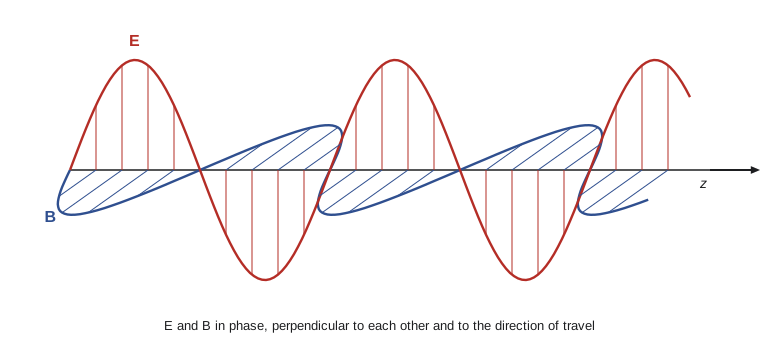
Take a plane wave travelling along \(z\), \(\mathbf E = \mathbf E_0\cos(kz - \omega t)\), with \(\omega = ck\). Gauss's law \(\nabla\cdot\mathbf E = 0\) forces \(E_{0z} = 0\): the field is perpendicular to the direction of travel, so the wave is transverse. Faraday's law then gives \(\mathbf B = \frac1c\hat{\mathbf z}\times\mathbf E\). The magnetic field is perpendicular to both \(\mathbf E\) and the direction of travel, in phase with \(\mathbf E\), and smaller by the factor \(c\): \(B_0 = E_0/c\). The direction of travel is the direction of \(\mathbf E\times\mathbf B\).
Energy, intensity and momentum
The energy density of the fields is \(u = \tfrac12\varepsilon_0E^2 + \frac{1}{2\mu_0}B^2\). For a wave \(B = E/c\), so the two terms are equal, the electromagnetic counterpart of the equal kinetic and potential energies of a string wave. The energy flux is given by the Poynting vector
introduced by John Henry Poynting in 1884, which points along the direction of travel with magnitude \(uc\). Averaging \(\cos^2\) over a cycle gives the intensity
\(Z_0\) is the impedance of free space, the ratio \(E/H\) for a plane wave, and it plays the same role as the string impedance in lesson 5. Sunlight at the top of the atmosphere has \(I \approx 1361\ \mathrm{W/m^2}\), so \(E_0 = \sqrt{2Z_0I} \approx 1010\ \mathrm{V/m}\) and \(B_0 \approx 3.4\ \mathrm{\mu T}\). Waves also carry momentum, with momentum density \(u/c\). Absorbed light exerts a radiation pressure \(I/c\), and perfectly reflected light exerts \(2I/c\): about \(4.5\ \mathrm{\mu Pa}\) and \(9\ \mathrm{\mu Pa}\) for sunlight. Tiny as that is, the solar sail of the Japanese probe IKAROS used it for propulsion in 2010, and laser tweezers use the momentum of tightly focused light to hold single cells and molecules, work honoured by half of the 2018 Nobel Prize in Physics to Arthur Ashkin.
In a transparent medium the speed becomes \(c/n\) with refractive index \(n = \sqrt{\varepsilon_r\mu_r}\), approximately \(\sqrt{\varepsilon_r}\) for nonmagnetic materials at optical frequencies. The relative permittivity at optical frequencies is set by how electrons respond to the rapidly oscillating field, and it depends on frequency, which is the dispersion of lesson 7. The medium's impedance is \(Z_0/n\), so the reflection of light at normal incidence follows the formula of lesson 5: \(r = (n_1 - n_2)/(n_1 + n_2)\), giving a reflectance of 4 parts in a hundred at each air-glass surface for \(n = 1.5\).
Polarization states
Because the field is transverse, a wave travelling along \(z\) has two independent field components, \(E_x\) and \(E_y\). Write the field as the real part of \(\mathbf{\tilde E}e^{i(kz - \omega t)}\) with a complex vector \(\mathbf{\tilde E} = (\tilde E_x, \tilde E_y)\), the Jones vector introduced by R. Clark Jones in 1941. If the two components are in phase, the tip of \(\mathbf E\) traces a line: linear polarization, for example \((1, 0)\) horizontal or \((\cos\theta, \sin\theta)\) at angle \(\theta\). If they have equal amplitude and are a quarter cycle apart, \((1, \pm i)/\sqrt2\), the tip traces a circle: circular polarization. Anything else gives an ellipse. Ordinary light from the Sun or a bulb is unpolarized: it is a rapid random succession of polarization states, so no direction is preferred on average.
A linear polarizer passes the field component along its transmission axis and absorbs the perpendicular one. In Jones form, a polarizer at angle \(\theta\) is the projection matrix
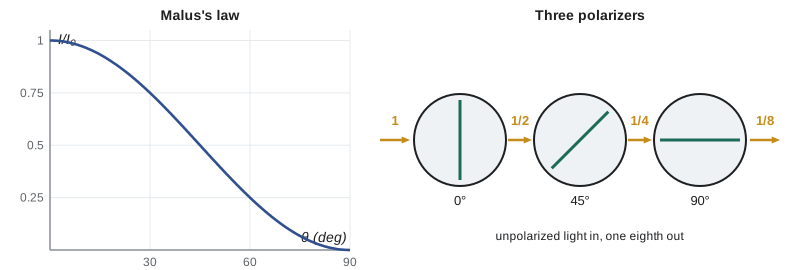
Light linearly polarized at angle \(\alpha\) emerges with amplitude \(\cos(\theta - \alpha)\) times the original, so the transmitted intensity is
Malus's law, found by Étienne-Louis Malus in 1808 while looking through a calcite crystal at sunlight reflected from the windows of the Luxembourg Palace. Unpolarized light through one ideal polarizer loses exactly half its intensity, the average of \(\cos^2\). Crossed polarizers transmit nothing, but insert a third polarizer at \(45^\circ\) between them and light gets through: \(\tfrac12 \times \cos^245^\circ \times \cos^245^\circ = \tfrac18\) of the original. The middle polarizer does not add light; it changes the polarization so the last one has something to pass.
Polarization by reflection
Reflection polarizes light. The fraction reflected depends on the polarization: for the component with \(\mathbf E\) perpendicular to the plane of incidence (s polarization) and the component in that plane (p polarization) Fresnel derived in 1821 the amplitude ratios
with \(\theta_t\) from Snell's law \(n_1\sin\theta_i = n_2\sin\theta_t\). At normal incidence both reduce to the formula above. The p reflectance vanishes when \(\theta_i + \theta_t = 90^\circ\), which with Snell's law gives Brewster's angle
David Brewster found the law experimentally in 1815. At \(\theta_B\) the reflected light is purely s polarized. For water, \(\theta_B = \arctan(1.33) = 53^\circ\), which is why glare from a lake or a wet road at moderate angles is mostly horizontally polarized, and why polarizing sunglasses, with vertical transmission axes, cut it. Photographers use a polarizing filter to darken reflections and the blue sky, whose scattered light is also partly polarized. Laser tubes have Brewster-angle windows so that one polarization passes with no reflection loss, which is why many gas lasers emit linearly polarized light.
Worked problem
Glare from a lake
Sunlight reflects from water (\(n = 1.33\)) at \(60^\circ\) incidence. Find the s and p reflectances and the degree of polarization of the reflected light.
Show solution
- Snell: \(\sin\theta_t = \sin60^\circ/1.33 = 0.651\), so \(\theta_t = 40.6^\circ\).
- \(r_s = (\cos60^\circ - 1.33\cos40.6^\circ)/(\cos60^\circ + 1.33\cos40.6^\circ) = (0.500 - 1.010)/(0.500 + 1.010) = -0.338\), so \(R_s = 0.114\).
- \(r_p = (1.33\cos60^\circ - \cos40.6^\circ)/(1.33\cos60^\circ + \cos40.6^\circ) = (0.665 - 0.759)/(0.665 + 0.759) = -0.066\), so \(R_p = 0.0044\).
- Degree of polarization \((R_s - R_p)/(R_s + R_p) = 0.93\).
Answer: The reflected glare is 93 parts in a hundred polarized, nearly all s, that is horizontal. Vertical polarizers block almost all of it.
Birefringence and wave plates
In crystals such as calcite and quartz, the refractive index depends on the polarization direction relative to the crystal axis. Light polarized along the fast axis travels with index \(n_f\) and along the slow axis with \(n_s > n_f\). A plate of thickness \(d\) introduces a phase difference \(\Gamma = 2\pi(n_s - n_f)d/\lambda\) between the two components. A quarter-wave plate has \(\Gamma = \pi/2\): light linearly polarized at \(45^\circ\) to its axes, Jones vector \((1, 1)/\sqrt2\), emerges as \((1, i)/\sqrt2\), circularly polarized. A half-wave plate, \(\Gamma = \pi\), rotates linear polarization by twice the angle between the polarization and the fast axis. With its axes along \(x\) and \(y\), a wave plate has the Jones matrix \(\begin{pmatrix} 1 & 0 \\ 0 & e^{i\Gamma} \end{pmatrix}\), and any sequence of polarizers and plates is analysed by multiplying matrices. Plastics under stress become birefringent, so viewing a clear plastic part between crossed polarizers shows stress concentrations as bands of varying hue; engineers used this photoelastic method to study stresses in models of bridges and gears before computer simulation.
A liquid-crystal display uses the same ideas. Each pixel sits between crossed polarizers, and a thin layer of liquid crystal twisted by \(90^\circ\) guides the polarization round so that light passes. A voltage across the layer untwists the molecules, the polarization is no longer rotated, and the crossed polarizers block the light. Varying the voltage gives grey levels, and filters over subpixels give the image its hues.
Worked problem
Making circular polarization
Quartz has \(n_s - n_f = 0.0092\) at 589 nm. Find the thinnest quarter-wave plate, and find the output when horizontally polarized light meets a quarter-wave plate whose fast axis is at \(45^\circ\).
Show solution
- \(\Gamma = \pi/2\) requires \(d = \lambda/4(n_s - n_f) = 589\times10^{-9}/(4 \times 0.0092) = 16.0\ \mathrm{\mu m}\).
- Resolved along the plate's axes, horizontal light has components \(\cos45^\circ\) and \(-\sin45^\circ\): equal amplitudes, in phase apart from the sign.
- The plate delays the slow component by a quarter cycle, making the two components a quarter cycle apart with equal amplitude: circular polarization.
Answer: A 16 μm plate, too thin to handle, so commercial plates are made a whole number of waves thicker, or from mica or polymer films. Linear light at \(45^\circ\) to the axes always becomes circular.
Computing with Jones matrices
The program implements Jones vectors and matrices, checks Malus's law and the three-polarizer result, makes circular polarization with a quarter-wave plate, and computes the Fresnel reflectances of glass against angle to locate Brewster's angle.
import math, cmath

def mat_vec(M, v): return [M[0][0]*v[0] + M[0][1]*v[1], M[1][0]*v[0] + M[1][1]*v[1]]
def intensity(v): return abs(v[0])**2 + abs(v[1])**2
def polarizer(th):
    c, s = math.cos(th), math.sin(th)
    return [[c*c, c*s], [c*s, s*s]]
def waveplate(gamma, axis):
    c, s = math.cos(axis), math.sin(axis)
    R = [[c, -s], [s, c]]; Rt = [[c, s], [-s, c]]
    D = [[1, 0], [0, cmath.exp(1j*gamma)]]
    mul = lambda A, B: [[sum(A[i][k]*B[k][j] for k in range(2)) for j in range(2)] for i in range(2)]
    return mul(R, mul(D, Rt))

# Malus's law
for deg in (0, 30, 45, 60, 90):
    out = mat_vec(polarizer(math.radians(deg)), [1, 0])
    print(f"horizontal light, polarizer at {deg:2d} deg: I/I0 = {intensity(out):.4f}, cos^2 = {math.cos(math.radians(deg))**2:.4f}")

# unpolarized light through 0, 45, 90 degrees: average two orthogonal inputs
total = 0.0
for v in ([1, 0], [0, 1]):
    for th in (0, 45, 90):
        v = mat_vec(polarizer(math.radians(th)), v)
    total += intensity(v) / 2
print(f"\nthree polarizers 0/45/90: I/I0 = {total:.4f}; without the middle one: {0.5*intensity(mat_vec(polarizer(math.pi/2), [1, 0])):.4f}")

# quarter-wave plate at 45 degrees on horizontal light
out = mat_vec(waveplate(math.pi/2, math.pi/4), [1, 0])
ratio = out[1] / out[0]
print(f"\nafter quarter-wave plate: |Ey/Ex| = {abs(ratio):.4f}, phase difference = {math.degrees(cmath.phase(ratio)):.1f} deg (circular)")

# Fresnel reflectances air to glass, n = 1.50
n1, n2 = 1.0, 1.50
print("\n angle    Rs      Rp")
for deg in (0, 30, 45, 56.31, 60, 75, 85):
    ti = math.radians(deg); tt = math.asin(n1 * math.sin(ti) / n2)
    rs = (n1*math.cos(ti) - n2*math.cos(tt)) / (n1*math.cos(ti) + n2*math.cos(tt))
    rp = (n2*math.cos(ti) - n1*math.cos(tt)) / (n2*math.cos(ti) + n1*math.cos(tt))
    print(f"{deg:6.2f}  {rs*rs:.4f}  {rp*rp:.5f}")
print(f"Brewster angle arctan(1.5) = {math.degrees(math.atan(1.5)):.2f} deg")horizontal light, polarizer at 0 deg: I/I0 = 1.0000, cos^2 = 1.0000 horizontal light, polarizer at 30 deg: I/I0 = 0.7500, cos^2 = 0.7500 horizontal light, polarizer at 45 deg: I/I0 = 0.5000, cos^2 = 0.5000 horizontal light, polarizer at 60 deg: I/I0 = 0.2500, cos^2 = 0.2500 horizontal light, polarizer at 90 deg: I/I0 = 0.0000, cos^2 = 0.0000 three polarizers 0/45/90: I/I0 = 0.1250; without the middle one: 0.0000 after quarter-wave plate: |Ey/Ex| = 1.0000, phase difference = -90.0 deg (circular) angle Rs Rp 0.00 0.0400 0.04000 30.00 0.0578 0.02525 45.00 0.0920 0.00847 56.31 0.1479 0.00000 60.00 0.1766 0.00180 75.00 0.3994 0.10677 85.00 0.7323 0.49325 Brewster angle arctan(1.5) = 56.31 deg
The polarizer results reproduce \(\cos^2\theta\), the crossed pair transmits nothing while the three-polarizer chain transmits one eighth, and the quarter-wave plate leaves equal components a quarter cycle apart. The reflectance table shows \(R_p\) falling to zero at \(56.31^\circ\), Brewster's angle for glass, while \(R_s\) rises steadily toward 1 at grazing incidence. At normal incidence both are 0.04.
Common mistakes
MistakeThinking the magnetic field of a light wave is negligible because \(B_0 = E_0/c\) is small in teslas.
InsteadThe magnetic energy density equals the electric; the factor \(c\) just reflects the units.
MistakeApplying Malus's law to unpolarized light.
InsteadUnpolarized light through an ideal polarizer loses exactly half; \(\cos^2\) applies to already polarized light.
MistakeBelieving crossed polarizers can never transmit light.
InsteadA third polarizer between them at an intermediate angle lets light through.
MistakeSaying light reflected at Brewster's angle is p polarized.
InsteadAt Brewster's angle the p reflectance is zero, so the reflected light is purely s polarized.
MistakeExpecting a quarter-wave plate to make circular light from any linear input.
InsteadThe input must be at \(45^\circ\) to the plate's axes; other angles give elliptical light.
Summary and key terms
- Maxwell's equations give \(\nabla^2\mathbf E = c^{-2}\partial_t^2\mathbf E\) with \(c = 1/\sqrt{\mu_0\varepsilon_0}\); waves are transverse with \(B_0 = E_0/c\).
- Intensity \(I = E_0^2/2Z_0\), \(Z_0 \approx 377\ \Omega\); radiation pressure is \(I/c\) absorbed and \(2I/c\) reflected.
- Jones vectors describe linear, circular and elliptical polarization; polarizers are projection matrices and give Malus's law \(I = I_0\cos^2\theta\).
- Fresnel's equations give polarization-dependent reflectance; \(R_p = 0\) at Brewster's angle \(\tan\theta_B = n_2/n_1\).
- Birefringent wave plates introduce a phase \(\Gamma = 2\pi\Delta n\,d/\lambda\); a quarter-wave plate makes circular from linear at \(45^\circ\).
- Poynting vector
- The energy flux of an electromagnetic field, E cross B over mu zero.
- impedance of free space
- The ratio of electric to magnetic field strength for a plane wave, about 377 ohms.
- Jones vector
- A complex two-component vector describing the polarization of a plane wave.
- Malus's law
- Polarized light through a polarizer at angle theta keeps cos squared theta of its intensity.
- Brewster's angle
- The angle of incidence at which p-polarized light is not reflected.
- birefringence
- Dependence of refractive index on polarization direction in a crystal.
Practice problems
Work each problem on paper first, then reveal the answer to check.
A laser beam of 5.0 mW is focused to a spot 20 μm across. Estimate the peak field amplitude.
Show answer
\(I \approx P/A = 5\times10^{-3}/(\pi\cdot10^{-10}) \approx 1.6\times10^7\ \mathrm{W/m^2}\); \(E_0 = \sqrt{2Z_0I} \approx 1.1\times10^5\ \mathrm{V/m}\).
Find the radiation force of sunlight on a perfectly reflecting sail of 200 m² facing the Sun near Earth.
Show answer
\(F = 2IA/c = 2(1361)(200)/3\times10^8 \approx 1.8\ \mathrm{mN}\).
Polarized light passes polarizers at \(20^\circ\), \(40^\circ\), \(60^\circ\), \(80^\circ\) relative to its plane. What fraction emerges?
Show answer
Four steps of \(20^\circ\): \((\cos^2 20^\circ)^4 = 0.883^4 = 0.61\), versus \(\cos^280^\circ = 0.030\) in one step. Many small steps rotate polarization with little loss.
Find Brewster's angle for light going from glass (\(n = 1.52\)) into air.
Show answer
\(\tan\theta_B = 1/1.52\), so \(\theta_B = 33.3^\circ\).
A half-wave plate has its fast axis at \(22.5^\circ\) to horizontally polarized input. What is the output?
Show answer
Linear polarization rotated by \(2 \times 22.5^\circ = 45^\circ\).
What fraction of normally incident light passes through both faces of a glass window (\(n = 1.5\)), ignoring multiple reflections?
Show answer
Each face transmits \(1 - 0.04 = 0.96\), so \(0.96^2 = 0.92\).
Lesson quiz · 5 questions
Score 60% or more to complete this lesson.
Create a free account to save your progress, take quizzes and earn a certificate.