
PHYS-230 · Lesson 10 of 12 · 25 min
Diffraction: single slit, gratings and resolution
Waves bend around obstacles and spread out after passing through openings. Sound turns corners easily because its wavelength is comparable to doorways; light seems to travel in straight lines because its wavelength is a million times smaller than everyday openings. But look closely at the edge of a shadow or at a bright point through a small aperture and the spreading is there, as fringes and rings. This is diffraction. It is the same physics as interference, with a continuum of sources instead of two, and this lesson develops it from Huygens's principle: the single slit, the diffraction grating that sorts light by wavelength, and the circular aperture whose pattern sets the sharpness of every camera, microscope and telescope. We end with X-ray diffraction by crystals, which revealed the arrangement of atoms in matter.
Huygens's principle and the two regimes
Huygens proposed in 1678 that every point on a wavefront acts as a source of secondary wavelets, and the new wavefront is their envelope. Fresnel added in 1818 that the wavelets interfere, so the field at any point is the sum of the contributions from every point of the aperture with their phases. That Huygens–Fresnel principle, later put on a firm footing by Gustav Kirchhoff's integral theorem of 1882, explains diffraction quantitatively. Two regimes are distinguished by the Fresnel number \(N_F = a^2/L\lambda\) for an aperture of half-width \(a\) viewed from distance \(L\). For \(N_F \gtrsim 1\), near the aperture, the pattern is Fresnel diffraction, a blurred image of the aperture edged with fringes. For \(N_F \ll 1\), far away or in the focal plane of a lens, it is Fraunhofer diffraction, which depends only on angle and is the Fourier transform of the aperture. We work in the Fraunhofer regime.
The single slit
A slit of width \(a\) is lit by a plane wave at normal incidence. Divide it into strips of width \(dy\) at position \(y\) from its centre. In direction \(\theta\), the strip at \(y\) is ahead of the centre by path \(y\sin\theta\), so it contributes a phasor proportional to \(e^{-iky\sin\theta}\,dy\). Summing,
The intensity has a bright central maximum and zeros where \(\beta = m\pi\), that is
There is a neat way to see the first zero: pair each strip in the top half of the slit with the strip \(a/2\) below it. When \(a\sin\theta = \lambda\), each pair differs in path by \(\lambda/2\) and cancels, so the whole slit gives nothing. The central maximum has angular half-width \(\lambda/a\), so a narrower slit spreads the light more, the bandwidth theorem again, now relating aperture size to angular spread. The secondary maxima fall off quickly: the first is only 4.7 parts in a hundred of the central peak. A slit 0.10 mm wide lit with 633 nm light makes a central band \(2L\lambda/a = 25\ \mathrm{mm}\) wide on a screen 2.0 m away.
Two slits and many slits
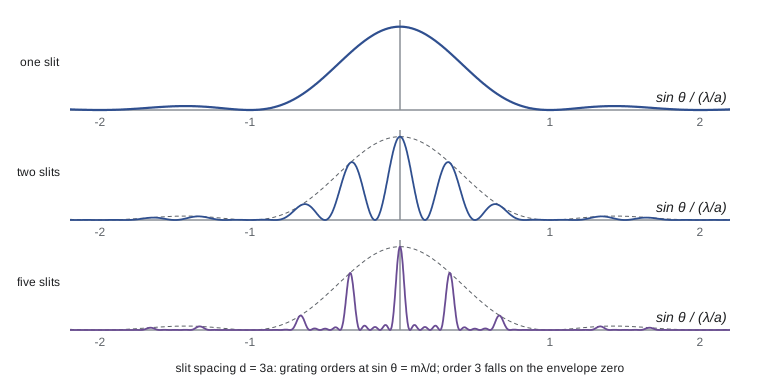
Two slits of width \(a\) and separation \(d\) produce Young's \(\cos^2\) fringes inside the single-slit envelope:
The product structure is general: the pattern of an array of identical apertures is the pattern of one aperture times the pattern of the array, a consequence of the Fourier-transform nature of Fraunhofer diffraction. For \(N\) equally spaced slits, adding \(N\) phasors each turned by \(2\alpha\) from the last gives a geometric series whose sum is
The array factor has principal maxima, of height \(N^2\), where \(\alpha = m\pi\), that is
the same angles as for two slits. Between them are \(N - 1\) zeros and \(N - 2\) weak subsidiary maxima. The principal maxima get narrower as \(N\) grows: the first zero beside the peak of order \(m\) is at \(\alpha = m\pi + \pi/N\). With thousands of slits the maxima become sharp lines, and that is a diffraction grating.
Diffraction gratings
Joseph von Fraunhofer made the first precise gratings in 1821 by winding fine wire between two screws, after he had mapped the dark absorption lines of the solar spectrum with a prism in 1814. Modern gratings have up to a few thousand grooves per millimetre ruled or holographically written on glass or metal. A grating with spacing \(d\) sends wavelength \(\lambda\) to angles given by \(d\sin\theta = m\lambda\), so it disperses light into spectra, one per order \(m\), and unlike a prism it does so with a dispersion fixed by geometry, which makes it ideal for measuring wavelengths. For light at incidence angle \(\theta_i\) the grating equation becomes \(d(\sin\theta_m - \sin\theta_i) = m\lambda\), with signs depending on convention.
How close can two wavelengths be and still be separated? Two lines are resolved when the peak of one falls on the first zero of the other. The peak of order \(m\) for \(\lambda + \Delta\lambda\) is at \(\alpha = m\pi(1 + \Delta\lambda/\lambda)\), and the first zero of \(\lambda\) is at \(m\pi + \pi/N\). Equating gives the resolving power
The sodium D lines at 589.00 and 589.59 nm need \(\mathcal R \approx 1000\): a grating with 1000 grooves illuminated in first order just separates them, while a 5 cm grating with 600 grooves per millimetre, 30,000 grooves in all, separates them thirty times over. Astronomical spectrographs reach resolving powers of 100,000 and more, enough to measure the Doppler wobble of a star of a few metres per second caused by an orbiting planet, which is how most of the first exoplanets were found after 1995. Gratings also show why compact discs and the wings of some insects shimmer: their periodic structures diffract white light into spectra.
Worked problem
A grating spectrometer
A grating with 600 lines per mm, 25 mm wide, is used at normal incidence. Find the angles of the first-order lines at 486 nm and 656 nm, the highest order visible at 656 nm, and whether first order resolves two lines 0.05 nm apart near 656 nm.
Show solution
- \(d = 1/600\ \mathrm{mm} = 1667\ \mathrm{nm}\). First order: \(\sin\theta = 486/1667 = 0.2916\), \(\theta = 16.9^\circ\); \(\sin\theta = 656/1667 = 0.3936\), \(\theta = 23.2^\circ\).
- Orders exist while \(m\lambda < d\): \(m < 1667/656 = 2.54\), so up to second order at 656 nm.
- \(N = 600 \times 25 = 15{,}000\), so first order gives \(\mathcal R = 15{,}000\) and \(\Delta\lambda_{\min} = 656/15{,}000 = 0.044\ \mathrm{nm}\).
Answer: The hydrogen lines appear at \(16.9^\circ\) and \(23.2^\circ\); 656 nm shows two orders; and first order just resolves 0.05 nm (the minimum is 0.044 nm). Second order would do it with a margin.
The circular aperture and the Rayleigh criterion
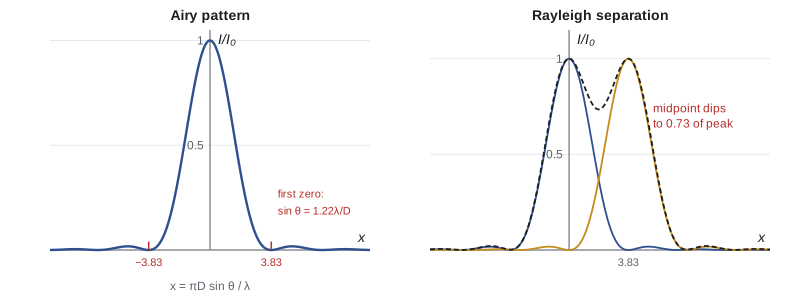
Lenses, mirrors and pupils are circular. Fraunhofer diffraction by a circular aperture of diameter \(D\) gives a bright central disc surrounded by faint rings, the Airy pattern, calculated by George Airy in 1835:
where \(J_1\) is the Bessel function of order one. Its first zero is at \(x = 3.8317\), so the first dark ring is at
About 84 parts in a hundred of the light falls inside this ring. Even a perfect lens therefore images a point as a small disc, and two points closer than the disc size blur together. Lord Rayleigh proposed in 1879 that two equal point sources are just resolved when the centre of one Airy pattern falls on the first dark ring of the other, giving the Rayleigh criterion
At that separation the combined pattern dips to about 73 parts in a hundred of the peaks between them, a dip the eye can see. The criterion is a convention rather than a law; modern image processing can do somewhat better with high signal-to-noise ratio, but it sets the scale. A human pupil of 3 mm at 550 nm gives \(2.2\times10^{-4}\ \mathrm{rad}\), about 0.8 minutes of arc, close to the measured acuity of the eye, whose receptor spacing evolved to match. The 2.4 m Hubble Space Telescope resolves 0.06 seconds of arc in visible light. The 6.5 m James Webb Space Telescope, launched on 25 December 2021, works in the infrared where wavelengths are longer, and its resolution at \(2\ \mathrm{\mu m}\) is similar to Hubble's in the visible.
Worked problem
Reading a licence plate from orbit
Could a satellite camera with a 1.0 m mirror at an altitude of 400 km read characters 5 cm apart on a plate, at 550 nm?
Show solution
- \(\theta_{\min} = 1.22(550\times10^{-9})/1.0 = 6.7\times10^{-7}\ \mathrm{rad}\).
- At 400 km this resolves \(6.7\times10^{-7} \times 4.0\times10^5 = 0.27\ \mathrm{m}\) on the ground.
- That is more than five times the 5 cm needed, before even counting atmospheric turbulence.
Answer: No. Diffraction alone limits it to about 27 cm on the ground; reading 5 cm characters would need a mirror over 5 m across.
X-ray diffraction by crystals
A crystal is a three-dimensional grating with spacings of a few tenths of a nanometre, matched to X-ray wavelengths. In 1912 Max von Laue proposed that crystals should diffract X-rays, and Walter Friedrich and Paul Knipping confirmed it. William Lawrence Bragg and his father William Henry Bragg then showed in 1913 that the strong reflections can be understood as mirror reflection from planes of atoms spaced \(d\) apart, reinforced when the path difference between successive planes is a whole number of wavelengths:
with \(\theta\) measured from the planes. Bragg's law turned X-ray diffraction into a tool for finding atomic structures, from rock salt in 1913 to the double helix of DNA, whose X-ray photograph by Rosalind Franklin and Raymond Gosling in 1952 showed the cross-shaped pattern of a helix, to the thousands of protein structures solved each year. The Braggs shared the 1915 Nobel Prize in Physics; the younger, at 25, remains the youngest physics laureate.
Computing diffraction patterns
The program sums Huygens wavelets across a slit numerically and compares with the \(\operatorname{sinc}^2\) formula, evaluates the \(N\)-slit pattern, finds the first Airy zero from a series for \(J_1\), computes the dip at the Rayleigh separation, and checks the grating worked example.
import math, cmath

lam, a = 633e-9, 0.10e-3
k = 2 * math.pi / lam
def slit_numeric(theta, n=2000):
    s = sum(cmath.exp(-1j * k * (-a/2 + (j + 0.5) * a / n) * math.sin(theta)) for j in range(n))
    return abs(s / n) ** 2
def slit_formula(theta):
    b = math.pi * a * math.sin(theta) / lam
    return 1.0 if b == 0 else (math.sin(b) / b) ** 2
print("single slit, a = 0.10 mm, 633 nm:")
for mrad in (0.0, 3.0, 6.33, 9.0, 12.66):
    th = mrad * 1e-3
    print(f"  theta = {mrad:5.2f} mrad: numeric {slit_numeric(th):.5f}, formula {slit_formula(th):.5f}")
b1 = 1.4303 * math.pi                     # first side maximum, tan b = b
print(f"first side maximum / central peak = {(math.sin(b1)/b1)**2:.4f}")

def nslit(s, N, d, w):
    al = math.pi * d * s / lam; be = math.pi * w * s / lam
    env = 1.0 if be == 0 else (math.sin(be) / be) ** 2
    arr = N * N if abs(math.sin(al)) < 1e-12 else (math.sin(N * al) / math.sin(al)) ** 2
    return env * arr
print("\nfive slits, d = 3a: principal maxima at sin(theta) = m lam/d")
for m in range(0, 4):
    s = m * lam / (3 * a)
    print(f"  m = {m}: I/I0 = {nslit(s, 5, 3*a, a):7.3f}  (N^2 = 25 times envelope {slit_formula(math.asin(s)):.3f})")

def J1(x, terms=40):
    return sum((-1)**m * (x/2)**(2*m + 1) / (math.factorial(m) * math.factorial(m + 1)) for m in range(terms))
lo, hi = 3.0, 4.5
for _ in range(60):
    mid = (lo + hi) / 2
    if J1(lo) * J1(mid) <= 0: hi = mid
    else: lo = mid
x1 = (lo + hi) / 2
print(f"\nfirst zero of J1 at x = {x1:.4f}; x/pi = {x1/math.pi:.4f}")
airy = lambda x: 1.0 if x == 0 else (2 * J1(x) / x) ** 2
dip = 2 * airy(x1 / 2)                    # midpoint between two images separated by x1
print(f"Rayleigh separation: midpoint intensity / peak = {dip / (1 + airy(x1)):.3f}")

d = 1e-3 / 600
for L in (486e-9, 656e-9):
    print(f"grating 600/mm, {L*1e9:.0f} nm: first order at {math.degrees(math.asin(L/d)):.2f} deg, max order {int(d // L)}")
print(f"resolving power with 15000 lines in first order: smallest resolvable step at 656 nm = {656/15000:.4f} nm")single slit, a = 0.10 mm, 633 nm: theta = 0.00 mrad: numeric 1.00000, formula 1.00000 theta = 3.00 mrad: numeric 0.44808, formula 0.44807 theta = 6.33 mrad: numeric 0.00000, formula 0.00000 theta = 9.00 mrad: numeric 0.04716, formula 0.04716 theta = 12.66 mrad: numeric 0.00000, formula 0.00000 first side maximum / central peak = 0.0472 five slits, d = 3a: principal maxima at sin(theta) = m lam/d m = 0: I/I0 = 25.000 (N^2 = 25 times envelope 1.000) m = 1: I/I0 = 17.098 (N^2 = 25 times envelope 0.684) m = 2: I/I0 = 4.274 (N^2 = 25 times envelope 0.171) m = 3: I/I0 = 0.000 (N^2 = 25 times envelope 0.000) first zero of J1 at x = 3.8317; x/pi = 1.2197 Rayleigh separation: midpoint intensity / peak = 0.735 grating 600/mm, 486 nm: first order at 16.95 deg, max order 3 grating 600/mm, 656 nm: first order at 23.18 deg, max order 2 resolving power with 15000 lines in first order: smallest resolvable step at 656 nm = 0.0437 nm
The numerical Huygens sum matches the formula, with zeros at 6.33 and 12.66 mrad, which are \(\lambda/a\) and \(2\lambda/a\). The first side maximum is 0.047 of the centre. For five slits the principal maxima reach \(25\) times the envelope, and the third order vanishes because it lands on an envelope zero. The bisection finds the first zero of \(J_1\) at 3.8317, which is \(1.2197\pi\), the origin of the factor 1.22, and the Rayleigh dip comes out at 0.735 of the peaks.
Common mistakes
MistakeUsing \(a\sin\theta = m\lambda\) for the bright fringes of a single slit.
InsteadFor a single slit it gives the dark fringes; the bright maxima lie roughly midway between them.
MistakeConfusing the slit width \(a\) with the slit spacing \(d\).
InsteadWidth sets the envelope; spacing sets the positions of the fringes or grating orders.
MistakeThinking more grating lines change the angles of the orders.
InsteadAngles depend only on \(d\); more lines make the lines sharper and raise the resolving power \(mN\).
MistakeForgetting the factor 1.22 for circular apertures.
InsteadA slit gives \(\lambda/a\); a circle gives \(1.22\lambda/D\) from the first zero of \(J_1\).
MistakeMeasuring Bragg angles from the normal to the planes.
InsteadIn \(2d\sin\theta = n\lambda\), \(\theta\) is measured from the planes themselves.
Summary and key terms
- Fraunhofer diffraction is the far-field Fourier transform of the aperture; Fresnel number \(a^2/L\lambda \ll 1\) marks the regime.
- A single slit gives \(I_0(\sin\beta/\beta)^2\) with zeros at \(a\sin\theta = m\lambda\).
- \(N\) slits give \((\sin N\alpha/\sin\alpha)^2\) times the envelope, with sharp maxima at \(d\sin\theta = m\lambda\).
- A grating has resolving power \(\lambda/\Delta\lambda = mN\).
- A circular aperture gives an Airy disc with first zero at \(1.22\lambda/D\), the Rayleigh limit; crystals diffract X-rays by Bragg's law \(2d\sin\theta = n\lambda\).
- Huygens–Fresnel principle
- Every point of a wavefront is a source of secondary wavelets that interfere.
- Fraunhofer diffraction
- Far-field diffraction, depending only on angle and given by the Fourier transform of the aperture.
- diffraction grating
- A surface with many equally spaced lines that sends each wavelength to its own angles.
- resolving power
- The ratio of wavelength to the smallest resolvable wavelength difference.
- Airy disc
- The central bright spot of diffraction by a circular aperture.
- Bragg's law
- The condition 2 d sin theta equals n lambda for strong X-ray reflection from crystal planes.
Practice problems
Work each problem on paper first, then reveal the answer to check.
Light of 550 nm passes through a 0.050 mm slit. Find the angular width of the central maximum.
Show answer
Half-width \(\lambda/a = 0.011\ \mathrm{rad}\), so full width 0.022 rad, about \(1.26^\circ\).
How many bright fringes of a double slit with \(d = 4a\) fit inside the central diffraction maximum?
Show answer
Orders \(m = 0, \pm1, \pm2, \pm3\) (order 4 falls on the first envelope zero): 7 fringes.
A grating has 400 lines per mm. Find the first- and second-order angles for 600 nm.
Show answer
\(d = 2500\ \mathrm{nm}\): \(\sin\theta_1 = 0.24\), \(13.9^\circ\); \(\sin\theta_2 = 0.48\), \(28.7^\circ\).
What resolving power is needed to separate the hydrogen and deuterium Balmer-alpha lines, 656.28 and 656.10 nm?
Show answer
\(\lambda/\Delta\lambda = 656.2/0.18 \approx 3600\).
Two headlights 1.4 m apart are viewed at night with a 5.0 mm pupil at 550 nm. At what distance can they just be resolved?
Show answer
\(\theta = 1.22(550\times10^{-9})/5.0\times10^{-3} = 1.34\times10^{-4}\); distance \(1.4/1.34\times10^{-4} \approx 10\ \mathrm{km}\).
X-rays of 0.154 nm reflect from crystal planes 0.282 nm apart. Find the first-order Bragg angle.
Show answer
\(\sin\theta = 0.154/(2 \times 0.282) = 0.273\), \(\theta = 15.8^\circ\).
Lesson quiz · 5 questions
Score 60% or more to complete this lesson.
Create a free account to save your progress, take quizzes and earn a certificate.