
PHOT-499 · Lesson 4 of 12 · 32 min
Production I: making the work
Production is the stretch of the term when the plan meets reality. For most capstones it runs from about week 4 to week 9, with the main shoots finished by week 7 so that the later weeks can be used for reshoots and gaps found in the edit. This lesson is about working methods during production: keeping a series consistent while letting it develop, working with the people in the images, capturing the information you will need later, reviewing as you go and tracking whether the project is on course. The technical skills themselves were taught earlier: exposure and light in PHOT-101 and PHOT-102, sensors and noise in PHOT-201, portable and studio lighting in PHOT-210 and PHOT-211, portraiture in PHOT-220 and fieldwork in PHOT-230. Here the question is how to deploy them across many shoots so that the result reads as one body of work.
Making a series rather than single images
A series is not a collection of good pictures on the same subject. It is a set of images that share an approach, so that each one gains meaning from the others. The approach includes decisions about distance, framing, lens, light, colour, format and the relationship between photographer and subject. Fixing some of these decisions early creates consistency; leaving others open allows variety and discovery. The art is in choosing which to fix.
Amara fixed several variables for her portraits: a 35 mm equivalent lens, the subject at about two metres, eye level, the subject facing the camera in their usual working position, one battery LED as key light from the subject's left, and a white balance set to match the ambient light so that the night colour stayed visible. She left open the pose, the props and the background, which came from each workplace. For the empty interiors she fixed a tripod height of 1.5 metres, a slightly wider lens and long exposures without added light, so the spaces carried the colour of their own fixtures.
| Variable | Portraits | Empty interiors |
|---|---|---|
| Lens and distance | Fixed: 35 mm equivalent at about 2 m | Fixed: 28 mm equivalent |
| Camera height | Fixed: eye level | Fixed: 1.5 m on a tripod |
| Light | Fixed: one LED key from the left, ambient fill | Fixed: existing light only |
| Colour | Fixed: white balance to ambient | Fixed: white balance to ambient |
| Pose and props | Open, chosen with the subject | Not applicable |
| Background | Open, from the workplace | Open, the space itself |
| Time | Fixed: during the shift | Fixed: between tasks or after hours |
A coverage plan for the series
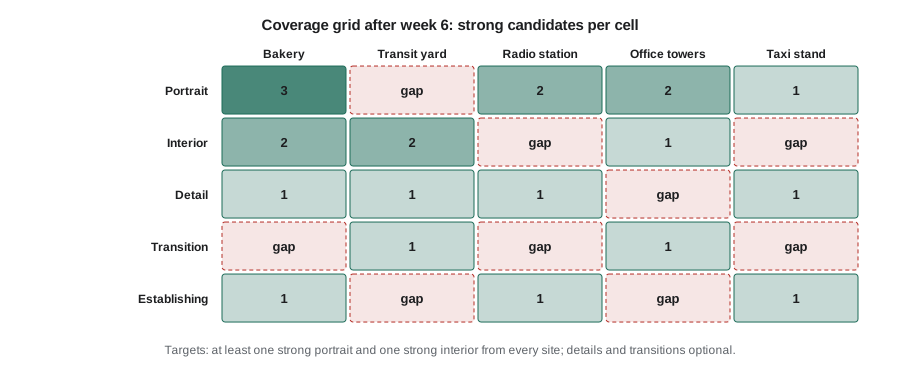
A shot list for a series is less specific than for a commercial job, but it should still define the kinds of images the body of work needs. Amara's coverage plan was a grid: five sites across the top and image types down the side (portrait, interior, detail, transition such as arrival or departure, and a wider establishing view). The target was at least one strong portrait and one strong interior from each site, with details and transitions optional. Filling in the grid after each review shows where the gaps are long before the edit.
Worked problem
Planning remaining shoots from the coverage grid
After week 6, Amara has strong portrait candidates at four of five sites (missing the transit yard) and strong interior candidates at three (missing the taxi stand and the radio station). On past shoots she gets a strong portrait on about 60 per cent of portrait-focused nights and a strong interior on about 50 per cent of interior-focused nights. How many more shoot nights should she plan to have about a 90 per cent chance of filling each gap, treating nights as independent?
Show solution
- For one gap needing a success with probability \( p \) per night, the chance of at least one success in \( n \) nights is \( 1 - (1 - p)^n \).
- Transit yard portrait, \( p = 0.6 \): \( n = 2 \) gives \( 1 - 0.4^2 = 0.84 \); \( n = 3 \) gives \( 1 - 0.4^3 = 0.936 \). Three nights.
- Each missing interior, \( p = 0.5 \): \( n = 3 \) gives \( 1 - 0.5^3 = 0.875 \); \( n = 4 \) gives 0.9375. Four nights each, or fewer if interiors can be shot on the same nights as portraits.
Answer: Up to 11 nights if every gap is shot separately, which is too many for weeks 7 to 9. Amara combines interiors with portrait nights at the same sites and plans about six nights, accepting that one interior may come from a reshoot.
Working with people
Most capstones involve people, and the quality of the relationship shows in the images. Before the first shoot at a site, introduce yourself and the project to everyone who might be photographed, not only the manager who approved access. Explain what you will do, how long it takes, how the images will be used and that people may say no or stop at any time. Ask about routines so that you can work around them; a baker cannot pause when the dough is ready. Respect time limits. Amara's test shoot had shown she had about three minutes with each worker, so she set up the light before asking, made a few frames, showed the person the back of the camera and finished within the time.
Reciprocity matters. People give their time and their image; offer something in return that suits the setting and avoids pressure, such as a print, a copy of the book dummy, an invitation to the opening, or images the workplace can use internally if the agreement allows. Do not pay in ways that compromise consent or documentary integrity, and be honest about what the project can and cannot do for them. Keep promises: if you said you would bring prints in two weeks, bring them in two weeks. PHOT-401 lesson 5 and PHOT-320 lesson 11 discuss consent, representation, trauma and vulnerability in more depth; apply those principles whenever subjects are minors, unwell, in crisis or in a dependent relationship with someone who approved your access.
| Practice | Why it matters |
|---|---|
| Introduce the project to everyone, not only the manager | Consent from staff is personal, not delegated |
| Ask about routines and time limits | Avoids disrupting work and builds trust |
| Show people images on the camera | Lets them see how they are represented |
| Stop when asked, and do not argue | Consent can be withdrawn at any time |
| Record names and spellings at the time | Accurate captions and credits later |
| Keep promises about prints and copies | Professional reputation and goodwill |
Technical consistency at night
Night and low-light work raises technical problems that can break a series if they are handled differently from shoot to shoot. Mixed light sources (LED, fluorescent, sodium vapour, screens) produce colour casts that vary within a frame. Low light forces a choice among higher ISO and more noise, slower shutter speeds and motion blur, and wider apertures and less depth of field. A portable light adds control but can flatten the mood if too strong. Decide on a consistent treatment and record your settings so that you can reproduce them.
Amara exposed portraits at ISO 1600 to 3200 with the LED as key and ambient as fill, and kept shutter speeds at 1/60 second or faster for people. She accepted visible ambient colour casts as part of the series and corrected only skin tones toward a natural hue in post-production. For interiors she used ISO 100 to 400 on a tripod with exposures of several seconds, which kept noise low and smoothed any movement. The noise characteristics of her camera and the denoising methods from PHOT-201 and PHOT-420 lesson 8 told her where her ceiling ISO lay.
Worked problem
Matching portable light to ambient light
Amara's interior ambient light meters at about 40 lux. She wants the key light on a face to be about two stops brighter than ambient. Her LED delivers 2,500 lux at 1 m at full power. At what distance should it sit, assuming the inverse square law holds for the bare panel?
Show solution
- Two stops brighter than 40 lux is \( 40 \times 2^2 = 160 \) lux.
- Inverse square: \( E = E_1 / d^2 \), so \( d = \sqrt{E_1 / E} = \sqrt{2500/160} \approx 3.95 \) m.
- At the planned 2 m working distance the light would give \( 2500/4 = 625 \) lux, nearly four stops over ambient, so she would dim it to about \( 160/625 \approx 26 \) per cent power.
Answer: Either place the light about 4 m away or keep it at 2 m and dim it to about a quarter of full power. Amara keeps it close for softer light and dims it, recording the power setting so each site matches.
Worked problem
Choosing an exposure for a night portrait
At ISO 1600 the ambient light reads 1/15 second at f/2.8. Amara wants 1/60 second to freeze small movements and f/2.8 for shallow depth of field. How many stops must she add, and what are her options?
Show solution
- From 1/15 to 1/60 is two stops less light (1/15 to 1/30 to 1/60).
- To keep ambient exposure unchanged she must raise ISO two stops, from 1600 to 6400, or accept ambient two stops darker.
- Using the LED as key at the required brightness and letting ambient fall two stops below creates separation between subject and background, which is the look she wants.
Answer: Keep ISO 1600, 1/60 second and f/2.8, light the face with the LED and let the background fall about two stops darker. This is consistent with her fixed lighting plan and keeps noise lower than ISO 6400.
Capturing information at the shoot
Many problems in the later stages trace back to information not captured at the shoot. Record, for each session: date, place, time, people present and their names and roles, releases signed, any conditions or requests, technical notes and the file number range. A small notebook or a phone note template works; voice memos are quick but must be transcribed. Write captions while the facts are fresh: who, what, where and when, in the subject's own words where possible. IPTC metadata (lesson 7) can be added at ingest from these notes, so a consistent template saves hours.
| Field | Example entry |
|---|---|
| Date and time | Thursday week 5, 01:10 to 03:40 |
| Site and area | Bakery, ovens room and loading door |
| People and roles | Owner (release), apprentice (release excludes social media) |
| Conditions | No photos of recipe board; owner review before exhibition |
| Light and settings | LED 30 per cent at 2 m, ISO 2000, 1/60 s, f/2.8 |
| Frames | Files 4120 to 4386 |
| Captions and quotes | Apprentice: "By four the street belongs to the delivery vans." |
| Next time | Arrive at 00:30 for dough shaping; bring smaller stand |
Daily and weekly review
Review every shoot within a day: ingest and back up (lesson 7), make a contact sheet, flag candidates and write a log entry. Once a week, lay out the strongest candidates from all shoots, physically or on screen, and look at them together. Weekly review is where you see whether the series is cohering, whether one site or image type dominates, and whether the fixed variables are still serving the work. It is also where you notice that you have been making the same picture again and again, which is a common sign that it is time to change something.
Iteration is part of the method. If a choice is not working, change it deliberately and record why. Amara found after week 5 that her empty interiors looked like real estate photographs because they were too evenly lit and too tidy. She moved the camera lower, included traces of work such as a mop bucket or a coat on a chair, and lengthened exposures to show the movement of fans and screens. The change made the interiors feel inhabited even without people, and the log records the week and the reason.
Tracking yield and progress
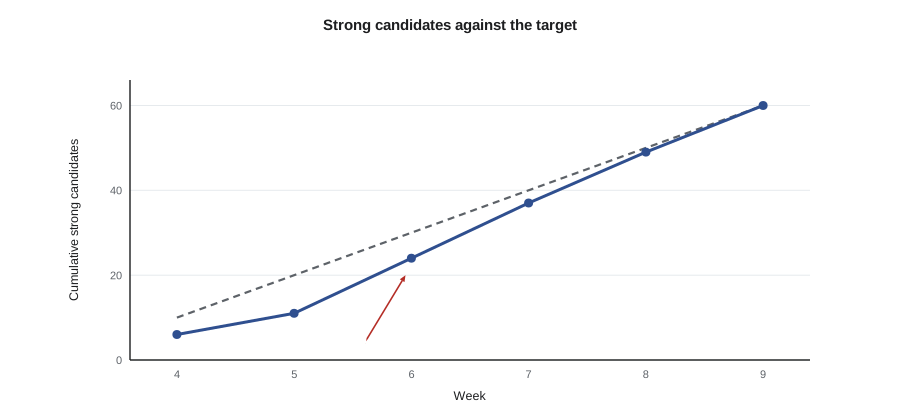
Track the number of strong candidates against the number the final output needs. Amara needed about 20 images on the wall and about 35 in the book, and she expected to discard perhaps half of her strong candidates in the edit for reasons of sequence, repetition or consent. That meant a target of about 60 strong candidates by the end of production. Counting candidates each week and comparing with the target shows early whether more shoots, different shoots or a change of approach are needed.
import random
random.seed(4991)
yield_per_shoot = [3, 2, 4, 1, 3, 5, 4, 2]  # strong candidates from the first eight shoots
mean = sum(yield_per_shoot) / len(yield_per_shoot)
have, target, nights_left = sum(yield_per_shoot), 60, 10
runs, hits = 10000, 0
for _ in range(runs):
    total = have + sum(random.choice(yield_per_shoot) for _ in range(nights_left))
    hits += total >= target
print(f'mean per shoot {mean:.2f}, have {have}, expected at end {have + mean * nights_left:.0f}')
print(f'chance of reaching {target}: {hits / runs:.0%}')
needed = (target - have) / mean
print(f'nights needed at the mean rate: {needed:.1f}')mean per shoot 3.00, have 24, expected at end 54 chance of reaching 60: 8% nights needed at the mean rate: 12.0
The resampling simulation draws future shoots from the yields Amara has already seen. With ten nights left, the expected total is about 54 candidates and the chance of reaching 60 is low. She has three options: add shoot nights, raise the yield per night by concentrating on the image types that work best, or lower the target by accepting a smaller book. She raises the yield by spending interior nights at the sites where interiors had worked and adds two nights in week 8.
When production goes well
Momentum is valuable but brings its own risks. When shoots are going well it is tempting to keep shooting past the schedule because each night produces something new. Remember the backward schedule from lesson 1: the last main shoot date is set by output lead times. More images also mean a longer edit. If you find a promising new direction late in production, write it down as a possible next project rather than trying to fold it into this one.
Common mistakes
MistakeChanging camera, lens and lighting choices from shoot to shoot without reason
InsteadFix the variables that define the series and record settings so each site matches.
MistakeTreating staff consent as given because a manager approved access
InsteadIntroduce the project to everyone and ask each person individually.
MistakeLeaving names and captions until the edit
InsteadRecord names, roles, quotes and releases in field notes at each shoot.
MistakeReviewing images only at the end of production
InsteadReview every shoot within a day and the whole set weekly.
MistakeShooting past the last planned date because things are going well
InsteadRespect the backward schedule and note new directions for future projects.
Summary and key terms
- A series shares an approach; fix some variables and leave others open.
- A coverage grid of sites and image types shows gaps early.
- Introduce the project to everyone, respect routines and time limits, and keep promises.
- Choose a consistent technical treatment for difficult light and record settings.
- Capture names, releases, conditions, captions and file ranges at every shoot.
- Review daily and weekly, and change approach deliberately when something is not working.
- Track strong candidates against the number the output needs.
- Series
- A set of images sharing an approach so that each gains meaning from the others.
- Fixed variable
- A decision held constant across a series, such as lens or light.
- Coverage grid
- A table of sites and image types used to track what the series still needs.
- Reciprocity
- What a photographer offers subjects in return for their time and image.
- Ambient light
- The light already present in a scene.
- Key light
- The main light that shapes a subject.
- Inverse square law
- Illuminance from a point source falls with the square of distance.
- Field notes
- Written records made during a shoot.
- Yield
- The number of strong candidate images produced per shoot.
- Iteration
- Deliberate change to an approach in response to review.
Practice problems
Work each problem on paper first, then reveal the answer to check.
A light gives 1,800 lux at 1 m. What does it give at 3 m?
Show answer
\( 1800/9 = 200 \) lux.
Ambient reads 50 lux. What is two stops brighter?
Show answer
200 lux.
With a 0.5 chance of success per night, what is the chance of at least one success in three nights?
Show answer
\( 1 - 0.5^3 = 0.875 \).
Name four variables a series might fix.
Show answer
Lens, distance, camera height, light, colour treatment or format.
Why show subjects images on the camera?
Show answer
So they see how they are represented and can respond.
From 1/30 s to 1/125 s is about how many stops?
Show answer
About two stops.
What should field notes include about releases?
Show answer
Who signed, which uses are covered and any conditions.
A project needs 25 images and expects to discard 55 per cent of candidates. About how many candidates are needed?
Show answer
\( 25/0.45 \approx 56 \).
What sign in weekly review suggests it is time to change something?
Show answer
Making the same picture again and again.
What should you do with a promising new direction found late in production?
Show answer
Record it as a future project rather than expanding this one.
Lesson quiz · 5 questions
Score 60% or more to complete this lesson.
Create a free account to save your progress, take quizzes and earn a certificate.