
PHOT-499 · Lesson 11 of 12 · 30 min
Presenting, critique and defence
In week 13 the capstone is reviewed in public. Each student presents the installed work and the book or screen output, takes part in a final critique with peers and faculty, and then defends the project in a shorter session with assessors. The critique tests how the work is received; the defence tests whether you can explain and justify the decisions behind it. Both are assessed, together with a written reflection in week 14 that lesson 12 covers. PHOT-401 lessons 6 to 8 taught how to read photographs and how to give and receive critique; this lesson prepares you for the specific formats of the final review and introduces the way rubric scores from several assessors are combined and checked.
The final critique and the defence
The final critique is a discussion of the finished work in its installed form. Peers and faculty look at the work, often before hearing anything from you, then discuss what they see, what works and what does not, and how the work relates to its stated intent. The defence is more formal: a short presentation by you followed by questions from two or more assessors about concept, research, method, ethics, production, post-production, output and what you learned. It resembles, on a small scale, the way graduate theses, grant interviews and job interviews for creative roles are conducted.
| Feature | Final critique | Defence |
|---|---|---|
| Who speaks first | Usually the reviewers, after looking | You, with a short presentation |
| Focus | How the work is received | Why you made the decisions you made |
| Participants | Peers and faculty | Two or more assessors |
| Typical length | 20 to 30 minutes per student | 20 to 30 minutes per student |
| Assessed on | The work and your engagement in discussion | Clarity, evidence and reflection in your answers |
Structuring the defence presentation
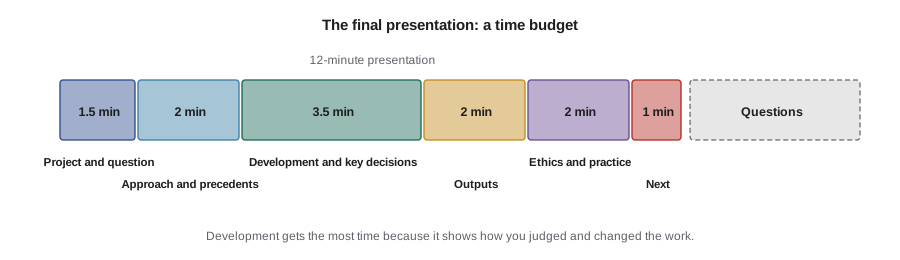
Most programmes allow about ten to fifteen minutes for the presentation. Plan it to a time budget and rehearse it aloud. A strong structure moves from the question to the evidence: what the project is and why you made it; how you approached it and what you learned from precedents; how the work developed, using two or three key decisions from your log as examples; what the final outputs are and why they take that form; the ethical and professional choices you made, including permissions and post-production; and what you would do next. Use the installed work and the book rather than slides where possible, and keep any slides simple: images, a timeline, a few words.
Worked problem
Budgeting the presentation time
Amara has 12 minutes. She allots 12.5 per cent to the project and question, 17 per cent to approach and precedents, 29 per cent to development and key decisions, 17 per cent to outputs, 16 per cent to ethics and professional practice and the rest to next steps. How many minutes and seconds does each part get, and how many words of speech is that at about 130 words per minute?
Show solution
- Project and question: \( 0.125 \times 12 = 1.5 \) min. Approach: \( 0.17 \times 12 = 2.04 \) min. Development: \( 0.29 \times 12 = 3.48 \) min. Outputs: 2.04 min. Ethics: \( 0.16 \times 12 = 1.92 \) min.
- Next steps: \( 100 - 12.5 - 17 - 29 - 17 - 16 = 8.5 \) per cent, or \( 0.085 \times 12 = 1.02 \) min.
- Total speech at 130 words per minute: \( 12 \times 130 = 1560 \) words, of which development gets about \( 3.48 \times 130 \approx 452 \) words.
Answer: About 1:30, 2:00, 3:30, 2:00, 2:00 and 1:00 after rounding, totalling 12 minutes and about 1,560 spoken words. Writing to word counts per part keeps rehearsals on time; speaking from notes rather than a script keeps delivery natural.
Preparing for questions
Assessors' questions are predictable in kind if not in detail. They ask why you made a particular choice and what the alternatives were; how your work differs from a precedent you cited; how you obtained consent and handled a sensitive situation; what your post-production statement means in a specific image; why one image is in the edit and another is not; what you would change with more time; and what you learned about your own practice. Prepare by listing likely questions under each heading, writing short answers with evidence from your log, and rehearsing with a classmate who asks follow-up questions.
| Area | Example question | Evidence to point to |
|---|---|---|
| Concept | What question is this work asking, and do the images answer it? | Statement of intent versions; viewer test results |
| Research | How does this differ from your main precedent? | Precedent analysis table |
| Method | Why one light and the ambient colour cast? | Test shoot, log entries, reference images |
| Ethics | How did you handle the worker who declined? | Release matrix, field notes, change log |
| Production | What happened when the hospital paused access? | Change log, supervisor approval |
| Post-production | Was anything removed from this image? | Post-production statement, raw file |
| Output | Why pairs on the wall and singles on the end wall? | Elevation, edit notes, viewer feedback |
| Reflection | What would you do differently? | Mid-term response, final log entries |
Answering well
Good answers are short, direct and evidenced. Repeat or rephrase the question if it is unclear, answer it in the first sentence, give one piece of evidence, and stop. If you do not know, say so and say how you would find out. If a question exposes a weakness, acknowledge it and explain what you learned; assessors reward honest reflection more than defensiveness. Disagreement is allowed. If an assessor suggests that an image should not be in the edit, you can explain why you included it, as long as your reasoning engages with their point rather than dismissing it.
| Question | Weak answer | Strong answer |
|---|---|---|
| Why include the taxi rank interior? | I just like it. | It is the only image where the city starts to wake; it closes the night before the final window. |
| Did you use AI tools? | Not really. | AI denoising on four high-ISO portraits, which changes no content; no generative editing; it is in the post-production statement. |
| Your portraits look similar. Was that intended? | No, you're right, they're boring. | Yes, the fixed framing is a typology; I added second portraits in new positions after the mid-term to vary it, and I would push that further next time. |
Giving critique to peers
In the final critique you are a reviewer as well as a presenter, and how you critique others is part of your assessment for professional engagement. Use the methods from PHOT-401 lesson 7: describe before you judge, refer to specific images, connect comments to the work's stated intent, balance strengths with suggestions, and phrase suggestions as questions or options. Many programmes ask students to score each other's work on a peer rubric as well as discuss it, which raises the question of how reliable such scores are.
Combining scores from several assessors
Rubric scores from several people rarely agree exactly. Combining them well protects students from one assessor's leniency or severity. Common methods are averaging, using the median, trimming the highest and lowest scores before averaging when there are many raters, and moderation, in which assessors discuss large disagreements and agree a score. Programmes also check how consistently assessors apply the rubric, using agreement statistics.
Worked problem
Trimmed mean of peer scores
Seven peers score Amara's work out of 20 on the presentation criterion: 15, 16, 16, 17, 18, 18, 9. What are the mean, the median and the mean after trimming the highest and lowest scores?
Show solution
- Mean: \( (15 + 16 + 16 + 17 + 18 + 18 + 9)/7 = 109/7 \approx 15.6 \).
- Sorted: 9, 15, 16, 16, 17, 18, 18. Median: 16.
- Trimmed mean, dropping 9 and one 18: \( (15 + 16 + 16 + 17 + 18)/5 = 82/5 = 16.4 \).
Answer: Mean about 15.6, median 16 and trimmed mean 16.4. The single low score pulls the plain mean down; the median and trimmed mean are more robust to one outlier, which is why many peer-scoring systems use them.
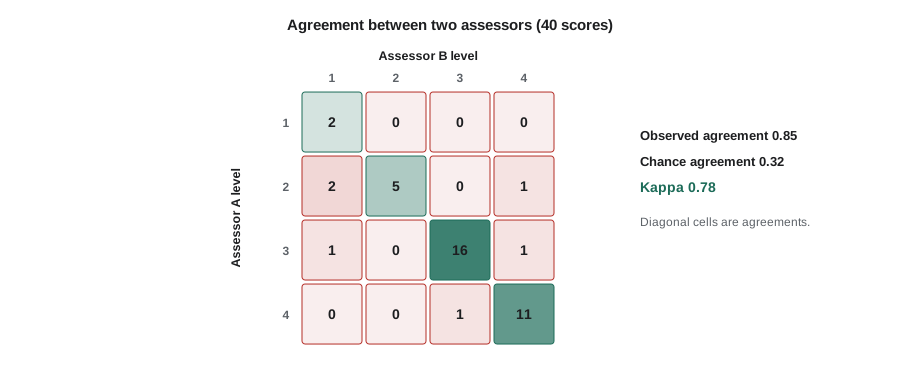
Agreement between two assessors can be measured simply as the percentage of criteria or students on which they gave the same level. Some of that agreement happens by chance, especially when most scores fall in one or two levels. Cohen's kappa corrects for chance: it compares observed agreement with the agreement expected if the two assessors had scored independently with their own overall distributions. Kappa is 1 for perfect agreement, 0 for agreement no better than chance, and negative for worse than chance. Values above about 0.6 are often described as substantial agreement, though such labels are conventions rather than rules.
import random
from collections import Counter
random.seed(4992)
levels = [1, 2, 3, 4]
a = [random.choices(levels, weights=[1, 3, 5, 3])[0] for _ in range(40)]
b = [x if random.random() < 0.7 else random.choice(levels) for x in a]  # assessor B mostly agrees
n = len(a)
po = sum(x == y for x, y in zip(a, b)) / n
ca, cb = Counter(a), Counter(b)
pe = sum(ca[k] * cb[k] for k in levels) / (n * n)
kappa = (po - pe) / (1 - pe)
print(f'observed agreement {po:.2f}, chance agreement {pe:.2f}, kappa {kappa:.2f}')
table = [[sum(1 for x, y in zip(a, b) if x == i and y == j) for j in levels] for i in levels]
for i, row in zip(levels, table):
print('A level', i, row)observed agreement 0.85, chance agreement 0.32, kappa 0.78 A level 1 [2, 0, 0, 0] A level 2 [2, 5, 0, 1] A level 3 [1, 0, 16, 1] A level 4 [0, 0, 1, 11]
Worked problem
Calculating kappa by hand
Two assessors each mark 20 capstones as pass or merit. Both say merit for 8, both say pass for 7, A says merit and B pass for 3, and A says pass and B merit for 2. What are the percentage agreement and kappa?
Show solution
- Observed agreement: \( (8 + 7)/20 = 0.75 \).
- A says merit for \( 8 + 3 = 11 \) and pass for 9; B says merit for \( 8 + 2 = 10 \) and pass for 10.
- Chance agreement: \( (11 \times 10 + 9 \times 10)/20^2 = (110 + 90)/400 = 0.5 \).
- Kappa: \( (0.75 - 0.5)/(1 - 0.5) = 0.5 \).
Answer: 75 per cent agreement but a kappa of 0.5, moderate agreement after allowing for chance. A programme seeing this would hold a moderation meeting to compare how the two assessors read the merit descriptors.
Receiving feedback at the end of a project
Final critique can be hard to hear after a term of effort. Expect to feel defensive and plan for it: listen, take notes, thank people and save your responses for later unless a factual correction is needed. In the days after, sort the feedback as you did after the mid-term, into points you accept, points to think about and points you set aside with reasons. Some of the most useful feedback concerns your next project rather than this one. Bring the sorted notes into your written reflection.
Presenting accessibly and professionally
Make your presentation accessible: speak clearly and face the room, describe images briefly for anyone who cannot see them well, use large text and high contrast on any slides, and caption any video. Dress and behave as you would for a professional meeting. Arrive early, check the installation and equipment, and have a backup of any presentation file on a second device. If the defence is online or hybrid, test the connection, camera and sound beforehand and have images ready to share at good resolution.
Self-assessment against the rubric
Before the defence, score your own work against the rubric from lesson 1, criterion by criterion, with a sentence of evidence for each score. Self-assessment prepares you for questions about weaknesses and shows assessors that you can judge your own work, which is one of the main outcomes of the degree. After grades are released, compare your scores with the assessors'. Large gaps in either direction are worth discussing with your supervisor, because they show where your judgement of your own work differs from professional judgement.
| Criterion | Self-score (1 to 4) | Evidence |
|---|---|---|
| Concept and research | 3 | Clear question; precedent analysis; viewers read the project as intended |
| Technical quality | 4 | Consistent light and colour; test prints matched |
| Coherence | 3 | Pairs work; taxi strand still thinner than others |
| Edit and sequence | 3 | Night order clear; one run of similar portraits remains in the book |
| Presentation and output | 3 | Clean installation; book proof has a gutter issue on two spreads |
| Risk and ambition | 4 | Negotiated access at five sites at night; site change managed |
Common mistakes
MistakeWriting a script and reading it aloud in the defence
InsteadPlan to a time budget, speak from notes and rehearse aloud with questions.
MistakeAnswering questions with long explanations and no evidence
InsteadAnswer in the first sentence, give one piece of evidence from your log, then stop.
MistakeBecoming defensive when weaknesses are raised
InsteadAcknowledge the point, explain what you learned and what you would change.
MistakeAveraging peer scores without checking for outliers
InsteadUse medians, trimmed means or moderation, and check assessor agreement.
MistakeTreating percentage agreement as a full measure of reliability
InsteadCorrect for chance agreement with a statistic such as Cohen's kappa.
Summary and key terms
- The final critique tests reception; the defence tests your reasoning and evidence.
- Structure the defence from question to evidence and give development the most time.
- Prepare likely questions by area and answer briefly with evidence from your log.
- Critique peers by describing first, being specific and connecting to their intent.
- Medians and trimmed means resist outliers when combining several raters.
- Cohen's kappa corrects agreement between two assessors for chance.
- Self-assess against the rubric before the defence and compare with assessors afterward.
- Final critique
- A group discussion of finished, installed work.
- Defence
- An oral presentation and questioning in which a student justifies a project's decisions.
- Time budget
- A plan dividing presentation time among its parts.
- Moderation
- A process in which assessors compare and agree scores.
- Median
- The middle value of sorted scores.
- Trimmed mean
- The average after removing the highest and lowest values.
- Percentage agreement
- The share of cases on which two assessors give the same score.
- Chance agreement
- The agreement expected if assessors scored independently.
- Cohen's kappa
- A statistic measuring agreement between two raters corrected for chance.
- Self-assessment
- Scoring one's own work against criteria with evidence.
Practice problems
Work each problem on paper first, then reveal the answer to check.
A 15-minute presentation gives 30 per cent to development. How long is that?
Show answer
4.5 minutes.
At 130 words per minute, how many words fill 10 minutes?
Show answer
1,300 words.
Scores of 12, 14, 15, 15, 16 and 5: what is the median?
Show answer
14.5.
Trim the highest and lowest from 10, 12, 13, 14, 20. What is the trimmed mean?
Show answer
13.
Observed agreement 0.8 and chance agreement 0.6. What is kappa?
Show answer
\( (0.8 - 0.6)/0.4 = 0.5 \).
What does a kappa of 0 mean?
Show answer
Agreement no better than chance.
How should you answer a question you cannot answer?
Show answer
Say you do not know and how you would find out.
What is the first step in giving critique?
Show answer
Describe what you see before judging.
Why self-assess before the defence?
Show answer
To prepare for questions about weaknesses and show you can judge your own work.
What should you do with feedback in the days after critique?
Show answer
Sort it into accepted, to think about and set aside with reasons, and use it in the reflection.
Lesson quiz · 5 questions
Score 60% or more to complete this lesson.
Create a free account to save your progress, take quizzes and earn a certificate.