
PHOT-430 · Lesson 9 of 12 · 35 min
Planning an exhibition
An exhibition is a project with a fixed opening date, many participants, a budget and real risks: prints that arrive late, frames that do not fit the walls, lights that fail, a press release that misses its deadline. PHOT-401 introduced where fine art photography is shown, exhibition agreements, editions and moral rights. This lesson turns to project planning: assembling a proposal package, reading a venue, defining roles, scheduling backward from the opening, budgeting with contingency, understanding artist fees, insurance and loan agreements, building an exhibition checklist, planning communications and public programmes, and managing risk. The same tools apply whether you are organizing a pop-up in a vacant shop or preparing for an artist-run centre or public gallery that has selected your proposal.
Where exhibitions come from
Exhibitions start in several ways. A gallery or curator may invite you after seeing your work in a book, portfolio review or another show. Artist-run centres and many public galleries issue open calls for proposals, often once or twice a year, with selection by a committee of artists and staff. Festivals select exhibitions for their programmes. Commercial galleries usually show artists they represent. And many photographers organize their own exhibitions, renting or borrowing space and taking on the curatorial and organizational work themselves. Each route has different expectations about who pays for what, so clarify roles and money at the first serious conversation.
The exhibition proposal package
A proposal for an exhibition differs from a general project proposal. Venues want to know not only what the work is about but what it will look like in their space and what it will require from them. A typical package includes:
- A short statement of the exhibition concept, distinct from the project statement, explaining what visitors will experience.
- A preliminary checklist of works with titles, dates, media, dimensions framed and unframed, and edition information.
- Images of the works and, if available, documentation of previous installations.
- A proposed layout or sketch on the venue's floor plan if you have it.
- Technical requirements: wall length, hanging system, lighting, any screens, projectors, sound or vitrines.
- A budget showing what you will provide and what you ask of the venue.
- A schedule and any constraints, such as dates when prints will be ready.
- Your CV and a short biography.
Tailor each proposal to the venue's programme, space and audience. Read its mandate and past exhibitions. A proposal for a community gallery in a small city might emphasize engagement with local audiences; a proposal for an artist-run centre might emphasize critical questions and experimentation. Follow application instructions exactly, including file sizes and word limits; committees review many applications and may discard incomplete ones.
Reading a venue
Before planning a layout or budget, gather the facts about the venue. Ask for a floor plan with wall lengths and ceiling heights, and visit if at all possible.
| Topic | Questions |
|---|---|
| Walls | Lengths, heights, material (drywall, plaster, brick), permitted fixings, existing hanging rails |
| Lighting | Track lighting? Number and type of fixtures, dimming, daylight from windows, light levels achievable |
| Climate | Temperature and humidity control, sunlight, risk of leaks |
| Security | Staffed hours, alarms, cameras, security hardware for frames |
| Access | Loading door size, freight elevator, parking, stairs, accessibility for visitors |
| Power and technology | Outlets, circuits, data, projectors or screens available |
| Staff and support | Installers or preparators, curatorial help, communications, front-of-house staff |
| Insurance | Does the venue insure works on its premises, in transit, both or neither? |
| Schedule | Installation and deinstallation days, opening date and time, hours open |
| Rules | Fire codes, maximum occupancy, restrictions on paint, vinyl and food at openings |
Measure walls yourself if the plan is old. Note obstacles such as doors, outlets, thermostats, fire extinguishers, sprinkler heads and windows; they reduce usable wall and affect layouts. Photograph each wall straight on. These photographs and measurements are the basis for the wall layouts developed in lesson 10.
Roles and responsibilities
Even a small exhibition involves several roles, which may be held by one person or many.
| Role | Responsibilities |
|---|---|
| Artist | Works, statement, approvals of layout and texts, participation in programmes |
| Curator | Concept, selection, layout, texts, relationship with the venue |
| Registrar | Checklist, loans, insurance, condition reports, shipping |
| Exhibition designer | Layout, colour, graphics, lighting design, accessibility |
| Preparator or installer | Building, painting, hanging, lighting, deinstallation |
| Communications | Press release, invitations, social media, documentation |
| Education and public programmes | Talks, tours, workshops, accessible programming |
| Front of house | Opening hours, visitor welcome, sales information, security |
In a self-organized exhibition, you hold most of these roles and should budget time accordingly. In an institutional exhibition, the venue holds many of them, and you need to know whom to contact for each issue. Record responsibilities in a short table in the exhibition agreement or in an email confirmed by both sides. Misunderstandings about who prints, frames, ships, hangs, insures and promotes are the most common source of conflict.
Scheduling backward from the opening
The opening date is usually fixed. Plan by working backward from it, estimating durations and dependencies. Some tasks cannot start until others finish: framing cannot begin until prints are made; prints cannot be made until the final selection and sizes are agreed; the press release cannot be written until the title and key images are chosen.
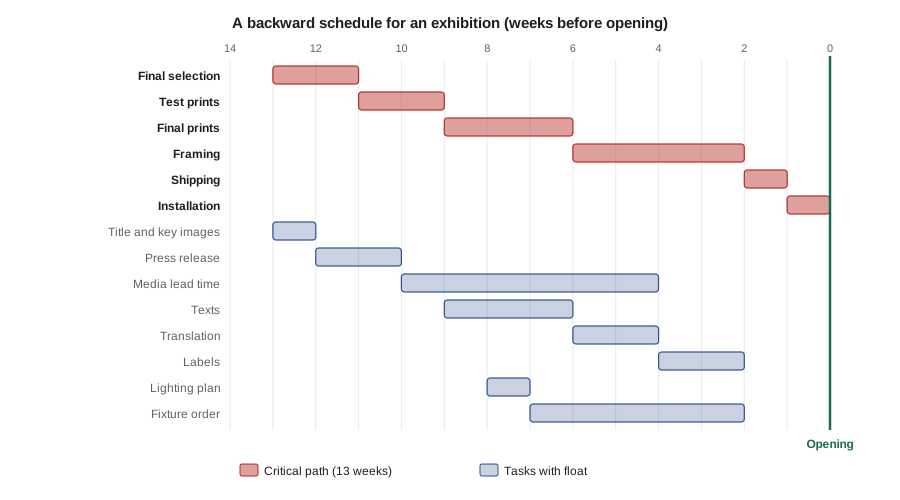
The critical path is the longest chain of dependent tasks, which determines the minimum time needed. Any delay on the critical path delays the opening unless another task is shortened. Tasks not on the critical path have float, or slack, which can absorb delays. Identify the critical path early and monitor it closely.
Worked problem
Finding the critical path
Before an opening, four chains of tasks must finish. Chain A: final selection 2 weeks, test prints 2 weeks, final prints 3 weeks, framing 4 weeks, shipping 1 week, installation 1 week. Chain B: title and key images 1 week, press release 2 weeks, media lead time 6 weeks. Chain C: texts 3 weeks, translation 2 weeks, label production 2 weeks. Chain D: lighting plan 1 week, fixture order 5 weeks. Which chain is critical, and how much float does chain B have?
Show solution
- Chain A: \( 2 + 2 + 3 + 4 + 1 + 1 = 13 \) weeks.
- Chain B: \( 1 + 2 + 6 = 9 \) weeks.
- Chain C: \( 3 + 2 + 2 = 7 \) weeks; chain D: \( 1 + 5 = 6 \) weeks.
- Float for chain B: \( 13 - 9 = 4 \) weeks.
Answer: Chain A, at 13 weeks, is the critical path; work must start at least 13 weeks before opening. Chain B has 4 weeks of float. A one-week delay in framing would push the opening; a one-week delay in the press release would not.
Budgeting an exhibition
An exhibition budget lists every expected cost and every source of income. Use separate lines so you can see where money goes and compare quotes. Include a contingency of about 10 to 15 per cent for unexpected costs; something always goes wrong.
| Category | Examples |
|---|---|
| Production | Test prints, final prints, mounting, framing, glazing, crates |
| Installation | Paint, hardware, hanging systems, vinyl, labels, lighting changes, installer fees |
| Shipping and travel | Freight, couriers, vehicle rental, artist travel and accommodation |
| Insurance | Transit and on-site cover not provided by the venue |
| Communications | Design of invitations, printing, advertising, photography of the installation |
| Programmes | Opening reception, talk honoraria, accessibility services such as ASL or LSQ interpretation |
| Fees | Artist fee, curator fee, writer fee, translation |
| Contingency | 10 to 15 per cent of costs |
| Income | Artist fee from venue, grants, sponsorship, sales commission retained |
Some costs, such as framing, can be treated as an investment if the frames will be reused or if framed works will be sold. Others, such as wall vinyl and opening refreshments, are spent once. Ask the venue which costs it covers. Public galleries may pay for shipping, insurance, installation and promotion; artist-run centres often pay a fee and cover installation and promotion but expect the artist to deliver finished work; commercial galleries vary.
Worked problem
Building a budget with contingency
A photographer's exhibition costs are: prints $2,600, framing $4,200, shipping $650, installation materials $400, invitations and documentation $500, opening $350. Add a 12 per cent contingency. The venue pays an artist fee of $2,000 and she has a grant of $4,500. What is the shortfall?
Show solution
- Costs: \( 2600 + 4200 + 650 + 400 + 500 + 350 = \$8700 \).
- Contingency: \( 0.12 \times 8700 = \$1044 \). Total: \( 8700 + 1044 = \$9744 \).
- Income: \( 2000 + 4500 = \$6500 \).
- Shortfall: \( 9744 - 6500 = \$3244 \).
Answer: A shortfall of about $3,240. She might reduce costs, for example by reusing frames or choosing a less expensive mounting, seek another source such as sponsorship, or plan to recover some cost through print sales.
Artist fees
In Canada, CARFAC and its Quebec counterpart RAAV negotiate and publish a minimum recommended fee schedule for artists' professional fees, including exhibition fees paid when work is shown in public venues that receive public funding. The schedule distinguishes types of exhibition and sizes of institution, is updated annually to reflect the cost of living, and is widely referenced by public galleries and artist-run centres; many funders expect grant recipients to pay according to it. The exhibition fee recognizes the public presentation of work and is separate from any sale. The Copyright Act gives artists in Canada an exhibition right for work created after 7 June 1988, which is the legal basis for exhibition fees.
In the United States, there is no statutory exhibition right and no single national fee schedule. The organization Working Artists and the Greater Economy (W.A.G.E.) runs a voluntary certification programme for nonprofit institutions that pay artist fees according to its standards, which scale with the institution's operating expenses; at the time of writing its floor fee for a solo exhibition is $1,250. Many institutions pay modest honoraria, and some pay nothing, expecting artists to benefit from exposure. Ask about fees directly and in writing; established institutions expect the question.
| Feature | Canada | United States |
|---|---|---|
| Legal basis | Exhibition right in the Copyright Act for works created after 7 June 1988 | No general exhibition right |
| Fee guidance | CARFAC-RAAV minimum recommended fee schedule, updated annually | Voluntary W.A.G.E. certification; institutional practice varies |
| Who usually pays | Publicly funded galleries and artist-run centres | Varies; certified nonprofits pay set minimums |
| Commercial galleries | Fees usually not paid; artist earns through sales | Same |
Worked problem
Comparing fee offers
An American nonprofit offers a $1,000 honorarium for a solo show. Its annual operating expenses are under $500,000. If it followed W.A.G.E. standards, what would the minimum fee be, and what is the difference?
Show solution
- For institutions below the threshold, W.A.G.E. sets a floor fee for a solo exhibition of \$1,250.
- Difference: \( 1250 - 1000 = \$250 \).
Answer: At least $1,250 under W.A.G.E. standards, $250 more than the offer. The photographer could cite the standard politely when negotiating, while recognizing that W.A.G.E. certification is voluntary.
Loan agreements, insurance and valuation
When work leaves your studio, it is at risk of damage, loss and theft in transit and on display. Whoever borrows or hosts the work should agree in writing who is responsible. Public institutions usually issue a loan agreement listing each work, its insurance value, the period of the loan, transit arrangements, display conditions, credit lines and condition reporting. Many institutional policies cover works "nail to nail" or "wall to wall", from the moment they are taken down in your studio until they are rehung there, including transit; others cover only the time on site.
Insurance value should reflect what it would cost to replace the work or the loss you would suffer. For editioned prints, the value is often the current retail price, or the net amount the artist would receive after a dealer's commission, depending on policy and agreement. Unique or irreplaceable works, such as vintage prints, may need appraisal. Keep records of sales prices to support values. PHOT-301 covered condition reports and care instructions; prepare a condition report for each work before it leaves and check it on return.
Worked problem
Setting insurance values
A photographer lends 14 framed prints for an exhibition. Her gallery sells them at $2,400 each and takes a 50 per cent commission. The venue's policy insures works at the artist's net value. Framing costs $300 per print and should be included. What total insurance value should she declare?
Show solution
- Net value per print: \( 2400 \times 0.5 = \$1200 \).
- Add framing: \( 1200 + 300 = \$1500 \) per framed work.
- Total: \( 14 \times 1500 = \$21\,000 \).
Answer: $21,000. If the agreement used retail value instead, the figure would be \( 14 \times (2400 + 300) = \$37\,800 \), so confirm which basis applies before signing.
The exhibition checklist
The exhibition checklist is the master list of works in the show. It is used for the layout, labels, insurance, shipping, condition reports, sales and documentation. Keep it in a spreadsheet with one row per work and columns for the following:
- Checklist number and image code from your master edit.
- Title, date of the image and date of the print.
- Medium and process, for example pigment print on cotton rag paper.
- Image size, paper size and framed size, in both metric and imperial units if the venue or shipper needs them.
- Edition number and edition size, including artist's proofs.
- Insurance value and sale price, if for sale.
- Owner and credit line, if lent by a collector.
- Location in the layout, crate number and condition notes.
Share the checklist with the venue and update it whenever details change. Errors on labels, such as wrong dates or misspelled titles, often trace back to an outdated checklist.
Communications and programming
An exhibition needs visitors. Plan communications on the same backward schedule as production. Many arts publications and listings need information six to eight weeks before opening, and some monthly or quarterly publications need it months earlier. A press release should give the essentials (who, what, where, when), a short description of the work, a quotation from the artist or curator, high-resolution images with captions and credits, and contact details. Invitations, social media posts, newsletters and listings follow.
Public programmes extend the life of an exhibition: an opening, an artist talk, a curator's tour, a panel discussion, a book launch, workshops for students or community groups. Plan accessible programming as part of the core schedule rather than an afterthought: offer relaxed or quiet hours, sign language interpretation (ASL in English-speaking communities, LSQ in Quebec), audio description and step-free routes. Record each programme and the visitor numbers, which funders often require in final reports.
Managing risk
A risk register lists what could go wrong, how likely it is, how serious the effect would be and what you will do about it. Rate each risk simply, for example likelihood and impact from 1 to 3, and focus attention on those with the highest product.
| Risk | Likelihood (1 to 3) | Impact (1 to 3) | Score | Response |
|---|---|---|---|---|
| Framing delayed | 2 | 3 | 6 | Order early, confirm dates in writing, keep a backup framer |
| Prints damaged in transit | 1 | 3 | 3 | Proper crates, insured shipping, condition reports |
| Grant refused | 2 | 2 | 4 | Apply to two sources; prepare a smaller version of the show |
| Low attendance | 2 | 2 | 4 | Communications plan, programmes, partner organizations |
| Illness of the artist at installation | 1 | 2 | 2 | Detailed hanging plan so others can install |
| Lighting fixtures unavailable | 2 | 2 | 4 | Confirm with the venue early; rent if necessary |
Revisit the register monthly and at key milestones. Many risks shrink as the opening approaches, while others, such as weather affecting shipping, appear late.
Common mistakes
MistakeSending the same generic proposal to every venue
InsteadTailor each proposal to the venue's programme, space and audience.
MistakePlanning a layout from an outdated floor plan
InsteadMeasure the walls and note obstacles before designing the layout.
MistakeLeaving responsibilities unstated
InsteadRecord who prints, frames, ships, hangs, insures and promotes.
MistakeBudgeting without contingency
InsteadAdd 10 to 15 per cent contingency for unexpected costs.
MistakeAssuming the venue's insurance covers transit
InsteadConfirm in the loan agreement whether cover is nail to nail or on site only.
Summary and key terms
- Exhibition proposals describe the visitor experience, checklist, technical needs, budget and schedule.
- Reading a venue means measuring walls and checking lighting, climate, security, access and insurance.
- Roles include artist, curator, registrar, designer, installer, communications and programmes.
- Backward scheduling and the critical path show the latest start dates for each task.
- Budgets need separate lines, venue contributions and a contingency of 10 to 15 per cent.
- Canada has a statutory exhibition right and the CARFAC-RAAV fee schedule; the United States relies on voluntary standards such as W.A.G.E.
- The exhibition checklist, loan agreement and risk register are core management documents.
- Open call
- A public invitation to submit exhibition proposals.
- Floor plan
- A scaled drawing of a venue showing walls, doors and features.
- Critical path
- The longest chain of dependent tasks determining the minimum project duration.
- Float
- The time a task can be delayed without delaying the project.
- Contingency
- A budget allowance for unexpected costs.
- Exhibition right
- In Canada, the right of artists to be paid for public exhibition of their work.
- Loan agreement
- A contract setting terms for lending works to an exhibition.
- Nail to nail
- Insurance covering works from removal at the lender's premises until their return.
- Exhibition checklist
- The master list of works with their details.
- Risk register
- A list of risks with likelihood, impact and responses.
Practice problems
Work each problem on paper first, then reveal the answer to check.
Name four items in an exhibition proposal package.
Show answer
Concept, checklist, images, layout sketch, technical needs, budget, schedule, CV.
Chains of 10, 7 and 12 weeks must finish before opening. Which is critical, and what float does the 7-week chain have?
Show answer
The 12-week chain; float of 5 weeks.
Costs total $6,000. What is a 15 per cent contingency?
Show answer
$900.
What is the legal basis for exhibition fees in Canada?
Show answer
The exhibition right in the Copyright Act for works made after 7 June 1988.
What does nail-to-nail insurance cover?
Show answer
From removal at the lender's premises through transit and display to return.
A print sells at $1,800 with 40 per cent commission. What is the artist's net value?
Show answer
\( 1800 \times 0.6 = \$1080 \).
List five columns in an exhibition checklist.
Show answer
Number, title, dates, medium, sizes, edition, value, owner, location.
How far ahead do many listings need exhibition information?
Show answer
About six to eight weeks, longer for monthly publications.
A risk has likelihood 3 and impact 2. What is its score?
Show answer
6.
Name two accessible programming options.
Show answer
Relaxed hours, ASL or LSQ interpretation, audio description, step-free routes.
Lesson quiz · 5 questions
Score 60% or more to complete this lesson.
Create a free account to save your progress, take quizzes and earn a certificate.