
PHOT-420 · Lesson 7 of 12 · 30 min
Super-resolution and computational zoom
Zoom is where phone cameras are most constrained. A thin body cannot hold a long lens, so phones combine several fixed lenses, crop from high-resolution sensors and use computation to fill the gaps between them. One of the most elegant ideas in computational photography makes the photographer's own shaky hands useful: because each frame of a hand-held burst is shifted by a fraction of a pixel, together the frames sample the scene more finely than any one of them, and an algorithm can reconstruct detail beyond the sensor's native resolution. This lesson explains sampling and aliasing, multi-frame super-resolution and how Google's Super Res Zoom replaced demosaicing with it, crop zoom from large sensors, multi-camera fusion and the honest limits of all of these. Single-image AI upscaling, which invents detail rather than measuring it, is the subject of lesson 8.
Sampling, resolution and aliasing
A sensor samples the continuous image formed by the lens at regularly spaced points. The sampling theorem says that detail can be represented without ambiguity only up to a spatial frequency of half the sampling rate, the Nyquist frequency. For a sensor with pixel pitch \( p \), the Nyquist frequency is:
Detail finer than this is not simply lost; it is aliased, folding back as false, coarser patterns. In a single image, aliasing is an artefact. But across several images shifted by different sub-pixel amounts, the aliased patterns differ, and the differences carry information about the fine detail. Super-resolution exploits exactly this. The Bayer pattern makes the situation worse for colour: red and blue are sampled at half the pixel pitch in each direction, so their Nyquist frequency is half that of a monochrome sensor, which is why demosaicing produces false colour on fine detail.
Worked problem
Nyquist frequency of a phone sensor
A phone sensor has a pixel pitch of 1.2 µm. What is its Nyquist frequency in line pairs per millimetre, and what is it for the red channel of a Bayer pattern?
Show solution
- \( f_N = 1 / (2 \times 0.0012 \text{ mm}) \approx 417 \) line pairs per mm.
- Red pixels are spaced \( 2p = 2.4 \) µm apart, so red Nyquist is about 208 line pairs per mm.
Answer: About 417 lp/mm for luminance-like sampling and 208 lp/mm for red; a small lens may not even deliver detail at these frequencies, which limits what super-resolution can recover.
Multi-frame super-resolution
Imagine four frames, each shifted by exactly half a pixel horizontally, vertically or both. Together they sample the scene on a grid twice as fine as any one frame. If the shifts are known, the samples can be placed on the fine grid and the high-resolution image reconstructed. Real shifts are random rather than ideal, so the algorithm must estimate each frame's sub-pixel shift precisely (the alignment of lesson 3, refined to a fraction of a pixel) and then interpolate the irregularly placed samples onto a regular fine grid, weighting each sample by its distance and by how trustworthy it is.
import numpy as np
rng = np.random.default_rng(420)
N = 400                                         # fine grid
x = np.arange(N)
scene = np.sin(2 * np.pi * x / 6.5) * 0.5 + 0.5    # detail with a period of 6.5 fine samples
step = 4                                         # sensor samples every 4 fine samples
# a single capture: too coarse for this detail (period 6.5 < 2 * 4 = 8), so it aliases
single = scene[0::step]
single_up = np.interp(x, x[0::step], single)
# four captures with sub-pixel shifts of 0, 1, 2, 3 fine samples (as from hand tremor)
shifts = [0, 1, 2, 3]
fused = np.zeros(N); count = np.zeros(N)
for s in shifts:
    samples = scene[s::step] + rng.normal(0, 0.01, len(scene[s::step]))
    fused[s::step] += samples; count[s::step] += 1
fused = fused / np.maximum(count, 1)
err_single = np.abs(single_up - scene)[10:-10].mean()
err_fused = np.abs(fused - scene)[10:-10].mean()
print(f"single capture error: {err_single:.3f}")
print(f"four shifted captures error: {err_fused:.3f}")
print(f"improvement: {err_single / err_fused:.0f} times")single capture error: 0.266 four shifted captures error: 0.008 improvement: 35 times
A single coarse capture cannot represent detail with a period shorter than two sensor samples, so interpolating it gives large errors (the pattern is aliased into a false, slower wave). Four captures with different sub-pixel shifts fill the fine grid and recover the pattern with small error. In real images, shifts are irregular, alignment is imperfect and lens blur limits the finest detail, so practical gains are smaller, typically a resolution improvement of about 1.5 to 2 times rather than unlimited.
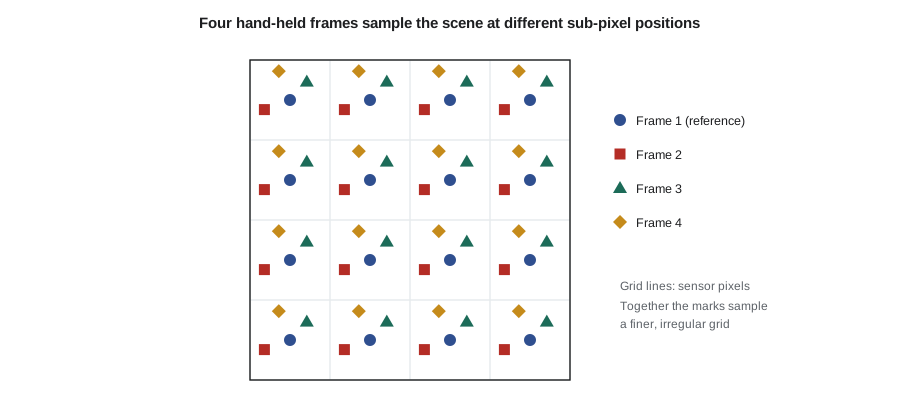
Super Res Zoom: replacing demosaicing
In 2019 Bartlomiej Wronski and colleagues at Google published "Handheld Multi-Frame Super-Resolution", the method behind the Pixel's Super Res Zoom. Its key insight was that a hand-held burst of raw Bayer frames, each shifted randomly, provides red, green and blue samples at many different positions. Instead of demosaicing each frame and then merging, the algorithm places every raw colour sample directly onto a fine output grid and reconstructs full colour from the accumulated samples. This performs demosaicing and super-resolution in one step and largely avoids demosaicing artefacts. The method uses an anisotropic kernel that adapts to local edges, so samples are spread along edges rather than across them, and a robustness model that rejects samples from moving or misaligned regions. When the phone is on a tripod and there is no natural tremor, the designers used the optical image stabilization system to move the lens slightly in a small pattern, creating the shifts deliberately.
Dedicated cameras do something similar with sensor-shift high-resolution modes, covered in PHOT-201: on a tripod, the sensor is moved by exact half- or one-pixel steps, recording each colour at each location or doubling the sampling grid. Several cameras now offer hand-held high-resolution modes that rely on natural tremor like the phone method. Both approaches need a static scene; moving leaves, water and people produce artefacts unless the software detects and handles motion.
| Method | Source of extra information | Requires | Typical gain |
|---|---|---|---|
| Sensor-shift high resolution (tripod) | Precise known sensor movements | Static scene, tripod | Full colour per pixel or about 2x linear |
| Hand-held multi-frame | Natural tremor sub-pixel shifts | Several frames, accurate alignment | About 1.5 to 2x linear |
| OIS-induced shifts | Deliberate lens wobble | Tripod or stable phone | Similar to hand-held |
| Single-image AI upscaling | Learned priors, not new measurements | Trained network | Apparent detail, partly invented |
Crop zoom from high-resolution sensors
Many phones have main sensors of 48 to 200 megapixels, usually binned to 12 or 50 megapixels for normal shots. Cropping the central part of the full-resolution readout gives a narrower field of view without upscaling, and manufacturers market this as "optical-quality" 2x zoom. Whether it truly matches an optical 2x lens depends on light: the full-resolution readout of a quad-Bayer sensor requires remosaicing and is noisier per pixel than binned output, so in dim light crop zoom degrades faster. Cropping a quarter of the area also uses only a quarter of the light collected by the whole sensor, so noise in the cropped image is higher than in the full frame at the same output size.
Worked problem
How much resolution does a crop leave?
A 50-megapixel sensor (8,160 by 6,120 pixels) is cropped to a 2x zoom. How many megapixels remain, and is that enough for a 12-megapixel output?
Show solution
- A 2x crop halves both dimensions: \( 4080 \times 3060 \).
- Pixels: \( 4080 \times 3060 \approx 12.5 \) megapixels.
- That just covers 12 megapixels without upscaling, but the effective colour resolution is lower because of the Bayer pattern.
Answer: About 12.5 megapixels remain, enough for a 12-megapixel output at 2x; at 3x only about 5.6 megapixels remain, so upscaling or super-resolution would be needed.
mp_full = 50.0
for zoom in (1, 1.5, 2, 3, 5, 10):
    remaining = mp_full / zoom ** 2
    light_share = 1 / zoom ** 2
print(f"{zoom:4.1f}x crop: {remaining:5.1f} MP remain, {light_share * 100:5.1f} % of the sensor's light")1.0x crop: 50.0 MP remain, 100.0 % of the sensor's light 1.5x crop: 22.2 MP remain, 44.4 % of the sensor's light 2.0x crop: 12.5 MP remain, 25.0 % of the sensor's light 3.0x crop: 5.6 MP remain, 11.1 % of the sensor's light 5.0x crop: 2.0 MP remain, 4.0 % of the sensor's light 10.0x crop: 0.5 MP remain, 1.0 % of the sensor's light
Multi-camera fusion
Phones typically carry an ultra-wide, a main and one or two telephoto cameras, often a periscope design that folds the light path sideways to fit a longer focal length in a thin body. When the user zooms to a value between two lenses, say 3x on a phone with 1x and 5x cameras, the phone crops from the main camera, possibly enhanced by super-resolution, and may fuse in detail from the telephoto camera where their fields overlap, at the centre of the frame. Fusion needs careful alignment because the two cameras are offset and see the scene from slightly different positions (parallax) and have different colour and noise characteristics. In low light the phone may refuse to use the telephoto, which usually has a smaller sensor and slower aperture, and crop from the main camera instead, sometimes surprising users who thought they were using the telephoto lens. Professional users who need to know which lens was used can check metadata, which often records the actual camera module.
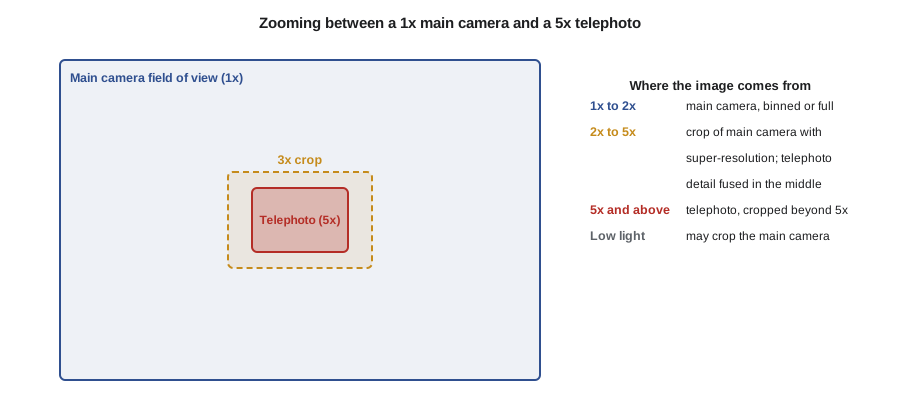
Long zoom, AI and the Moon problem
At extreme zoom, 30x to 100x, the light and detail available are tiny. Phones combine telephoto optics, crop, multi-frame super-resolution and increasingly learned enhancement. This is where the line between measurement and invention is most often crossed. The 2023 controversy over a phone's Moon photos, mentioned in lesson 1, arose because a model trained to recognize the Moon added texture consistent with the Moon's known appearance. Similar learned enhancement is applied to text, faces and architecture at high zoom by several manufacturers. The output looks sharp, but some detail is predicted from training data rather than recorded. For a holiday snap this is harmless; for a wildlife record, a legal photograph of a licence plate or a scientific observation, it can be misleading. Some phones now label or allow disabling of such enhancement, and some include content credentials noting AI processing (lesson 11).
Testing resolution claims
Photographers evaluating zoom should test rather than trust marketing. Photograph a resolution chart or a page of fine text at each zoom setting, in good light and dim light, and compare with a dedicated camera. Shoot fine natural textures such as foliage and brick, which reveal smearing from noise reduction and repeating patterns that can fool alignment. Check metadata to see which camera module was used. Compare single-frame raw captures with the processed output to see how much the pipeline adds. A simple metric is the modulation transfer function (MTF), which describes how much contrast is retained at each spatial frequency; MTF50, the frequency at which contrast falls to half, is a common single-number summary. Software such as Imatest or open-source tools such as MTF Mapper can measure it from slanted-edge targets.
Worked problem
Comparing MTF50
At 2x zoom a phone measures MTF50 of 0.22 cycles per pixel on its 12-megapixel output, while a crop from its main camera without super-resolution measures 0.15. What is the relative improvement?
Show solution
- Ratio: \( 0.22 / 0.15 \approx 1.47 \).
- An improvement of about 47 per cent in the frequency at which half contrast remains.
Answer: Super-resolution raised MTF50 by about 1.5 times, consistent with typical multi-frame gains; a sharpening filter could raise MTF50 too, so check for haloes and noise before crediting the algorithm.
The caution in that answer matters. Sharpening and learned enhancement can raise measured MTF without adding real information. Good testing examines detail that the algorithm cannot predict, such as random text or irregular textures, and compares against a reference.
Common mistakes
MistakeBelieving super-resolution can increase resolution without limit
InsteadExpect gains of about 1.5 to 2 times, limited by alignment accuracy, motion and lens sharpness.
MistakeAssuming a tripod always improves super-resolution
InsteadWithout tremor there are no sub-pixel shifts unless the camera creates them, for example with OIS movement.
MistakeTreating crop zoom as identical to optical zoom
InsteadRemember crop zoom uses less light and is noisier, especially in dim conditions.
MistakeAssuming the telephoto lens was used at its marked zoom
InsteadCheck metadata; in low light many phones crop the main camera instead.
MistakeUsing extreme AI zoom images as evidence of fine detail
InsteadTreat learned enhancement as prediction and use optical captures for records.
Summary and key terms
- Sensors resolve detail up to the Nyquist frequency \( 1/(2p) \); finer detail aliases.
- Sub-pixel shifts between frames let multi-frame super-resolution recover detail beyond one frame's sampling.
- Super Res Zoom accumulates raw Bayer samples onto a fine grid, combining demosaicing and super-resolution.
- Sensor-shift and OIS-induced shifts create the needed movement when the camera is still.
- Crop zoom from high-resolution sensors keeps pixels but uses less light.
- Multi-camera fusion blends telephoto detail into cropped images between focal lengths.
- Extreme zoom often uses learned enhancement, which predicts rather than records detail.
- Nyquist frequency
- Half the sampling rate; the highest spatial frequency a sensor can represent without aliasing.
- Aliasing
- False lower-frequency patterns created when detail exceeds the sampling limit.
- Multi-frame super-resolution
- Combining sub-pixel-shifted frames to reconstruct a higher-resolution image.
- Sub-pixel shift
- A displacement between frames of less than one pixel.
- Anisotropic kernel
- An interpolation kernel stretched along local edges.
- Crop zoom
- Narrowing the field of view by using only the central part of the sensor.
- Periscope telephoto
- A folded lens design that fits a long focal length in a thin phone.
- Parallax
- The apparent shift of objects between two viewpoints, larger for nearer objects.
- Modulation transfer function (MTF)
- A measure of contrast retained at each spatial frequency.
- MTF50
- The spatial frequency at which contrast falls to half, a summary of sharpness.
Practice problems
Work each problem on paper first, then reveal the answer to check.
Pixel pitch is 0.8 µm. What is the Nyquist frequency in line pairs per mm?
Show answer
\( 1/(2 \times 0.0008) = 625 \) lp/mm.
Why do shifted frames carry extra information?
Show answer
Each samples the scene at different positions, so their aliasing differs and together they sample more finely.
How did Super Res Zoom handle a phone on a tripod?
Show answer
It used optical image stabilization to move the lens slightly, creating shifts.
What does Super Res Zoom do instead of demosaicing each frame?
Show answer
It places raw colour samples from all frames onto a fine grid and reconstructs full colour.
A 200 MP sensor is cropped at 4x. How many megapixels remain?
Show answer
12.5 MP.
What share of the sensor's light does a 3x crop use?
Show answer
About 11 per cent (one-ninth).
Why might a phone crop the main camera instead of using the telephoto at 5x in dim light?
Show answer
The telephoto usually has a smaller sensor and slower aperture, so it is noisier.
How can you check which camera module took a phone photo?
Show answer
Inspect the metadata, which often records the module or focal length.
Why can MTF rise without real added detail?
Show answer
Sharpening and learned enhancement increase edge contrast or predict texture.
Give one situation where AI zoom enhancement is inappropriate.
Show answer
Wildlife records, evidence such as licence plates, or scientific observation.
Lesson quiz · 5 questions
Score 60% or more to complete this lesson.
Create a free account to save your progress, take quizzes and earn a certificate.