
PHOT-420 · Lesson 12 of 12 · 31 min
Capstone: a computational photography pipeline and provenance policy
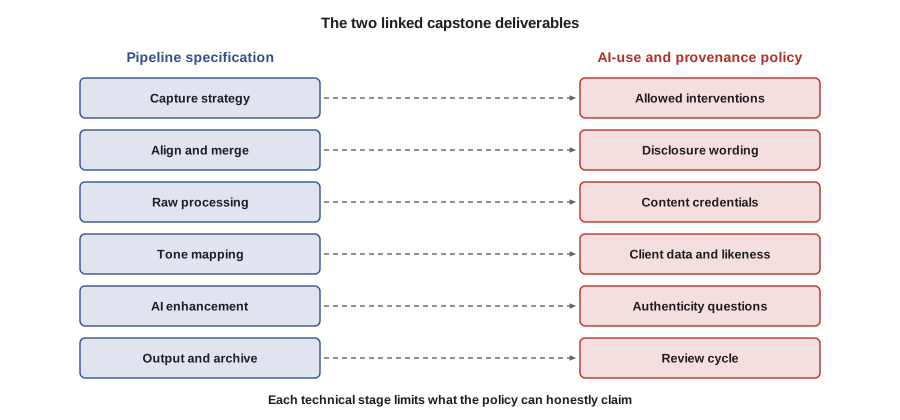
This capstone brings the course together in two linked deliverables. First, you design a computational photography pipeline for a defined use, specifying capture strategy, alignment and merging, demosaicing, tone mapping, any AI enhancement, and output, with justified parameters, a compute budget and a test plan. Second, you write an AI-use and provenance policy for a photography practice that would use such tools, covering which interventions are allowed for which kinds of work, disclosure wording, content credentials, client data and likeness, and how to respond to questions about authenticity. The two deliverables connect because every technical choice in a pipeline, from merging frames to AI upscaling, has consequences for what you can honestly claim about the resulting images. This lesson provides a worked example, a runnable miniature pipeline, templates, a checklist and an assessment rubric.
The brief
Choose one of the following scenarios, or propose your own with your instructor's approval.
- Scenario A, night events: an event photography studio wants a phone-based or camera-based workflow for hand-held candid images at evening receptions, with natural-looking colour and no visible ghosting of dancing guests.
- Scenario B, product e-commerce: a small studio photographs hundreds of products weekly and wants consistent, clean images with backgrounds extended for different web layouts, delivered quickly.
- Scenario C, documentary field work: a journalist working in low light needs maximum image quality while preserving a defensible chain of provenance and avoiding invented detail.
- Scenario D, landscape fine art: a photographer wants high-resolution prints from hand-held captures with wide dynamic range and is open to creative use of AI.
Each scenario pulls the design in different directions. Night events need robust merging and motion-aware frame lengths (lessons 3 and 6). Product work benefits from consistency, generative expand and careful disclosure (lessons 9 and 10). Documentary work must stay at the measurement end of the spectrum and prioritize provenance (lessons 1 and 11). Fine art can embrace super-resolution, HDR and even generative techniques, honestly described (lessons 4, 7 and 9).
Part 1: the pipeline specification
Your pipeline specification should cover the following sections, each with a short justification referring to the course.
- Use case and constraints: subjects, light levels, motion, output sizes, delivery times and device.
- Capture: single frame, burst or brackets; frame count and exposure per frame as a function of light and motion; raw or processed.
- Alignment and merging: global or tile-based, robust weighting, handling of moving subjects.
- Raw processing: noise model, demosaicing method, white balance strategy, colour correction.
- Tone mapping: global or local, HDR output with gain maps or SDR only, target look.
- AI enhancement: denoising, sharpening, upscaling or generative steps, with settings and where each sits on the intervention ladder.
- Output and provenance: formats, colour spaces, content credentials, metadata and archiving.
- Compute and storage budget: data volumes and processing time per image.
- Test plan: scenes, metrics and acceptance criteria.
A worked example: Scenario A, night events
The following condensed specification shows the expected level of detail.
Use case: hand-held candids at receptions lit by warm tungsten and LED uplighting, about EV 3 to 5, guests dancing; deliver 300 to 600 edited images within a week, printed up to 8 by 10 inches and shared online. Device: a full-frame mirrorless camera with a fast 35 mm lens, plus a recent phone for backup and social clips.
Capture: with the camera, shoot single frames at 1/125 s to freeze dancing, f/1.8, ISO 6,400 to 12,800, raw. A burst would freeze motion only if frames were very short, and robust merging would reject moving dancers anyway, so for this subject a single short frame plus strong AI denoising is the better design. For static details such as table settings and the venue, use a 6 to 8 frame hand-held burst at 1/30 s and merge, or the camera's multi-shot noise reduction mode.
Raw processing and AI: apply a raw-domain learned denoiser at moderate strength, checking faces and fabric at 100 per cent for invented texture; set white balance per scene with a reference shot of a grey card under the dominant light, keeping some warmth so the reception looks like evening; use AI subject masks to lift faces modestly. These are levels 2 and 3 on the ladder. No generative additions; minor cleanup such as exit signs only with the client's agreement in the contract.
Output: sRGB JPEG for online galleries, high-quality JPEG or TIFF for print, with copyright and contact metadata; content credentials enabled in the editing software's export; raw originals archived with two copies, one off site.
Worked problem
Checking the exposure and noise trade-off
At EV 4 the correct exposure at f/1.8 and ISO 6,400 is about 1/125 s. A static detail could instead be shot as eight frames at 1/30 s at ISO 1,600. Compare the light gathered and the expected SNR improvement.
Show solution
- One frame at 1/30 s gathers \( (1/30)/(1/125) \approx 4.2 \) times the light of 1/125 s, allowing ISO 1,600 (two stops lower).
- Eight such frames gather \( 8 \times 4.2 \approx 33 \) times the light of the single 1/125 s frame.
- Shot-noise SNR improves by about \( \sqrt{33} \approx 5.8 \) times, minus a small read-noise penalty.
Answer: The burst gives roughly 5.8 times better SNR for static subjects, about 5 stops of light, but would ghost or reject moving dancers; that is why the specification uses bursts only for static details.
Worked problem
Compute and storage budget
The camera produces 24-megapixel 14-bit raw files of about 25 MB each after lossless compression. The photographer shoots 3,000 frames per event. How much storage is needed for originals with two backups, and how long does AI denoising take at 6 seconds per image for 600 selects?
Show solution
- Originals: \( 3000 \times 25 = 75\,000 \) MB, or about 75 GB.
- Three copies (working plus two backups): about 225 GB per event.
- Denoising: \( 600 \times 6 = 3600 \) s, which is 1 hour of computer time.
Answer: About 225 GB per event across three copies and about an hour of denoising, which can run unattended overnight; denoise only the selects, not all 3,000 frames.
A miniature pipeline you can run
The following program strings together simplified versions of the techniques from lessons 2 to 4 and 8 on synthetic data: it captures a noisy burst of a scene with a moving object, aligns nothing (the camera is assumed steady), merges robustly, tone maps with the Reinhard operator, and reports noise and ghosting at each stage. Use it as a starting point for experimenting with parameters in your specification.
import numpy as np
rng = np.random.default_rng(420)
h, w, n = 60, 90, 8
radiance = np.full((h, w), 0.05); radiance[:, 60:] = 2.0        # dark room, bright window (40:1)
gain, read = 200.0, 2.0                                          # electrons per unit, read noise
def frame(k):
    r = radiance.copy()
    r[20:40, 10 + 4 * k:16 + 4 * k] = 0.6                        # a moving person
    e = rng.poisson(r * gain) + rng.normal(0, read, r.shape)
    return np.clip(e / gain, 0, 1.2)                             # sensor clips at 1.2 units
burst = np.array([frame(k) for k in range(n)])
ref = burst[0]
sigma = np.sqrt(np.maximum(ref, 0.01) / gain + (read / gain) ** 2)
w8 = np.clip(1 - (np.abs(burst - ref) - 2 * sigma) / (2 * sigma), 0, 1)
merged = (w8 * burst).sum(0) / w8.sum(0)
def reinhard(x, key=0.18):
    lw = np.exp(np.mean(np.log(x + 1e-4))); L = key * x / lw
    return L * (1 + L / L.max() ** 2) / (1 + L)
room = (slice(45, 60), slice(0, 50))
print(f"room noise: single frame {ref[room].std():.4f}, merged {merged[room].std():.4f}")
path = (slice(20, 40), slice(20, 44))
print(f"ghosting on the person's path: plain mean {burst.mean(0)[path].mean() - 0.05:+.3f}, robust {merged[path].mean() - 0.05:+.3f}")
out = reinhard(merged)
print(f"window clipped in capture: {np.mean(ref[:, 60:] >= 1.2) * 100:.0f} % of window pixels")
print(f"display values: room {out[room].mean():.3f}, window {out[:, 65:].mean():.3f}, max {out.max():.3f}")room noise: single frame 0.0181, merged 0.0076 ghosting on the person's path: plain mean +0.098, robust -0.001 window clipped in capture: 100 % of window pixels display values: room 0.058, window 1.000, max 1.000
The output shows the merged room is more than twice as clean as a single frame and robust merging suppresses the moving person's ghost. Tone mapping, however, leaves the room very dark and pushes the window to pure white. That reveals the limitation: the window is clipped in every frame, because all frames share one exposure. A real design would underexpose to protect the window and lift the room in tone mapping, or add a short frame, which is exactly the kind of reasoning your specification should document. Try changing the gain, the number of frames or the clipping level and observe the effects.
Test plan and acceptance criteria
A pipeline is only as good as its testing. Your test plan should include standard targets and real scenes, quantitative metrics and visual checks, and explicit pass criteria.
| Test | Method | Metric or check | Acceptance criterion |
|---|---|---|---|
| Noise in shadows | Grey patch at EV 3, ISO 12,800 | Standard deviation, visual | Fine grain, no blotches at 100 per cent |
| Skin and fabric texture | Portrait under tungsten | Visual at 100 per cent | No waxy skin or invented weave pattern |
| Motion | Dancers at 1/125 s | Visual | No ghosts; acceptable motion blur at hands only |
| White balance | Grey card in each lighting zone | Delta E or visual | Neutral within a slight warm bias |
| Highlight handling | Uplights and candles | Clipping percentage | Light sources may clip; faces must not |
| Provenance | Export and verify credentials | C2PA verification tool | Valid credential listing edits |
| Turnaround | Full event workflow | Hours | Delivery within 7 days |
Part 2: the AI-use and provenance policy
Your policy should be written for clients and the public, in plain language, and should be specific enough to guide decisions. A strong policy includes the following sections.
- Scope: which services and image types it covers.
- Our approach: a short statement of values, for example that photographs are presented as truthful records of real events unless clearly labelled otherwise.
- What we do: the ladder levels used by service, such as AI culling, denoising and masking for all work; cleanup for portraits on request; generative expand for product layouts with approval.
- What we do not do: for example, no generative alteration of documentary images; no changes to people's bodies or faces beyond agreed retouching; no fully synthetic images presented as photographs; no deepfakes of real people.
- Disclosure: how generative changes are labelled in captions, delivery notes and metadata, and that content credentials are attached where supported.
- Client images and data: which AI services are used, whether uploads may be used for training, storage locations, biometric features and consent, and deletion on request.
- Likeness and consent: releases for people in images, and no training of models on clients or subjects without written consent.
- Authenticity questions: how the studio responds if an image's authenticity is questioned, including providing originals and provenance.
- Review: how often the policy is updated as tools and laws change.
Worked problem
Drafting a disclosure clause for Scenario B
Write a delivery-note clause for a product studio that uses generative expand to widen backgrounds and occasionally removes dust and stray threads.
Show solution
- Name the interventions in plain words.
- Confirm what is not altered, namely the product itself.
- Mention provenance and what the client should do when publishing.
Answer: "Backgrounds in images marked 'extended' were widened using generative AI; dust and stray threads were removed. Products, colours, labels and dimensions are unaltered. Content credentials recording these edits are attached; platforms may remove them on upload, so keep the delivered files as your record."
Presenting and defending the work
Present your pipeline specification and policy as a short report of about 2,000 to 3,000 words with diagrams, plus your test results. Be ready to answer questions such as: where on the measurement-interpretation-invention spectrum does each stage sit; what would change if the light fell by two stops; how would you respond if a client asked you to remove a person from a documentary image; what happens to your content credentials when the client posts the image to social media; and which parts of your images might not be protected by copyright. Strong answers connect technical and ethical reasoning rather than treating them separately.
| Criterion | Excellent | Adequate | Weak |
|---|---|---|---|
| Technical design | Each stage justified with course concepts and numbers | Stages listed with some justification | Generic or inconsistent choices |
| Quantitative reasoning | Correct SNR, exposure, budget and metric calculations | Minor errors | Missing or wrong calculations |
| Test plan | Specific scenes, metrics and pass criteria | Some metrics | No clear criteria |
| Ethics and provenance | Ladder levels, disclosure and credentials tied to genre and law | General statements | Missing or contradictory |
| Policy clarity | Plain language, specific, actionable | Mostly clear | Vague or legalistic |
| Currency | Facts dated and sourced, with awareness of change | Some sources | Outdated or unsupported claims |
Looking ahead
Computational photography and generative AI will keep changing faster than any course can. New sensors will capture more information per exposure; pipelines will increasingly be single neural networks from raw to finished image; generative models will become part of capture itself, filling gaps in real time; and provenance will either become routine or remain patchy, depending on choices made by manufacturers, platforms and lawmakers. The concepts in this course, photon budgets, alignment, robust merging, tone mapping, depth, sampling, the perception-distortion trade-off, diffusion and provenance, will remain the tools for understanding whatever comes next. The habit that matters most is honesty about what a photograph measured, what it interpreted and what it invented.
Common mistakes
MistakeDesigning a pipeline without a defined use case
InsteadStart from subjects, light, motion and output, and justify each stage against them.
MistakeUsing bursts for fast-moving subjects without considering rejection
InsteadRemember robust merging rejects moving areas; use short single frames where motion dominates.
MistakeWriting a policy too vague to guide decisions
InsteadState specific allowed and forbidden interventions by service, with disclosure wording.
MistakeForgetting that platforms strip credentials
InsteadKeep originals and delivered files as records, and tell clients what to expect.
MistakeTreating technical and ethical sections separately
InsteadLink each technical stage to what it permits you to claim about the image.
Summary and key terms
- The capstone combines a justified pipeline specification with an AI-use and provenance policy.
- A specification covers capture, merging, raw processing, tone mapping, AI enhancement, output, budget and testing.
- Design choices depend on subject motion, light, output and the honesty required by the genre.
- Bursts excel for static subjects; short single frames with learned denoising suit fast action.
- Test plans need specific scenes, metrics and acceptance criteria, including provenance checks.
- A strong policy states what the studio does and does not do, how it discloses, and how it protects client data and likeness.
- The lasting habit is honesty about measurement, interpretation and invention.
- Pipeline specification
- A document describing and justifying each stage of an image processing workflow.
- Acceptance criterion
- A measurable condition a design must meet to pass testing.
- Test target
- A standard chart or scene used to measure image quality.
- Delta E
- A measure of colour difference used in colour accuracy testing.
- Chain of custody
- The documented handling of an image from capture to publication.
- Delivery note
- A document accompanying delivered images that describes their processing and usage.
- Turnaround time
- The time from capture to delivery of finished images.
- Sensitivity analysis
- Examining how results change when key inputs, such as light level, change.
- Policy review cycle
- The schedule for updating a policy as tools and laws change.
- Rubric
- A set of criteria and performance levels used to assess work.
Practice problems
Work each problem on paper first, then reveal the answer to check.
Why might a single short frame suit dancing guests better than a burst?
Show answer
Robust merging rejects moving areas, so a burst gives little benefit for fast motion while risking artefacts.
Eight frames each gather 3 times the light of a reference frame. What is the SNR improvement?
Show answer
\( \sqrt{24} \approx 4.9 \) times.
2,000 raw files of 30 MB with two backups need how much storage?
Show answer
\( 2000 \times 30 \times 3 = 180 \) GB.
Denoising 400 selects at 8 s each takes how long?
Show answer
3,200 s, about 53 minutes.
What limitation did the miniature pipeline reveal, and how would you fix it?
Show answer
The window clipped in all frames; underexpose to protect it and lift shadows, or add a short frame.
List four sections of an AI-use policy.
Show answer
Scope, what we do, what we do not do, disclosure (also client data, likeness, authenticity questions, review).
Write a one-sentence disclosure for a sky replacement in a fine art print.
Show answer
"Sky digitally replaced using generative AI; the landscape is a photograph taken on location."
Which test verifies provenance in your plan?
Show answer
Exporting with content credentials and checking them in a C2PA verification tool.
Where should documentary pipelines sit on the spectrum?
Show answer
At the measurement end, avoiding invented detail.
Why link technical and ethical reasoning in the capstone?
Show answer
Each processing choice determines what you can honestly claim about the image.
Lesson quiz · 5 questions
Score 60% or more to complete this lesson.
Create a free account to save your progress, take quizzes and earn a certificate.