
PHOT-410 · Lesson 9 of 12 · 28 min
Bookkeeping, GST/HST and taxes
A photography business can be busy and profitable on paper yet still run out of money, miss a tax deadline or face penalties for poor records. Financial management is not glamorous, but it is what keeps the business alive between jobs. This lesson covers bookkeeping systems, the difference between profit and cash, cash-flow forecasting with deposits, sales taxes, income tax and self-employment contributions, instalments or estimated payments, and the most common deductions photographers claim, such as home offices and vehicles. CRE-330 covers creator taxes in more depth, including corporations and retirement savings. Tax rules change every year; figures here are for 2026 where stated and should be checked against current government guidance or with an accountant.
Bookkeeping basics
Bookkeeping is the routine recording of every financial transaction: income received, expenses paid, money owed to you and money you owe. Good bookkeeping makes tax filing straightforward, shows whether the business is profitable, and provides evidence if the tax authority asks questions.
- Separate accounts: use a business bank account and card for all business transactions, so personal and business spending do not mix.
- Chart of accounts: group transactions into categories, such as session revenue, licensing revenue, print sales, equipment, software, insurance, marketing, travel, assistants and professional fees.
- Receipts and invoices: keep a digital copy of every receipt and invoice, linked to the transaction. Most accounting apps let you photograph receipts.
- Regular routine: record and reconcile transactions weekly or monthly, matching your records to bank statements.
- Reports: review a monthly profit and loss statement and cash balance, and an annual balance sheet.
Accounting software designed for small businesses can import bank transactions, issue invoices, track sales tax and produce reports. Choose one your accountant can work with.
Record keeping rules
In Canada, the Canada Revenue Agency generally requires business records to be kept for six years from the end of the tax year they relate to, in English or French, in a form that can be audited. Business income is normally reported on the accrual basis, recognizing income when earned and expenses when incurred, rather than when cash moves; your accountant can advise on how deposits received for work in a later year are treated.
Profit is not cash
Profit is revenue minus expenses for a period. Cash is the money actually in your account. The two differ because of timing: a client may owe you $5,000 for a job finished last month, so it counts as revenue but is not yet cash; a camera bought for cash is deducted gradually through depreciation, so your cash fell more than your expenses; deposits for next year's weddings arrive as cash before the work is done. A business can be profitable but run out of cash, especially if it grows quickly or works in strong seasons.
Cash-flow forecasting
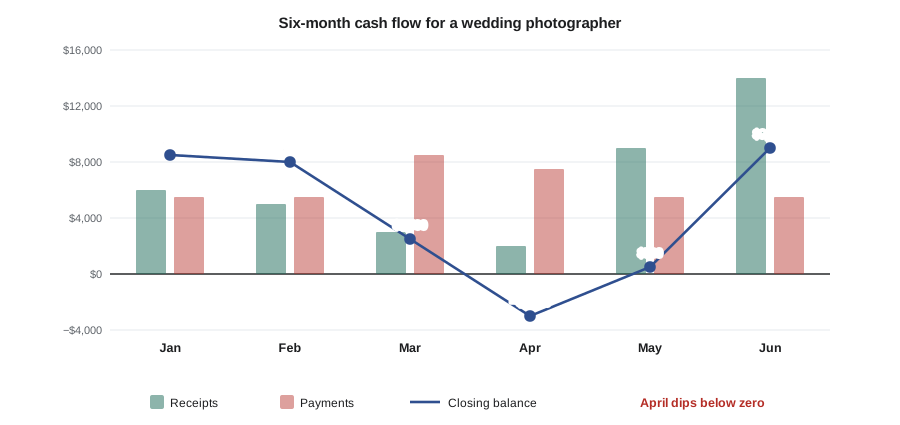
A cash-flow forecast predicts cash coming in and going out each month and the resulting balance. For photographers with seasonal work and deposits, it is one of the most useful tools in the business, because it reveals months when cash will run short before they arrive.
| Month | Opening | Receipts | Payments | Closing |
|---|---|---|---|---|
| January | $8,000 | $6,000 (deposits) | $5,500 | $8,500 |
| February | $8,500 | $5,000 (deposits) | $5,500 | $8,000 |
| March | $8,000 | $3,000 | $8,500 (incl. $3,000 lens) | $2,500 |
| April | $2,500 | $2,000 | $7,500 (incl. $2,000 tax) | −$3,000 |
| May | −$3,000 | $9,000 (balances) | $5,500 | $500 |
| June | $500 | $14,000 (balances) | $5,500 | $9,000 |
Worked problem
Fixing a cash shortfall
In the forecast above, the balance falls to −$3,000 in April. Suggest two changes that would keep the balance positive, and check one of them.
Show solution
- Option 1: delay the $3,000 lens purchase from March to June, after wedding balances arrive.
- Check: March closing becomes \( 8000 + 3000 - 5500 = \$5500 \); April becomes \( 5500 + 2000 - 7500 = \$0 \); May \( 0 + 9000 - 5500 = \$3500 \); June after buying the lens \( 3500 + 14\,000 - 8500 = \$9000 \).
- Option 2: hold a cash reserve of at least one month of payments, or collect a second instalment from couples 90 days before the wedding.
Answer: Moving the lens purchase keeps cash at or above zero, though April is still tight. Combining it with a reserve or an earlier instalment schedule gives a safer margin. The forecast showed the problem two months early.
Sales taxes
Most photography services and products in Canada are subject to the goods and services tax (GST) or the harmonized sales tax (HST), which combines GST with a provincial portion. Rates in 2026 are 5% GST in Alberta, British Columbia, Manitoba, Saskatchewan, Quebec and the territories; 13% HST in Ontario; 14% HST in Nova Scotia; and 15% HST in New Brunswick, Newfoundland and Labrador and Prince Edward Island. Quebec adds the Quebec sales tax (QST) of 9.975%, and British Columbia, Manitoba and Saskatchewan have provincial sales taxes that apply mainly to goods and some services, so check whether prints or other products are taxable there.
You must register for GST/HST once your taxable revenue exceeds $30,000 in a single calendar quarter or over four consecutive calendar quarters; below that, you are a small supplier and may register voluntarily. Registered businesses charge tax on their sales and claim input tax credits for the GST/HST paid on business purchases, so registering can recover tax on equipment. Eligible small businesses may use the quick method, remitting a fixed percentage of tax-included sales instead of tracking credits on most expenses.
Worked problem
Sales tax registration
A photographer in Ontario earned $6,000, $9,500, $8,000 and $7,800 in four consecutive quarters of taxable sales. Must she register for GST/HST? If she registers and charges 13% HST on a $1,200 session, how much tax does she collect and how much does she owe if she paid $40 of HST on supplies for that job?
Show solution
- Four-quarter total: \( 6000 + 9500 + 8000 + 7800 = \$31\,300 \), which exceeds $30,000.
- She must register; HST collected: \( 0.13 \times 1200 = \$156 \).
- Net remittance after the input tax credit: \( 156 - 40 = \$116 \).
Answer: Yes, she must register; she collects $156 and remits $116 after claiming $40 of input tax credits.
Income tax and self-employment contributions
Self-employed photographers in Canada report business income on form T2125 with their personal return. Personal income tax is charged at graduated federal and provincial rates on net income after expenses. In addition, you pay both the employee and employer shares of Canada Pension Plan contributions on self-employment earnings: for 2026, 11.9% on earnings between $3,500 and $74,600, a maximum of $8,460.90, plus second additional contributions (CPP2) of 8% on earnings between $74,600 and $85,000, a maximum of $832. Half of the base contributions is deductible and half earns a credit. Quebec residents contribute to the Quebec Pension Plan instead, at slightly different rates. Self-employed people can opt into employment insurance special benefits, such as parental and sickness benefits.
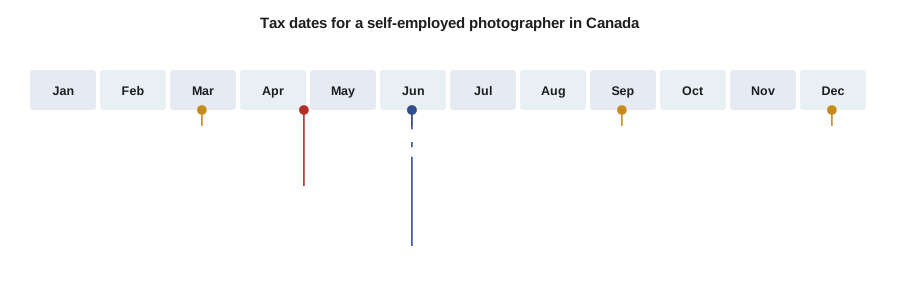
Self-employed individuals must file by June 15, but any balance owing is due by April 30. If your net tax owing exceeds $3,000 ($1,800 in Quebec) in the current year and in either of the two previous years, you must pay instalments, generally due on March 15, June 15, September 15 and December 15.
Worked problem
Self-employment contributions
A Canadian photographer outside Quebec has net self-employment income of $60,000 in 2026. What CPP contributions does she pay, and how much should she set aside monthly for them?
Show solution
- Contributory earnings: \( 60\,000 - 3500 = \$56\,500 \).
- Contributions: \( 56\,500 \times 0.119 = \$6723.50 \); earnings are below $74,600, so no CPP2 applies.
- Monthly set-aside: \( 6723.50 / 12 \approx \$560 \), in addition to income tax.
Answer: About $6,724 in CPP contributions, or about $560 a month. Many photographers transfer a fixed percentage of every payment, such as 25 to 30%, to a separate tax savings account.
Common deductions
Business expenses that are reasonable and incurred to earn income are generally deductible. For photographers these include software and subscriptions, insurance, marketing, professional fees, association dues, education related to the current business, studio rent, assistants and contractors, props and supplies, phone and internet (business share), travel for jobs, and equipment through depreciation (Lesson 10).
Home office: you may deduct a share of home costs, such as rent, utilities, insurance and property tax, if the work space is your principal place of business, or is used only to earn business income and regularly to meet clients. The share is usually based on floor area. Vehicle: self-employed people deduct actual vehicle costs, such as fuel, insurance, maintenance, lease or loan interest within limits, and capital cost allowance, multiplied by the share of kilometres driven for business; keep a logbook. The CRA's per-kilometre allowance rates (73 cents for the first 5,000 km in 2026) are for employers reimbursing employees, not a deduction method for the self-employed.
Paying yourself
Sole proprietors do not pay themselves a salary in the legal sense; they draw money from the business, and tax is based on the business's net income, not on the amount drawn. Even so, paying yourself a regular, planned amount each month, rather than taking money whenever the account looks full, makes personal budgeting easier and keeps enough in the business for taxes, equipment and slow seasons. A common system divides each payment received into separate accounts: a share for tax, a share for operating expenses, a share for profit or savings and the remainder for owner pay. Reviewing the percentages each quarter keeps the system aligned with actual results.
Working with an accountant
An accountant who understands self-employed creatives can save more than their fee through correct deductions, timing of purchases, instalment planning and advice on structure. Give them organized records: categorized transactions, reconciled bank statements, sales tax returns, a list of equipment bought and sold, mileage or vehicle logs, and home office measurements. Meet before year end, not just at filing time, so there is still time to act on their advice, such as buying needed equipment before the year closes or setting aside more for tax. Ask them to explain any figure you do not understand; you remain responsible for what is filed in your name.
Key financial ratios
Three ratios give a quick picture of financial health. Gross margin, revenue minus direct costs divided by revenue, shows how much each sale contributes to overheads and profit. Net margin, profit divided by revenue, shows overall profitability. Days sales outstanding, the average number of days clients take to pay, shows how quickly invoices turn into cash. Tracking these each quarter reveals trends long before they become crises.
Set calendar reminders for every filing and payment date at the start of the year, with a week's warning, so deadlines never arrive as surprises.
Common mistakes
MistakeMixing personal and business transactions
InsteadUse separate accounts and record every transaction with a receipt.
MistakeConfusing profit with cash
InsteadPrepare a monthly cash-flow forecast, especially in seasonal businesses.
MistakeIgnoring sales tax thresholds
InsteadTrack taxable sales each quarter and register when required.
MistakeSpending all receipts and facing a large tax bill
InsteadSet aside a fixed percentage of every payment in a tax account.
MistakeClaiming vehicle costs without a log
InsteadKeep a logbook or mileage app to support the business share.
Summary and key terms
- Bookkeeping records every transaction in categories, with receipts and regular reconciliation.
- Profit and cash differ because of timing; deposits and purchases can create cash crunches.
- A cash-flow forecast reveals shortfalls months in advance.
- Sales tax rules differ: GST/HST in Canada with a $30,000 small supplier threshold; state rules and economic nexus in the United States.
- Self-employed photographers pay pension contributions or self-employment tax in addition to income tax.
- Instalments or estimated payments are due quarterly when tax owing exceeds set thresholds.
- Home office and vehicle deductions require clear records of business use.
- Bookkeeping
- The routine recording of financial transactions.
- Chart of accounts
- The list of categories used to group transactions.
- Reconciliation
- Matching recorded transactions to bank statements.
- Accrual basis
- Recognizing income when earned and expenses when incurred.
- Cash basis
- Recognizing income when received and expenses when paid.
- Cash-flow forecast
- A projection of monthly cash receipts, payments and balances.
- Input tax credit
- A Canadian credit for GST/HST paid on business purchases.
- Economic nexus
- A US sales tax obligation triggered by sales volume into a state.
- Self-employment tax
- US Social Security and Medicare tax paid by the self-employed.
- Instalments
- Advance tax payments made during the year.
Practice problems
Work each problem on paper first, then reveal the answer to check.
Opening cash $4,000, receipts $3,000, payments $6,500. What is the closing balance?
Show answer
\( 4000 + 3000 - 6500 = \$500 \).
Why can a profitable business run out of cash?
Show answer
Timing differences between earning, receiving and spending money.
What is the Canadian small supplier threshold for GST/HST?
Show answer
$30,000 of taxable revenue in a quarter or four consecutive quarters.
What is a common US economic nexus threshold?
Show answer
$100,000 of sales into a state in a year.
Calculate 2026 CPP contributions on $40,000 of self-employment income.
Show answer
\( (40\,000 - 3500) \times 0.119 = \$4343.50 \).
Calculate US self-employment tax on $40,000 of net earnings.
Show answer
\( 40\,000 \times 0.9235 \times 0.153 = \$5651.82 \).
Name the four quarterly tax payment months in Canada.
Show answer
March, June, September and December.
Name the four estimated tax payment months in the United States.
Show answer
April, June, September and January.
What records support a vehicle deduction?
Show answer
A logbook or mileage record of business and total distance.
Why set aside a percentage of each payment?
Show answer
To have money ready for tax and contributions when due.
Lesson quiz · 5 questions
Score 60% or more to complete this lesson.
Create a free account to save your progress, take quizzes and earn a certificate.