
PHOT-410 · Lesson 1 of 12 · 27 min
Photography business models
Talent and technical skill are necessary for a photography career, but they do not pay the rent on their own. What turns skill into a living is a business model: a clear answer to who pays you, for what, how often, and how much it costs to deliver. Two photographers with identical portfolios can have very different incomes because one sells day rates and usage licences to agencies while the other sells one-off sessions to families. This course treats photography as a small business and works through the decisions that sustain one: structure, pricing, licensing, contracts, marketing, sales, finances, insurance and growth. Earlier courses introduced some of these topics in context, such as commercial estimates in PHOT-310, event contracts in PHOT-340, portfolios and professional networks in VIS-410, and creator business structures in CRE-330. This course pulls them together into a single operating view of a photography business.
What a business model answers
A business model is a simple description of how a business creates value and earns money. For a photographer, it can be summarized in six questions.
- Customers: who buys? Brands, agencies, magazines, couples, families, businesses, collectors, students or other photographers.
- Offer: what do they buy? Time on set, finished images, rights to use images, physical products, experiences or knowledge.
- Price basis: how is the price set? By day, by image, by package, by usage, by subscription or by product.
- Channels: how do customers find and reach you? Referrals, agencies, search, social media, galleries, platforms or direct outreach.
- Costs: what does it cost to deliver? Equipment, studio, assistants, editing time, travel, marketing and overheads.
- Repeatability: how often does the same customer return, and how predictable is income from month to month?
Writing the answers down for your own business is the first exercise of this course. It often reveals that a photographer is trying to run several businesses at once, each with different customers and pricing, without realizing that each needs its own marketing and its own price list.
The main photography business models
Photography is not one industry but a cluster of markets. The main ones differ in who buys, how prices are set and how stable income is.
| Model | Typical customers | Price basis | Income pattern |
|---|---|---|---|
| Commercial and advertising | Brands, agencies, corporations | Creative fee plus usage licence, or day rate | Irregular, large jobs |
| Portrait and family | Individuals and families | Session fee plus product sales | Seasonal, repeat clients |
| Wedding and event | Couples, organizations | Packages with deposits | Strongly seasonal, booked far ahead |
| Editorial | Magazines, newspapers, online publishers | Day rate or per-image fee | Low rates, regular for some |
| Stock and licensing | Agencies and platforms, buyers worldwide | Royalty per download or licence | Small, ongoing, slow to build |
| Fine art | Collectors, galleries, institutions | Print and edition sales | Very irregular |
| Education and products | Students, hobbyists, other photographers | Workshops, courses, presets, books | Scalable, depends on audience |
| Hybrid stills and video | Brands, small businesses, creators | Production budgets, retainers | Regular if clients retain you |
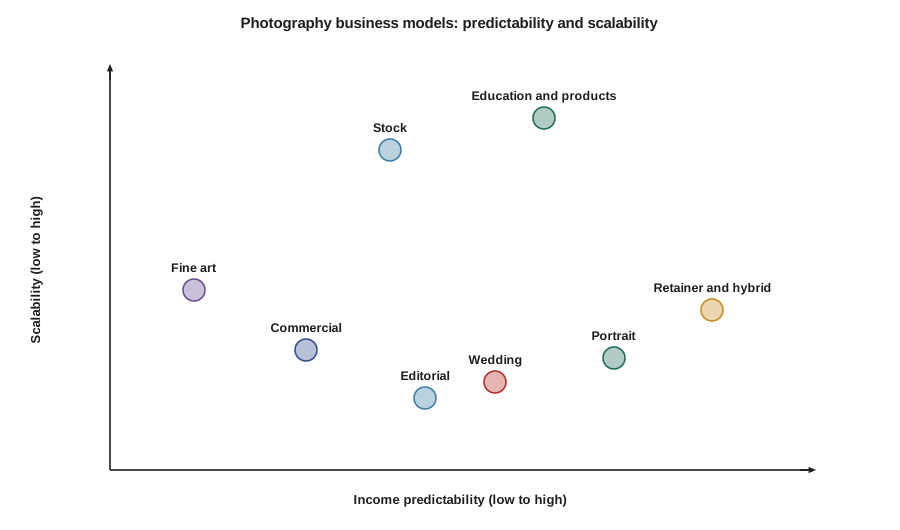
Each model has its own economics. Commercial work pays well per day but jobs are irregular and depend on relationships with art buyers, producers and agencies. Portrait work pays less per session but can be steady, with in-person product sales raising the average order. Weddings bring large bookings months in advance, which helps cash flow, but concentrate work into one season and carry high stakes on a single day. Editorial pays modestly but builds visibility and portfolio. Stock and products are scalable, since one image or course can sell many times, but earnings per sale are small and markets are crowded.
Time-for-money and scalable income
Most photography income is time for money: you are paid for a shoot, and when you stop shooting, income stops. There are only so many shoot days in a year, and editing, marketing and administration take much of the rest. This puts a ceiling on income unless prices rise. Scalable income, by contrast, can grow without a matching increase in your time: stock licences, prints sold repeatedly, online courses, presets, books or licensing an existing archive.
Few photographers live entirely on scalable income. A more realistic strategy is a core time-based service that pays the bills, plus one or two scalable streams that grow slowly in the background. The danger is spreading effort too thinly, so that no stream receives enough attention to succeed.
Worked problem
Estimating a time-for-money ceiling
A portrait photographer can shoot at most 4 sessions a week, 46 weeks a year, and each session also needs about 4 hours of editing, ordering and admin. Her average sale is $650. What is her maximum annual revenue, and how many hours do sessions take?
Show solution
- Maximum sessions: \( 4 \times 46 = 184 \) sessions a year.
- Maximum revenue: \( 184 \times 650 = \$119\,600 \).
- Time per session including the 2-hour shoot: \( 2 + 4 = 6 \) hours, so \( 184 \times 6 = 1104 \) hours a year.
- Marketing, bookkeeping and sales meetings add more hours that are not billed.
Answer: About $119,600 at full capacity, using roughly 1,100 hours on sessions alone. In practice she will not book every slot, so real revenue will be lower; raising the average sale or price, not adding sessions, is the main way to grow.
Revenue mix and concentration risk
Many photographers combine models, such as weddings in summer and portraits or commercial work in winter. A revenue mix smooths seasonal swings and reduces dependence on any one market. It also spreads risk: if one large client provides half your revenue and leaves, the business may not survive. A common rule of thumb in small-business advice is to worry when any single client exceeds about a quarter to a third of revenue, though the right level depends on the relationship.
Worked problem
Measuring client concentration
A commercial photographer earned $96,000 last year: $42,000 from one agency, $18,000 from a retailer, and $36,000 from twelve smaller clients. What share came from the largest client, and what happens to revenue if that client leaves?
Show solution
- Largest client's share: \( 42\,000 / 96\,000 = 0.4375 \), or about 44%.
- Revenue without that client: \( 96\,000 - 42\,000 = \$54\,000 \).
- That is a fall of 44%, while most overheads stay the same.
Answer: About 44% of revenue depends on one client. Losing it would cut revenue to $54,000; the photographer should diversify by marketing to more agencies or adding a second market.
Market trends at the time of writing
The photography market keeps changing, and a business model must respond. Several trends shape decisions in the mid-2020s.
- Generative AI imagery: image generators now produce convincing illustrations and some stock-style images at low cost. This has put pressure on generic stock and simple product or concept images, while increasing demand for authentic, verifiable photographs of real people, places and events.
- Video convergence: many clients expect short video alongside stills for social platforms, so hybrid shooters can capture larger budgets.
- In-house content teams: some brands now employ their own photographers, reducing freelance commissions for routine work but leaving specialist and high-end projects to outside photographers.
- Platform dependence: social platforms change algorithms and policies quickly, so reach built entirely on one platform is fragile.
- Content credentials: provenance standards such as C2PA content credentials let photographers attach verifiable information about how an image was made, which may become a selling point.
None of these trends makes photography obsolete, but each rewards photographers who offer something hard to replace: trust, access, direction of people, local knowledge, a recognizable voice, and service. Lesson 8 returns to AI licensing and stock in detail.
Choosing and testing a model
Choosing a model is partly personal: what work you enjoy, what lifestyle you want, and where you live. A wedding business suits someone who enjoys people and can handle intense weekends; commercial work suits someone comfortable with production teams and long sales cycles; fine art suits someone with a strong personal voice and patience. Market factors matter too: a small town may support portraits and weddings but few agency jobs, while a large city has more commercial clients and more competition.
Test a model cheaply before committing. Run a small number of paid jobs in the new market, calculate actual costs and hours, and ask clients what they valued. Many photographers discover that a market they assumed was lucrative pays less once editing and admin time are counted, or that a market they overlooked is underserved.
A value proposition
A value proposition states why a particular customer should hire you rather than an alternative, including doing nothing, using a phone, hiring a cheaper photographer or using AI imagery. A good value proposition names the customer, the problem and the outcome. "Product photography for independent food brands that need images for online stores within five working days" is clearer and more marketable than "creative photography for all your needs." Lessons 6 and 7 show how positioning and sales build on this statement.
Reading a market before entering it
Before committing to a market, gather simple evidence. Search for photographers already serving it in your area and note their published prices, package contents, turnaround times and how they present themselves. Count how many there are and how active they seem. Talk to potential buyers: an art buyer, a wedding planner, a marketing manager at a local company or a gallery owner can tell you what they pay, what frustrates them about current suppliers and what they wish someone offered. Look at demand signals such as job postings for in-house photographers, the number of new businesses opening in your area, or seasonal search interest for terms like family photographer or headshots.
This research does not need to be elaborate. A one-page summary of competitors, typical prices, buyer needs and gaps is enough to decide whether a market is worth testing. It also gives you language for your value proposition, because buyers often describe their problems in words you can reuse in marketing.
Lifestyle and sustainability
A business model should also fit the life you want. Weddings mean working most summer weekends; commercial work can mean sudden travel; portrait studios mean evenings and weekends when families are free; editorial can mean tight deadlines at short notice. Physical demands matter too, since carrying gear and standing for twelve-hour days becomes harder over a career. Many experienced photographers shift their model over time, moving from weddings to commercial or education, or from freelance shooting to teaching and consulting. Planning for that evolution from the start, by building relationships, an archive and a reputation that can carry into a new market, is part of a sustainable career.
Common mistakes
MistakeTreating photography as a single market with one price list
InsteadIdentify each market you serve and give each its own offer, pricing and marketing.
MistakeAssuming more shoots are the only way to grow
InsteadCalculate your time ceiling and grow through price, average sale and scalable streams as well.
MistakeLetting one client provide most of your revenue
InsteadTrack client concentration and diversify before a large client leaves.
MistakeChasing every trend at once
InsteadAdd new streams one at a time and give each enough effort to succeed.
MistakeIgnoring editing and admin time when judging a market
InsteadCount all hours a job takes, not only time on set.
Summary and key terms
- A business model answers who pays, for what, how prices are set, through which channels, at what cost, and how often.
- Photography markets include commercial, portrait, wedding, editorial, stock, fine art, education and hybrid video.
- Models differ in income predictability, scalability and seasonality.
- Time-for-money income has a ceiling set by available shooting and editing hours.
- A revenue mix smooths seasons and reduces concentration risk.
- AI imagery, video convergence, in-house teams and platform change are reshaping the market.
- A clear value proposition names the customer, the problem and the outcome.
- Business model
- A description of how a business creates value and earns money.
- Value proposition
- A statement of why a specific customer should choose you.
- Time-for-money income
- Income earned only while you are working, such as shoot fees.
- Scalable income
- Income that can grow without a matching increase in your time.
- Revenue mix
- The combination of income streams a business relies on.
- Concentration risk
- The danger of depending heavily on one client or market.
- Average sale
- Total revenue divided by the number of clients or orders.
- Hybrid shooter
- A photographer who offers both stills and video.
- Content credentials
- Verifiable provenance information attached to a digital image.
- In-house team
- Photographers employed directly by a brand or company.
Practice problems
Work each problem on paper first, then reveal the answer to check.
Name the six questions a photography business model answers.
Show answer
Customers, offer, price basis, channels, costs and repeatability.
A photographer can do 3 sessions a week for 48 weeks at $800 each. What is the maximum revenue?
Show answer
\( 3 \times 48 \times 800 = \$115\,200 \).
One client provides $30,000 of $75,000 revenue. What is its share?
Show answer
\( 30\,000 / 75\,000 = 40\% \).
Give two examples of scalable photography income.
Show answer
Stock licences, repeated print sales, online courses, presets, books.
Why are wedding businesses good for cash flow but risky?
Show answer
Bookings and deposits arrive months ahead, but work is seasonal and each day is high-stakes.
Name two market trends affecting photographers in the mid-2020s.
Show answer
AI imagery, video convergence, in-house teams, platform dependence, content credentials.
Write a value proposition for a headshot business.
Show answer
For example: polished headshots for real estate agents, delivered within 48 hours.
Why test a new market with a few jobs first?
Show answer
To measure real costs, hours and demand before committing.
A session takes 2 hours to shoot and 3 hours to edit. How many hours do 150 sessions take?
Show answer
\( 150 \times 5 = 750 \) hours.
What is the main way to grow a time-for-money business at capacity?
Show answer
Raise prices or average sale, or add scalable streams.
Lesson quiz · 5 questions
Score 60% or more to complete this lesson.
Create a free account to save your progress, take quizzes and earn a certificate.