
PHOT-410 · Lesson 4 of 12 · 28 min
Licensing, usage and copyright as a business asset
A photograph is two things at once: a file or print, and a bundle of legal rights. For a professional photographer, those rights are often worth more than the time spent making the image, because the same photograph can be licensed again and again for different uses, places and periods. Treating copyright as a business asset means knowing who owns it, how to license it, how to price usage, how to register and protect it, and how to respond when someone uses your work without permission. PHOT-310 showed how usage appears on a commercial estimate; this lesson explains the system behind it and the differences between Canadian and American law.
Copyright basics for photographers
Copyright arises automatically when an original photograph is created and fixed; no registration or notice is required for it to exist. It gives the owner exclusive rights to reproduce the work, publish it, communicate it to the public, adapt it and authorize others to do these things. In both Canada and the United States, the general term of protection is the life of the author plus 70 years. Canada extended its term from life plus 50 years to life plus 70 years at the end of 2022, without reviving works whose term had already expired.
Copyright protects the expression, not the idea. Another photographer may photograph the same landmark, in the same light, without infringing; copying your specific image, or closely imitating its particular creative choices, is another matter.
Who owns the copyright
In Canada, the photographer is generally the first owner of copyright in a photograph, including a commissioned one. Before the Copyright Modernization Act of 2012, a person who ordered and paid for a photograph was usually the first owner; that rule was repealed, so clients now receive only the rights the photographer grants them. One exception protects private clients: an individual who commissions a photograph for personal or domestic purposes may use it for private, non-commercial purposes, such as sharing family portraits with relatives, unless the contract says otherwise. Photographs made by an employee in the course of employment belong to the employer unless agreed otherwise. Any assignment of copyright, or an exclusive licence, must be in writing and signed by the owner to be valid.
Canada also protects moral rights: the right to be associated with a work by name or pseudonym, or to remain anonymous, and the right to the integrity of the work. Moral rights cannot be assigned, but they can be waived in writing, and many commercial contracts ask for a waiver.
Whatever the default rule, the contract governs what the client may do. A clear licence prevents misunderstandings about who can use what.
What a licence grants
A licence is permission to use a work in specified ways while the owner keeps the copyright. Usage licences in photography are usually defined by a set of parameters.
- Media: where the image appears, such as a website, social media, print advertising, packaging, out-of-home billboards, broadcast or a point-of-sale display.
- Territory: the geographic area, such as a city, a province or state, a country, North America or the world.
- Duration: how long the use may continue, such as six months, one year, three years or in perpetuity.
- Exclusivity: whether the photographer may license the same image to others, and in which categories.
- Quantity or placement: print run, number of insertions, size or prominence, such as a cover versus an inside page.
The narrower the licence, the lower the fee; the broader the licence, the higher. An unlimited, worldwide, perpetual, exclusive licence approaches the value of buying the copyright outright, and should be priced accordingly. Clients often request "all rights" or a buyout by habit rather than need; asking how they actually plan to use the images can produce a narrower licence that suits their budget and keeps future value for you.
Pricing usage with multipliers
Many photographers price usage as a base licence fee adjusted by multipliers for media, territory, duration and exclusivity. The multipliers below are illustrative; real figures depend on market, industry and client size, and pricing software, association surveys and agency rate cards give more specific guidance.
| Factor | Option | Multiplier |
|---|---|---|
| Media | Web and social only | 1.0 |
| Media | Print advertising | 1.5 |
| Media | Out-of-home (billboards, transit) | 2.0 |
| Territory | Regional | 1.0 |
| Territory | National | 1.6 |
| Territory | Worldwide | 2.5 |
| Duration | 1 year | 1.0 |
| Duration | 2 years | 1.6 |
| Duration | Perpetual | 3.0 |
| Exclusivity | Exclusive in client's industry | 1.25 |
Worked problem
A usage licence calculator
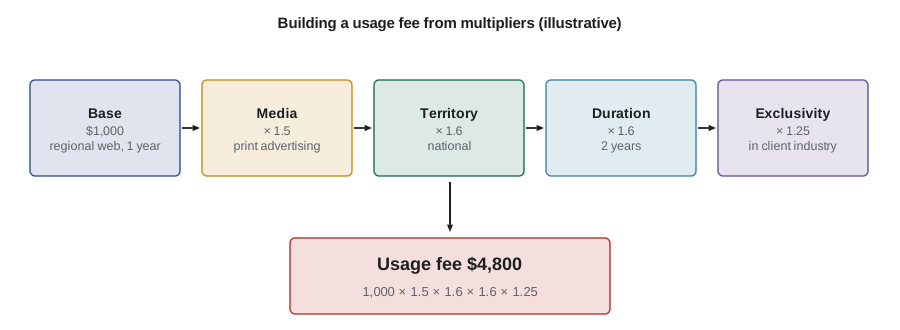
A base licence fee is $1,000 for regional web use for one year. A client wants national print advertising for two years, exclusive in its industry. Using the illustrative multipliers, what is the licence fee?
Show solution
- Media multiplier for print advertising: 1.5.
- Territory multiplier for national use: 1.6.
- Duration multiplier for two years: 1.6.
- Exclusivity multiplier: 1.25.
- Fee: \( 1000 \times 1.5 \times 1.6 \times 1.6 \times 1.25 = \$4800 \).
Answer: $4,800 for the licence, in addition to the creative fee and expenses. Showing the parameters on the estimate helps the client see why national, exclusive use costs more than a regional web licence.
Worked problem
Renewing and extending a licence
Two years later the client wants to extend the same national print licence for one more year, non-exclusive. What fee does the calculator give, and why is a renewal valuable?
Show solution
- Fee: \( 1000 \times 1.5 \times 1.6 \times 1.0 \times 1.0 = \$2400 \).
- No new shoot is needed, so almost all of the fee is profit.
Answer: $2,400. Renewals and extensions earn income from existing work, which is why tracking licence expiry dates and contacting clients before they lapse is good business.
Registration and remedies
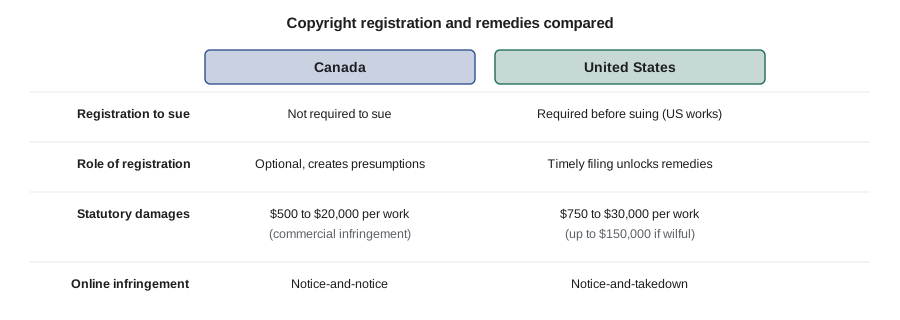
Canada does not require registration for copyright to exist or to sue. Registration with the Canadian Intellectual Property Office is optional and inexpensive, and a certificate creates a presumption that copyright subsists and that the registered person owns it, which can help in a dispute. When infringement is proven, a court can award actual damages and the infringer's profits, or, at the owner's choice, statutory damages: for commercial infringement, between $500 and $20,000 per work, and for non-commercial infringement, between $100 and $5,000 for all works together. Registration is not a condition for statutory damages, though it may affect damages against an infringer who did not know copyright existed.
Small claims and online infringement
Most photo infringements are small: a blog, a small business website or a social media account using an image without permission. Full litigation is expensive, so both countries offer lighter routes.
In Canada, small claims courts in each province hear claims up to a provincial limit, such as $50,000 in Ontario (raised from $35,000 in 2025) and $100,000 in Alberta at the time of writing; check the current limit in your province. For online infringement, Canada uses a notice-and-notice system: a copyright owner can send a notice to an internet service provider, which must forward it to the subscriber and keep records, but the provider is not required to remove material. Hosting platforms often have their own takedown processes under their terms of service.
Before sending any demand, document the use with screenshots, dates and URLs, confirm you have not licensed the image to that party, and consider whether a polite invoice for a retroactive licence will resolve the issue faster than a formal demand. Some photographers use image-search and monitoring services that find copies of their images online and help collect fees, usually for a share of the recovery.
Worked problem
Valuing a retroactive licence
A local business has used one of your images on its home page for 8 months without permission. Your standard rate for that use would be $600 for one year. You decide to invoice the standard fee prorated for the period used, plus 50% for the unauthorized use and your time. What do you invoice?
Show solution
- Prorated fee: \( 600 \times 8 / 12 = \$400 \).
- Additional 50%: \( 0.5 \times 400 = \$200 \).
- Total: \( 400 + 200 = \$600 \), with an offer of a licence going forward.
Answer: $600. Many disputes settle at this stage; if they do not, you can consider small claims or, where the facts justify it, legal advice about statutory damages.
Managing rights as an asset
An archive of images with clear rights is a long-term asset. To manage it, embed copyright and contact details in the IPTC metadata of every file, keep model and property releases linked to the images they cover, record every licence with its parameters and expiry date, and use consistent file naming and keywords so images can be found again. Content credentials, using the C2PA standard, can add a verifiable record of authorship and edits. A well-managed archive can be licensed for years and may form part of the value of the business if it is ever sold or passed on.
Negotiating usage with clients
Clients sometimes resist usage fees, especially if they are used to buying "all rights" from cheaper suppliers. Explain usage in business terms: a narrower licence costs less now, and the client can extend it later if the campaign succeeds. Offer options, such as a one-year licence at one price and a three-year licence at a higher price, so the client can choose. If a client insists on unlimited rights, price that request realistically and make sure the contract says exactly what is granted. Some photographers accept a buyout for routine work but keep the right to show images in their portfolio and to license outtakes that the client did not select. Others agree to exclusivity only within the client's industry and for a defined period. Each concession should be deliberate and reflected in the fee.
Credit and attribution
A credit line, such as a byline next to an editorial image, is valuable for visibility but is not a substitute for payment. Where credit matters, write it into the licence, specifying the form of credit and where it appears. In Canada, the moral right of attribution supports credit claims unless waived; in the United States, credit generally depends on the contract. Removing copyright management information, such as your name embedded in metadata, can also create liability under both countries' laws in some circumstances.
Common mistakes
MistakeAssuming a paying client owns the copyright
InsteadCheck the law and the contract; photographers usually own copyright unless they assign it or it is work made for hire.
MistakeGranting all rights when the client needs narrow use
InsteadAsk how images will be used and license only what is needed.
MistakeForgetting to track licence expiry dates
InsteadRecord every licence and contact clients before renewals.
MistakeExpecting statutory damages without checking registration rules
InsteadKnow your country's rules; in the United States, register promptly.
MistakeSending an aggressive demand without documentation
InsteadCollect evidence first and consider a retroactive licence invoice.
Summary and key terms
- Copyright arises automatically and lasts for life plus 70 years in both countries.
- Photographers usually own commissioned photographs unless they assign rights or create a work made for hire.
- Licences are defined by media, territory, duration, exclusivity and quantity.
- Usage fees can be built from a base fee and multipliers.
- Registration is optional in Canada but crucial for US remedies and suits.
- Small claims routes and notice systems handle most online infringements.
- A well-documented archive is a lasting business asset.
- Copyright
- The exclusive legal right to reproduce and use an original work.
- Licence
- Permission to use a work in defined ways while the owner keeps copyright.
- Assignment
- A transfer of copyright ownership, which must be in signed writing.
- Usage
- The specified ways, places and periods in which a licensed image may be used.
- Buyout
- A broad licence or assignment giving the client extensive rights.
- Statutory damages
- Damages set by law within a range, without proving actual loss.
- Work made for hire
- A US category in which the employer or commissioning party is the author.
- Moral rights
- Rights of attribution and integrity that protect an author's connection to a work.
- Canadian notice-and-notice
- Canada's system in which service providers forward infringement notices to subscribers.
- US notice-and-takedown
- The US system in which hosts remove material after a valid notice.
Practice problems
Work each problem on paper first, then reveal the answer to check.
Base fee $800, multipliers 1.5, 1.6 and 1.0. What is the licence fee?
Show answer
\( 800 \times 1.5 \times 1.6 = \$1920 \).
How long does copyright generally last in Canada and the United States?
Show answer
The life of the author plus 70 years.
Name four parameters of a usage licence.
Show answer
Media, territory, duration, exclusivity, quantity.
Why ask clients how they will use images?
Show answer
A narrower licence can fit their budget and preserve future value for you.
What did the Copyright Modernization Act of 2012 change for Canadian photographers?
Show answer
Photographers became first owners of commissioned photographs.
What is the maximum total claim at the US Copyright Claims Board?
Show answer
$30,000.
What must a US owner do before suing for infringement of a US work?
Show answer
Register the work or have registration refused.
A $900 annual use ran for 4 months unlicensed. What is the prorated fee?
Show answer
\( 900 \times 4 / 12 = \$300 \).
Name two ways to manage an image archive as an asset.
Show answer
Embedded metadata, linked releases, licence records, keywords, content credentials.
What is the difference between notice-and-notice and notice-and-takedown?
Show answer
The first forwards notices to subscribers; the second requires hosts to remove material to keep safe harbour.
Lesson quiz · 5 questions
Score 60% or more to complete this lesson.
Create a free account to save your progress, take quizzes and earn a certificate.