
PHOT-350 · Lesson 3 of 12 · 28 min
Drone regulations and pilot certification in Canada
Drones share the sky with airplanes, helicopters, air ambulances and other drones, and they fly over people and property. That is why every country with a meaningful drone industry regulates them as aircraft. For a professional photographer, the rules are not an obstacle to work around; they are part of the job. Clients, insurers, venues and municipalities increasingly ask to see certificates, registrations and flight plans, and a single careless flight can bring fines, lost insurance and damage to a business's reputation. This lesson explains the national rules that govern most photography and mapping flights, who must hold which certificate, how registration and identification work, the main operating limits, and how special permissions and newer categories fit in. It is not a substitute for the official study material or exams, and rules change; always check the regulator's current guidance before a job.
The Canadian framework: CARs Part IX
In Canada, Transport Canada regulates drones under Part IX of the Canadian Aviation Regulations (CARs), titled Remotely Piloted Aircraft Systems. Part IX took effect on June 1, 2019, and covers drones weighing from 250 grams up to 25 kilograms flown within visual line of sight. A major amendment that took effect on November 4, 2025, expanded the framework to include extended visual line of sight, sheltered operations, medium drones up to 150 kilograms and lower-risk beyond-visual-line-of-sight flights. Transport Canada uses the term remotely piloted aircraft system (RPAS) for the drone, its control station and the link between them. The rules apply to recreational and commercial pilots alike: since 2019 Canada no longer separates hobby and paid flying for drones in this weight range, so a photographer selling images follows the same core rules as anyone else in the same category.
Weight categories and registration
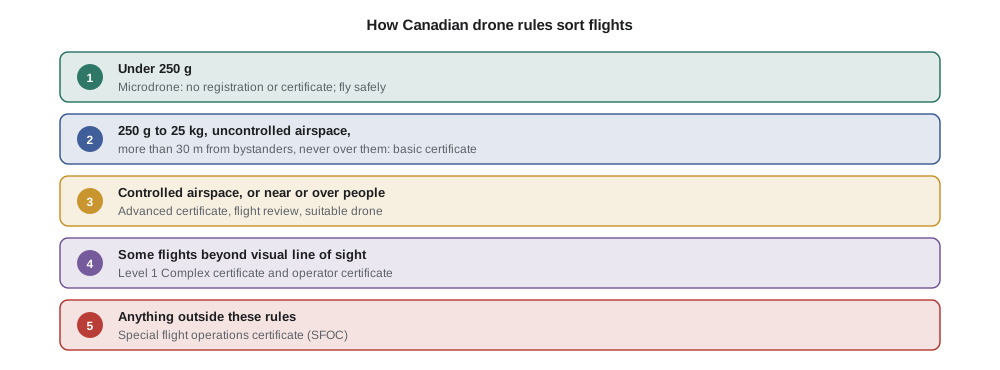
Canadian rules start at weight. Drones under 250 grams, called microdrones, do not need registration or a pilot certificate, but the pilot must still fly safely and must not put aviation or people at risk; since April 1, 2025, flying a microdrone at an advertised event requires a special flight operations certificate (SFOC). Drones from 250 grams to 25 kilograms, called small drones, must be registered with Transport Canada before flight, and the registration number must be marked on the aircraft where it can be read. Registration is done online through the Drone Management Portal; the fee rose to $10 per drone on April 1, 2025. Drones over 25 kilograms and up to 150 kilograms are medium drones, which from November 4, 2025, may be flown within visual line of sight by advanced pilots if the drone is declared safe for the operation. Drones over 150 kilograms still need an SFOC.
Pilot certificates: basic and advanced
To fly a small drone you need a Pilot Certificate – Small RPAS, at the basic or advanced level. The basic certificate requires passing an online multiple-choice exam on air law, flight operations, meteorology, navigation and human factors. The minimum age is 14, or younger under the supervision of someone with the right certificate. The advanced certificate requires passing a harder online exam and then an in-person flight review with a flight reviewer, who checks that the pilot can plan and fly safely, handle emergencies and follow procedures. The minimum age for advanced operations is 16. A newer Level 1 Complex certificate, available since April 2025 for operations beginning November 4, 2025, allows certain lower-risk beyond-visual-line-of-sight flights; it requires being at least 18, holding the advanced knowledge, passing a Level 1 Complex exam, completing at least 20 hours of ground school and passing a flight review. Pilots must carry their certificate, and they must show recency: within the previous 24 months they must have completed one of the recognized recency activities, such as passing an exam, completing a flight review or attending a recognized safety seminar or self-paced study program.
Basic and advanced operations
Transport Canada sorts small-drone flights into categories based on where they happen and how close they are to people. A flight is a basic operation if all of these hold: it is in uncontrolled airspace; it is more than 30 metres horizontally from bystanders; and it never passes over bystanders. Bystanders are people not involved in the operation. If any of these conditions is not met, the flight is an advanced operation, which needs the advanced certificate and a drone whose manufacturer has declared it meets the safety requirements for that kind of operation. For example, flying within 30 metres of bystanders, or over them, needs a drone declared for that purpose, and flying in controlled airspace needs both the advanced certificate and an authorization from NAV CANADA, usually obtained through the NAV Drone app. Distances from aerodromes also apply: basic operations must stay at least 5.6 kilometres (3 nautical miles) from certified airports and military aerodromes and at least 1.9 kilometres (1 nautical mile) from certified heliports.
General operating rules
Whatever the category, small drones in Canada must be flown within visual line of sight (unless operating under the new extended or beyond-visual-line-of-sight rules), no higher than 122 metres (400 feet) above ground level, away from emergency scenes and advertised events unless authorized by an SFOC, and with right of way given to crewed aircraft. The pilot must conduct a site survey before each operation, check the drone before flight, have a plan for emergencies, keep records of flights and maintenance, and not fly while impaired. Night flying is allowed if the drone carries position lights visible enough to keep it in sight. Pilots must not fly from a moving vehicle or vessel except under specific conditions. The 2025 amendments also allow advanced pilots to fly sheltered operations, close to structures (no more than 30 metres above and within 61 metres horizontally of the structure, and more than 30 metres from uninvolved people), and extended visual line of sight flights using visual observers within 2 nautical miles (3.6 kilometres).
Special flight operations certificates
Operations outside the standard rules need a special flight operations certificate (SFOC) from Transport Canada. Examples include flying drones over 150 kilograms, flying at advertised events (including with microdrones), flying higher than 122 metres in some circumstances, and some beyond-visual-line-of-sight flights that do not fit Level 1 Complex. Applications describe the operation, the risk assessment and the mitigations, and may take weeks to process; since November 4, 2025, most applicants pay a fee based on complexity, from $20 for very low complexity to $2,000 for high complexity. Operators conducting beyond-visual-line-of-sight work under the new rules must also hold an RPAS Operator Certificate showing they have suitable policies and procedures.
Parks, provinces and municipalities
Federal aviation rules are not the only rules that apply. Parks Canada does not allow recreational drone use in national parks, historic sites or marine conservation areas, and commercial filming requires permits that are rarely granted for drones except for park management or research. Provincial parks have their own restrictions; many provinces ban or limit drones in parks without permission. Municipalities cannot regulate airspace, which is federal, but they can control where drones take off and land on municipal property, and many require permits for take-off from city parks. Privacy, trespass and nuisance laws also apply (lesson 10). A professional should check federal airspace, park rules, municipal bylaws and property owner permission for every site.
Enforcement and penalties
Transport Canada can issue administrative monetary penalties for breaking Part IX, and the amounts can reach thousands of dollars per offence for individuals and more for corporations; endangering aircraft or people carries the highest penalties. Police can also lay charges under the Criminal Code for dangerous operation, mischief or voyeurism, and provincial privacy and trespass laws apply. Insurance policies typically exclude illegal flights, so a rule violation can leave the operator personally liable for damage.
Worked problem
Classifying a Canadian real estate flight
A photographer plans to photograph a house in a suburb outside any controlled airspace. Neighbours are often in their yards about 20 metres away, and the drone weighs 249 g. Another job uses a 900 g drone over the same street. Which certificate is needed for each?
Show solution
- The 249 g drone is a microdrone: no registration or certificate is required, but it must still be flown safely and not endanger people.
- The 900 g drone is a small drone: registration is required.
- Flying within 30 m of bystanders makes the flight an advanced operation.
- So the 900 g flight needs an advanced certificate and a drone declared by its manufacturer for operations near people.
Answer: The 249 g drone needs no certificate (safe flying still required); the 900 g drone needs registration and an advanced certificate with a suitable drone.
Worked problem
Checking aerodrome distances
A basic-certificate pilot wants to fly 4 km from a certified airport and 2.5 km from a certified heliport, in uncontrolled airspace. Is this allowed under basic rules?
Show solution
- Basic operations must be at least 5.6 km from certified airports; 4 km is too close.
- The heliport distance of 2.5 km exceeds 1.9 km, which is acceptable.
- The airport distance alone rules out a basic operation.
Answer: Not under basic rules; it would need advanced procedures and permissions or a different site.
| Item | Basic | Advanced |
|---|---|---|
| Exam | Online basic exam | Online advanced exam plus flight review |
| Minimum age | 14 | 16 |
| Airspace | Uncontrolled only | Controlled with NAV CANADA authorization |
| Distance from bystanders | More than 30 m, never over | Closer or over with a declared drone |
| Altitude limit | 122 m AGL | 122 m AGL (sheltered operations near structures) |
| Recency | Within 24 months | Within 24 months |
Building compliance into a business
Professionals treat compliance as a routine, not a scramble before each job. A simple system includes a current copy of the pilot certificate and drone registrations, a log of flights, maintenance and battery cycles, a standard site survey and risk assessment form, a checklist for pre-flight and post-flight, and a calendar reminder for recency training. Insurance certificates should name the correct aircraft and pilots. When a client asks for proof of compliance, sending these documents quickly builds confidence and often wins work over less organized competitors.
Clients rarely know the rules themselves. A wedding couple may ask for a low pass over guests during the ceremony; a developer may want a flight in the airport's approach path at rush hour. Part of the professional's value is explaining what is legal, what needs permission and what is unsafe, and suggesting alternatives. The next lesson turns to airspace, weather, planning and risk assessment, the work done before the drone leaves the case.
Keeping up with rule changes
Drone rules change more often than most aviation rules, because regulators are still adapting them to new aircraft, new uses and new safety data. The Canadian rules were rewritten in 2019 and expanded again in 2025, and US rules have added Remote ID, operations over people, night flying and online recurrent training since Part 107 first took effect in 2016, with a beyond-visual-line-of-sight rule still in progress. A professional operator therefore treats regulatory knowledge as something to refresh, not something learned once. Good habits include subscribing to the regulator's email updates, reading advisory circulars and guidance when they appear, checking the current text of the rules before taking on an unusual job, keeping certificates and recency requirements current, and asking an aviation lawyer or experienced operator when a job falls near a grey area. Clients and insurers increasingly ask operators to show that they follow current rules, and a short written note in each flight plan stating which rules apply is an easy way to demonstrate it.
Common mistakes
MistakeAssuming a sub-250 g drone can fly anywhere.
InsteadMicrodrones still must not endanger people or aircraft, and some events need an SFOC.
MistakeFlying in controlled airspace without authorization because the site is small.
InsteadGet NAV CANADA authorization and hold an advanced certificate.
MistakeLetting certificate currency lapse.
InsteadTrack recency or recurrent training on a calendar and complete it before 24 months pass.
MistakeTreating federal rules as the only rules.
InsteadCheck parks, provincial or state laws, municipal rules and landowner permission too.
MistakeAgreeing to client requests that break the rules.
InsteadExplain the limits, offer compliant alternatives and decline unsafe flights.
Summary and key terms
- Transport Canada regulates drones under CARs Part IX, in force since June 1, 2019, and expanded on November 4, 2025.
- Drones under 250 g are microdrones; 250 g to 25 kg are small drones that must be registered and marked.
- Basic certificates allow flights in uncontrolled airspace more than 30 m from bystanders; advanced certificates add controlled airspace and closer operations with a flight review.
- Small drones fly within visual line of sight below 122 m AGL, away from aerodromes, emergency scenes and advertised events.
- The 2025 changes added sheltered operations, extended visual line of sight, medium drones to 150 kg and the Level 1 Complex certificate.
- SFOCs cover operations outside the standard rules; RPAS Operator Certificates are needed for BVLOS operators.
- Parks Canada, provincial parks, municipalities and privacy laws add further limits.
Practice problems
Work each problem on paper first, then reveal the answer to check.
What weight range does CARs Part IX mainly cover for visual line of sight flights?
Show answer
250 g to 25 kg, with medium drones up to 150 kg added in 2025.
Name the three conditions for a basic operation.
Show answer
Uncontrolled airspace, more than 30 m horizontally from bystanders, never over bystanders.
What is the maximum altitude for standard small-drone flights?
Show answer
122 m (400 ft) above ground level.
How do you get permission to fly in controlled airspace?
Show answer
Hold an advanced certificate and request authorization from NAV CANADA, usually through NAV Drone.
How often must currency training be completed?
Show answer
Within every 24 months.
Give two operations that need an SFOC.
Show answer
Drones over 150 kg and flights at advertised events.
What did the November 4, 2025 changes add?
Show answer
Sheltered operations, EVLOS, medium drones up to 150 kg and Level 1 Complex BVLOS.
What is the minimum distance from a certified airport for basic operations?
Show answer
5.6 km (3 nautical miles).
Why can a rule violation leave an operator personally liable?
Show answer
Insurance policies usually exclude unlawful flights.
List three documents a compliant business keeps ready for clients.
Show answer
Pilot certificate, drone registrations and insurance certificate (plus flight logs and checklists).
Lesson quiz · 5 questions
Score 60% or more to complete this lesson.
Create a free account to save your progress, take quizzes and earn a certificate.