
PHOT-350 · Lesson 2 of 12 · 30 min
Drone platforms, cameras and gimbals
Choosing a drone is less about brand than about matching an aircraft and sensor to the work. A real estate photographer needs a light, quiet aircraft with a good stills camera that can be flown legally near houses. A surveyor needs stable, repeatable flight, a mechanical shutter or a well-characterized rolling shutter, and accurate positioning. An inspector may need a zoom lens and a thermal camera on the same gimbal. This lesson explains how drones fly, the main airframe types, the parts that matter for safety and endurance, and the cameras and sensors that make images. It describes categories and specifications rather than recommending products, because models change every year while the principles stay the same.
How a multirotor flies
Most photography drones are multirotors: aircraft with three or more fixed-pitch propellers driven by electric motors. A quadcopter has four, a hexacopter six and an octocopter eight. Opposite propellers spin in opposite directions so that their turning forces cancel. The aircraft moves by changing the speed of individual motors. Speeding up all motors together makes it climb. Speeding up the rear motors and slowing the front ones tilts the aircraft forward, so part of the thrust pushes it forward. Speeding up the motors that spin one way and slowing the others makes it yaw, turning on the spot. None of this would be possible without the flight controller, a small computer that reads gyroscopes, accelerometers, a barometer, a magnetometer and a satellite positioning receiver hundreds of times a second and adjusts motor speeds to keep the aircraft where the pilot wants it.
Multirotors can take off and land vertically, hover in one place and fly slowly, which makes them ideal for photography, inspection and small mapping jobs. Their weakness is efficiency: they spend energy simply staying in the air, so flight times are short, often 20 to 45 minutes for camera drones in good conditions, and much less in cold weather or wind.
Fixed-wing and VTOL aircraft
A fixed-wing drone flies like a small airplane. Its wing produces lift as it moves forward, so it needs far less power than a multirotor and can stay up for an hour or more, covering large areas efficiently. That makes fixed-wing aircraft popular for mapping farms, mines, pipelines and forests. The trade-offs are that it cannot hover, it needs room to launch and land (often by hand launch or catapult and a belly landing), and it is harder to use for close inspection or creative angles.
A VTOL (vertical take-off and landing) hybrid combines the two: rotors lift it vertically, then it transitions to wing-borne flight for efficient cruising, and transitions back to land vertically. VTOL aircraft are common for professional mapping of large areas where no runway is available. They are more complex and expensive than either pure type.
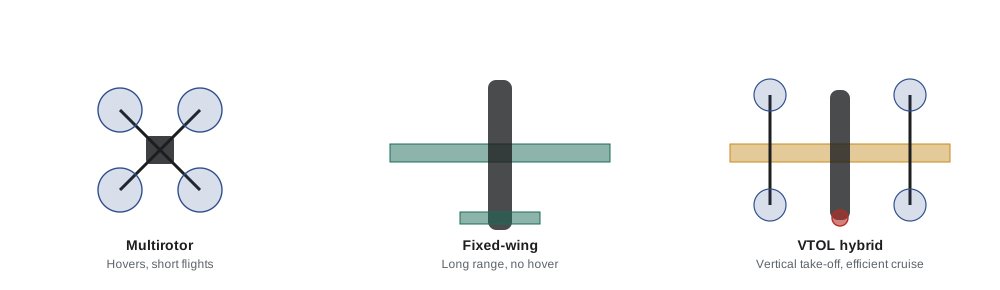
| Type | Typical endurance | Strengths | Limits | Typical uses |
|---|---|---|---|---|
| Multirotor | 20 to 45 min | Hover, precise positioning, small launch area | Short endurance, slower coverage | Photography, video, inspection, small maps |
| Fixed-wing | 45 to 120 min or more | Large areas, efficient, fast | Needs launch and landing space, cannot hover | Large-area mapping, agriculture, corridors |
| VTOL hybrid | 45 to 90 min or more | Vertical take-off with long range | Cost, complexity, maintenance | Large mapping jobs from small sites |
Weight classes and why weight matters
Weight is the most important number on a drone's specification sheet, because rules depend on it. Very light drones, under 250 grams, are treated more leniently in both Canada and the United States, though they still have to be flown safely and, for paid work in the US, under Part 107. Most professional camera drones weigh from about 250 grams to a few kilograms. Heavier aircraft carrying cinema cameras or lidar may weigh 10 to 25 kilograms or more. Weight affects not only the rules but also the harm a falling drone can cause: kinetic energy rises with mass and with the square of speed.
Worked problem
Comparing impact energy
A 0.249 kg drone and a 0.9 kg drone both fall and hit the ground at about 20 m/s. Compare their kinetic energies.
Show solution
- Small drone: \( E = 0.5 \times 0.249 \times 20^2 = 0.5 \times 0.249 \times 400 \approx 50 \) J.
- Larger drone: \( E = 0.5 \times 0.9 \times 400 = 180 \) J.
- Ratio: 180 ÷ 50 ≈ 3.6.
Answer: The 0.9 kg drone carries about 3.6 times the impact energy, which is one reason rules and safe distances tighten as weight rises.
Regulators use energy and weight thresholds when setting categories for flights over people. The US rules for operations over people, for example, include a category for drones of 0.55 pounds (about 250 grams) or less and categories based on impact energy for heavier designs. Lesson 3 covers these rules.
Key parts that affect safety and endurance
Batteries. Camera drones use lithium-polymer (LiPo) or lithium-ion packs, usually with built-in electronics that report charge, cell voltages, temperature and cycle count. Capacity is given in milliampere-hours (mAh) and energy in watt-hours (Wh). Usable flight time drops sharply in cold weather because chemical reactions slow down, a real issue for Canadian winter work and northern US states. Lesson 5 covers battery care, storage and transport rules.
Propellers. Props must be undamaged and correctly fitted. A chipped or cracked propeller vibrates, blurs images and can fail in flight. Professionals carry spares and inspect them before every flight.
Motors and electronic speed controllers. Brushless motors are reliable but can overheat with heavy payloads or in hot weather. Some larger drones have redundant motors (a hexacopter can often land if one motor fails; a quadcopter usually cannot).
Positioning and sensors. Satellite positioning (GPS and other constellations such as GLONASS, Galileo and BeiDou, together called GNSS) provides position hold and return to home. Compasses help with heading but can be confused by metal structures and power lines. Many drones add downward cameras for low-altitude positioning and obstacle-sensing cameras or sensors. Obstacle sensing helps but does not see thin wires, glass or branches reliably.
Control and video link. The radio link between controller and drone carries commands, telemetry and live video. Range depends on interference, terrain and antenna orientation. When the link is lost, the drone follows a programmed failsafe, usually returning home or hovering. Pilots must understand and set these behaviours before flight.
Remote identification. Many drones broadcast an electronic identifier and position so authorities can see who is flying. In the United States this Remote ID broadcast has been required for most registered drones since 2023 and enforced since March 16, 2024, either built into the drone or added with a broadcast module. Canada does not require Remote ID at the time of writing, but some drones broadcast it anyway.
Cameras and image quality
The camera matters as much as the aircraft. Key specifications are sensor size, resolution, lens focal length and aperture, shutter type, bit depth and video options.
Sensor size affects image quality, especially dynamic range and noise in low light. Small drones often use sensors around 1/1.3 inch; mid-range professional drones use 1-inch or four-thirds sensors; high-end platforms carry full-frame or medium-format mapping cameras. Larger sensors capture more light and generally produce cleaner images at sunrise, sunset and in overcast conditions.
Resolution in megapixels sets how large a print or how fine a map can be. For mapping, what matters is the size of each pixel on the ground, the ground sample distance, which depends on sensor width, image width in pixels, focal length and altitude (lesson 8).
Lens. Most drones use a fixed wide-angle lens, often equivalent to about 20 to 28 mm on full frame. Some carry multiple cameras: a wide, a medium telephoto and a long telephoto, which helps inspection and lets photographers compress perspective. A fixed aperture limits control over exposure, so neutral density filters are used for video (lesson 7). Variable-aperture drone lenses exist on higher-end models.
Shutter type. Many small cameras use an electronic rolling shutter, which reads the sensor line by line. When the drone moves quickly, straight lines can lean or wobble. For mapping, a mechanical or global shutter is preferred because every pixel is exposed at once, which improves geometric accuracy. Mapping software can correct rolling shutter effects if it knows the readout time and the drone flies at modest speed.
Bit depth and formats. Raw stills (often in DNG format) capture more tonal information than JPEG and allow greater adjustment. Video in 10-bit log profiles preserves highlights and shadows for grading. Mapping usually uses JPEG or high-quality TIFF with embedded position data.
| Sensor class (approx.) | Typical uses | Notes |
|---|---|---|
| Small (1/2.3 to 1/1.3 inch) | Light drones, social media, simple real estate | Good in daylight; noisier at dusk |
| 1 inch | Professional stills and video, mapping | Better dynamic range and low-light quality |
| Four Thirds | Higher-end photography and cinema | Shallower depth of field possible, larger aircraft |
| Full frame and larger | High-end mapping and cinema | Heavier payloads, interchangeable lenses on some |
Gimbals
A gimbal keeps the camera steady and level while the drone tilts and vibrates. Three-axis gimbals use brushless motors to correct pitch (tilt), roll and yaw. The gimbal is why drone video looks smooth even in light wind. Photographers control gimbal pitch to choose between straight-down (nadir) views and oblique angles. Gimbals are delicate: a protective clamp or cover should be fitted for transport, and the gimbal must move freely before take-off. Gimbal calibration helps if the horizon tilts in images.
Specialized sensors
Beyond ordinary colour cameras, drones carry sensors that see what eyes cannot.
- Thermal cameras record infrared radiation emitted by objects, showing temperature differences. They are used for roof and building envelope inspection, solar panel faults, electrical equipment, firefighting and search and rescue. Thermal resolution is low compared with visible cameras, often 640 × 512 pixels.
- Multispectral cameras record several narrow bands, typically green, red, red edge and near-infrared, for vegetation analysis such as the NDVI index used in agriculture and forestry (lesson 9).
- Lidar sensors fire laser pulses and time their return to build 3-D point clouds. Lidar can measure the ground beneath vegetation, which photogrammetry cannot do well. It is heavier and much more expensive.
- Zoom cameras with long optical zoom let inspectors see bolts and cracks from a safe distance.
Each sensor adds weight, cost and processing work. A photographer expanding into specialized work should master standard photography and mapping first.
Matching platform to job
Choosing equipment is a balance of requirements, rules, budget and risk. A simple decision process is to list the outputs the client needs, the area or subject size, the accuracy or image quality required, where the flights will take place (near people, in controlled airspace, in cold weather), and the budget. Then choose the lightest, simplest aircraft that meets those needs, because lighter aircraft are easier to fly legally, cheaper to replace and less dangerous.
Worked problem
Choosing between two drones for a real estate business
Drone A weighs 249 g, has a 1/1.3-inch sensor and flies 30 minutes. Drone B weighs 900 g, has a four-thirds sensor and flies 40 minutes. Most jobs are suburban houses, many near neighbours, shot in daylight and at dusk. Which is a better primary aircraft?
Show solution
- Suburban houses mean people nearby; a lighter aircraft carries less energy and may give more flexibility near people under the rules.
- Dusk work benefits from a larger sensor, which favours Drone B.
- Consider owning both: Drone A for tight suburban sites in daylight, Drone B for dusk and premium listings where distance rules can be met.
Answer: Many real estate photographers start with a light drone for most jobs and add a larger-sensor aircraft for twilight and premium work, checking the distance rules for each.
Worked problem
Estimating batteries for a job
A camera drone flies 32 minutes in ideal conditions. The photographer plans to land with 25 percent remaining and expects 20 percent less flight time in a cold wind. How many minutes of usable flying does each battery give, and how many batteries are needed for 90 minutes of flying?
Show solution
- Cold and wind: 32 × 0.8 = 25.6 minutes.
- Keep 25 percent reserve: usable = 25.6 × 0.75 ≈ 19 minutes.
- 90 ÷ 19 ≈ 4.7, so 5 batteries, plus a spare.
Answer: About 19 usable minutes per battery; plan for 5 or 6 batteries.
Common mistakes
MistakeChoosing a drone by brand popularity alone.
InsteadStart from the outputs, rules, conditions and budget, then choose the lightest aircraft that meets them.
MistakeTrusting obstacle sensors to avoid wires and branches.
InsteadTreat obstacle sensing as a backup; plan and fly with clear margins.
MistakeUsing a rolling-shutter camera for fast mapping flights.
InsteadFly slower, enable rolling-shutter correction or use a mechanical or global shutter.
MistakeTransporting a drone with the gimbal unclamped.
InsteadFit the gimbal guard and check free movement before take-off.
MistakeAssuming rated flight time applies in winter.
InsteadPlan for shorter flights in cold and wind and keep generous reserves.
Summary and key terms
- Multirotors hover and fly precisely but have short endurance; fixed-wing aircraft cover large areas; VTOL hybrids combine both.
- The flight controller uses motion sensors, a barometer, a compass and GNSS to keep the drone stable.
- Weight drives rules and risk because impact energy rises with mass and the square of speed.
- Batteries, propellers, motors, positioning and the control link all affect safety and endurance.
- Sensor size, resolution, lens, shutter type and bit depth determine image quality and mapping accuracy.
- Three-axis gimbals stabilize the camera and set nadir or oblique angles.
- Thermal, multispectral, lidar and zoom sensors extend drones into inspection and analysis.
Practice problems
Work each problem on paper first, then reveal the answer to check.
How does a quadcopter move forward?
Show answer
It speeds up the rear motors and slows the front ones, tilting forward so thrust pushes it forward.
Why can fixed-wing drones fly longer than multirotors?
Show answer
Their wings produce lift from forward motion, so they use far less power than rotors that must hold the aircraft up.
A 2 kg drone hits at 15 m/s. What is its kinetic energy?
Show answer
0.5 × 2 × 225 = 225 J.
Why is a global or mechanical shutter preferred for mapping?
Show answer
All pixels are exposed at once, avoiding geometric distortion from motion.
Name two weaknesses of obstacle sensors.
Show answer
They may miss thin wires, glass, bare branches and objects in low light.
What does a multispectral camera usually record?
Show answer
Narrow bands such as green, red, red edge and near-infrared.
What can lidar do that photogrammetry struggles with?
Show answer
Measure the ground surface beneath vegetation.
A battery gives 28 minutes ideal. With 15 percent cold loss and 25 percent reserve, what is usable time?
Show answer
28 × 0.85 × 0.75 ≈ 17.9 minutes.
Why fit a gimbal guard for transport?
Show answer
To protect the delicate gimbal motors and camera from knocks.
What is the safest general rule for choosing a drone?
Show answer
Choose the lightest, simplest aircraft that meets the job's needs.
Lesson quiz · 5 questions
Score 60% or more to complete this lesson.
Create a free account to save your progress, take quizzes and earn a certificate.