
PHOT-240 · Lesson 2 of 12 · 25 min
How film works: emulsions, sensitivity and the characteristic curve
Every decision in analog photography, from choosing a film to setting development time, rests on how photographic materials respond to light and chemistry. A roll of black-and-white film is a thin plastic base coated with an emulsion of light-sensitive silver halide crystals suspended in gelatin. Light creates an invisible latent image in the crystals; development turns exposed crystals into metallic silver, forming the dark areas of the negative; fixing removes unexposed crystals, making the image permanent. This lesson explains the structure of film, the formation of the latent image, development and fixing, film speed and the ISO system, grain and sharpness, spectral sensitivity, and the characteristic curve, the graph that connects exposure with negative density and underlies the zone system and printing.
The structure of film
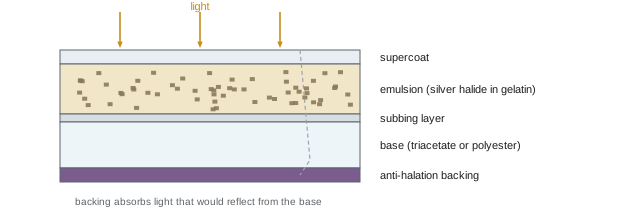
Modern black-and-white film consists of several layers:
- The base: a flexible, transparent support, usually cellulose triacetate or polyester (PET), about 0.1 mm thick for roll film. Earlier films used highly flammable cellulose nitrate, which was phased out for still photography by the 1950s and must be handled as a hazardous material in archives.
- The emulsion: silver halide crystals, mainly silver bromide with some silver iodide, suspended in gelatin, sometimes in two or more layers of different sensitivity.
- A supercoat: a thin protective gelatin layer that resists scratches.
- Anti-halation protection: a dye layer or dyed base that absorbs light passing through the emulsion, preventing it from reflecting back from the base and creating halos around bright highlights. This dye usually washes out during processing, sometimes tinting the developer or first rinse.
- An anti-curl backing on some films.
Colour films have many more layers, each sensitive to a different part of the spectrum (Lesson 11).
The latent image
When a photon of light is absorbed by a silver halide crystal, it can free an electron, which migrates to a sensitivity site in the crystal and combines with a silver ion to form an atom of metallic silver. When a few atoms, around four or more, cluster together at a site, they form a stable latent image centre. The crystal now carries an invisible mark that makes it developable. Crystals that received no light, or too little to form a stable centre, remain undevelopable. The latent image is stable for weeks or months under good conditions but slowly fades, especially in heat and humidity, so exposed film should be developed reasonably soon and kept cool. Larger crystals are more likely to absorb enough photons to form a latent image, which is why faster films have larger crystals and more visible grain.
Development and fixing
A developer is a chemical solution containing a reducing agent, such as metol, hydroquinone, phenidone or ascorbic acid, in an alkaline environment. The developer converts crystals that carry latent image centres into metallic silver, much faster than unexposed crystals, amplifying the latent image billions of times. The more light a region received, the more crystals are developed and the denser, or darker, that region of the negative becomes. Development is stopped after a carefully controlled time, at a controlled temperature, because longer development converts more crystals and increases density and contrast, and eventually begins developing unexposed crystals, producing fog.
After development, a stop bath of dilute acetic or citric acid, or a plain water rinse, halts development. The fixer, usually sodium or ammonium thiosulfate, dissolves the remaining undeveloped silver halide, which would otherwise darken on exposure to light, leaving only the metallic silver image in clear gelatin. Thorough washing then removes the fixer, which would otherwise attack the silver image over time. Lesson 6 covers these steps in practice.
Density and the negative
The darkness of a negative is measured as density, the logarithm of how much light it blocks:
where \(T\) is the transmittance, the fraction of light that passes through. A density of 0.3 transmits half the light, a density of 1.0 transmits a tenth, and a density of 2.0 transmits a hundredth. Because each 0.3 of density corresponds to one stop, density differences relate directly to stops in printing. Even unexposed areas of processed film have some density, called base plus fog: the density of the base itself plus a small amount of fog from development, typically about 0.1 to 0.3 for black-and-white films. Densitometers measure density precisely, and they are used for film testing (Lesson 5).
| Density | Transmittance | Equivalent in stops |
|---|---|---|
| 0.0 | 100 % | 0 |
| 0.3 | 50 % | 1 stop |
| 0.6 | 25 % | 2 stops |
| 0.9 | 12.5 % | 3 stops |
| 1.0 | 10 % | About 3.3 stops |
| 2.0 | 1 % | About 6.6 stops |
Film speed and the ISO system
Film speed describes a film's sensitivity to light. The ISO system, which combined the earlier American ASA and German DIN scales, gives arithmetic values such as ISO 100 or 400; doubling the number means the film needs half the exposure, one stop less. The ISO standard for black-and-white negative film defines speed from the exposure needed to produce a density of 0.1 above base plus fog under standard development conditions. Common speeds include slow films around ISO 25 to 100, with fine grain and high sharpness; medium films around ISO 125 to 200; fast films around ISO 400, which are versatile for handheld work; and very fast films such as ISO 3200, which use large crystals and are typically pushed (Lesson 4). Many photographers find that, with their own equipment, metering and development, a film gives better shadow detail when rated at a lower exposure index than its box speed, a reason for personal film testing (Lesson 5).
Grain and sharpness
Grain is the visible clumping of silver particles in an enlarged print. It depends on the size of the silver halide crystals, the developer, development time, degree of exposure and the degree of enlargement. Slow films have smaller crystals and finer grain; fast films have larger, more visible grain. Tabular-grain films, such as Kodak T-Max and Ilford Delta, use flat, plate-like crystals that capture light efficiently with finer grain for their speed than traditional cubic-grain films such as Kodak Tri-X and Ilford HP5 Plus, though many photographers prefer the tonal character of traditional films. Grain is more visible in mid-tones and in larger enlargements; a 35 mm negative enlarged to 8 × 10 inches is magnified about eight times, while a 6 × 7 medium format negative is magnified only about 3.5 times. Sharpness, or acutance, is the perceived crispness of edges, influenced by the film, developer and lens; some developers enhance edge contrast at the cost of finer grain.
Spectral sensitivity
Silver halide is naturally sensitive only to blue and ultraviolet light. Early materials were therefore "colour blind", rendering blue skies white and reds as black. Dye sensitization extended sensitivity: orthochromatic films are sensitive to blue and green but not red, so they can be handled under a deep red safelight and render red lips and skin darker; panchromatic films, standard today for general photography, are sensitive to all visible colours, rendering them in approximately the brightness the eye perceives. Some films, such as Ilford SFX, have extended red sensitivity for near-infrared effects, and true infrared films record radiation beyond the visible spectrum. Because panchromatic films are sensitive to all colours, they must be handled in complete darkness during loading and development, while black-and-white printing papers, which are blue-sensitive or orthochromatic, can be handled under amber or red safelights.
The characteristic curve
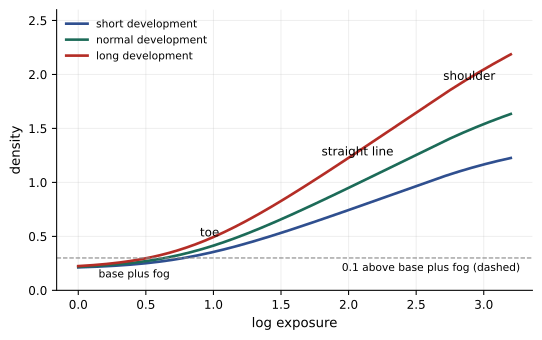
The characteristic curve, also called the H and D curve after Ferdinand Hurter and Vero Charles Driffield, who studied it in the 1890s, plots the density of the developed negative against the logarithm of exposure. Its shape has three regions:
- The toe: at low exposures, density rises slowly from base plus fog; shadows recorded here have compressed tonal separation.
- The straight-line portion: in the middle, density rises steadily with log exposure; tones are separated evenly.
- The shoulder: at high exposures, density rises more slowly again, compressing highlights; with most modern negative films, the shoulder is reached only with heavy overexposure.
The slope of the straight-line portion is called gamma, and a related measure, contrast index, averages the slope over the portion of the curve normally used. Longer development increases the slope, making the negative more contrasty; shorter development decreases it. A typical contrast index of about 0.55 to 0.62 produces negatives that print well on normal-grade paper with condenser or diffusion enlargers respectively.
Worked problem
Reading density differences in stops
A negative has a density of 0.35 in a shadow area and 1.25 in a highlight area. How many stops of difference is this in printing, and what does it mean for paper contrast?
Show solution
- Density range: 1.25 − 0.35 = 0.90.
- Each 0.3 of density is one stop: 0.90 / 0.3 = 3 stops.
- A density range of about 0.9 to 1.2 typically prints well on a normal grade (grade 2) paper with a diffusion enlarger.
Answer: A density range of 0.90, or 3 stops, which suits a normal-grade paper.
Storage and handling of film
Film is perishable. Heat, humidity and time gradually increase fog and reduce speed and contrast, and high-speed films are affected more, also by background radiation and airport scanners. Store unexposed film in a cool, dry place, ideally in a refrigerator below about 13 °C, or a freezer for long-term storage, sealed in its packaging; allow it to warm to room temperature for several hours before opening to prevent condensation. Avoid leaving cameras loaded in hot cars. Carry film in hand luggage and request a hand inspection when travelling, especially for films of ISO 800 or more, since some computed tomography (CT) scanners used for checked and increasingly for carry-on baggage can fog film. Expired film can still be used, often with extra exposure of about one stop per decade past expiry for colour films, but results vary.
Developers and grain in practice
The interaction of film and developer determines much of a negative's character. A fast traditional film such as Kodak Tri-X or Ilford HP5 Plus developed in a general-purpose developer produces visible, well-defined grain and a classic tonal scale that many documentary and street photographers love. The same film in a fine-grain developer shows smaller grain but slightly softer edges; in a high-acutance developer at high dilution, the grain becomes sharper and more pronounced. Slow films such as Ilford Pan F Plus or Kodak T-Max 100 show very fine grain and high detail, well suited to landscapes and large prints. Experimenting with one film and one developer until you know their behaviour well is more productive than frequently changing combinations.
Film base and curl
The base also affects handling. Polyester bases are very strong and dimensionally stable, preferred for archival and technical films, but they are hard to tear, so a jam can damage a camera rather than breaking the film, and they can pipe light along their length if left exposed at the leader. Triacetate bases tear more easily and are common for general films. Some films curl strongly after drying, especially in low humidity, making them harder to scan and print flat; storing negatives under gentle pressure in sleeves usually flattens them over time.
Testing a new film
When trying a new film, shoot a test roll of familiar subjects in varied light, including a grey card and a scene with deep shadows and bright highlights, and develop it with the manufacturer's recommended time. Comparing the results with your usual film reveals differences in speed, contrast and grain before you commit it to an important project.
Common mistakes
MistakeLoading panchromatic film under a safelight.
InsteadHandle panchromatic film in total darkness.
MistakeAssuming box speed is always correct.
InsteadTest your personal exposure index.
MistakeStoring film in hot cars or near heat.
InsteadKeep film cool and dry, refrigerated if possible.
MistakeLeaving exposed film undeveloped for months.
InsteadDevelop soon, since the latent image fades.
MistakeSending fast film through checked-baggage scanners.
InsteadCarry film by hand and request hand inspection.
Summary and key terms
- Film is an emulsion of silver halide crystals in gelatin on a plastic base.
- Light forms a latent image; developer converts exposed crystals to silver.
- Stop bath halts development; fixer removes unexposed halide.
- Density is the logarithm of opacity; 0.3 density equals one stop.
- ISO speed doubles with each stop of sensitivity; personal EI may differ.
- Grain depends on crystal size, developer, exposure and enlargement.
- The characteristic curve links log exposure to density; development changes its slope.
- Emulsion
- Light-sensitive layer of silver halide in gelatin.
- Silver halide
- Light-sensitive silver compound such as silver bromide.
- Latent image
- Invisible image formed by exposure.
- Developer
- Solution that reduces exposed halide to silver.
- Fixer
- Solution that removes undeveloped halide.
- Density
- Logarithmic measure of how much light a negative blocks.
- Base plus fog
- Density of unexposed processed film.
- Panchromatic
- Sensitive to all visible colours.
- Characteristic curve
- Graph of density against log exposure.
- Gamma
- Slope of the straight-line portion of the curve.
Practice problems
Work each problem on paper first, then reveal the answer to check.
What does anti-halation protection prevent?
Show answer
Halos from light reflecting off the base.
How many silver atoms form a stable latent image centre?
Show answer
About four or more.
Name two developing agents.
Show answer
Metol, hydroquinone, phenidone, ascorbic acid.
What does fixer do?
Show answer
Dissolves undeveloped silver halide.
Transmittance at density 0.6?
Show answer
25 %.
How many stops is a density difference of 1.2?
Show answer
4 stops.
What density defines ISO speed for B&W negative film?
Show answer
0.1 above base plus fog.
Why do fast films have more grain?
Show answer
They have larger crystals.
What is orthochromatic film insensitive to?
Show answer
Red light.
What does longer development do to the curve?
Show answer
Increases its slope and contrast.
Lesson quiz · 5 questions
Score 60% or more to complete this lesson.
Create a free account to save your progress, take quizzes and earn a certificate.