
PET-499 · Lesson 12 of 12 · 20 min
Final plan and presentation
In week 13 the team presents its draft plan at a design review: two hours with Ethan, Diane Mercer, Sofia Reyes, Grace Nakoochee, Graham Whitlock and Dr. Achterberg. A design review is not a rehearsal for the final presentation. Its purpose is to find the weaknesses in the plan while there is still time to fix them, and the reviewers are expected to be hard on it. In week 14 the team presents the final plan to Prairie Crest's development committee, chaired by Lena Haugen. This lesson covers the design review and what changed because of it, how the team chooses between the options, how it writes and presents the plan, and what the define stage must do next.
The design review
The team circulates the draft report three days ahead, so that reviewers come with questions rather than reading in the meeting. Aisha opens with a ten-minute summary and then hands over to each lead in turn. The reviewers' questions fall into three groups, and the team records every one in an action log with an owner and a due date.
Graham's questions are about consistency and classification. He traces the oil in place from the depth map through the volumetrics to the tank model and checks that the same formation volume factor is used throughout; it is, because of the master data sheet. Then he asks what the company could book as reserves if it sanctioned option C. The answer the team had not prepared is that the two phase 1 producers and the discovery well, with the aquifer support demonstrated by the extended test, could support proved and probable reserves for primary production, but the incremental volumes from injection could not be booked as reserves until the phase 2 decision is made, because the company has not yet committed to that project. They would remain contingent resources until then. Daniel adds a section on reserves booking by option to the report, which shows that option B would allow more reserves to be booked at sanction, a point the committee will care about.
Sofia's questions are about buildability. She asks whether the horizontal laterals can really be kept within the standoff window over 700 m given the depth uncertainty of the reservoir top, and whether the first producer should be drilled with a pilot hole to confirm the top before the lateral is landed. The team agrees and adds the pilot hole to the cost estimate. Diane's questions are about the economics: whether the price assumption is consistent with the company's planning deck, whether the tax deductions assume the company is taxable, and whether the decision tree's probabilities have been tested. The team adds a sensitivity showing the aquifer probability at which option B would overtake option C.
Worked problem
How strong must the belief in a weak aquifer be to prefer option B?
With the NPVs from Lesson 10, option B is worth 56.1, 59.3 and 62.5 million dollars in the weak, matched and strong cases, and option C 56.0, 58.9 and 71.2 million. Keeping the strong-case probability at 0.20, at what weak-case probability would the two options have the same expected value?
Show solution
- Let the weak probability be w and the matched probability 0.80 − w.
- C − B = w(56.0 − 56.1) + (0.80 − w)(58.9 − 59.3) + 0.20(71.2 − 62.5) = −0.1w − 0.32 + 0.4w + 1.74.
- C − B = 0.3w + 1.42, which is positive for every w between 0 and 0.80.
Answer: For any split between the weak and matched cases, option C stays ahead as long as the strong case keeps a probability of 0.20. Option B would overtake it only if the strong-aquifer probability fell below about 0.04. The recommendation is robust to the judgment the reviewers were most worried about.
Choosing between the options
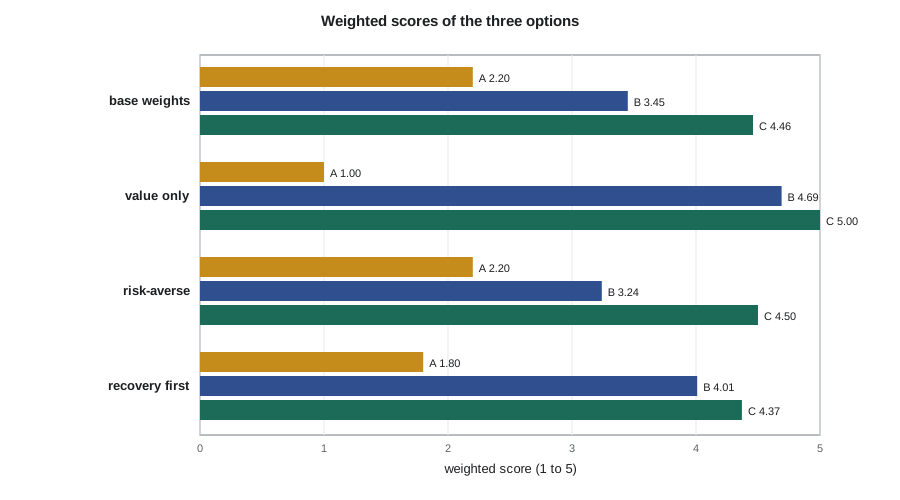
Value is the main criterion, but not the only one. The committee will also weigh capital efficiency, resilience to low prices, recovery of the resource, emissions and the difficulty of executing the project. Aisha builds a simple weighted scorecard so that the team's judgment is explicit and can be challenged. Each criterion is scaled from 1 to 5 across the options, weighted, and summed. The weights are the team's view of what the committee cares about. The code then tests whether the ranking survives three different sets of priorities.
# Final option scorecard: weighted criteria, ranking and a test of how sensitive the ranking is to the weights.
SI = True      # True: Canadian case, False: US case
# results carried from Lessons 8, 10 and 11 (millions of dollars, fraction of oil in place, kg CO2e per boe)
if SI:
    data = {"A": dict(emv=39.9, pir=1.19, down=21.0, rf=0.25, ghg=3.9, ease=5),
            "B": dict(emv=58.8, pir=0.94, down=24.6, rf=0.35, ghg=3.7, ease=2),
            "C": dict(emv=60.4, pir=1.08, down=26.3, rf=0.33, ghg=3.7, ease=4)}
else:
    data = {"A": dict(emv=10.5, pir=0.57, down=1.2, rf=0.25, ghg=6.2, ease=5),
            "B": dict(emv=13.3, pir=0.33, down=-3.0, rf=0.35, ghg=5.9, ease=2),
            "C": dict(emv=15.5, pir=0.41, down=-0.9, rf=0.33, ghg=5.9, ease=4)}
weights = {"emv": 0.30, "pir": 0.15, "down": 0.20, "rf": 0.10, "ghg": 0.10, "ease": 0.15}
labels = {"emv": "expected NPV10", "pir": "capital efficiency", "down": "value at low price", "rf": "recovery",
          "ghg": "emissions intensity", "ease": "ease of execution"}
lower_better = {"ghg"}

def scores(w):
    out = {o: 0.0 for o in data}
    for c, wt in w.items():
        vals = [data[o][c] for o in data]; lo, hi = min(vals), max(vals)
        for o in data:
            x = 1 + 4 * (data[o][c] - lo) / (hi - lo) if hi > lo else 3   # scale each criterion to 1-5
            if c in lower_better: x = 6 - x
            out[o] += wt * x
    return out

print(f"{'criterion':22s} {'weight':>6s}   " + "   ".join(f"{o:>6s}" for o in data))
for c, wt in weights.items():
    print(f"{labels[c]:22s} {wt:6.2f}   " + "   ".join(f"{data[o][c]:6.2f}" for o in data))
s = scores(weights)
rank = sorted(s, key=s.get, reverse=True)
print("weighted score (1 to 5): " + ", ".join(f"{o} {s[o]:.2f}" for o in rank))
# Does the ranking survive different priorities?
tests = {"value only": {"emv": 1.0},
         "risk-averse": {"emv": 0.15, "pir": 0.15, "down": 0.40, "rf": 0.05, "ghg": 0.10, "ease": 0.15},
         "recovery first": {"emv": 0.20, "pir": 0.10, "down": 0.10, "rf": 0.40, "ghg": 0.10, "ease": 0.10}}
for name, w in tests.items():
    t = scores(w); r = sorted(t, key=t.get, reverse=True)
print(f"{name:15s}: " + " > ".join(f"{o} ({t[o]:.2f})" for o in r))criterion weight A B C expected NPV10 0.30 39.90 58.80 60.40 capital efficiency 0.15 1.19 0.94 1.08 value at low price 0.20 21.00 24.60 26.30 recovery 0.10 0.25 0.35 0.33 emissions intensity 0.10 3.90 3.70 3.70 ease of execution 0.15 5.00 2.00 4.00 weighted score (1 to 5): C 4.46, B 3.45, A 2.20 value only : C (5.00) > B (4.69) > A (1.00) risk-averse : C (4.50) > B (3.24) > A (2.20) recovery first : C (4.37) > B (4.01) > A (1.80)
Option C scores 4.46 against 3.45 for option B and 2.20 for option A, and it ranks first under every set of weights tested: value only, risk-averse and recovery first. The Canadian recommendation is therefore clear and robust.
A scorecard is a communication device, not a calculator of truth. Its scales and weights are judgments, and an option with a slightly higher score is not necessarily better. Its value is that it shows the committee which criteria favour which option and how sensitive the choice is to priorities. Dr. Achterberg warns the team against one common misuse: adding a criterion, such as net present value, that is already the sum of others, such as recovery and cost, so that the same effect is counted twice. The team's six criteria are chosen to be as independent as possible.
The recommendation
The team recommends option C: develop Spruce Ridge with two horizontal producers and the discovery well, a battery built ready for water injection, a sour gas pipeline to the Poplar Creek gas plant and an oil pipeline to the Tamarack battery, at a capital cost of about 45 million dollars; monitor the reservoir pressure for 18 months with the permanent gauge in the 06-09 well; and add water injection, at about 11 million dollars, unless the pressure history shows that the aquifer is strong. The expected after-tax NPV10 is about 60 million dollars, the project remains strongly positive at the P90 oil in place, at a 25 percent lower price and with a 25 percent capital overrun, and the recommendation holds for any reasonable aquifer probabilities.
The recommendation comes with a define-stage work program, the list of what must be done before the company commits the capital. It includes the data acquisition items from Lesson 2: a core and a fluid sample from the first development well, a pilot hole to confirm the reservoir top, a water analysis and compatibility test, and the permanent pressure gauge. It includes the engineering items: a full-field simulation model built on the new data, a class 3 cost estimate from equipment quotations, the pipeline route surveys and the emergency planning zone calculations. And it includes the commercial and regulatory items: the gas processing and gathering agreements, the participant involvement or unitization program, and the applications. Each item has an owner, a cost and a date.
Writing the report
The final report follows a conventional structure, because the readers know where to find things in it. It opens with an executive summary of two pages that a committee member could read in five minutes and still understand the recommendation, the value, the main risks and the next steps. The body follows the chain of the plan: data, geology and petrophysics, fluids, volumetrics, reservoir performance, development options, wells, production forecasts, facilities, economics and decision analysis, environment, regulation and stakeholders, and the recommendation with the define-stage program. Appendices hold the detailed calculations, the code, the data inventory and the master data sheet.
Aisha sets three rules for the writing. Every number in the report comes from the master data sheet or a calculation that can be traced back to it. Every assumption is stated where it is used, not hidden in an appendix. And every uncertainty that could change the recommendation is described in the main text, with its effect. Daniel adds a fourth: the executive summary must not contain anything the body does not support.
Presenting the plan
The final presentation has 25 minutes and 15 minutes of questions. The team builds it around a single message, stated on the first slide and repeated on the last: what the team recommends, why, what it is worth and what it needs. Every slide in between supports that message, with a headline that states its conclusion rather than its topic, so that a reader who saw only the headlines would follow the argument. The geology slide is headed “A prolific reef with a thick oil column and a moderate aquifer”, not “Geology”.
The team rehearses twice in front of Dr. Achterberg and once in front of students from another team, who are asked to play hostile committee members. The rehearsals expose the usual problems: too many numbers on the economics slide, an unexplained acronym on the facilities slide, and a speaker who reads the slides. They also expose a more important one: the team's answer to “What would make you change your recommendation?” was different depending on who answered it. They agree on a single answer, which goes on a backup slide: the evidence that would change the recommendation and what the team would recommend instead.
At the final presentation, Lena's first question is the one Ethan asked in week 1, in a different form: “If we gave you the money tomorrow, what is the first thing that could go wrong?” Mateo answers that the first producer could land its lateral too low because the reservoir top comes in deeper than mapped, which is why the plan includes a pilot hole, and that the second is that the aquifer turns out weaker than the history match suggests, which is why the battery is built ready for injection. The committee's discussion afterwards turns on the define-stage budget, not on whether the plan is sound, which is the outcome a capstone team should hope for.
Looking back
At the end of the term the team writes a short reflection, which the course requires and which most engineers wish they had written after their first real project. Three lessons recur in it. The critical path really was critical: the history match took the full two weeks and would have delayed everything if Mateo had not started early. The data review saved the project from at least one serious error, the supercharged pressure point that would have moved the free water level. And the most valuable result was not a number but an insight: that the aquifer uncertainty mattered mainly because it decided whether injection was worth buying, and that the phased option made that uncertainty much less important. Ethan's comment on the final report says the same thing in fewer words: “You found the decision that mattered and made it cheap to get right.”
Common mistakes
MistakeTreating the design review as a rehearsal.
InsteadUse it to find weaknesses; record every question with an owner and fix the plan, not just the slides.
MistakePresenting a scorecard as if it calculated the right answer.
InsteadUse it to make judgments explicit and test their sensitivity; avoid double-counting criteria.
MistakeHiding the conditions under which the recommendation would change.
InsteadState them, and say what the team would recommend instead.
MistakeEnding with a recommendation but no next steps.
InsteadAttach a define-stage program with owners, costs and dates.
Summary and key terms
- A design review is held early enough to fix what it finds; every question goes into an action log.
- Reserves that can be booked at sanction differ between options, which matters to the committee.
- Sensitivity of the choice to judgmental probabilities and weights should be shown explicitly.
- The recommendation states the option, its value, its risks, the conditions that would change it and the define-stage work program.
- The report follows the chain of the plan; every number is traceable and every material uncertainty is in the main text.
- A presentation is built around one message, with headlines that state conclusions.
- Design review
- A structured review of a design by independent reviewers to find weaknesses before it is finalized.
- Action log
- A record of review questions and the actions, owners and dates agreed to resolve them.
- Dominance
- One option is at least as good as another in every outcome and better in at least one.
- Executive summary
- A short summary of a report's recommendation, value, risks and next steps.
- Define-stage work program
- The list of data, engineering, commercial and regulatory work needed before sanction.
Practice problems
Work each problem on paper first, then reveal the answer to check.
Why can't the injection volumes in option C be booked as reserves at sanction?
Show answer
The company has not yet committed to injection; that decision is made after 18 months.
What does it mean that option C dominates option B in the US case?
Show answer
It is worth more in every aquifer case, so it is preferred for any probabilities.
Why should every slide headline state a conclusion?
Show answer
So that the argument can be followed from the headlines alone.
Give three items in the define-stage work program.
Show answer
A pilot hole and core in the first well, a full-field simulation model and a class 3 estimate; also agreements, water tests and applications.
Lesson quiz · 5 questions
Score 60% or more to complete this lesson.
Create a free account to save your progress, take quizzes and earn a certificate.