
PET-499 · Lesson 11 of 12 · 20 min
Environmental, regulatory and stakeholder plan
Daniel's other assignment, the one with four weeks of float, is the part of the plan that many engineering teams leave until last and regret. A development that is technically sound and economic can still be delayed for years by an approval that was not applied for in time, a community that was not consulted, or an emissions problem that was not designed out. Lena Haugen's advice when the team met her in week 3 was blunt: “The committee will read your economics. The regulator and the neighbours will read this chapter. Write it as if they were the audience, because they are.” This lesson covers the approvals the project needs, how sour gas shapes safety and emergency planning, the greenhouse gas inventory and how to reduce it, and the plan for working with the people affected.
The approvals
In Alberta, nearly every approval for an oil development comes from the AER, which regulates wells, facilities, pipelines, water use for oil and gas operations and reclamation under several provincial statutes. Daniel lists the approvals the project needs and the order in which they must be obtained, because some depend on others.
| Approval | Main requirements | Notes |
|---|---|---|
| Well licences for new producers and injectors | Directive 056 application, participant involvement, emergency planning zone for sour wells | The AERH2S model became mandatory for sour applications on January 1, 2026 |
| Facility licence for the battery | Directive 056; design for sour service; flaring, venting and methane requirements | Emergency response plan under Directive 071 before sour operations start |
| Pipeline licences: sour gas and oil lines | Directive 056; design and construction to CSA Z662 | Route selection considers the emergency planning zone |
| Enhanced recovery scheme approval | Application for water injection showing the reservoir case and monitoring | Needed before phase 2 injection in option C |
| Water source and disposal | Approval to use saline groundwater; disposal well approvals if needed | Fresh water use is strongly discouraged |
| Federal methane regulations | Venting, flaring, leak detection and repair requirements | Amendments published at the end of 2025 take effect mainly from January 1, 2028 |
The longest lead items are the sour well and facility applications, because they need participant involvement with everyone inside the emergency planning zone before they can be filed, and the enhanced recovery scheme approval for injection. Daniel puts the participant involvement program at the start of the define stage, so that applications can be filed within six months of sanction, and notes that the enhanced recovery application for option C can be prepared during phase 1 using the production data that will inform the decision.
Sour gas: safety and emergency planning
Hydrogen sulfide is the main safety hazard of the project. At low concentrations it smells of rotten eggs, but at higher concentrations it deadens the sense of smell, and a few hundred parts per million can be lethal in minutes. The design measures described in Lesson 9, sour-service materials, H₂S detection, emergency shutdown and a safe flare, reduce the chance of a release. Emergency planning deals with what happens if one occurs anyway.
In Alberta, every sour well, facility and pipeline has an emergency planning zone, the area around it in which residents could be exposed to hazardous concentrations in a credible worst-case release. The zone's size depends on the H₂S release rate, which the AER's AERH2S model calculates from the H₂S content, the potential flow rate and the mitigation measures in place. Within the zone, the licensee must identify every resident, provide information, and have an emergency response plan with notification, evacuation and ignition procedures. The team's preliminary estimate puts the zone for the producing wells at roughly 1 to 2 km, which includes four farmsteads. That number is what makes the participant involvement program so important.
The greenhouse gas inventory
Every development plan now needs an estimate of its greenhouse gas emissions, both for regulation and because investors and lenders ask for it. Hannah and Daniel build a source-by-source inventory for the battery at plateau. The main sources are fuel combustion in compressors and the heater treater, flaring of pilot, purge, upset and tank vapours, venting from gas-driven pneumatic controllers, and fugitive leaks from the thousands of valves, flanges and connections. Methane is counted with its 100-year global warming potential of 28, the IPCC's fifth assessment value; reporting programs specify their own values, which the define stage will apply.
The inventory compares two designs. The conventional design uses gas-engine compressors, gas-driven pneumatic controllers, routes tank vapours to the flare and has a basic leak inspection program. The low-emission design uses electric motors for compression, instrument air for the controllers, a vapour recovery unit on the tanks, and a leak detection and repair program with frequent optical gas imaging surveys.
# Greenhouse gas inventory for the Spruce Ridge battery at plateau: a conventional design and a low-emission design.
SI = True      # True: Canadian case (m3, Alberta grid), False: US case (bbl, North Dakota grid)
GWP = 28.0                                       # 100-year global warming potential of methane (AR5)
if SI:
    oil, gas = 320.0, 48000.0                    # m3/d oil, m3/d raw solution gas to the plant
    ch4_frac, rho_ch4 = 0.70, 0.678              # methane mole fraction of the gas, kg/m3 at standard conditions
    comp_kw, grid = 450.0, 0.48                  # compression load; grid intensity t CO2e per MWh (illustrative)
    co2_per_m3_fuel, fuel_per_kwh = 2.25, 0.28   # kg CO2 per m3 of fuel gas; m3 of fuel per kWh from a gas engine
    boe = oil * 6.2898 + gas * 35.3147 / 6000    # barrels of oil equivalent per day (6 Mcf per bbl)
else:
    oil, gas = 1600.0, 1.44e6 / 35.3147          # bbl/d oil, raw gas converted to m3/d for the calculation
    ch4_frac, rho_ch4 = 0.70, 0.678
    comp_kw, grid = 520.0, 0.62
    co2_per_m3_fuel, fuel_per_kwh = 2.25, 0.28
    boe = oil + gas * 35.3147 / 6000
pilot = 100.0                                    # m3/d of pilot and purge gas to the flare
upset = 0.005                                    # fraction of produced gas flared in upsets and maintenance
eff = 0.98                                       # combustion efficiency: 2 percent of the methane passes through unburned

def inventory(electric, air_pneumatics, vru, ldar):
    """Daily emissions by source, t CO2e."""
    t = {}
    fuel = 0.0 if electric else comp_kw * 24 * fuel_per_kwh
    t["compression"] = comp_kw * 24 / 1000 * grid if electric else fuel * co2_per_m3_fuel / 1000
    t["heater treater"] = 900.0 * co2_per_m3_fuel / 1000      # 900 m3/d of fuel gas in both designs
    tank = 0.0 if vru else oil * (1 if SI else 1 / 6.2898) * 1.8  # sour tank flash gas, m3 per m3 of oil: flared, never vented
    flared = pilot + upset * gas + tank
    t["flare CO2"] = flared * 2.6 / 1000                         # kg CO2 per m3 of rich gas burned (illustrative)
    t["flare methane slip"] = flared * ch4_frac * rho_ch4 * (1 - eff) * GWP / 1000
    pneu = 0.0 if air_pneumatics else 30 * 0.17 * 24             # 30 intermittent gas-driven controllers, m3/h each
    t["pneumatic venting"] = pneu * ch4_frac * rho_ch4 * GWP / 1000
    fug = gas * (0.0005 if ldar else 0.0015)                      # fugitive leakage as a fraction of throughput
    t["fugitives"] = fug * ch4_frac * rho_ch4 * GWP / 1000
    return t

for name, args in (("conventional", (False, False, False, False)), ("low-emission", (True, True, True, True))):
    t = inventory(*args); total = sum(t.values())
    ch4 = (t["flare methane slip"] + t["pneumatic venting"] + t["fugitives"]) / GWP   # t CH4 per day
    print(f"{name} design: {total:.1f} t CO2e per day, {total * 365 / 1000:.1f} kt per year; intensity {1000 * total / boe:.1f} kg CO2e per boe" +
          (f" ({1000 * total / (boe / 6.2898):.0f} kg per m3 OE)" if SI else ""))
    gas_ch4_t = gas * ch4_frac * rho_ch4 / 1000
    print(f"   methane {ch4:.3f} t/d = {100 * ch4 / gas_ch4_t:.2f} percent of the methane produced")
    for k, v in sorted(t.items(), key=lambda kv: -kv[1]):
print(f" {k:20s} {v:7.2f} t CO2e/d")conventional design: 14.0 t CO2e per day, 5.1 kt per year; intensity 6.1 kg CO2e per boe (38 kg per m3 OE) methane 0.101 t/d = 0.44 percent of the methane produced compression 6.80 t CO2e/d flare CO2 2.38 t CO2e/d heater treater 2.02 t CO2e/d pneumatic venting 1.63 t CO2e/d fugitives 0.96 t CO2e/d flare methane slip 0.24 t CO2e/d low-emission design: 8.5 t CO2e per day, 3.1 kt per year; intensity 3.7 kg CO2e per boe (23 kg per m3 OE) methane 0.015 t/d = 0.06 percent of the methane produced compression 5.18 t CO2e/d heater treater 2.02 t CO2e/d flare CO2 0.88 t CO2e/d fugitives 0.32 t CO2e/d flare methane slip 0.09 t CO2e/d pneumatic venting 0.00 t CO2e/d
The conventional design emits about 14 tonnes of CO₂ equivalent a day, 5.1 kilotonnes a year, an intensity of 6.1 kg per barrel of oil equivalent (38 kg per m³ OE), with methane losses of 0.44 percent of the methane produced. The low-emission design cuts this to 8.5 tonnes a day, 3.7 kg per barrel of oil equivalent, and reduces methane losses almost to zero, 0.06 percent. The largest reductions come from eliminating pneumatic venting, recovering the tank vapours instead of flaring them, and the leak program. Electric compression helps less than expected, about 1.6 tonnes a day, because Alberta's electricity still comes partly from natural gas.
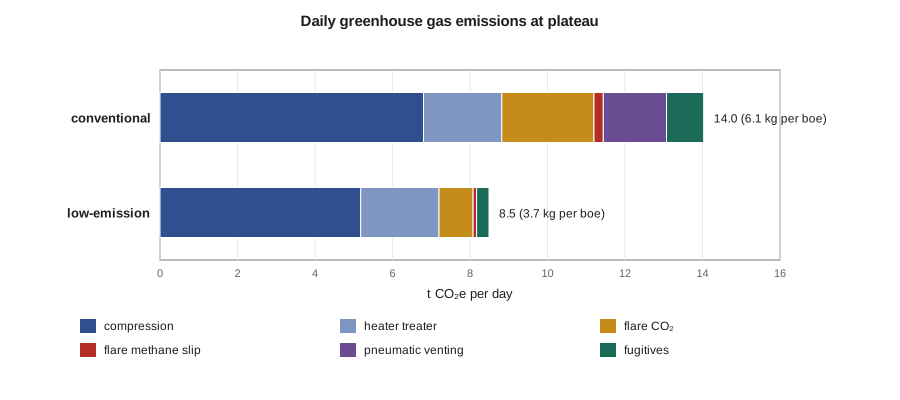
The low-emission design costs about 1.2 million dollars more in capital, mostly for the vapour recovery unit and the electrical supply, and that amount is already in the battery estimates of Lesson 9. The team includes it in every option, for three reasons. Venting sour vapours is unacceptable anyway, so the vapour recovery unit replaces a flare duty rather than adding a new one. Methane rules in both jurisdictions are tightening: they would require most of these measures within a few years in any case, and retrofitting is more expensive than building in. And the recovered gas has value. The emissions intensity is therefore almost the same for all three options, and it is not a major differentiator between them, though option A produces slightly fewer barrels for similar fixed emissions and so has a slightly higher intensity.
Worked problem
Annual methane and its value
The conventional design loses 0.101 tonnes of methane a day; the low-emission design 0.015. Methane at standard conditions has a density of 0.678 kg/m³, and the gas is 70 percent methane by volume. At 0.08 dollars per m³ of raw gas, what is the annual value of the gas saved, and how much CO₂ equivalent is avoided?
Show solution
- Methane saved = 0.086 t/d × 365 = 31.4 t a year.
- Gas volume = 31,400 kg / 0.678 / 0.70 ≈ 66,200 m³ of raw gas, worth about 5,300 dollars a year.
- CO₂ equivalent avoided = 31.4 × 28 ≈ 880 t a year.
Answer: The gas saved is worth little; the emissions avoided are significant. Methane controls are justified by their climate effect and by regulation, not by the value of the gas, which is why regulations rather than markets drive most of them.
Land, water and reclamation
The development's footprint is small: two well pads, the battery site, the pipeline rights of way and an access road. The team routes the pipelines along existing rights of way where possible, avoids wetlands and watercourses, and plans to bore under the one creek that the gas line must cross rather than trench through it. The battery is sited to keep the emergency planning zone away from as many residences as possible and to allow a buffer from the nearest farmstead. Water for injection make-up comes from a saline aquifer, and produced water is reinjected into the reservoir, so the project uses no fresh water for injection. At the end of the field's life, the wells will be abandoned and the sites reclaimed to equivalent land capability, and the cost of doing so is included in the economics.
Working with the people affected
The stakeholders are the landowners whose land the wells, battery and pipelines will occupy; residents inside the emergency planning zone; the county, which maintains the roads and provides emergency services; the Poplar Creek gas plant operator; and the Indigenous communities whose traditional territory includes the area. In Alberta, the Crown's duty to consult Indigenous peoples on resource decisions that may affect treaty rights is managed by the provincial Aboriginal Consultation Office, which assesses whether consultation on an AER application has been adequate; the proponent carries out much of the consultation itself. Daniel's plan starts with early, informal meetings before any application is drafted, so that concerns about routes, traffic, noise, flaring and sour gas can shape the design rather than arrive as objections.
The plan identifies what the project can offer and what it cannot. It can offer early information, routes and site locations adjusted where feasible, a pipeline instead of truck traffic, no routine flaring, and a named contact who answers calls. It cannot offer to remove all risk, and it should not pretend to. Lena's experience is that people affected by a sour gas development want to be told honestly what could happen and what will be done about it, and that they remember whether the company kept its word.
Common mistakes
MistakeLeaving approvals to be identified after sanction.
InsteadList the approvals and their lead times in the plan; some, such as consultation, unitization or scheme approval, can control the schedule.
MistakeTreating emergency planning as a paperwork requirement.
InsteadUse the planning zone in siting and routing decisions, and engage every resident inside it early.
MistakeCounting only combustion CO₂.
InsteadInclude methane from venting, fugitives and incomplete combustion; for many batteries it dominates.
MistakeChoosing methane controls on the value of the gas saved.
InsteadJudge them on emissions avoided, regulatory direction and retrofit cost; the gas value is usually small.
Summary and key terms
- The plan must list every approval, its requirements and its lead time; consultation, unitization and scheme approvals often control the schedule.
- Sour gas requires emergency planning around wells, facilities and pipelines, and the planning zone shapes siting and engagement.
- A source-by-source greenhouse gas inventory identifies where emissions come from; methane is counted with its global warming potential.
- Instrument air, vapour recovery and leak detection and repair remove most methane; electric compression helps only where the grid is clean.
- Using saline water for injection and reinjecting produced water avoids fresh water use.
- Stakeholder engagement should start before applications are filed and be honest about risk.
- Emergency planning zone
- The area around a sour well, facility or pipeline where a credible release could expose people to hazardous H₂S.
- Participant involvement
- The engagement with affected parties required before certain energy applications are filed.
- Unitization
- Combining the interests in a pool so that it can be developed and operated as one unit.
- Global warming potential
- The ratio of a gas's warming effect over a period to that of the same mass of CO₂.
- Leak detection and repair (LDAR)
- A program of surveys to find and fix fugitive leaks.
- Emissions intensity
- Emissions per unit of production, such as kg CO₂ equivalent per barrel of oil equivalent.
Practice problems
Work each problem on paper first, then reveal the answer to check.
Why is the participant involvement program on the critical path for the approvals?
Show answer
Sour well and facility applications cannot be filed until affected parties in the planning zone have been engaged.
What are the two largest methane sources in the conventional design?
Show answer
Pneumatic venting and fugitive leaks.
Why does electric compression reduce emissions less in some regions than others?
Show answer
Its benefit depends on the emissions intensity of the grid supplying the electricity.
Why is the low-emission design included in all three options?
Show answer
Venting sour vapours is unacceptable, methane rules are tightening, and retrofitting is costlier than building in.
Lesson quiz · 5 questions
Score 60% or more to complete this lesson.
Create a free account to save your progress, take quizzes and earn a certificate.