
PET-460 · Lesson 11 of 12 · 19 min
Regulation, liability and credits in Canada
Lena brought in Nadia Brandt, Prairie Crest's regulatory lead, for the meeting Ethan had been dreading. “The rocks will take it,” Nadia said, looking at his capacity charts. “Now tell me who owns the pore space, who approves the wells, who is responsible for the CO₂ in a hundred years, and who pays us. Those four answers decide whether this is a project.” In Alberta, she explained, most of them have been settled in law for over a decade. The money is less settled, and it moves with policy.
Who owns the pore space
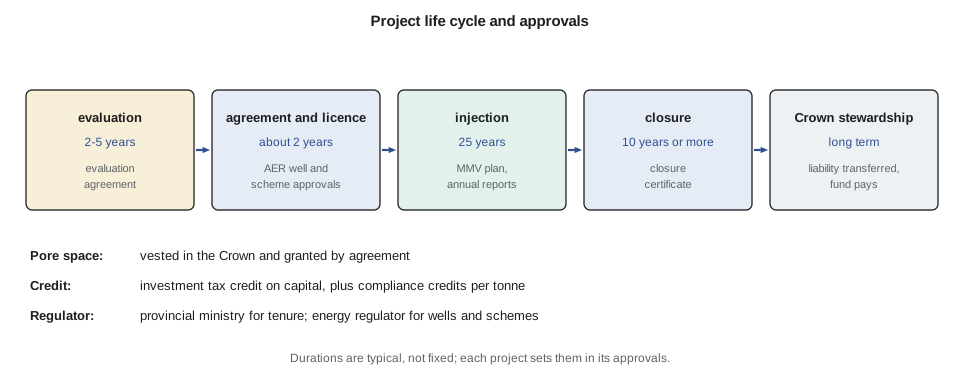
Storage needs the right to use the pore space of a formation. In 2010, Alberta's Carbon Capture and Storage Statutes Amendment Act declared that the pore space below most land in the province belongs to the Crown, regardless of who owns the surface or the minerals, which removed a problem that still complicates storage in many US states. The province grants the right to use it under the Mines and Minerals Act. Since 2022 Alberta has allocated storage through a hub process: after competitive calls for proposals, the government selected proponents for 24 hubs, six in the Industrial Heartland and eighteen across the rest of the province. Each starts with a carbon sequestration evaluation agreement, which allows drilling and testing, and moves to a carbon sequestration agreement, which grants the right to inject, once storage is shown to be feasible. Hub operators must offer open access to third-party emitters at reasonable rates. Saskatchewan and British Columbia have their own frameworks, and the Sturgeon Ridge evaluation agreement put Prairie Crest at the first stage of the Alberta process.
Who approves the project
The AER regulates storage wells, pipelines and facilities in Alberta under the same acts and directives as oil and gas, with specific requirements for CO₂ storage schemes. An application includes the site characterization, a risk assessment, a measurement, monitoring and verification plan, and a closure plan, and the AER can require changes to injection rates and monitoring during operation. Other approvals cover environmental protection, water and land, and the pipeline. CSA Z741, the binational Canadian and US standard for geological storage of CO₂, and ISO 27914 provide good practice that regulators and operators reference. The federal government's role is mainly through credits and impact assessment for very large projects; for most hubs, approval is provincial.
Who is responsible in the long term
Liability is the question that most separates storage from oil and gas. An operator is responsible for its wells and for any harm its operations cause, but a storage project's purpose is to leave CO₂ underground indefinitely, long after any company may exist. Regulators handle this with a closure process and, in some jurisdictions, a transfer of long-term responsibility to the state.
In Alberta, after injection ends and the operator has shown through monitoring that the CO₂ is behaving as predicted and that the wells and facilities are properly abandoned and reclaimed, the operator can apply for a closure certificate. When it is issued, the Crown assumes the operator's obligations under the province's main environmental and resource statutes and its liability for the stored CO₂, with limited exceptions. The Post-closure Stewardship Fund, built from a per-tonne levy paid by operators during injection, pays for the Crown's long-term monitoring and any remediation. The closure period and the levy are set through the agreement and regulations; the hub's economics in Lesson 12 include an illustrative levy of 0.50 Canadian dollars per tonne. This framework is one of the clearest in the world, and was designed with Quest as its first test.
Worked problem
Financial assurance for closure
The hub must demonstrate financial assurance for plugging its 4 injectors and 6 monitoring wells at about 2.5 million each, for 10 years of post-closure monitoring at 3 million a year, and for an emergency and remedial response estimate of 20 million. Find the undiscounted total.
Show solution
- Plugging = 10 × 2.5 = 25 million.
- Post-injection monitoring = 10 × 3 = 30 million.
- Total = 25 + 30 + 20 = 75 million Canadian dollars.
Answer: About 75 million Canadian dollars, which the AER would require as security; after closure, the Crown's long-term costs are covered by the stewardship fund.
Who pays: credits and carbon prices
Canada supports CCS through three channels. The federal CCUS investment tax credit, enacted in 2024, is refundable and pays a share of eligible capital costs: 60 percent for direct air capture equipment, 50 percent for other capture equipment and 37.5 percent for transport, storage and use equipment for projects spending money from 2022 through 2035, after the 2025 federal budget extended the full rates by five years; the rates halve from 2036 to 2040. CO₂ must be stored in a jurisdiction with approved storage regulations, which includes Alberta, and use for enhanced oil recovery is not eligible, although the federal government has committed to extend credits to enhanced recovery. Second, industrial carbon pricing creates value per tonne: under Alberta's TIER system, a facility that reduces its emissions below its benchmark earns credits it can sell. Under the 2025 Canada-Alberta memorandum of understanding and its May 2026 implementation agreement, the TIER headline price is 95 dollars a tonne in 2026, 100 dollars from 2027 to 2029 and 115 dollars in 2030, rising to 130 dollars in 2035 and 140 dollars in 2040; Alberta is to manage the market so that the effective credit price reaches 130 dollars by 2040, with a minimum credit transfer price from 2030. Because credit prices have traded well below the headline, carbon contracts for difference, which guarantee a project a price per tonne, are the third channel: the two governments have committed to jointly fund contracts covering up to 75 million tonnes of reductions. Alberta also offers a provincial capital grant for CCUS projects.
# What the policy support is worth per tonne: Canada's investment tax credit plus a compliance-market credit,
# versus the US 45Q production credit. Illustrative project, 3.0 Mt/yr for 25 years, real discount rate 8%.
SI = True      # True: Canadian hub (ITC + carbon credits), False: US hub (45Q)

rate, years, r = 3.0, 25, 0.08
disc = [1 / (1 + r) ** (t + 1) for t in range(years)]          # operations years 1..25 after a construction year 0
pv_tonnes = sum(rate * d for d in disc)                        # discounted Mt
if SI:
    capex = {"capture (four sources)": 1650.0, "compression and trunk line": 420.0, "storage wells and facilities": 330.0}   # million CAD
    itc = {"capture (four sources)": 0.50, "compression and trunk line": 0.375, "storage wells and facilities": 0.375}
    credit_price, realized = 95.0, 0.70        # headline compliance price per tonne, and share realized after discounts (illustrative)
    pv_itc = sum(capex[k] * itc[k] for k in capex)     # received at start-up
    pv_cc = sum(rate * credit_price * realized * d for d in disc)
    print("Investment tax credit (full-rate period):")
    for k in capex: print(f"  {k:30s} {capex[k]:7,.0f} M x {itc[k]:.1%} = {capex[k] * itc[k]:6,.0f} M CAD")
    print(f"  total ITC {pv_itc:,.0f} M CAD on {sum(capex.values()):,.0f} M of capital ({pv_itc / sum(capex.values()):.0%})")
    print(f"Compliance credits: {credit_price:.0f} CAD/t x {realized:.0%} realized, PV {pv_cc:,.0f} M CAD")
    print(f"Support per discounted tonne: ITC {pv_itc / pv_tonnes:.0f} + credits {pv_cc / pv_tonnes:.0f} = {(pv_itc + pv_cc) / pv_tonnes:.0f} CAD/t")
    print("Sensitivity: if the realized credit value falls to 40% of headline, support drops to "
          f"{(pv_itc + pv_cc * 0.40 / realized) / pv_tonnes:.0f} CAD/t.")
else:
    credit, credit_years, infl = 85.0, 12, 0.02     # 45Q per metric ton, credit period, assumed inflation adjustment (nominal)
    pv_45q = sum(rate * credit * (1 + infl) ** t * d for t, d in enumerate(disc[:credit_years]))
    print(f"45Q: {credit:.0f} USD per metric ton for {credit_years} years, inflation-adjusted at an assumed {infl:.0%}/yr")
    print(f"  PV of credits {pv_45q:,.0f} M USD on {pv_tonnes:.1f} discounted Mt")
    print(f"  Support per discounted metric ton over the 25-year project: {pv_45q / pv_tonnes:.0f} USD")
    print(f"  ... over the first 12 years only: {pv_45q / sum(rate * d for d in disc[:credit_years]):.0f} USD")
    print("After year 12 the hub must cover its costs from tariffs alone, so contracts often step up tariffs or end then.")
    for start_delay in (0, 2):
        pv = sum(rate * credit * (1 + infl) ** t * disc[t + start_delay] for t in range(credit_years))
print(f" Start-up delayed {start_delay} years: PV of credits {pv:,.0f} M USD (credit period still 12 years)")Investment tax credit (full-rate period): capture (four sources) 1,650 M x 50.0% = 825 M CAD compression and trunk line 420 M x 37.5% = 158 M CAD storage wells and facilities 330 M x 37.5% = 124 M CAD total ITC 1,106 M CAD on 2,400 M of capital (46%) Compliance credits: 95 CAD/t x 70% realized, PV 2,130 M CAD Support per discounted tonne: ITC 35 + credits 66 = 101 CAD/t Sensitivity: if the realized credit value falls to 40% of headline, support drops to 73 CAD/t.
The ITC returns about 1.1 billion dollars of the hub chain's 2.4 billion of capital at start-up, equal to about 35 dollars per discounted tonne. Compliance credits, at 70 percent of the 95-dollar headline price, add about 66 dollars, for total support of about 101 dollars per tonne. The weak point is the credit value: if realized prices fell to 40 percent of headline, support would drop to about 73 dollars. That is why contracts for difference matter so much to emitters, and why Lena wanted each source's capture decision tied to one. The support only goes to the emitters that capture; the hub earns its revenue from them through tariffs, the subject of Lesson 12.
Beyond Alberta
In the United States, storage is regulated through EPA's Class VI well permits, issued by EPA or by states with primacy, and supported by the 45Q tax credit of 85 US dollars per metric ton for point-source CO₂ stored geologically. Pore space generally belongs to the surface owner, and long-term liability stays with the operator unless state law provides a transfer. Internationally, the London Protocol to the marine dumping convention was amended to allow sub-seabed storage and, later, export of CO₂ for storage in another country, which European projects such as Northern Lights rely on. The European Union's 2009 directive on geological storage of CO₂ sets a permit and closure framework similar to Alberta's, with liability transfer after at least 20 years, and Norway, the United Kingdom, the Netherlands and Denmark license offshore storage.
The contract chain
Regulation defines who answers to the government; contracts define who answers to whom along the chain. A transport and storage agreement between the hub and each emitter typically covers the reserved capacity and a take-or-pay commitment, so that the hub is paid for capacity it holds even if a source is off line; the CO₂ specification at the delivery point and what happens to off-specification CO₂; the metering point where custody and responsibility pass; outage rules, since an emitter that cannot deliver loses credits and a hub that cannot accept forces venting; and the allocation of credit risk if stored CO₂ is later found to have leaked and credits must be cancelled or replaced. It also covers who carries the cost of the regulator's closure and post-closure obligations, usually the hub, recovered through the tariff. Nadia's draft term sheet put custody transfer at each source's meter, made the hub responsible for anything that happened downstream of it, and set a tariff with a capacity charge and a smaller charge per tonne, indexed to inflation. That structure gave the hub the predictable revenue its lenders would want, and gave emitters a clear boundary of responsibility, which their own credit claims required.
Communities and trust
Regulation sets the minimum; acceptance determines whether a project proceeds. Several US pipeline projects in the Midwest have been delayed or cancelled after landowners and counties objected to routes and the use of eminent domain, and storage projects have met concerns about groundwater, property values and long-term liability. Projects that succeed tend to engage early, share monitoring data openly, explain risks honestly, offer benefits to the communities that host them and, where projects are on or near the lands of First Nations and Métis communities, involve those communities as partners and, increasingly, as equity owners. The Sturgeon Ridge area lies within Treaty 6 territory, and Prairie Crest began discussions with nearby Nations at the evaluation stage.
Common mistakes
MistakeAssuming the surface owner's consent is enough to inject.
InsteadConfirm who owns the pore space under the applicable law and secure it across the whole area the plume will occupy.
MistakeTreating closure as the end of responsibility everywhere.
InsteadCheck whether the jurisdiction transfers liability; under federal US rules the operator remains liable.
MistakeValuing credits at headline prices.
InsteadUse realized credit prices, credit periods and timing; a delayed start or a 12-year limit cuts value sharply.
MistakeEngaging communities after the permit is filed.
InsteadStart engagement at site selection and share monitoring data throughout.
Summary and key terms
- Alberta vested pore space in the Crown in 2010 and allocates storage through hub evaluation and sequestration agreements.
- The AER approves wells and storage schemes with risk assessment, MMV and closure plans.
- After closure, the Crown assumes long-term liability, funded by a per-tonne stewardship levy.
- Federal ITC rates are 60, 50 and 37.5 percent through 2035; TIER credits and contracts for difference add per-tonne value.
- Credits go to the capturing emitter; transport and storage operators earn tariffs.
- Early, honest community engagement is as important as regulatory approval.
- Pore space
- The void space in rock that can hold fluids, including injected CO₂.
- Closure certificate
- In Alberta, the document that ends the operator's obligations and transfers long-term liability to the Crown.
- Class VI well
- The US injection well class for geologic sequestration of CO₂.
- Primacy
- Authority delegated by EPA to a state to run its own injection permitting program.
- Investment tax credit
- A credit paying a share of eligible capital costs, as in Canada's CCUS ITC.
- 45Q
- The US federal tax credit per metric ton of CO₂ captured and stored or used.
Practice problems
Work each problem on paper first, then reveal the answer to check.
Who owns the pore space under farmland near Fort Saskatchewan?
Show answer
The Crown, under Alberta's 2010 legislation.
What rate of ITC applies to a compressor and pipeline built in 2029?
Show answer
37.5 percent, the full rate for transport equipment through 2035.
What funds the Crown's costs after a closure certificate?
Show answer
The Post-closure Stewardship Fund, built from a per-tonne levy during injection.
Why does a delay in start-up reduce the value of credits even if the credit period is unchanged?
Show answer
The credits arrive later and are worth less when discounted.
Lesson quiz · 5 questions
Score 60% or more to complete this lesson.
Create a free account to save your progress, take quizzes and earn a certificate.