
PET-460 · Lesson 2 of 12 · 21 min
Post-combustion capture with amines
Gwen Halvorsen had spent the gas project designing amine units that stripped CO₂ and H₂S out of raw gas at 7,000 kPa (1,000 psia). The Heartland cogeneration plant would be a different problem. “Same chemistry, upside-down conditions,” she told Ethan. “Raw gas comes in at high pressure with a lot of CO₂ in a small volume. Flue gas comes in at atmospheric pressure with 20 percent CO₂ in an enormous volume, plus oxygen that eats the amine. The absorber is the biggest piece of equipment on the site, and the steam bill is the biggest operating cost.” Her job for the study was to size the capture plant at the Riverbend cement plant and estimate its energy demand, because that energy sets both the cost and the CO₂ avoided.
How chemical absorption works
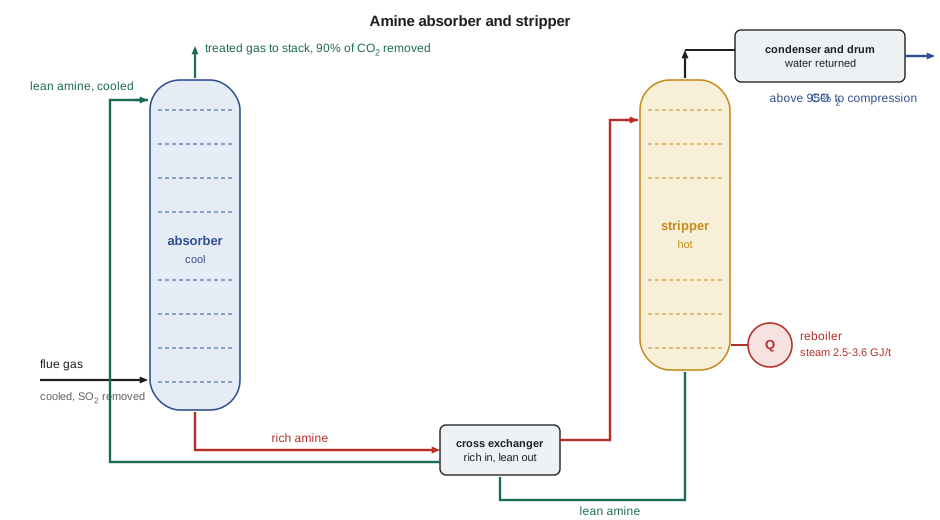
Post-combustion capture removes CO₂ from flue gas after the fuel has been burned. The established method is chemical absorption in an aqueous amine, most often monoethanolamine (MEA) at about 30 percent by weight. CO₂ is a weak acid gas, and amines are weak bases. At about 40 to 60 °C the CO₂ reacts with the amine to form a carbamate and bicarbonate in solution; when the solution is heated to about 100 to 120 °C, the reactions reverse and release nearly pure CO₂. A capture plant is therefore two columns joined in a loop. In the absorber, cooled flue gas rises through packing against a falling stream of lean amine, which picks up CO₂ and leaves the bottom as rich amine. The rich amine is heated in a cross exchanger by the hot lean amine returning from the stripper, enters the top of the stripper and flows down against steam generated in a reboiler. The steam heats the solution, drives off the CO₂ and carries it overhead, where a condenser returns the water and sends CO₂ above 95 percent purity to compression.
The same process has removed CO₂ from natural gas for most of a century, which is why it is the most mature capture technology. Applying it to flue gas began commercially at Boundary Dam Unit 3 in 2014 and at Petra Nova in Texas in 2017, and it is the basis of most announced projects for cement, power and refinery sources. Its weaknesses are also well known: the steam demand, the size of the equipment for low-pressure gas, and degradation of the amine by oxygen, heat and trace impurities.
Loading and circulation
The amount of CO₂ a solvent carries is described by its loading, α, in moles of CO₂ per mole of amine. For MEA, stoichiometry limits loading to about 0.5, because two amine molecules are consumed per CO₂ molecule in carbamate formation. In practice the rich amine leaving the absorber reaches about 0.45 to 0.50, and the lean amine leaving the stripper is about 0.15 to 0.25. The difference, the cyclic loading, sets the circulation rate:
Here ṅ_CO₂ is the molar rate of CO₂ captured and c_amine the amine concentration in moles per kilogram of solution, about 4.9 mol/kg for 30 percent MEA. A cyclic loading of 0.28 means each kilogram of solution carries about 1.4 moles of CO₂, or about 60 g. Capturing a tonne of CO₂ requires circulating about 16.5 tonnes of solution. Lower lean loading, achieved by stripping harder with more steam, raises the cyclic loading and cuts circulation, but costs heat; there is an optimum, usually near a lean loading of 0.2 for MEA.
Where the heat goes
The reboiler duty, the steam heat per tonne of CO₂, is the most important performance figure of a capture plant. It has three parts. The sensible heat raises the rich solution from the cross-exchanger outlet temperature to the reboiler temperature; it is proportional to the circulation rate and to the approach temperature of the cross exchanger. The heat of desorption reverses the absorption reactions; for MEA it is about 85 kJ per mole of CO₂, and it is the part chemistry fixes. The stripping steam is the water vapour that leaves the top of the stripper with the CO₂ and is condensed overhead; it provides the driving force for desorption by lowering the CO₂ partial pressure in the stripper.
For 30 percent MEA, with a 15 K exchanger approach and 0.8 mole of stripping steam per mole of CO₂, the three terms add to about 3.6 GJ per tonne. That was the performance of early commercial plants. Advanced amine blends, such as hindered amines and piperazine-promoted solvents, have lower heats of reaction, higher cyclic capacity and better resistance to degradation, and with process improvements such as lean vapour compression and split flows they reach 2.4 to 2.8 GJ per tonne in published results.
# Amine capture design check: solvent circulation, reboiler duty and absorber size for a flue gas source.
import math
SI = True      # True: Canadian cement plant, metric; False: US refinery heaters, US units alongside SI

if SI: name, cap_mt, y_co2, f_cap = "cement kiln flue gas", 0.60, 0.20, 0.90
else:  name, cap_mt, y_co2, f_cap = "refinery heater flue gas", 0.40, 0.08, 0.90
hours = 8000                                  # operating hours per year
MW_CO2, MW_MEA = 44.01, 61.08
co2 = cap_mt * 1e9 / hours / MW_CO2           # kmol/h captured
gas = co2 / f_cap / y_co2                     # kmol/h of flue gas entering the absorber

def solvent(w_mea, lean, rich):
    mea_per_kg = w_mea / MW_MEA * 1000        # mol MEA per kg of solution
    cyclic = (rich - lean) * mea_per_kg       # mol CO2 picked up per kg of solution
    return cyclic, co2 * 1000 / cyclic        # mol/kg, and solution kg/h

def duty(cyclic, dT=15.0, cp=3.7, dh_des=85.0, steam_ratio=0.8):
    """Reboiler heat in GJ per tonne CO2: sensible + desorption + stripping steam."""
    mol_t = 1e6 / MW_CO2
    sens = mol_t / cyclic * cp * dT / 1e6
    des = mol_t * dh_des / 1e6
    strip = mol_t * steam_ratio * 40.7 / 1e6
    return sens, des, strip

print(f"Source: {name}, {cap_mt:.2f} Mt/yr captured at {f_cap:.0%} recovery")
print(f"CO2 captured {co2:,.0f} kmol/h ({co2 * MW_CO2 / 1000:,.1f} t/h); flue gas {gas:,.0f} kmol/h at {y_co2:.0%} CO2")
for label, w, lean, rich, dT, steam in [("30 wt% MEA", 0.30, 0.20, 0.48, 15, 0.8), ("30 wt% MEA, poor cross exchanger", 0.30, 0.20, 0.48, 25, 0.8),
                                        ("advanced amine blend (illustrative)", 0.40, 0.15, 0.55, 10, 0.5)]:
    cyc, sol = solvent(w, lean, rich)
    s, d, st = duty(cyc, dT, steam_ratio=steam, dh_des=85.0 if 'MEA' in label else 72.0)
    flow = sol / 1010 if SI else sol / 1010 * 4.403    # m3/h, or US gal/min
    unit = "m3/h" if SI else "US gal/min"
    print(f"\n{label}: cyclic loading {cyc:.2f} mol/kg, circulation {flow:,.0f} {unit}")
    print(f"  reboiler duty {s + d + st:.2f} GJ/t  (sensible {s:.2f}, desorption {d:.2f}, stripping steam {st:.2f})")
    print(f"  heat demand {(s + d + st) * co2 * MW_CO2 / 1000 / 3.6:,.0f} MW thermal")
# absorber diameter at a superficial gas velocity of 2.5 m/s, 45 C, 1.05 bar
q = gas * 1000 / 3600 * 8.314 * 318.15 / 105000      # actual m3/s
d = math.sqrt(4 * q / (math.pi * 2.5))
print(f"\nFlue gas {q:,.0f} actual m3/s; one absorber at 2.5 m/s would be {d:.1f} m ({d * 3.281:.0f} ft) in diameter.")Source: cement kiln flue gas, 0.60 Mt/yr captured at 90% recovery CO2 captured 1,704 kmol/h (75.0 t/h); flue gas 9,468 kmol/h at 20% CO2 30 wt% MEA: cyclic loading 1.38 mol/kg, circulation 1,227 m3/h reboiler duty 3.59 GJ/t (sensible 0.92, desorption 1.93, stripping steam 0.74) heat demand 75 MW thermal 30 wt% MEA, poor cross exchanger: cyclic loading 1.38 mol/kg, circulation 1,227 m3/h reboiler duty 4.20 GJ/t (sensible 1.53, desorption 1.93, stripping steam 0.74) heat demand 87 MW thermal advanced amine blend (illustrative): cyclic loading 2.62 mol/kg, circulation 644 m3/h reboiler duty 2.42 GJ/t (sensible 0.32, desorption 1.64, stripping steam 0.46) heat demand 50 MW thermal Flue gas 66 actual m3/s; one absorber at 2.5 m/s would be 5.8 m (19 ft) in diameter.
The cement plant capture 0.60 million tonnes a year, about 75 tonnes an hour. With 30 percent MEA, the solvent circulates at about 1,230 m³/h and the reboiler needs about 75 MW of heat. A poor cross exchanger, with a 25 K approach instead of 15, raises the duty by 17 percent, which is why designers spend money on large plate exchangers. An advanced solvent cuts circulation by almost half and heat by a third. Gwen used the advanced-solvent figure of about 2.4 to 3.2 GJ per tonne in the hub's energy balance, with MEA as the conservative case.
The absorber: big and low-pressure
Flue gas at atmospheric pressure takes up a large volume. The cement plant's flue gas, about 66 m³/s at 45 °C, would need an absorber about 5.8 m in diameter at a superficial gas velocity of 2.5 m/s. Large plants, such as a coal unit of several hundred megawatts, need several absorbers or rectangular concrete towers. Packing height is typically 15 to 25 m, set by the rate at which CO₂ transfers from gas to liquid. The fan that pushes flue gas through the packing, the solvent pumps and the cooling water system add electrical load of roughly 20 to 40 kWh per tonne of CO₂, on top of the compression power covered in Lesson 5.
Before the absorber, flue gas must be cooled to about 40 °C in a direct contact cooler, and sulphur dioxide must be removed to a few parts per million, because SO₂ reacts irreversibly with amines to form heat-stable salts. NOₓ, oxygen and particulates also degrade the solvent. A coal or cement plant therefore needs a polishing scrubber ahead of the capture unit even if it already has flue gas desulphurization. After the absorber, a water wash section at the top of the column catches amine droplets and vapour, because amines and their degradation products, including nitrosamines and ammonia, must not be emitted. Environmental approvals for capture plants now routinely set limits on these emissions.
Degradation and solvent management
Amine degrades in two ways. Oxidative degradation, caused by dissolved oxygen in the absorber, produces ammonia, organic acids and other compounds; flue gas with 5 to 10 percent oxygen makes it the main loss mechanism. Thermal degradation occurs in the stripper and reboiler, especially above about 120 °C, and limits how hard the solvent can be stripped. Degradation products form heat-stable salts, increase corrosion and foaming, and must be removed by a reclaimer, which distills good amine away from the residue. MEA consumption of about 0.3 to 1.5 kg per tonne of CO₂ was common in early plants; better solvents and oxygen control have reduced it. Corrosion of carbon steel by rich amine is controlled by limiting loading and temperature, using stainless steel in hot rich service and adding inhibitors.
Worked problem
Steam for the capture plant
A capture plant captures 50 tonnes of CO₂ per hour with a reboiler duty of 3.2 GJ/t. Steam is supplied as saturated steam at about 3 bar, with a latent heat of 2,160 kJ/kg. Find the steam rate, and the fuel a gas boiler at 88 percent efficiency would burn.
Show solution
- Heat = 50 t/h × 3.2 GJ/t = 160 GJ/h = 44.4 MW.
- Steam = 160 × 10⁶ kJ/h ÷ 2,160 kJ/kg = 74,100 kg/h, about 74 t/h.
- Fuel = 160 ÷ 0.88 = 182 GJ/h of natural gas.
- The boiler emits 182 × 0.0503 = 9.1 t/h of CO₂, 18 percent of what the plant captures, unless its own flue gas is also treated.
Answer: About 74 t/h of steam, from 182 GJ/h of fuel. Using waste heat or extraction steam from an existing turbine avoids most of the boiler's emissions, which is why heat integration decides the avoided fraction.
Where the heat comes from
Integration with the host plant is where capture projects are won or lost. A power plant can extract low-pressure steam from its turbine, losing about 0.25 to 0.35 MWh of electricity per tonne of CO₂, a penalty of 20 to 30 percent of output for a coal unit. A cement plant has waste heat at useful temperatures but not enough for full capture, so most cement capture designs add a gas-fired boiler or a combined heat and power unit, whose own emissions must be counted or captured. A refinery has a steam system and can often supply part of the demand from existing boilers. Heat pumps and electrically heated reboilers are being studied to use low-carbon electricity instead of gas. Gwen's estimate for the Riverbend cement plant assumed 40 percent of the heat from waste heat recovery and the rest from a new boiler whose flue gas would join the capture plant's feed, a design that raises capture cost but lifts the avoided fraction.
Capture rate and the last ten percent
Most designs capture about 90 percent of the CO₂ in the treated gas. Going to 95 or 99 percent is possible with taller packing and harder stripping, and recent studies suggest the marginal cost per tonne rises only modestly to about 95 percent, then steeply. A higher capture rate matters for policy: a plant that captures 90 percent of its flue gas but leaves its boiler stack untreated may capture only 75 percent of its total emissions. Several jurisdictions now ask capture projects to state their capture rate on the whole facility, not the treated stream.
| Item | 30% MEA | Advanced amine (typical published range) |
|---|---|---|
| Reboiler duty, GJ/t CO₂ | 3.4–4.0 | 2.4–2.9 |
| Rich loading, mol/mol | 0.45–0.50 | solvent-specific, higher capacity |
| Solvent loss, kg/t CO₂ | 0.5–1.5 | 0.1–0.5 |
| Max reboiler temperature, °C | about 120 | 120–150 for some solvents |
| Electrical load (no compression), kWh/t | 20–40 | 20–40 |
Common mistakes
MistakeSizing a flue gas absorber with natural gas treating rules.
InsteadFlue gas is near atmospheric pressure with oxygen and SO₂; volume, degradation and pretreatment dominate the design.
MistakeIgnoring the cross exchanger approach when estimating steam.
InsteadSensible heat is about a quarter of the duty; a 10 K worse approach can add 15 to 20 percent.
MistakeCounting capture on the treated stream as capture on the facility.
InsteadState the capture rate on the whole facility, including boilers added to supply capture heat.
MistakeForgetting amine emissions from the absorber top.
InsteadDesign a water wash and monitor amines, nitrosamines and ammonia in the treated gas.
Summary and key terms
- Post-combustion capture absorbs CO₂ from flue gas in an aqueous amine and releases it by heating in a stripper.
- Circulation is set by cyclic loading; 30 percent MEA carries about 60 g of CO₂ per kg of solution.
- Reboiler duty is the sum of sensible heat, heat of desorption and stripping steam; about 3.6 GJ/t for MEA and 2.4 to 2.9 for advanced solvents.
- Flue gas needs cooling, SO₂ polishing and a water wash; oxygen drives solvent degradation.
- Heat integration with the host plant decides both the cost and the CO₂ avoided.
- Lean and rich amine
- Solvent leaving the stripper (low CO₂ loading) and leaving the absorber (high loading).
- Loading
- Moles of CO₂ per mole of amine in solution.
- Reboiler duty
- Heat supplied to the stripper per tonne of CO₂ captured.
- Heat-stable salt
- An amine salt of a strong acid that does not release on heating and must be reclaimed.
- Reclaimer
- A unit that recovers usable amine from degraded solvent.
- Capture rate
- The fraction of CO₂ removed from the treated gas or from the whole facility.
Practice problems
Work each problem on paper first, then reveal the answer to check.
Lean loading 0.22, rich 0.48, 30 percent MEA (4.9 mol/kg). Find the cyclic capacity in g CO₂ per kg solution.
Show answer
0.26 × 4.9 = 1.27 mol/kg × 44 g/mol = 56 g/kg.
Which part of the reboiler duty does a better cross exchanger reduce?
Show answer
The sensible heat.
Why must SO₂ be removed before an amine absorber?
Show answer
It forms heat-stable salts that consume amine irreversibly.
A plant captures 90 percent of a boiler's flue gas but adds an untreated gas boiler for steam that emits 20 percent as much CO₂ as the main boiler. What is the facility capture rate?
Show answer
Captured 0.9 of 1.0; total emitted before capture 1.2; rate = 0.9/1.2 = 75 percent.
Lesson quiz · 5 questions
Score 60% or more to complete this lesson.
Create a free account to save your progress, take quizzes and earn a certificate.