
PET-370 · Lesson 11 of 12 · 19 min
Environmental performance and regulation
Every quarter, Prairie Crest's board receives a page on the environmental performance of Wapiti Lake: greenhouse gas emissions and intensity, water use, land disturbed and reclaimed, and any incidents. Mei Lin has asked Ethan to prepare the draft for the next meeting. 'In the oil sands, environmental performance is not a side issue,' she says. 'It decides whether a project gets approved, what it costs to run and whether investors will fund it. The carbon line alone is now one of our bigger operating costs.'
This lesson covers the main environmental issues in heavy oil and bitumen production, greenhouse gases, water, land and tailings, air quality and containment, and the rules that govern them. It shows how greenhouse gas intensity follows from the steam-oil ratio, how industrial carbon pricing turns that intensity into a cost and what operators are doing to reduce both.
Greenhouse gas emissions
Most of the greenhouse gas emissions from a thermal project come from burning natural gas to make steam. The emissions per unit of oil therefore scale almost directly with the steam-oil ratio, the efficiency of the steam generators and the carbon content of the fuel. Smaller contributions come from electricity, processing, venting and fugitive methane, and the transport and upgrading of the product. Mining projects emit less per barrel at the extraction stage than in situ projects, because they use hot water rather than steam, but many add emissions from upgrading.
A useful estimate links intensity to SOR. Making one tonne of steam from feedwater takes about 2.4 GJ; at a boiler efficiency of 85 percent that needs about 2.8 GJ of gas, which emits about 0.14 t of CO₂. Multiplying by the SOR in tonnes of steam per cubic metre of oil and adding other sources gives the intensity.
# Greenhouse gas intensity of a thermal project from its steam-oil ratio
SI = True
def ghg_per_m3(sor, eff=0.85, h_steam=2.4e6, ng_ef=0.0503, other=40.0):
    # sor: m3 CWE steam per m3 oil; h_steam: J per kg of steam made from feedwater; ng_ef: kg CO2 per MJ of gas (about 50 g/MJ)
    steam_kg = sor * 1000.0
    gas_mj = steam_kg * h_steam / eff / 1e6
    return gas_mj * ng_ef + other           # kg CO2e per m3 of oil; 'other' covers power, venting and treating
for sor in (2.5, 3.0, 3.5, 4.5):
    e = ghg_per_m3(sor)
    if SI: print(f"SOR {sor}: about {e:,.0f} kg CO2e per m3 of bitumen ({e / 6.2898:.0f} kg per barrel)")
    else:  print(f"SOR {sor}: about {e / 6.2898:.0f} kg CO2e per barrel of oil")
# carbon cost against a benchmark: pay only on emissions above the facility benchmark
oil_day = 5000.0 if SI else 5000.0 * 6.2898
sor = 3.0
e = ghg_per_m3(sor) if SI else ghg_per_m3(sor) / 6.2898
bench = 0.85 * e                           # illustrative benchmark set at 85 % of this facility's intensity
price = 95.0 if SI else 30.0                # illustrative: CA dollars per t under TIER in 2026; US dollars per t allowance price
excess_t = oil_day * (e - bench) / 1000.0 * 365
print(f"emissions above the benchmark: {excess_t:,.0f} t per year; cost {excess_t * price / 1e6:.1f} million at {price:.0f} per tonne")SOR 2.5: about 395 kg CO2e per m3 of bitumen (63 kg per barrel) SOR 3.0: about 466 kg CO2e per m3 of bitumen (74 kg per barrel) SOR 3.5: about 537 kg CO2e per m3 of bitumen (85 kg per barrel) SOR 4.5: about 679 kg CO2e per m3 of bitumen (108 kg per barrel) emissions above the benchmark: 127,587 t per year; cost 12.1 million at 95 per tonne
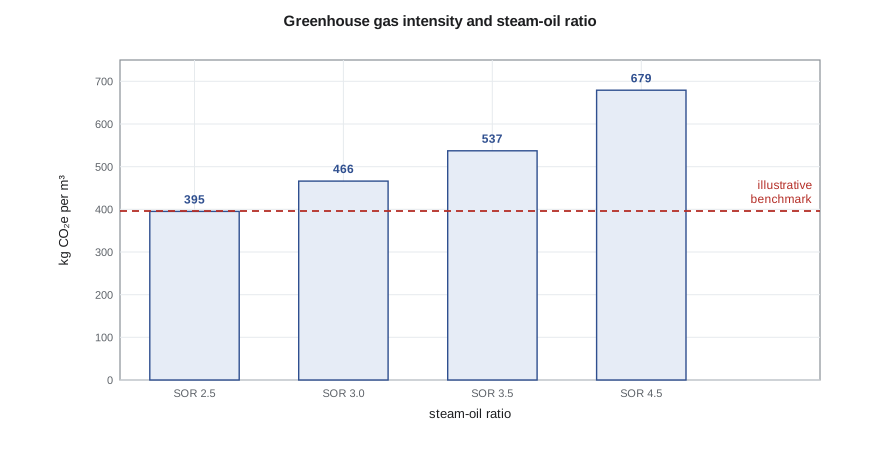
The calculation shows intensity rising from about 63 kg CO₂e per barrel at an SOR of 2.5 to over 100 kg at 4.5. That link explains why so much of the innovation in thermal recovery, from solvent co-injection to better well placement, is measured in SOR. The second result turns intensity into money: a project 15 percent above its benchmark pays carbon costs on every tonne of the excess.
Carbon pricing and climate rules
In Alberta, large industrial emitters are covered by the Technology Innovation and Emissions Reduction Regulation, TIER. Each facility has a benchmark, an emissions intensity per unit of product, and must pay for emissions above it by buying emission performance credits or offsets or by paying into the TIER fund. Facilities that perform better than their benchmark earn credits they can sell. The price was frozen at 95 dollars per tonne in 2025, and under the implementation agreement for the November 2025 Canada-Alberta memorandum of understanding, released in May 2026, it stays at 95 dollars in 2026 and rises to 100 dollars from 2027 and 115 dollars by 2030, with a minimum credit price from 2030.
The largest oil sands producers formed the Pathways Alliance, which has proposed a carbon capture and storage network that would gather CO₂ from many oil sands facilities and store it underground near Cold Lake. The 2025 memorandum of understanding linked support for a new oil pipeline to progress on that project. Federal rules also matter, including methane regulations for the oil and gas sector and a proposed national cap on oil and gas emissions.
Water
Thermal projects use large volumes of water, but most of it is recycled. Alberta's Directive 081 sets limits on the disposal of produced water and the use of fresh make-up water at in situ projects, and operators report recycle rates that are often above 90 percent. Make-up water comes mainly from saline aquifers. Mining projects withdraw water from the Athabasca River under licences with limits that tighten when river flows are low, and recycle much of it from tailings ponds. Groundwater and surface water quality around the oil sands are monitored under the joint Canada-Alberta Oil Sands Monitoring Program.
Land, tailings and reclamation
Mining disturbs large areas, and the ponds of fluid tailings it creates are one of the oil sands' most visible environmental issues. Directive 085 sets requirements for managing fluid tailings volumes, with thresholds for each mine and plans to return tailings to a ready-to-reclaim state. Technologies such as centrifuging, thickening and water capping of end pit lakes are used to treat tailings. In situ projects disturb less land per barrel, mainly for pads, roads, pipelines and plants, but they fragment boreal forest habitat, including that of woodland caribou, so operators reclaim seismic lines and well sites and plan facilities to reduce their footprint. In 2023, the disclosure of seepage of industrial wastewater from tailings at the Kearl mine led to tighter notification requirements.
Air quality and containment
Thermal plants emit nitrogen oxides from steam generators, sulphur compounds from the treatment of gas containing H₂S and volatile organic compounds from storage and processing. Low-NOx burners, selective catalytic reduction, sulphur recovery and vapour recovery are standard controls. Containment, keeping steam and fluids in the target zone, is an environmental requirement as well as an operational one. Steam releases to surface and surface expressions are reportable incidents, and both jurisdictions require cap rock studies, pressure limits and monitoring for steam injection.
Reducing the footprint
The tools for reducing environmental impact are the ones covered in earlier lessons: lower SOR through better reservoir selection and well placement, solvent-assisted processes, cogeneration and efficient boilers, carbon capture, electrification with low-carbon power, high water recycling, compact pads and progressive reclamation. Reporting matters too. Investors, regulators and communities increasingly expect operators to publish emissions intensity, water use and reclamation progress, and to show how their plans meet climate targets.
Worked problem
Carbon cost above a benchmark
A SAGD project produces 4,000 m³/d of bitumen at an intensity of 470 kg CO₂e/m³. Its benchmark is 400 kg/m³ and the TIER price is 95 dollars per tonne. Estimate its annual compliance cost.
Show solution
- Excess intensity = 470 − 400 = 70 kg/m³.
- Excess emissions = 4,000 × 70 × 365 / 1,000 = 102,200 t per year.
- Cost = 102,200 × 95 = 9.7 million dollars per year.
Answer: About 9.7 million dollars a year. Cutting the SOR enough to reach the benchmark would eliminate that cost, and going below it would earn credits.
Measuring and reporting emissions
Emissions must be measured and reported before they can be priced. Large facilities in Alberta quantify their emissions using approved methods, fuel gas metering and composition, flare and vent measurements, electricity use and estimates of fugitive leaks, and submit annual compliance reports that are verified by an independent third party. Facility emissions are also reported to the federal Greenhouse Gas Reporting Program, which publishes data for each large facility. Methane receives particular attention: operators run leak detection and repair surveys with handheld cameras, aircraft or satellites, repair leaks within set times and replace high-bleed pneumatic devices. Alberta's methane rules, under AER Directive 060 among others, set limits on venting and flaring and require these surveys.
Intensity is the measure investors and regulators compare most often. A project's intensity, expressed per cubic metre or per barrel, can be benchmarked against other projects and against its own history, and changes can be traced to causes: a rising SOR, a boiler running below its design efficiency, or a new cogeneration unit that cuts the emissions attributed to the oil. Operators set intensity targets and report progress, and many have adopted company-wide goals for net emissions.
Carbon capture and storage
Carbon capture and storage, CCS, takes CO₂ from a concentrated source, such as the flue gas of steam generators or the off-gas of a hydrogen plant, compresses it and injects it into a deep saline aquifer or depleted reservoir where it stays permanently. Capturing CO₂ from the dilute flue gas of a steam generator is more expensive than from a hydrogen plant, because the gas must first be separated from large volumes of nitrogen, usually with amine solvents. Storage requires a site with enough capacity, a sealing cap rock and monitoring to show that the CO₂ remains in place.
Alberta already operates large CCS projects. The Quest project, at Shell's Scotford upgrader near Edmonton, has captured and stored more than eight million tonnes of CO₂ since it began operating in 2015, and the Alberta Carbon Trunk Line carries CO₂ from industrial sources to storage and enhanced oil recovery in central Alberta. The Pathways proposal would extend capture to many in situ facilities, linking them by pipeline to a storage hub. Under TIER, captured and stored CO₂ reduces a facility's reported emissions, and federal investment tax credits support capital costs.
Communities and consultation
Oil sands projects are developed on the traditional territories of First Nations and Métis communities, whose rights are protected under section 35 of Canada's Constitution. Before a project is approved, the Crown has a duty to consult affected communities, and in Alberta the Aboriginal Consultation Office manages that process for provincial approvals. Many operators have negotiated impact benefit agreements covering jobs, contracts, environmental monitoring and revenue sharing, and some communities have become equity owners in pipelines and infrastructure, supported by the Alberta Indigenous Opportunities Corporation's loan guarantees. Environmental performance, especially on water, wildlife and air quality, is central to these relationships.
Environmental performance is therefore part of every thermal engineer's job. The SOR, the boiler efficiency, the water recycle rate and the integrity of the cap rock are reservoir and facility numbers, but they are also the numbers that decide what a project costs, whether it is approved and how the community it operates in regards it.
Closure and long-term liability
Every well, pad and plant must eventually be decommissioned and its site reclaimed. Alberta's Liability Management Framework, administered by the AER, assesses each licensee's ability to meet its closure obligations, can require security deposits and sets mandatory annual closure spending targets for the industry, so that inactive wells and facilities are retired steadily rather than left for the future. Mines provide financial security under the Mine Financial Security Program, which grows as the disturbed area grows and is reduced as land is certified as reclaimed. Reclamation certificates are issued only when the land supports a self-sustaining ecosystem comparable to what was there before, a process that can take decades for mined land. For an engineer, closure is a design question from the start: wells built to be abandoned safely, compact pads and progressive reclamation reduce the long-term liability and the cost carried on the company's balance sheet.
Common mistakes
MistakeTreating emissions as unrelated to SOR.
InsteadMost thermal emissions come from steam; SOR drives intensity.
MistakeIgnoring benchmarks in carbon cost.
InsteadCompliance cost depends on emissions above the benchmark or free allocation.
MistakeAssuming water recycling removes water issues.
InsteadMake-up, disposal and quality rules still apply.
MistakeLeaving reclamation to the end of the project.
InsteadProgressive reclamation and financial security are required.
Summary and key terms
- Thermal greenhouse gas intensity is driven mainly by steam generation and scales with SOR.
- Alberta's TIER sets facility benchmarks; the price is 95 dollars in 2026 and rises to 115 dollars by 2030.
- Water use is regulated; most thermal projects recycle the bulk of their produced water.
- Tailings and land disturbance are governed by Directive 085 and reclamation requirements.
- Lower SOR, solvents, cogeneration, CCS and recycling are the main ways to reduce impact.
- GHG intensity
- Greenhouse gas emissions per unit of oil produced.
- TIER
- Alberta's Technology Innovation and Emissions Reduction Regulation for large emitters.
- Cap-and-trade
- A program that caps emissions and requires allowances for each tonne emitted.
- Benchmark
- An emissions intensity standard against which a facility is measured.
- Fluid tailings
- The mixture of water, clay and residual bitumen left from oil sands extraction.
- Surface expression
- Fluids reaching the surface from a steamed zone, a reportable incident.
Practice problems
Work each problem on paper first, then reveal the answer to check.
Why does lowering SOR reduce emissions?
Show answer
Less steam needs less gas to be burned.
What does a facility pay for under a benchmark system?
Show answer
Emissions above its benchmark or free allocation.
Name two air pollutants from thermal plants.
Show answer
Nitrogen oxides and sulphur compounds.
Name two ways to reduce thermal emissions other than SOR.
Show answer
Carbon capture and cogeneration.
Lesson quiz · 5 questions
Score 60% or more to complete this lesson.
Create a free account to save your progress, take quizzes and earn a certificate.