
PET-370 · Lesson 11 of 12 · 19 min
Environmental performance and regulation
Every quarter, Prairie Crest's board receives a page on the environmental performance of Tamarisk Hill: greenhouse gas emissions and intensity, water handled and disposed of, methane leaks found and repaired, and any incidents. Mei Lin has asked Ethan to prepare the draft for the next meeting. 'In California, environmental performance decides what we are allowed to drill, what it costs to run and whether investors will fund us,' she says. 'The carbon line is now one of our bigger operating costs, and the permitting rules have changed twice in the last four years.'
This lesson covers the main environmental issues in heavy oil and bitumen production, greenhouse gases, water, land and tailings, air quality and containment, and the rules that govern them. It shows how greenhouse gas intensity follows from the steam-oil ratio, how industrial carbon pricing turns that intensity into a cost and what operators are doing to reduce both.
Greenhouse gas emissions
Most of the greenhouse gas emissions from a thermal project come from burning natural gas to make steam. The emissions per unit of oil therefore scale almost directly with the steam-oil ratio, the efficiency of the steam generators and the carbon content of the fuel. Smaller contributions come from electricity, processing, venting and fugitive methane, and the transport and upgrading of the product. Mining projects emit less per barrel at the extraction stage than in situ projects, because they use hot water rather than steam, but many add emissions from upgrading.
A useful estimate links intensity to SOR. Making one metric ton of steam from feedwater takes about 2.4 GJ; at a boiler efficiency of 85 percent that needs about 2.8 GJ of gas, which emits about 0.14 t of CO₂. Multiplying by the SOR in metric tons of steam per cubic meter of oil and adding other sources gives the intensity.
# Greenhouse gas intensity of a thermal project from its steam-oil ratio
SI = False
def ghg_per_m3(sor, eff=0.85, h_steam=2.4e6, ng_ef=0.0503, other=40.0):
    # sor: m3 CWE steam per m3 oil; h_steam: J per kg of steam made from feedwater; ng_ef: kg CO2 per MJ of gas (about 50 g/MJ)
    steam_kg = sor * 1000.0
    gas_mj = steam_kg * h_steam / eff / 1e6
    return gas_mj * ng_ef + other           # kg CO2e per m3 of oil; 'other' covers power, venting and treating
for sor in (2.5, 3.0, 3.5, 4.5):
    e = ghg_per_m3(sor)
    if SI: print(f"SOR {sor}: about {e:,.0f} kg CO2e per m3 of bitumen ({e / 6.2898:.0f} kg per barrel)")
    else:  print(f"SOR {sor}: about {e / 6.2898:.0f} kg CO2e per barrel of oil")
# carbon cost against a benchmark: pay only on emissions above the facility benchmark
oil_day = 5000.0 if SI else 5000.0 * 6.2898
sor = 3.0
e = ghg_per_m3(sor) if SI else ghg_per_m3(sor) / 6.2898
bench = 0.85 * e                           # illustrative benchmark set at 85 % of this facility's intensity
price = 95.0 if SI else 30.0                # illustrative: CA dollars per t under TIER in 2026; US dollars per t allowance price
excess_t = oil_day * (e - bench) / 1000.0 * 365
print(f"emissions above the benchmark: {excess_t:,.0f} t per year; cost {excess_t * price / 1e6:.1f} million at {price:.0f} per metric ton")SOR 2.5: about 63 kg CO2e per barrel of oil SOR 3.0: about 74 kg CO2e per barrel of oil SOR 3.5: about 85 kg CO2e per barrel of oil SOR 4.5: about 108 kg CO2e per barrel of oil emissions above the benchmark: 127,587 t per year; cost 3.8 million at 30 per metric ton
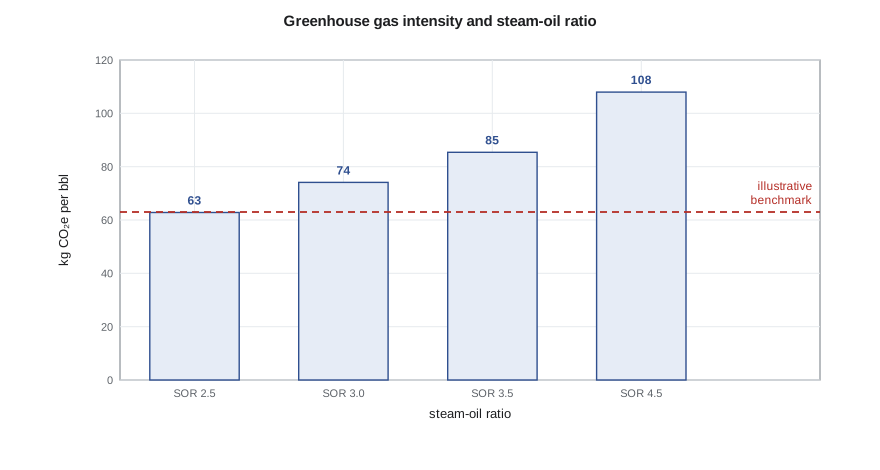
The calculation shows intensity rising from about 63 kg CO₂e per barrel at an SOR of 2.5 to over 100 kg at 4.5. That link explains why so much of the innovation in thermal recovery, from solvent co-injection to better well placement, is measured in SOR. The second result turns intensity into money: a project 15 percent above its benchmark pays carbon costs on every metric ton of the excess.
Carbon pricing and climate rules
In California, large emitters, including oil producers, are covered by the state's cap-and-trade program, run by the California Air Resources Board. The program sets a declining cap on total emissions and issues allowances, part of them allocated free to industry on the basis of product benchmarks and the rest auctioned. A producer must surrender one allowance for each metric ton of emissions, buying any it lacks. The legislature extended the program in 2025, renaming it cap-and-invest. Allowance prices in recent years have been around 30 dollars per metric ton. California's Low Carbon Fuel Standard also counts the carbon intensity of crude used in the state's refineries, giving thermal producers a further incentive to cut emissions, and some have built solar power at their fields to do so.
Methane, a potent greenhouse gas, receives separate attention. CARB's oil and gas methane regulation requires leak detection and repair, vapor collection and controls on venting at production facilities, and federal rules set further requirements, though their timing has been revised. Thermal operators are also examining carbon capture: in California, CalGEM and the U.S. Environmental Protection Agency handle different parts of the permitting of CO₂ storage wells, and several projects have been proposed in Kern County.
Water
Steamfloods produce more water than they need for steam. The surplus is reinjected for disposal or into the producing formation, or in a few places treated and used for crop irrigation, under permits that set water quality requirements and protect groundwater. CalGEM regulates injection wells under the federal underground injection control program, and the regional water boards set requirements for any discharge or reuse. The Central Valley's water scarcity has made produced water reuse more attractive, and also more closely scrutinised.
Land, tailings and reclamation
Steamflood fields occupy compact areas, but they are crowded with wells, pipelines and plants, and their surface footprint is long-lived. Idle and abandoned wells must be plugged and the land restored; California requires operators to provide financial security for this and to manage idle wells under a program that sets plugging targets. Operations near homes, schools and hospitals are restricted by SB 1137, which sets a 3,200 ft health protection zone around sensitive sites and came into force after a 2024 referendum was withdrawn. In 2025, SB 237 created a streamlined path for new well permits in Kern County, issued against the county's environmental review, up to an annual limit.
Air quality and containment
Thermal plants emit nitrogen oxides from steam generators, sulfur compounds from the treatment of gas containing H₂S and volatile organic compounds from storage and processing. Low-NOx burners, selective catalytic reduction, sulfur recovery and vapor recovery are standard controls. Containment, keeping steam and fluids in the target zone, is an environmental requirement as well as an operational one. Steam releases to surface and surface expressions are reportable incidents, and both jurisdictions require cap rock studies, pressure limits and monitoring for steam injection.
Reducing the footprint
The tools for reducing environmental impact are the ones covered in earlier lessons: lower SOR through better reservoir selection and well placement, solvent-assisted processes, cogeneration and efficient boilers, carbon capture, electrification with low-carbon power, high water recycling, compact pads and progressive reclamation. Reporting matters too. Investors, regulators and communities increasingly expect operators to publish emissions intensity, water use and reclamation progress, and to show how their plans meet climate targets.
Worked problem
Carbon cost above a benchmark
A steamflood produces 25,000 bbl/d of oil at an intensity of 90 kg CO₂e/bbl. It receives free allowances equivalent to 75 kg/bbl and the allowance price is 30 dollars per metric ton. Estimate its annual allowance cost.
Show solution
- Uncovered intensity = 90 − 75 = 15 kg/bbl.
- Uncovered emissions = 25,000 × 15 × 365 / 1,000 = 136,900 t per year.
- Cost = 136,900 × 30 = 4.1 million dollars per year.
Answer: About 4.1 million dollars a year. Each 0.1 reduction in SOR cuts intensity by about 2.3 kg/bbl, or about 620,000 dollars a year at this scale.
Measuring and reporting emissions
Emissions must be measured and reported before they can be priced. Large facilities in California report their greenhouse gas emissions annually to the California Air Resources Board under its mandatory reporting regulation, using approved methods based on fuel gas metering and composition, flare and vent measurements and estimates of fugitive leaks, and their reports are verified by accredited third parties. Facilities above federal thresholds also report to the U.S. Environmental Protection Agency's Greenhouse Gas Reporting Program, which publishes data for each large facility. Methane receives particular attention: operators run leak detection and repair surveys with handheld cameras, aircraft or satellites and repair leaks within set times.
Intensity is the measure investors and regulators compare most often. A project's intensity, expressed per cubic meter or per barrel, can be benchmarked against other projects and against its own history, and changes can be traced to causes: a rising SOR, a boiler running below its design efficiency, or a new cogeneration unit that cuts the emissions attributed to the oil. Operators set intensity targets and report progress, and many have adopted company-wide goals for net emissions.
Carbon capture and storage
Carbon capture and storage, CCS, takes CO₂ from a concentrated source, such as the flue gas of steam generators or the off-gas of a hydrogen plant, compresses it and injects it into a deep saline aquifer or depleted reservoir where it stays permanently. Capturing CO₂ from the dilute flue gas of a steam generator is more expensive than from a hydrogen plant, because the gas must first be separated from large volumes of nitrogen, usually with amine solvents. Storage requires a site with enough capacity, a sealing cap rock and monitoring to show that the CO₂ remains in place.
Carbon capture projects for oil field steam generators and power plants in Kern County have been proposed in recent years, taking advantage of the deep sandstones of the San Joaquin Basin for storage. Storage wells need a federal Class VI permit, and California has added state requirements, including a ban on using captured CO₂ for enhanced oil recovery. Federal tax credits under section 45Q of the tax code pay a set amount per metric ton stored, which, together with cap-and-trade and LCFS credits, shapes the economics of these projects.
Communities and consultation
Kern County's oil fields sit close to farms, small towns and growing suburbs, and communities have long raised concerns about air quality, water and health. State rules such as the SB 1137 setbacks reflect those concerns, and community air monitoring has expanded in recent years under California's AB 617 program for communities with high pollution burdens. Operators engage with local residents, publish monitoring data and coordinate on emergency response, because public trust affects permitting and the long-term future of the fields.
Environmental performance is therefore part of every thermal engineer's job. The SOR, the boiler efficiency, the water recycle rate and the integrity of the cap rock are reservoir and facility numbers, but they are also the numbers that decide what a project costs, whether it is approved and how the community it operates in regards it.
Closure and long-term liability
Every well, pipeline and plant must eventually be decommissioned and its site restored. California requires operators to post financial security for plugging and abandonment, scaled to the number of wells they hold, and requires idle wells to be tested, managed and plugged under a schedule. Laws passed in recent years have also made earlier owners liable in some circumstances for plugging wells that a later operator cannot pay for. The state maintains a program to plug orphan wells, supported by federal funding from the 2021 infrastructure law. For an engineer, closure is a design question from the start: wells built to be abandoned safely, consolidated facilities and steady retirement of idle wells reduce the long-term liability and the cost carried on the company's balance sheet. In a field as old and dense as Tamarisk Hill, with wells dating back many decades, that work is a large and permanent part of the operating plan.
Common mistakes
MistakeTreating emissions as unrelated to SOR.
InsteadMost thermal emissions come from steam; SOR drives intensity.
MistakeIgnoring benchmarks in carbon cost.
InsteadCompliance cost depends on emissions above the benchmark or free allocation.
MistakeAssuming water recycling removes water issues.
InsteadMake-up, disposal and quality rules still apply.
MistakeLeaving reclamation to the end of the project.
InsteadProgressive reclamation and financial security are required.
Summary and key terms
- Thermal greenhouse gas intensity is driven mainly by steam generation and scales with SOR.
- California's cap-and-trade, renamed cap-and-invest, requires allowances for emissions; the LCFS adds incentives.
- Water use is regulated; most thermal projects recycle the bulk of their produced water.
- Setbacks, idle well rules and permitting laws shape where and how wells are drilled.
- Lower SOR, solvents, cogeneration, CCS and recycling are the main ways to reduce impact.
- GHG intensity
- Greenhouse gas emissions per unit of oil produced.
- TIER
- Alberta's Technology Innovation and Emissions Reduction Regulation for large emitters.
- Cap-and-trade
- A program that caps emissions and requires allowances for each metric ton emitted.
- Benchmark
- An emissions intensity standard against which a facility is measured.
- Fluid tailings
- The mixture of water, clay and residual bitumen left from oil sands extraction.
- Surface expression
- Fluids reaching the surface from a steamed zone, a reportable incident.
Practice problems
Work each problem on paper first, then reveal the answer to check.
Why does lowering SOR reduce emissions?
Show answer
Less steam needs less gas to be burned.
What does a facility pay for under a benchmark system?
Show answer
Emissions above its benchmark or free allocation.
Name two air pollutants from thermal plants.
Show answer
Nitrogen oxides and sulfur compounds.
Name two ways to reduce thermal emissions other than SOR.
Show answer
Carbon capture and cogeneration.
Lesson quiz · 5 questions
Score 60% or more to complete this lesson.
Create a free account to save your progress, take quizzes and earn a certificate.