
PET-240 · Lesson 7 of 12 · 25 min
Combined loading
Real members rarely carry just one kind of internal action. A column supporting a beam on a bracket carries axial load and bending. A sign post in the wind carries bending, shear and torsion all at once. A retaining wall carries its own weight plus the bending caused by soil pressure. A crane hook, a pre-stressed concrete girder and a footing under an off-centre column all combine axial force with bending moment. This lesson shows how to put the results of the previous lessons together to find the stress at any point in such members.
The principle of superposition
The tool that makes combined loading manageable is superposition: the stress caused by several loads acting together equals the sum of the stresses caused by each load acting alone. Superposition is valid when two conditions hold.
- The material is linear elastic, so stress is proportional to strain.
- Deformations are small, so the geometry, and therefore the internal forces, are not changed appreciably by the loads.
The second condition fails for slender columns, where a small lateral deflection multiplies the bending effect of an axial load. That is the subject of lesson 12. For stocky members and ordinary beams, superposition is accurate and is used throughout structural design.
The procedure is always the same. Find the internal actions at the section of interest (normal force, shear forces, bending moments and torque). Compute the stress each produces at the point of interest, using the formulas from lessons 1 to 6. Add stresses of the same kind acting on the same plane: normal stresses with normal stresses, shear stresses with shear stresses. The result is the state of stress at the point, which lesson 8 then examines on other planes.
Axial force plus bending
An axial force \(P\) and a bending moment \(M\) both produce normal stresses on the cross-section, so they add directly:
With tension positive and \(y\) measured upward from the centroid, a positive moment adds compression at the top and tension at the bottom. The combined distribution is still linear, but the neutral axis, where \(\sigma = 0\), moves away from the centroid. With enough axial compression, the whole section may stay in compression; with enough moment, part of it goes into tension.
This matters a great deal for materials that are weak in tension. Unreinforced masonry walls, stone arches, mass concrete dams and the soil under footings cannot sustain tension, so a designer must keep the resultant force within limits that keep the whole section in compression. Prestressed concrete is designed the other way round: a large compressive force is deliberately applied below the centroid, so that the bending under service loads only reduces, and never reverses, the compression in the bottom of the girder.
Eccentric axial loads
A common source of combined stress is an axial load that does not act through the centroid. A load \(P\) at an eccentricity \(e\) from the centroid is statically equivalent to the same load at the centroid plus a moment \(M = P\,e\). The stress at a fibre a distance \(y\) from the centroid, on the same side as the load, is then
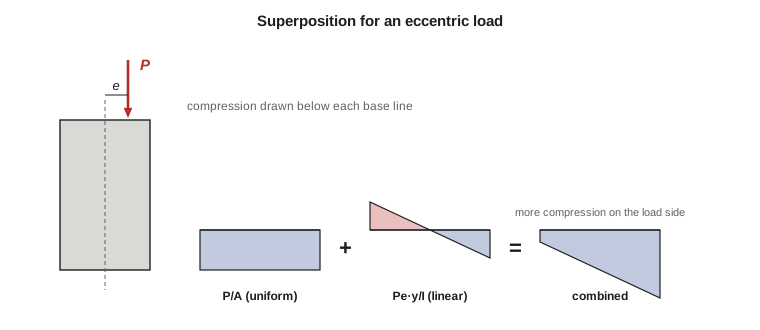
Worked problem
A short post with an eccentric load
A short rectangular concrete pier 300 mm × 500 mm carries a compressive load of 600 kN applied 60 mm from the centroid along the 500 mm direction. Find the maximum and minimum normal stresses.
Show solution
- \(A = 150\,000\ \text{mm}^2\); \(I = 300(500)^3/12 = 3.125 \times 10^9\ \text{mm}^4\); \(c = 250\ \text{mm}\).
- \[\frac{P}{A} = \frac{600\,000}{150\,000} = 4.0\ \text{MPa}\]
- \[\frac{M\,c}{I} = \frac{600\,000 \times 60 \times 250}{3.125 \times 10^9} = 2.88\ \text{MPa}\]
- Load side: \(\sigma = -4.0 - 2.88 = -6.88\ \text{MPa}\). Far side: \(\sigma = -4.0 + 2.88 = -1.12\ \text{MPa}\).
Answer: The stress varies from 6.88 MPa compression on the side nearer the load to 1.12 MPa compression on the far side. The whole section stays in compression.
The kern and the middle-third rule
How far can the load move before tension appears? Setting the stress on the far side to zero gives the limiting eccentricity \(e = I/(A\,c)\). For a rectangle of depth \(h\), that is
So a compressive load on a rectangular section causes no tension anywhere if it stays within the middle third of the depth. In two directions, the zone within which the load can act without causing tension is a diamond-shaped region called the kern (or core) of the section. For a solid circle, the kern is a circle of radius \(d/8\).
The middle-third rule is old but still central to the design of footings, gravity retaining walls, masonry piers and arches. For a spread footing, the soil pressure distribution under an eccentric column load follows the same linear formula, and if the resultant falls outside the middle third, part of the footing lifts off the soil. The pressure distribution then becomes triangular over a reduced contact length, and the peak pressure rises sharply.

Worked problem
Soil pressure under a footing
A square footing 2.4 m × 2.4 m carries a total vertical load (column load plus footing and soil weight) of 900 kN and a moment of 270 kN·m about one axis. Find the soil pressure at the two edges and check whether the resultant is inside the middle third.
Show solution
- Eccentricity: \(e = M/P = 270/900 = 0.30\ \text{m}\). The middle-third limit is \(L/6 = 2.4/6 = 0.40\ \text{m}\), so the resultant is inside the kern.
- \[\frac{P}{A} = \frac{900}{5.76} = 156.3\ \text{kPa}\]
- \[\frac{M}{S} = \frac{270}{2.4 \times 2.4^2/6} = \frac{270}{2.304} = 117.2\ \text{kPa}\]
- Edge pressures: \(156.3 + 117.2 = 273.5\ \text{kPa}\) and \(156.3 - 117.2 = 39.1\ \text{kPa}\).
Answer: The pressure ranges from 274 kPa to 39 kPa, all compression, so the whole footing bears on the soil. The peak is compared with the factored bearing resistance given in the geotechnical report.
Biaxial bending
When a member bends about both principal axes at once, as a corner column or a purlin on a sloping roof does, the two bending stresses add to the axial stress:
For a rectangular section the maximum stress occurs at a corner, where both bending terms have their largest magnitude with the same sign. The signs depend on the directions of the moments; drawing a sketch of which corner is pushed hardest is the most reliable check.
Bending, shear and torsion together
Some members carry shear stress from torsion or transverse shear at the same time as normal stress from bending and axial force. A circular sign post or a light standard in the wind is the classic example. The wind on the sign, which is offset from the post, produces a horizontal force (shear), a bending moment that grows toward the base, and a torque about the post's axis.
At the base of such a post, the critical point is usually on the surface where the bending stress is greatest. There the normal stress is \(\sigma = Mc/I\) (plus any axial stress from self-weight), and the shear stress from torsion is \(\tau = Tc/J\). The transverse shear stress \(VQ/(It)\) is zero at that point, because it is an extreme fibre for bending, but it is greatest at the points on the neutral axis, where it adds to the torsional shear. Both locations must be checked. The combination of a normal stress and a shear stress at the same point is not added into one number; it is a state of plane stress, and lesson 8 shows how to find the principal stresses and maximum shear it produces.
Worked problem
A sign post in the wind
A steel pipe post, 4.0 m tall, outside diameter 168 mm and wall thickness 7.1 mm, supports a sign whose centre is 4.0 m above the base and 0.9 m to one side of the post's axis. The wind force on the sign is 3.0 kN. Find the bending stress and the torsional shear stress at the base.
Show solution
- Section: \(c_o = 84\ \text{mm}\), \(c_i = 76.9\ \text{mm}\). \(I = \pi(84^4 - 76.9^4)/4 = 11.64 \times 10^6\ \text{mm}^4\), and \(J = 2I = 23.27 \times 10^6\ \text{mm}^4\).
- Internal actions at the base: \(M = 3.0 \times 4.0 = 12.0\ \text{kN·m}\), \(T = 3.0 \times 0.9 = 2.7\ \text{kN·m}\), \(V = 3.0\ \text{kN}\).
- \[\sigma = \frac{M\,c}{I} = \frac{12 \times 10^6 \times 84}{11.64 \times 10^6} = 86.6\ \text{MPa}\]
- \[\tau = \frac{T\,c}{J} = \frac{2.7 \times 10^6 \times 84}{23.27 \times 10^6} = 9.7\ \text{MPa}\]
- Transverse shear is small: for a thin tube \(\tau_{\max} \approx 2V/A\), with \(A = 3\,589\ \text{mm}^2\), giving 1.7 MPa at the neutral axis.
Answer: At the most stressed point the post carries 86.6 MPa of bending stress with 9.7 MPa of torsional shear. Lesson 8 combines these into principal stresses.
Stresses at the corners by code
For a rectangular section under axial load and biaxial bending, the four corner stresses tell you the extremes. The program below computes them for several load cases and reports whether any corner goes into tension, which is the check needed for a masonry pier or a footing.
# Corner stresses in a rectangular section under P, Mx, My (N, mm); compression negative
b, h = 400.0, 600.0                  # width (z-direction) and depth (y-direction)
A = b * h
Iz = b * h**3 / 12                   # bending about z uses y = +-h/2
Iy = h * b**3 / 12                   # bending about y uses z = +-b/2

def corners(P, Mz, My):
    out = {}
    for y in (h / 2, -h / 2):
        for z in (b / 2, -b / 2):
            out[(int(y), int(z))] = P / A - Mz * y / Iz + My * z / Iy
    return out

cases = {"axial only": (-1500e3, 0, 0),
         "plus Mz = 100 kN*m": (-1500e3, 100e6, 0),
         "plus My = 60 kN*m": (-1500e3, 100e6, 60e6),
         "large moments": (-1500e3, 160e6, 80e6)}
for name, (P, Mz, My) in cases.items():
    s = corners(P, Mz, My)
    vals = ", ".join(f"{v:6.2f}" for v in s.values())
    flag = "TENSION at a corner" if max(s.values()) > 0 else "all compression"
print(f"{name:22s}: {vals} MPa -> {flag}")axial only : -6.25, -6.25, -6.25, -6.25 MPa -> all compression plus Mz = 100 kN*m : -10.42, -10.42, -2.08, -2.08 MPa -> all compression plus My = 60 kN*m : -6.67, -14.17, 1.67, -5.83 MPa -> TENSION at a corner large moments : -7.92, -17.92, 5.42, -4.58 MPa -> TENSION at a corner
The moment about one axis alone leaves the section in compression, but adding a moderate moment about the other axis puts a corner into tension. A quick check that matches the code is the biaxial kern condition for a rectangle: no tension occurs if \(e_y/h + e_z/b \le 1/6\), where \(e_y = M_z/P\) and \(e_z = M_y/P\). For the second case, \(0.0667/0.6 = 0.111 \le 0.167\), so no tension. For the third case, \(0.0667/0.6 + 0.040/0.4 = 0.211 > 0.167\), which confirms the tension the code found.
Common mistakes
MistakeAdding a normal stress and a shear stress at the same point into one number.
InsteadThey act differently. Combine normal stresses with normal stresses and shear with shear, then use lesson 8 to find principal stresses.
MistakeUsing superposition for a slender column with a large axial load.
InsteadLateral deflection amplifies the moment in slender columns; use the methods of lesson 12.
MistakeAssuming the maximum transverse shear stress occurs at the same point as the maximum bending stress.
InsteadTransverse shear is zero at the extreme fibres and largest at the neutral axis. Check both locations.
MistakeUsing the linear soil pressure formula when the resultant is outside the middle third.
InsteadSoil cannot carry tension. Outside the kern, the contact length shrinks and the pressure distribution becomes triangular with a higher peak.
Summary and key terms
- Superposition adds the stresses from each load, provided the material is linear elastic and deformations are small.
- Axial force and bending combine as \(\sigma = P/A - My/I\); the neutral axis shifts away from the centroid.
- An eccentric load \(P\) at eccentricity \(e\) equals \(P\) at the centroid plus a moment \(Pe\).
- A rectangle has no tension if a compressive load stays within the middle third; the kern generalizes this to two directions.
- In biaxial bending of a rectangle the extreme stresses occur at the corners.
- Members with bending and torsion have both normal and shear stress at a point; combine them with lesson 8.
- Superposition
- Adding the effects of several loads computed one at a time.
- Eccentricity
- The distance from the centroid to the line of action of an axial load.
- Kern
- The region of a cross-section within which a compressive load causes no tension anywhere.
- Middle-third rule
- A load within the middle third of a rectangular section causes no tension.
- Biaxial bending
- Bending about both principal axes at once.
- Prestressing
- Deliberately applying compression to a member so service loads do not cause tension.
- Plane stress
- A state in which the stresses act in one plane, typically a normal stress and a shear stress at a surface point.
Practice problems
Work each problem on paper first, then reveal the answer to check.
A 200 × 200 mm post carries 400 kN at an eccentricity of 25 mm. Find the extreme stresses.
Show answer
\(P/A = 10\ \text{MPa}\); \(M/S = 400\,000 \times 25/(1.333 \times 10^6) = 7.5\ \text{MPa}\). Stresses: 17.5 and 2.5 MPa compression.
What is the largest eccentricity for no tension on a 600 mm deep rectangular section?
Show answer
\(h/6 = 100\ \text{mm}\).
What is the kern radius of a solid circular pier 1.2 m in diameter?
Show answer
\(d/8 = 0.15\ \text{m}\).
A footing 3 m long carries 1,200 kN with \(e = 0.6\ \text{m}\). Is the resultant within the middle third?
Show answer
No: \(L/6 = 0.5\ \text{m} < 0.6\ \text{m}\), so part of the footing lifts off and the pressure is triangular.
At the base of a sign post, where is the transverse shear stress greatest?
Show answer
At the points on the neutral axis of bending, where the bending stress is zero.
Why is superposition not valid for a slender column?
Show answer
Its lateral deflection changes the moment produced by the axial load, so the response is not linear.
Lesson quiz · 5 questions
Score 60% or more to complete this lesson.
Create a free account to save your progress, take quizzes and earn a certificate.