
PET-240 · Lesson 12 of 12 · 23 min
Columns and buckling
Every member so far has failed, if it failed at all, because a stress reached the strength of the material. Slender members in compression can fail in a different way: they suddenly bow sideways and lose their ability to carry load, at a stress that may be well below the yield strength. This is buckling, a failure of stability rather than strength. Columns, truss compression chords, bracing members, the compression flanges of beams and thin plates are all vulnerable. Buckling failures tend to be sudden and can trigger progressive collapse, which is why understanding them is part of every structural engineer's training.
Stability and the critical load
A ball resting at the bottom of a bowl is in stable equilibrium: nudge it and it rolls back. On top of an upturned bowl it is unstable: the slightest nudge sends it away. On a flat table it is neutral. A straight column under axial compression behaves in the same way. At small loads, if something pushes it slightly sideways, the internal bending stiffness pulls it back straight. As the load increases, the destabilizing effect of the axial force acting on the bent shape grows, until at a particular load, the critical load \(P_{cr}\), the column can stay in equilibrium in a slightly bent shape. Beyond that load, the straight shape is unstable and any small disturbance causes large lateral deflection.
Euler's formula for a pin-ended column
Consider an ideal column: perfectly straight, of linear elastic material, pinned at both ends and loaded exactly through its centroid. Suppose it has bowed slightly, with lateral deflection \(v(x)\). At a section \(x\), the axial load \(P\) acting with lever arm \(v\) produces a bending moment \(M = -P\,v\). Substituting into the elastic curve equation of lesson 10:
The general solution is \(v = A\sin kx + B\cos kx\). The condition \(v(0) = 0\) gives \(B = 0\). The condition \(v(L) = 0\) requires \(A\sin kL = 0\). Either \(A = 0\), which is the straight column, or \(\sin kL = 0\), which means \(kL = n\pi\). The smallest nonzero load that allows a bent shape is \(n = 1\):
This is Euler's buckling load, published by Leonhard Euler in 1744. The buckled shape is a half sine wave. Several features stand out. The critical load depends on the stiffness \(E\) and the second moment of area \(I\), not on the strength of the material. It falls with the square of the length, so doubling the length cuts it to a quarter. And because \(I\) differs about the two principal axes, a column buckles about the axis with the smaller \(I\), the weak axis, unless it is braced in that direction.
Effective length
End conditions change the buckled shape and so the critical load. They are handled with an effective length \(KL\), the length of the equivalent pin-ended column whose half sine wave matches the buckled shape between its points of inflection:
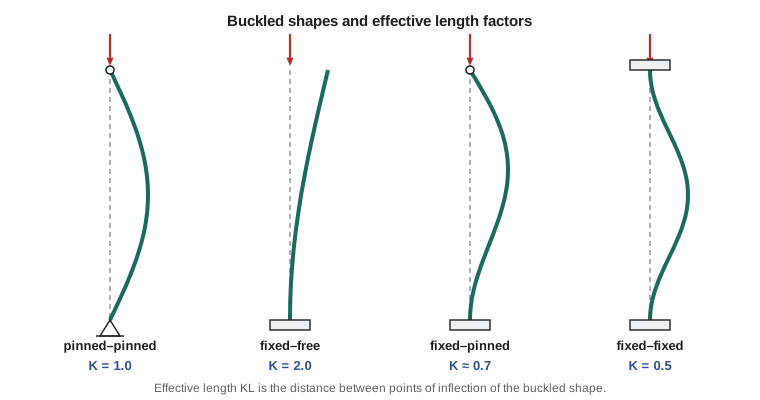
| End conditions | Theoretical K | Typical design value | Buckling load relative to pinned–pinned |
|---|---|---|---|
| Pinned–pinned | 1.0 | 1.0 | 1 |
| Fixed–free (flagpole) | 2.0 | 2.1 | 1/4 |
| Fixed–pinned | 0.7 | 0.8 | about 2 |
| Fixed–fixed | 0.5 | 0.65 | 4 |
Design standards recommend effective length factors somewhat larger than the theoretical values for fixed ends, because a truly rigid connection does not exist: every connection and foundation rotates a little. For columns in building frames, the effective length depends on the stiffness of the beams framing into the columns and on whether the frame is braced against sway. Structural steel design courses teach the alignment charts and other methods used to find it.
Slenderness ratio and critical stress
Dividing the critical load by the area gives the critical stress. Writing \(I = A r^2\), where \(r = \sqrt{I/A}\) is the radius of gyration:
The dimensionless ratio \(KL/r\) is the slenderness ratio, the single most important parameter in column behaviour. The radius of gyration measures how far the area is spread from the axis, so efficient columns, like tubes and wide-flange shapes with wide flanges, have large \(r\) for their area. Codes cap the slenderness of compression members, commonly at about 200, because very slender members are easily damaged and vibrate.
Euler's formula is valid only while the critical stress stays below the proportional limit. For structural steel with \(E = 200\ \text{GPa}\) and a yield strength of 350 MPa, setting \(\sigma_{cr} = 350\) gives \(KL/r = \pi\sqrt{200\,000/350} = 75\). Columns more slender than that buckle elastically; stockier columns would reach yield first by Euler's formula, but in reality they fail at a stress below both curves because of the effects described next.
Worked problem
Euler load of a steel pipe column
A steel pipe column (outside diameter 114.3 mm, wall 6.0 mm, \(E = 200\ \text{GPa}\), \(\sigma_y = 350\ \text{MPa}\)) is 4.0 m long and pinned at both ends. Find the slenderness ratio, the Euler load and the Euler stress, and check whether elastic buckling governs.
Show solution
- \(A = \pi(57.15^2 - 51.15^2) = 2\,041\ \text{mm}^2\); \(I = \pi(57.15^4 - 51.15^4)/4 = 3.00 \times 10^6\ \text{mm}^4\); \(r = \sqrt{I/A} = 38.3\ \text{mm}\).
- Slenderness \(KL/r = 4000/38.3 = 104\).
- \[P_{cr} = \frac{\pi^2 (200\,000)(3.00 \times 10^6)}{4000^2} = 370\ \text{kN}\]
- \[\sigma_{cr} = \frac{370\,000}{2041} = 181\ \text{MPa}\]
Answer: The Euler load is about 370 kN, a stress of 181 MPa, roughly half the yield strength. With \(KL/r = 104 > 75\), the column is in the elastic range, so buckling, not yielding, governs.
Worked problem
Which axis governs?
A steel wide-flange column has \(A = 9\,100\ \text{mm}^2\), \(r_x = 112\ \text{mm}\) and \(r_y = 51\ \text{mm}\). It is 7.5 m tall, pinned at top and bottom, and braced at mid-height against movement in the weak (\(y\)) direction only. Find the governing slenderness ratio and the Euler stress.
Show solution
- Strong axis: unbraced length 7.5 m, \(KL/r_x = 7500/112 = 67\).
- Weak axis: the brace halves the length, \(KL/r_y = 3750/51 = 74\).
- Governing slenderness is the larger: 74, about the weak axis.
- \[\sigma_{cr} = \frac{\pi^2 (200\,000)}{74^2} = 360\ \text{MPa}\]
Answer: The weak axis still governs, though only just; mid-height bracing has nearly balanced the two axes, which is the efficient design. The Euler stress of 360 MPa is near the yield strength, so in practice inelastic buckling and imperfections will control, as discussed next.
Real columns: imperfections, residual stress and inelastic buckling
Real columns differ from Euler's ideal in three important ways. They are never perfectly straight; steel standards permit an out-of-straightness of about 1/1000 of the length. Loads are never perfectly centred. And hot-rolled and welded steel sections contain residual stresses locked in by uneven cooling, which cause parts of the section to yield early. Each of these lowers the load a column can carry, most strongly for columns of intermediate slenderness, where Euler's curve and the yield stress meet.
An initially crooked column does not stay straight until \(P_{cr}\) and then snap sideways. It bends from the start, and the bending grows faster and faster as the load approaches \(P_{cr}\), roughly in proportion to \(1/(1 - P/P_{cr})\). The extra moment from the axial load acting on this growing deflection, called the P-delta effect, eventually causes the most stressed fibres to yield, and the column fails. The secant formula describes this for an eccentrically loaded elastic column, and it shows why superposition fails for slender columns, as lesson 7 warned.
For stocky and intermediate columns, the material yields before elastic buckling can occur. The tangent modulus theory replaces \(E\) in Euler's formula with the slope of the stress–strain curve at the current stress, which drops as yielding spreads. Historically, engineers fitted simple curves to test results, such as the Johnson parabola. Modern codes use column curves calibrated to tests and to computer simulations that include imperfections and residual stresses.
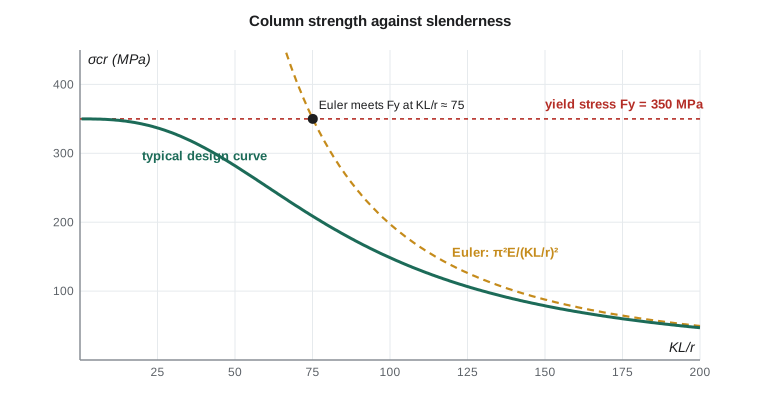
In CSA S16, the compressive resistance of a steel column has the form \(C_r = \phi\,A\,F_y\,(1 + \lambda^{2n})^{-1/n}\), where \(\lambda = (KL/r)\sqrt{F_y/(\pi^2E)}\) is a nondimensional slenderness, \(\phi = 0.9\), and \(n = 1.34\) for most hot-rolled and fabricated sections (with a higher value for some sections with low residual stress). At \(\lambda = 1\), where the Euler stress equals the yield stress, the curve gives only about 60 % of the squash load \(AF_y\). The details belong to steel design; the point here is that the mechanics of buckling is the foundation of the code curve.
Other forms of buckling
Column buckling is only one member of a large family. Thin plates, such as the webs and flanges of steel sections, can buckle locally in ripples before the member as a whole buckles; codes control this with width-to-thickness limits that classify sections as compact, noncompact or slender. Beams that are not braced laterally can fail by lateral–torsional buckling, in which the compression flange buckles sideways and the section twists. Open thin-walled columns, such as angles and channels, may buckle torsionally or in a combined flexural–torsional mode. Whole frames can sway sideways if their lateral stiffness is inadequate. Each of these is covered in steel design and stability courses, but they all share the idea introduced here: an axial compression that destabilizes a member once its stiffness can no longer hold it straight.
Comparing column curves by code
The program below tabulates the critical stress against slenderness for steel with a yield strength of 350 MPa, comparing the Euler formula, the simple yield cut-off, and the CSA S16 and AISC 360 curves written above. It shows how much the design curves fall below the ideal at intermediate slenderness, and how they approach the Euler curve for slender columns.
# Column curves: Euler, yield cut-off, CSA S16 (n = 1.34) and AISC 360 forms (stress in MPa)
import math

E, Fy = 200000.0, 350.0

def euler(kl_r):
    return math.pi**2 * E / kl_r**2

def csa(kl_r, n=1.34):
    lam = kl_r * math.sqrt(Fy / (math.pi**2 * E))
    return Fy * (1 + lam**(2 * n)) ** (-1 / n)

def aisc(kl_r):
    Fe = euler(kl_r)
    if kl_r <= 4.71 * math.sqrt(E / Fy):
        return 0.658 ** (Fy / Fe) * Fy
    return 0.877 * Fe

print(" KL/r   Euler  min(Euler,Fy)   CSA form   AISC form")
for kl_r in [20, 40, 60, 75, 100, 125, 150, 200]:
    e = euler(kl_r)
    print(f"{kl_r:5d} {e:7.0f} {min(e, Fy):12.0f} {csa(kl_r):10.0f} {aisc(kl_r):11.0f}")
print(f"Slenderness where Euler stress equals Fy: {math.pi * math.sqrt(E / Fy):.1f}")KL/r Euler min(Euler,Fy) CSA form AISC form 20 4935 350 343 340 40 1234 350 308 311 60 548 350 253 268 75 351 350 209 231 100 197 197 149 167 125 126 126 107 111 150 88 88 79 77 200 49 49 47 43 Slenderness where Euler stress equals Fy: 75.1
At a slenderness of 75, where Euler's curve meets the yield stress, both design forms give only about 60 to 66 % of the yield stress. For very stocky columns all the curves approach the yield stress, and for very slender ones the design curves approach the Euler hyperbola, slightly below it. The two codes differ in detail but tell the same story, because both are calibrated to the same physics.
Common mistakes
MistakeUsing the strong-axis radius of gyration for a column that is free to buckle about its weak axis.
InsteadCheck slenderness about both axes with their own unbraced lengths, and use the larger \(KL/r\).
MistakeApplying Euler's formula to a stocky column.
InsteadEuler's formula is valid only in the elastic range. For intermediate and short columns, use an inelastic or code column curve.
MistakeAssuming a higher-strength steel greatly increases the capacity of a slender column.
InsteadElastic buckling depends on \(E\), which is the same for all steels. Strength matters only for stocky and intermediate columns.
MistakeUsing theoretical K values for fixed ends in design.
InsteadReal connections rotate; use the larger recommended design values or a frame stability analysis.
Summary and key terms
- Buckling is a loss of stability that can occur at stresses well below the yield strength.
- Euler's critical load for a pin-ended column is \(P_{cr} = \pi^2EI/L^2\); other end conditions use an effective length \(KL\).
- The slenderness ratio \(KL/r\) governs column behaviour; columns buckle about the axis with the larger \(KL/r\).
- Euler's formula applies only in the elastic range; for steel with \(F_y = 350\ \text{MPa}\), roughly \(KL/r > 75\).
- Imperfections, eccentricity and residual stresses reduce real column strength, especially at intermediate slenderness.
- Design codes use calibrated column curves that blend from the yield stress to a reduced Euler curve.
- Buckling
- Sudden lateral deflection of a compression member when it becomes unstable.
- Critical load
- The axial load at which a straight column can be in equilibrium in a bent shape.
- Effective length
- The length of the equivalent pin-ended column, KL, between points of inflection of the buckled shape.
- Radius of gyration
- The square root of I divided by A, a measure of how far the area is spread from the axis.
- Slenderness ratio
- The effective length divided by the radius of gyration.
- Residual stress
- Stress locked into a member by manufacturing processes such as uneven cooling.
- P-delta effect
- Additional bending caused by axial load acting on a member’s lateral deflection.
- Local buckling
- Buckling of a thin plate element of a section, such as a flange or web.
Practice problems
Work each problem on paper first, then reveal the answer to check.
A pin-ended column has \(P_{cr} = 400\ \text{kN}\). What is \(P_{cr}\) if its length is doubled?
Show answer
100 kN, a quarter of the original.
What is the effective length factor of an ideal flagpole (fixed base, free top)?
Show answer
2.0, so its buckling load is one quarter of a pinned column of the same length.
Find \(r\) for a solid circular bar of diameter 50 mm.
Show answer
\(r = d/4 = 12.5\ \text{mm}\).
A steel strut has \(KL/r = 150\). Find its Euler stress.
Show answer
\(\pi^2(200\,000)/150^2 = 87.7\ \text{MPa}\).
Why does bracing a column at mid-height about its weak axis often increase its capacity substantially?
Show answer
It halves the weak-axis effective length, quadrupling the weak-axis Euler load, so the column may then be governed by the stronger axis.
Why does a stockier column of higher-strength steel gain more from the higher yield strength than a slender one?
Show answer
Stocky columns fail near the yield stress, while slender ones fail by elastic buckling, which depends on \(E\), not strength.
Lesson quiz · 5 questions
Score 60% or more to complete this lesson.
Create a free account to save your progress, take quizzes and earn a certificate.