
PET-200 · Lesson 9 of 12 · 19 min
Surface facilities, pipelines and midstream
What comes out of a Tamarack Lake field well is not saleable oil. It is a hot, frothy mixture of oil, gas, salty water and a little sand, at a pressure of several hundred kilopascals. Before it can be sold, the gas must be separated and processed, the water removed and disposed of, the oil treated until it meets pipeline specifications and every stream measured accurately, because royalties, taxes and partners' shares depend on the numbers. Sofia spends as much time on the surface equipment as on the wells. This lesson follows the fluids from the wellhead to the sales point.
The battery: separating oil, gas and water
Production from several wells flows through gathering lines to a battery, the facility where it is separated, treated, measured and stored. In Alberta, the term battery covers everything from a single-well site with a tank to a large central facility serving dozens of wells. Each well's production is periodically routed through a test separator so that it can be measured on its own, and the totals are prorated back to the wells.
The first piece of equipment is the separator, a horizontal or vertical steel vessel in which the mixture slows down so that gas can rise out of the liquid and water can settle below the oil. A two-phase separator splits gas from liquid; a three-phase separator also draws off free water. The vessel is sized to hold the liquid long enough for the phases to separate, typically a few minutes, and to keep the gas velocity low enough that liquid droplets fall out of it. A mist extractor near the gas outlet catches fine droplets. Separators often operate in stages at decreasing pressure, which keeps more of the lighter hydrocarbons in the oil and increases the volume of stock-tank oil.
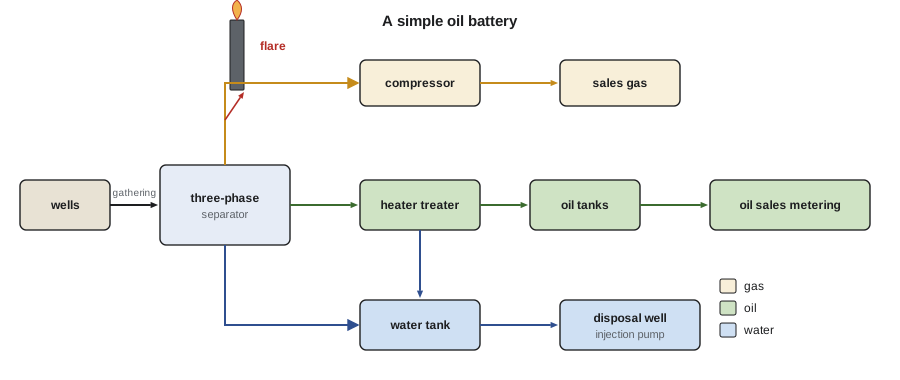
Oil and water often leave the separator as an emulsion, tiny water droplets suspended in oil, stabilized by natural surfactants. A heater treater warms the emulsion, which lowers the oil's viscosity and helps droplets merge, and gives it time to settle; chemical demulsifiers help further. The goal is pipeline-quality oil, usually with less than 0.5 percent water and sediment. Treated oil goes to stock tanks, where vapour recovery units capture the gas that flashes off as the oil reaches atmospheric pressure. Oil is then pumped into a pipeline through a custody-transfer meter or loaded onto trucks.
Gas handling and processing
Gas from the separators is compressed and sent through gathering pipelines to a gas processing plant. Raw gas contains water vapour, which can form hydrates and corrode pipelines, so it is dehydrated, often by contact with glycol. Sour gas contains hydrogen sulphide, which is removed with amine solutions and converted to elemental sulphur. Carbon dioxide may also be removed. Heavier hydrocarbons such as ethane, propane, butane and pentanes plus are extracted, because they are worth more as natural gas liquids than as fuel and because they must be removed for the gas to meet pipeline specifications for heating value and dew point. The remaining dry gas, mostly methane, goes into transmission pipelines.
Solution gas from oil wells used to be flared or vented when there was no pipeline to take it. the AER's Directive 060 now requires operators to evaluate conservation of solution gas and to conserve it when economic, and it sets limits on flaring, venting and fugitive emissions. Alberta's methane rules, designed to cut upstream methane emissions 45 percent from 2014 levels by 2025, require leak detection and repair programs and limits on venting from pneumatic devices, compressors and tanks. Prairie Crest conserves almost all the gas from Tamarack Lake field, sending it to a third-party gas plant.
# Battery check: separator retention time, solution gas and conservation (SI units)
oil, water = 160.0, 70.0        # m3/d of new production
liquid_volume = 1.2             # m3 held in the separator at normal level
retention = liquid_volume / ((oil + water) / 1440)
print(f"Liquid retention time: {retention:.1f} min (design minimum 4 min) -> {'OK' if retention >= 4 else 'too small'}")

gor = 210.0                     # m3 of gas per m3 of oil
gas = oil * gor / 1000          # 10^3 m3/d
print(f"Solution gas: {gas:.1f} 10^3 m3/d = {gas * 35.3147:,.0f} Mcf/d")
for conserved in (0.90, 0.98, 0.995):
    flared = gas * (1 - conserved)
    co2e_flared = flared * 1000 * 0.68 * 2.75 / 1000   # t/d: 0.68 kg CH4 per m3, 2.75 kg CO2 per kg CH4 burned
    print(f"  conserve {conserved:6.1%}: flare {flared:5.2f} 10^3 m3/d, about {co2e_flared:4.1f} t/d of CO2 from combustion")
boe = oil * 6.29 + gas * 35.3147 / 6
print(f"Total new production: {boe:,.0f} BOE/d")Liquid retention time: 7.5 min (design minimum 4 min) -> OK Solution gas: 33.6 10^3 m3/d = 1,187 Mcf/d conserve 90.0%: flare 3.36 10^3 m3/d, about 6.3 t/d of CO2 from combustion conserve 98.0%: flare 0.67 10^3 m3/d, about 1.3 t/d of CO2 from combustion conserve 99.5%: flare 0.17 10^3 m3/d, about 0.3 t/d of CO2 from combustion Total new production: 1,204 BOE/d
Produced water
In many fields, water is the largest fluid stream. Produced water is often several times saltier than seawater and carries dissolved metals, hydrocarbons and sometimes naturally occurring radioactive material. It is separated, treated to remove oil and solids and then injected into deep disposal wells or reused in waterfloods and fracturing. Disposal wells inject into porous formations far below groundwater, isolated by thick seals, and the regulator limits their injection pressure so that they do not fracture the rock or trigger earthquakes. Pipelines that carry produced water must be monitored as carefully as oil lines, because brine spills can sterilize soil for years.
In Alberta, produced water from Tamarack Lake field is injected into the Cardium waterflood, which uses it to maintain reservoir pressure. Excess water goes to licensed disposal wells. Any spill must be reported to the AER and cleaned up to the province's remediation standards.
Pipelines and markets
Pipelines are the cheapest and safest way to move large volumes of oil and gas over land. Gathering lines collect production from wells and batteries; feeder lines carry it to larger systems; transmission pipelines, up to 1,200 mm (48 inches) in diameter, carry it hundreds or thousands of kilometres to refineries, export terminals and cities. Pumps or compressors along the route keep the fluid moving. Pipelines are made of steel with corrosion-resistant coatings and cathodic protection, buried below frost depth, and monitored by pressure and flow measurements, inline inspection tools called pigs and aerial patrols. Midstream companies also own storage tanks and caverns, rail terminals, fractionation plants that split natural gas liquids and liquefied natural gas (LNG) export facilities.
Western Canada's oil is landlocked, and pipeline capacity to markets has repeatedly limited prices. The Trans Mountain expansion, completed in May 2024, nearly tripled capacity from Alberta to the Pacific coast, to about 890,000 barrels a day, and narrowed the discount on Canadian heavy crude. The first large LNG export terminal, LNG Canada at Kitimat, shipped its first cargo in mid-2025. A proposed new oil pipeline to the northwest coast was part of a 2025 agreement between Ottawa and Alberta. Federal pipelines are regulated by the Canada Energy Regulator; pipelines within Alberta by the AER.
Prices are set at trading hubs. In North America the main crude benchmark is West Texas Intermediate (WTI) at Cushing; producers receive WTI minus a differential that reflects transport cost and crude quality. Gas prices are set at hubs such as Henry Hub in Louisiana and AECO in Alberta. Light, sweet crude commands a premium over heavy, sour crude because it yields more gasoline and diesel with less refining. Engineers include these differentials and transport tariffs in every economic evaluation, as Lesson 10 shows.
Worked problem
Is the separator big enough?
Sofia is adding four new wells to a battery. The combined new liquid rate will be 160 m³/d of oil and 70 m³/d of water. The existing three-phase separator has a liquid volume of 1.2 m³ at its normal operating level, and the design calls for at least 4 minutes of retention time. Is it large enough?
Show solution
- Total liquid: 160 + 70 = 230 m³/d.
- Per minute: 230 / 1,440 = 0.160 m³/min.
- Retention time: 1.2 / 0.160 = 7.5 min.
- Required: 4 min, so the separator has a margin of almost 2 times.
Answer: Yes: about 7.5 minutes of retention, comfortably above the 4-minute design minimum. Sofia still checks gas capacity, which may limit the vessel before the liquid does.
Measurement and allocation
Every volume that leaves a battery is money, so measurement is regulated as carefully as safety. Custody-transfer meters, where ownership changes hands, must meet strict accuracy standards and be proved regularly against a calibrated reference. Oil is measured by turbine or Coriolis meters or by gauging tanks, and corrected to standard temperature and pressure. Gas is measured by orifice, ultrasonic or Coriolis meters, with its composition analysed to calculate heating value. Water is measured too, because regulators track how much is produced and where it goes.
In Alberta, the AER's Directive 017 sets the measurement requirements for oil, gas and water, including meter accuracy, proving frequency, test frequency for wells and the acceptable uncertainty of each measurement point. Battery volumes are prorated back to individual wells from their tests, and the proration factor, the ratio of measured to estimated production, is watched closely: a factor that drifts far from one signals bad tests or metering problems. Production is reported monthly to the provincial Petrinex system, which royalty calculations draw on.
Measurement errors are not small matters. A 1 percent bias on a battery producing 1,000 barrels a day amounts to more than 3,600 barrels a year, worth a quarter of a million dollars at typical prices, and every royalty owner and partner is affected. Engineers therefore audit meters, compare battery totals with sales volumes and investigate any imbalance. Good measurement also underpins emissions reporting, because vented and flared volumes, fuel gas and leaks must all be quantified.
Facility safety and integrity
Surface facilities hold flammable fluids under pressure, often near homes and roads. Every pressure vessel is designed and inspected to a recognized code and fitted with pressure-relief valves that open before the vessel can be overpressured. Shutdown valves close automatically if pressure, level or temperature goes outside safe limits, and flame arrestors and proper spacing reduce fire risk. Sour facilities add hydrogen sulphide detectors, alarms and breathing apparatus. Pipelines are tested at pressures well above their operating pressure before use, and their integrity is managed through corrosion monitoring, inline inspection and repair programs. Many serious incidents in the industry have started with a small leak or a bypassed safety system, which is why management of change, the formal review of any modification, is a core part of facilities engineering.
Facilities engineers also plan for the whole life of a site. A battery sized for the first year's flush production can be too large once rates decline, wasting fuel and making separators hard to control, so many operators use modular, skid-mounted equipment that can be moved to new pads as old ones decline. Consolidating several small batteries into one larger site cuts operating costs, emissions and the number of tanks and flares to inspect. When a battery is finally decommissioned, its equipment is removed, its soil is tested and the site is reclaimed with the wells it served, as Lesson 11 describes.
Common mistakes
MistakeTreating the separator's job as only gas and liquid.
InsteadThree-phase separators remove free water too; emulsions still need treating.
MistakeAssuming measured oil is the same as the well's share.
InsteadBattery volumes are prorated back to wells from tests; good test data matter for royalties and allocation.
MistakeForgetting vapour from storage tanks.
InsteadOil flashes gas at atmospheric pressure; vapour recovery prevents emissions and recovers product.
MistakeIgnoring the price differential.
InsteadProducers receive the benchmark minus quality and transport adjustments.
Summary and key terms
- Batteries separate, treat, measure and store production from wells.
- Separators split gas, oil and water by gravity; heater treaters break emulsions to meet sales specifications.
- Gas is compressed, dehydrated, sweetened and stripped of natural gas liquids before entering transmission pipelines.
- Flaring and venting are regulated; conservation and leak detection reduce methane emissions.
- Produced water is treated and reused or injected into deep disposal wells under regulatory limits.
- Pipelines link fields to markets; prices are set at hubs such as WTI Cushing, Henry Hub and AECO, less differentials.
- Battery
- A facility that separates, treats, measures and stores production from one or more wells.
- Separator
- A pressure vessel that separates well fluids into gas, oil and water by gravity.
- Heater treater
- A vessel that heats oil-water emulsions to separate the water.
- Emulsion
- A stable mixture of fine water droplets in oil, or oil droplets in water.
- Natural gas liquids
- Ethane, propane, butanes and heavier hydrocarbons extracted from natural gas.
- Flaring
- Burning gas that cannot be conserved, rather than releasing it unburned.
- Differential
- The difference between a benchmark price and the price a producer actually receives.
Practice problems
Work each problem on paper first, then reveal the answer to check.
A separator holds 0.9 m³ of liquid and handles 120 m³/d of total liquid. What is the retention time?
Show answer
120/1,440 = 0.0833 m³/min; 0.9/0.0833 = 10.8 min.
Why are natural gas liquids removed from raw gas?
Show answer
They are worth more as separate products, and removing them lets the gas meet pipeline specifications for heating value and dew point.
Name two ways produced water is handled.
Show answer
Injection into deep disposal wells, reuse in waterfloods or fracturing, after treatment to remove oil and solids.
A producer sells light crude at a 4 dollar per barrel discount to WTI, which is 70 dollars. Transport costs another 3 dollars. What does the producer net per barrel before royalties?
Show answer
70 − 4 − 3 = 63 dollars per barrel.
Lesson quiz · 5 questions
Score 60% or more to complete this lesson.
Create a free account to save your progress, take quizzes and earn a certificate.