
PET-200 · Lesson 3 of 12 · 18 min
Rock and fluid properties
When Lena estimates how much oil sits under the northern block, she multiplies the volume of rock by a few numbers that describe the rock and its fluids: how much of it is pore space, how much of that space holds oil rather than water, and how much the oil shrinks when it is brought to the surface. When she estimates how fast a well will produce, she needs two more: how easily fluid moves through the rock and how thick and sticky the oil is. These properties are measured on rock samples called cores, interpreted from logs run in the wellbore and calculated from laboratory tests on fluid samples. This lesson introduces each one; PET-250 Rock and Fluid Properties and PET-260 Phase Behaviour of Reservoir Fluids treat them in full.
Porosity
Porosity, written \(\phi\), is the fraction of a rock's bulk volume that is pore space. A sandstone with 15 percent porosity has 15 cubic metres of pores in every 100 cubic metres of rock. Porosity depends on how the grains are sorted and packed, how much cement has grown between them and how much has dissolved. Clean, well-sorted sand can have about 30 percent porosity when deposited; burial compacts it and minerals precipitate in the pores, so most reservoir sandstones have 10 to 25 percent. Carbonates range more widely, from a few percent to over 30 percent, because dissolution can create large pores called vugs. Tight sandstones and shales have only a few percent.
Engineers distinguish total porosity, which counts every pore, from effective porosity, which counts only the connected pores that can contribute to flow. Isolated pores and the water bound to clay surfaces do not produce, so effective porosity is the number used in reserve estimates. Porosity is measured in the laboratory on core plugs by gas expansion or fluid saturation, and estimated along the whole wellbore from density, neutron and sonic logs.
Saturation
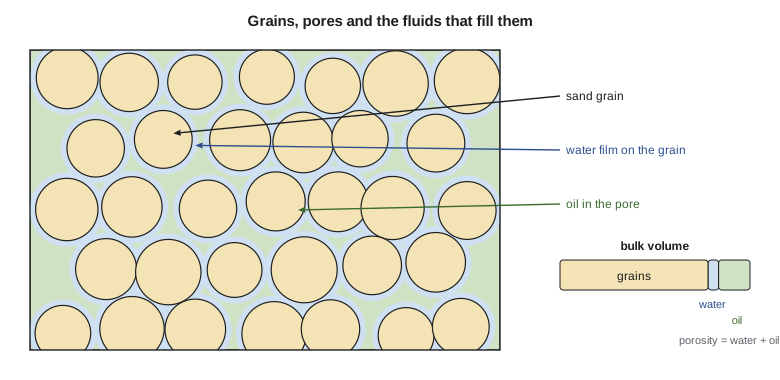
Saturation is the fraction of the pore volume filled by a given fluid: water saturation \(S_w\), oil saturation \(S_o\) and gas saturation \(S_g\). In any pore volume they add to one. The water left behind when oil migrated into the rock is called connate or irreducible water, typically 15 to 40 percent of the pore volume in a conventional reservoir. Water saturation is estimated from resistivity logs: rock grains and oil do not conduct electricity, but salty water does, so a formation full of oil reads a much higher resistivity than the same rock full of water.
Gus Archie, a Shell engineer, published the relationship in 1942 that is still the starting point for log analysis. For a clean rock, the resistivity of the formation \(R_t\) depends on the resistivity of the formation water \(R_w\), the porosity and the water saturation. With typical exponents of 2, it reads:
The hydrocarbon pore volume of a rock is \(\phi(1 - S_w)\): the fraction of the bulk volume that holds oil or gas. A sandstone with 18 percent porosity and 30 percent water saturation has a hydrocarbon pore volume of 0.18 × 0.70 = 0.126, so about an eighth of the rock is oil. Clay-rich rocks conduct electricity through their clays as well as their water, and they need more complex equations, but the principle is the same.
# Log-derived porosity, Archie water saturation and hydrocarbon pore volume
RW = 0.045          # formation water resistivity, ohm-m
A, M, N = 1.0, 2.0, 2.0

def archie_sw(phi, rt):
    return min(1.0, (A * RW / (phi ** M * rt)) ** (1 / N))

readings = [  # depth label, porosity, deep resistivity (ohm-m)
    ('upper sand', 0.14, 28.0),
    ('main sand', 0.12, 35.0),
    ('lower sand', 0.10, 9.0),
    ('shaly base', 0.07, 4.5),
]
print("interval      phi    Rt    Sw    phi(1-Sw)")
for name, phi, rt in readings:
    sw = archie_sw(phi, rt)
    print(f"{name:12s} {phi:5.2f} {rt:5.1f}  {sw:5.2f}   {phi * (1 - sw):6.3f}")

# Gas formation volume factor, Bg = (psc/Tsc) * z T / p
def bg(p, t_abs, z, psc, tsc):
    return psc / tsc * z * t_abs / p
bg_si = bg(15000.0, 70 + 273.15, 0.88, 101.325, 288.15)          # m3 per standard m3
bg_us = bg(2200.0, 160 + 459.67, 0.86, 14.7, 519.67)              # ft3 per scf
print(f"\nSI: Bg = {bg_si:.5f} m3/sm3 -> {1 / bg_si:.0f} standard m3 of gas per m3 of pore space")
print(f"Oilfield: Bg = {bg_us:.5f} ft3/scf -> {5.615 / bg_us:.0f} scf of gas per barrel of pore space")interval phi Rt Sw phi(1-Sw) upper sand 0.14 28.0 0.29 0.100 main sand 0.12 35.0 0.30 0.084 lower sand 0.10 9.0 0.71 0.029 shaly base 0.07 4.5 1.00 0.000 SI: Bg = 0.00708 m3/sm3 -> 141 standard m3 of gas per m3 of pore space Oilfield: Bg = 0.00685 ft3/scf -> 819 scf of gas per barrel of pore space
Permeability
Permeability measures how easily a fluid flows through a rock. Henry Darcy, a French engineer designing water filters for the fountains of Dijon in 1856, found that the flow rate through a bed of sand is proportional to the pressure drop across it and to the area, and inversely proportional to the length and to the fluid's viscosity. For flow through a rock sample, Darcy's law reads:
Here q is the volumetric flow rate, A the cross-sectional area, \(\Delta p\) the pressure difference over length L, \(\mu\) the fluid viscosity and k the permeability. Permeability has units of area. The oilfield unit is the darcy, about 0.987 square micrometres, and most reservoirs are measured in millidarcies (mD). A good conventional sandstone might have 10 to 1,000 mD. Tight rocks have 0.001 to 0.1 mD, and shales are measured in nanodarcies, a millionth of a millidarcy. Permeability can differ greatly between horizontal and vertical directions, because thin shale layers often block vertical flow.
The Cardium sandstone at Tamarack Lake field has about 12 percent porosity and permeability of 0.5 to 5 mD, low enough that wells produce poorly without fracturing but high enough to support a waterflood in the better parts of the pool. The conglomerate lenses within it can reach hundreds of millidarcies, which is why wells that hit them are much better than their neighbours.
| Rock type | Porosity (%) | Permeability (mD) | Typical development |
|---|---|---|---|
| Clean, unconsolidated sand | 25 to 35 | 1,000 to 10,000 | Vertical wells, sand control |
| Conventional sandstone | 12 to 25 | 10 to 1,000 | Vertical or horizontal wells |
| Vuggy carbonate | 5 to 30 | 1 to 5,000 | Variable; fractures and vugs dominate |
| Tight sandstone | 5 to 12 | 0.001 to 1 | Horizontal wells and fracturing |
| Shale or mudstone reservoir | 3 to 10 | 0.00001 to 0.001 | Long horizontal wells, many fracture stages |
Reservoir fluids and their behaviour
Reservoir oil is not the same liquid that fills a tank at the surface. Deep underground, under high pressure and temperature, oil holds natural gas dissolved in it, like carbon dioxide in a sealed soft drink. When the oil is produced, the pressure falls, the gas comes out of solution and the oil shrinks. Engineers describe this with three properties measured in a pressure-volume-temperature (PVT) laboratory on a fluid sample.
The solution gas-oil ratio \(R_s\) is the volume of gas dissolved in a unit volume of stock-tank oil. The oil formation volume factor \(B_o\) is the volume the oil occupies in the reservoir, including its dissolved gas, divided by its volume at the surface. A \(B_o\) of 1.3 means 1.3 barrels of reservoir oil shrink to 1 stock-tank barrel. The bubble point pressure \(p_b\) is the pressure at which the first gas bubble appears as pressure falls. Above it the oil is undersaturated and all the gas stays dissolved; below it free gas forms in the reservoir, which changes how the reservoir behaves, as Lesson 7 shows.
Gas is described by its own formation volume factor \(B_g\), the reservoir volume of a quantity of gas divided by its volume at standard conditions (15 °C and 101.325 kPa in Canada). Because gas is so compressible, \(B_g\) is small: at 15,000 kPa and 70 °C, with z = 0.88 a cubic metre of reservoir pore space holds about 140 standard cubic metres of gas.
In this equation z is the gas compressibility factor, which corrects the ideal gas law for real-gas behaviour and usually lies between about 0.8 and 1.1 at reservoir conditions, and T and p are the absolute reservoir temperature and pressure. Viscosity matters as much as volume. Gas has a viscosity of about 0.02 centipoise, light oil 0.5 to 5 cP, heavy oil hundreds to thousands, and bitumen over a million at reservoir temperature. By Darcy's law, a fluid a thousand times more viscous flows a thousand times more slowly through the same rock.
Worked problem
Oil in a block of reservoir rock
A block of the Cardium sandstone is 800 m long, 400 m wide and 6.0 m thick. Its porosity is 12 percent, its water saturation 28 percent and the oil formation volume factor is 1.25. How much stock-tank oil does it contain?
Show solution
- Bulk volume: 800 × 400 × 6.0 = 1.92 × 10⁶ m³.
- Pore volume: 1.92 × 10⁶ × 0.12 = 2.30 × 10⁵ m³.
- Oil in the reservoir: 2.30 × 10⁵ × (1 − 0.28) = 1.66 × 10⁵ m³.
- At the surface: 1.66 × 10⁵ / 1.25 = 1.33 × 10⁵ m³, or about 836,000 bbl.
Answer: About 133,000 m³ (0.84 million barrels) of oil in place. Only part of it can be recovered; Lesson 7 shows how recovery factors are estimated.
The example shows why porosity and saturation matter so much. A two-percentage-point error in porosity, say 12 instead of 10, changes the oil in place by 20 percent. That is why companies spend heavily on cores and logs, and why reserve evaluators insist on seeing the data behind every number.
Relative permeability and wettability
Darcy's law as written applies to one fluid filling the pores. In a reservoir, oil, water and often gas share the pores, and each gets in the way of the others. Relative permeability describes how much of the rock's permeability each fluid can use at a given saturation. When water saturation is low, oil flows almost as if it were alone and water barely moves. As water saturation rises, oil's relative permeability falls and water's rises, until at the residual oil saturation the remaining oil is trapped as isolated droplets and stops flowing altogether. That residual oil, often 20 to 35 percent of the pore volume after a waterflood, is the target of the enhanced recovery methods in PET-430.
Wettability, the preference of the rock surface for one fluid over another, controls these curves. In a water-wet rock, water coats the grains and occupies the smallest pores, as in the figure earlier in this lesson, and oil sits in the centres of the larger pores. In an oil-wet rock the roles reverse. Many carbonate reservoirs and some tight rocks are mixed-wet or oil-wet, which changes how water displaces oil and how much oil a waterflood can recover. Laboratory measurements on preserved cores, which have not been cleaned of their original oil, are needed to establish wettability, because cleaning can alter it.
Common mistakes
MistakeConfusing porosity with permeability.
InsteadPorosity measures storage; permeability measures flow. A shale can have 8 percent porosity and almost no permeability.
MistakeForgetting the formation volume factor.
InsteadReservoir barrels shrink when gas leaves solution. Divide by B_o to get stock-tank volumes.
MistakeUsing total porosity in reserve estimates.
InsteadUse effective porosity, the connected pore space that can deliver fluid.
MistakeTreating water saturation as zero in an oil zone.
InsteadConnate water always remains, typically 15 to 40 percent of the pore volume.
Summary and key terms
- Porosity is the pore fraction of the rock; effective porosity counts only connected pores.
- Saturations of water, oil and gas add to one; Archie's equation estimates water saturation from resistivity logs.
- Permeability, defined by Darcy's law, measures how easily fluid flows; units are darcies and millidarcies.
- Reservoir oil holds dissolved gas; B_o, R_s and the bubble point describe how it shrinks and releases gas as pressure falls.
- Gas volume changes strongly with pressure, described by B_g and the compressibility factor z.
- Viscosity controls flow rate as strongly as permeability does.
- Porosity
- The fraction of a rock's bulk volume that is pore space.
- Water saturation
- The fraction of the pore volume occupied by water.
- Permeability
- A measure of how easily fluid flows through a rock, in darcies or millidarcies.
- Darcy's law
- The relation stating that flow rate through a porous medium is proportional to permeability, area and pressure gradient and inversely proportional to viscosity.
- Formation volume factor
- The ratio of a fluid's volume at reservoir conditions to its volume at surface conditions.
- Bubble point pressure
- The pressure at which dissolved gas first begins to come out of solution in an oil.
- Solution gas-oil ratio
- The volume of gas dissolved in a unit volume of stock-tank oil.
Practice problems
Work each problem on paper first, then reveal the answer to check.
A core plug has a bulk volume of 25.0 cm³ and a grain volume of 21.5 cm³. What is its porosity?
Show answer
φ = (25.0 − 21.5)/25.0 = 0.14, or 14 percent.
A clean sandstone has φ = 0.20, R_w = 0.05 ohm·m and R_t = 12 ohm·m. Using a = 1 and m = n = 2, find S_w.
Show answer
S_w = √(0.05/(0.04 × 12)) = √0.104 = 0.32.
Two rocks have the same permeability. Oil A has a viscosity of 1 cP and oil B 50 cP. Under the same pressure drop, compare their flow rates.
Show answer
By Darcy's law, oil A flows 50 times faster than oil B.
An oil has B_o = 1.40. How many stock-tank barrels come from 10,000 reservoir barrels?
Show answer
10,000/1.40 = 7,140 stock-tank barrels.
Lesson quiz · 5 questions
Score 60% or more to complete this lesson.
Create a free account to save your progress, take quizzes and earn a certificate.