
PET-200 · Lesson 5 of 12 · 19 min
Well planning and drilling
Marcus Obi has been asked to design the first well on the northern section: a horizontal well that drops vertically to about 1,500 m, curves through 90 degrees and runs 2,800 m sideways through the Cardium sandstone. He will plan its path, choose the casing and cement, specify the drilling fluid, estimate the cost and apply to the AER for a well licence. Then a drilling contractor's rig and crew will drill it in about twelve days, with Marcus on call and a company wellsite supervisor on location around the clock. This lesson describes how a well is planned and drilled; PET-310 Drilling Engineering covers the calculations in depth.
The drilling rig
Almost all oil and gas wells are drilled by rotary drilling. A drill bit at the bottom of a long string of steel pipe is rotated and pushed against the rock, grinding it into small chips called cuttings. A drilling fluid, usually called mud, is pumped down the inside of the pipe, out through nozzles in the bit and back up the space between the pipe and the hole, called the annulus. The mud carries the cuttings to the surface, cools and lubricates the bit, and, most importantly, exerts pressure on the rock to keep formation fluids from flowing into the well.
A land rig has five main systems. The hoisting system, a tall mast with a block and drawworks, raises and lowers the drill string, which can weigh more than 100 tonnes. The rotating system, now usually a top drive motor hanging from the block, turns the pipe. The circulating system includes powerful mud pumps, the mud tanks and solids-control equipment such as shale shakers that screen cuttings out of the returning mud. The power system supplies electricity, from diesel or natural gas engines or increasingly from grid power and batteries. The well control system, centred on the blowout preventer, seals the well if formation fluids start to enter it.
Planning the well path
The well plan starts with the target: the position and depth of the reservoir interval and, for a horizontal well, the direction and length of the lateral. Drilling engineers design a trajectory that reaches it with smooth curves, because sharp bends, called doglegs, increase friction and wear on the pipe and make it hard to run casing. Most horizontal wells are drilled with a vertical section, a build section in which the angle increases at a planned rate, often 8 to 12 degrees per 30 m, and the lateral. Several wells are often drilled from one surface location, called a pad, which reduces land disturbance, roads and pipelines.
Directional drilling uses a downhole motor or a rotary steerable system to point the bit. A mud motor has a slight bend in its housing; by stopping the rotation of the drill string and orienting the bend, the driller can steer, then resume rotating to drill straight. Rotary steerable systems steer while rotating, using pads that push against the borehole wall. Measurement-while-drilling tools near the bit report the hole's inclination and direction to the surface through pressure pulses in the mud. Logging-while-drilling tools add gamma ray and resistivity readings, letting a geosteering geologist keep the lateral inside a target only a few metres thick.
Drilling fluids and pressure control
The mud's most important job is pressure control. The fluids in a formation's pores are under pressure, called pore pressure or formation pressure. In most basins it is close to the pressure of a column of salt water reaching to the surface, called normal pressure, about 10.5 kPa per metre of depth (0.465 psi per foot). Some formations are overpressured, holding fluid at higher pressure because it could not escape as the sediments were buried. If the pressure of the mud column falls below the pore pressure in a permeable formation, gas, oil or water flows into the well. This influx is called a kick, and if it is not controlled it can become a blowout.
The pressure of a fluid column depends only on its density and vertical height. In SI units, hydrostatic pressure in kilopascals equals the mud density in kilograms per cubic metre times 0.00981 times the true vertical depth in metres. The mud weight is chosen to exceed the expected pore pressure by a safety margin, but it must stay below the fracture pressure, the pressure at which the mud would crack the rock open and be lost into it. The narrow window between pore pressure and fracture pressure is one of the main constraints in well design.
# Mud hydrostatic pressure against pore and fracture pressure (SI units)
G = 0.00981                      # kPa per (kg/m3 * m)
mud = 1090                       # kg/m3
points = [  # TVD (m), pore pressure (kPa), fracture pressure (kPa)
    (400, 4100, 7800),
    (900, 9300, 16800),
    (1300, 13400, 23400),
    (1520, 15200, 27000),
]
print(" TVD   pore    mud    frac   overbalance  margin to frac  (kPa)")
for tvd, pp, fp in points:
    ph = G * mud * tvd
    print(f"{tvd:5d} {pp:6d} {ph:6.0f} {fp:6d}   {ph - pp:7.0f}      {fp - ph:7.0f}")

# Equivalent mud densities give the same comparison as densities
for tvd, pp, fp in points[-1:]:
    print(f"\nAt {tvd} m: pore pressure = {pp / (G * tvd):.0f} kg/m3 equivalent, "
f"fracture = {fp / (G * tvd):.0f} kg/m3 equivalent, mud = {mud} kg/m3")TVD pore mud frac overbalance margin to frac (kPa) 400 4100 4277 7800 177 3523 900 9300 9624 16800 324 7176 1300 13400 13901 23400 501 9499 1520 15200 16253 27000 1053 10747 At 1520 m: pore pressure = 1019 kg/m3 equivalent, fracture = 1811 kg/m3 equivalent, mud = 1090 kg/m3
Mud comes in two main families. Water-based muds use water with bentonite clay, polymers and weighting materials such as barite. Oil-based or synthetic-based muds use a base of diesel or refined mineral oil, which keeps reactive shales from swelling and lubricates long horizontal wells, but costs more and needs careful handling and disposal of the cuttings. Mud engineers test the mud's density, viscosity, gel strength, filtration and chemistry several times a day and adjust it as the well deepens.
If a kick occurs, the crew closes the blowout preventer, a stack of large hydraulic valves on top of the well. Annular preventers close a rubber element around any pipe in the hole; ram preventers close steel rams around the pipe or, in the case of blind or shear rams, cut the pipe and seal the hole. The crew then circulates the influx out through a choke while pumping heavier mud to restore control. Rig crews practise well control drills regularly, and supervisors must hold current well control certification.
Casing and cementing
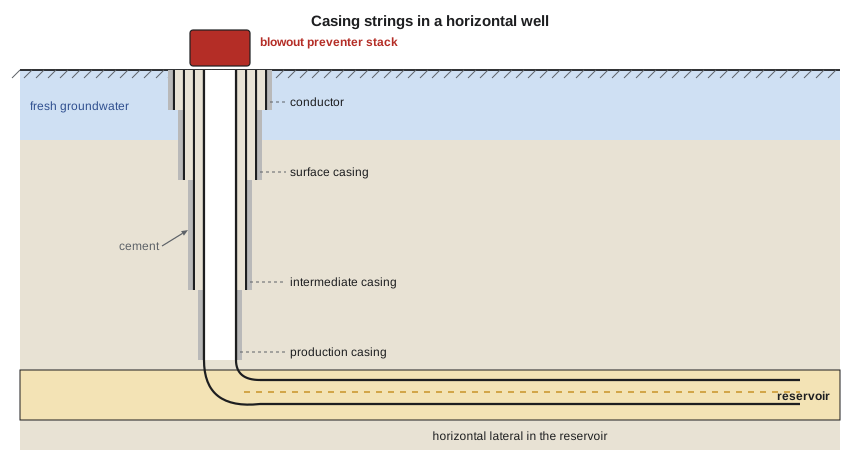
A well is drilled in sections, each smaller in diameter than the one above. After each section, a string of steel casing is run to the bottom and cemented in place. Casing keeps the hole from collapsing, isolates formations with different pressures, protects fresh groundwater and provides a strong conduit for production. Cement is pumped down the casing and up the annulus, then left to harden. A good cement job seals the annulus so that fluids cannot move along the outside of the casing between formations or to the surface.
The shallowest strings protect groundwater. In Alberta, the AER's Directive 008 sets minimum surface casing depths, which depend on the depth of the base of groundwater protection and the well's planned depth, and the surface casing must be cemented all the way back to the surface. The Tamarack Lake field wells use 244 mm surface casing to about 400 m and 139.7 mm production casing to the end of the lateral, with cement placed to isolate the Cardium from the zones above. Casing design checks each string against three loads: burst from internal pressure, collapse from external pressure and tension from its own weight.
Worked problem
Choosing a mud weight
At the top of the Cardium the true vertical depth is 1,520 m and the pore pressure is estimated at 15,200 kPa. The fracture pressure at the casing shoe above, at 400 m, is about 7,800 kPa. Marcus wants an overbalance of at least 1,000 kPa at the Cardium. What mud density does he need, and is it safe at the shoe?
Show solution
- Required bottom-hole pressure: 15,200 + 1,000 = 16,200 kPa.
- Mud density: ρ = 16,200 / (0.00981 × 1,520) = 1,086 kg/m³; round up to 1,090 kg/m³.
- Pressure at the 400 m shoe: 0.00981 × 1,090 × 400 = 4,280 kPa, well below 7,800 kPa.
Answer: A mud of about 1,090 kg/m³ controls the Cardium with a comfortable margin below the fracture pressure at the shoe. Circulating the mud adds friction pressure, so the effective density while pumping is somewhat higher, which Marcus also checks.
Cost, time and the wellsite
A well's cost depends mostly on time, because rigs, crews and services are charged by the day. Engineers track every hour against the plan and study offset wells to find faster methods. Over the past fifteen years, horizontal wells in North American shale and tight plays have become two to three times longer while being drilled in fewer days, through better bits, more powerful rigs, rotary steerable tools and automation. Safety and environmental performance are tracked just as closely: dropped objects, pinch points and well control are the main hazards on the rig floor, and spills and noise are the main concerns for neighbours.
Before drilling, Prairie Crest must hold a well licence from the AER. The application, under Directive 056, describes the location, depth, target and setbacks from residences and water bodies, and identifies whether sour gas could be present. If it could, the company must prepare an emergency response plan and consult residents within a planning zone. During drilling, the AER requires blowout preventer equipment and testing under Directive 036, and after drilling the company files logs, cores and well data under Directive 059.
Drill bits and drilling performance
Two families of bits do almost all the work. Roller-cone bits have two or three cones studded with steel teeth or tungsten carbide inserts that crush and gouge the rock as the cones turn. Fixed-cutter bits, usually called PDC bits after their polycrystalline diamond compact cutters, have no moving parts; their synthetic diamond cutters shear the rock like a plane shaving wood. PDC bits now drill most footage in North America because they last longer and drill faster in shales and sandstones, and in many wells a single PDC bit drills the entire lateral. Roller-cone bits remain useful in very hard or interbedded rock.
Drilling engineers measure performance by the rate of penetration, the depth drilled per hour, and by the cost per metre, which combines bit cost, rig time and trips to change equipment. The driller controls the weight on the bit, the rotary speed and the mud flow rate, and modern rigs adjust them automatically to find the fastest stable combination while avoiding vibration, which can destroy bits and tools. Problems that cost the most time include stuck pipe, lost circulation into weak or fractured zones, unstable shale that caves into the hole and equipment failures. Careful planning based on offset wells, and a drilling team that responds quickly to early signs of trouble, prevent most of them.
Common mistakes
MistakeUsing measured depth for hydrostatic pressure.
InsteadHydrostatic pressure depends on true vertical depth. A horizontal lateral adds measured length but no extra hydrostatic head.
MistakeChoosing the heaviest possible mud for safety.
InsteadToo heavy a mud fractures weak zones and causes lost circulation, which can itself lead to a kick. Stay inside the window.
MistakeTreating cement as a structural afterthought.
InsteadPoor cement lets fluids migrate behind casing, a leading cause of groundwater problems and later leaks.
MistakeAssuming the bit can be steered freely.
InsteadDoglegs increase friction and casing wear; well paths are planned with limited build and turn rates.
Summary and key terms
- Rotary drilling grinds rock with a bit while mud carries cuttings up and controls formation pressure.
- A rig has hoisting, rotating, circulating, power and well control systems.
- Horizontal wells use directional tools and measurement while drilling to steer a lateral within a thin target.
- Mud weight must exceed pore pressure and stay below fracture pressure; hydrostatic pressure depends on true vertical depth.
- Kicks are controlled by closing the blowout preventer and circulating heavier mud.
- Casing strings, cemented in place, protect groundwater, isolate zones and provide the production conduit.
- Drilling mud
- The fluid circulated through the drill string and annulus to carry cuttings, cool the bit and control formation pressure.
- Kick
- An unplanned influx of formation fluid into the wellbore.
- Blowout preventer
- A set of high-pressure valves at the wellhead that can seal the well during a kick.
- Pore pressure
- The pressure of fluids in a formation's pores.
- Fracture pressure
- The pressure at which a formation cracks and accepts fluid.
- Casing
- Steel pipe run into a drilled hole and cemented in place.
- True vertical depth
- The vertical distance from the surface to a point in the well, as opposed to measured depth along the hole.
Practice problems
Work each problem on paper first, then reveal the answer to check.
What hydrostatic pressure does a 1,150 kg/m³ mud exert at 1,800 m TVD?
Show answer
0.00981 × 1,150 × 1,800 = 20,300 kPa.
A horizontal well has a measured depth of 4,500 m and a true vertical depth of 1,600 m. Which depth sets the hydrostatic pressure at the toe?
Show answer
The true vertical depth, 1,600 m, because pressure depends only on vertical height.
Name three jobs that casing does.
Show answer
Prevents hole collapse, isolates zones with different pressures, protects groundwater, and gives a conduit for production and a place to anchor wellhead equipment.
Why are several wells often drilled from one pad?
Show answer
It reduces surface disturbance, roads and pipelines, lets facilities be shared, and lowers cost by moving the rig short distances.
Lesson quiz · 5 questions
Score 60% or more to complete this lesson.
Create a free account to save your progress, take quizzes and earn a certificate.