
PET-200 · Lesson 11 of 12 · 19 min
Regulation, environment and well abandonment
Among Prairie Crest's 160 wells at Tamarack Lake field, about thirty no longer produce. Some were poor wells from the start; others watered out. Each still has a wellhead, a lease road and a pipeline connection, and each is a liability: it must eventually be properly abandoned, its equipment removed and the land returned to farming. the AER tracks every company's inactive wells and requires it to spend a set amount each year closing them. Ethan has been asked to plan the coming year's closure program. This lesson covers how oil and gas are regulated, how environmental risks are managed and how wells are retired.
Who regulates oil and gas
In Canada, the provinces own most oil and gas resources and regulate their development. In Alberta, Alberta Energy Regulator (AER) is the single regulator for oil, gas, oil sands, coal and pipelines within the province, under the Responsible Energy Development Act of 2013. It licenses wells, facilities and pipelines; sets rules in documents called directives; inspects operations; investigates incidents; and enforces compliance with warnings, orders, fines and, in serious cases, shutting in production or suspending a licence. The province's environment ministry sets standards for air, water and land, which the AER applies to energy projects. The federal government regulates interprovincial pipelines through the Canada Energy Regulator and sets national rules for greenhouse gases and methane.
Regulators pursue several goals at once: safety of workers and the public, protection of the environment, conservation of resources by preventing waste, fairness among owners of a shared reservoir, and orderly development. Spacing rules, for example, limit how close wells can be to each other and to the boundaries of a lease, so that one owner does not drain a neighbour's oil. Pooling rules let owners combine their interests in a spacing unit so that a single well can be drilled and the revenue shared.
Environmental protection during operations
Every stage of a well's life carries environmental risks. Drilling and completion use large volumes of water and generate cuttings, spent fluids and flowback that must be handled and disposed of properly. Production facilities can leak oil, produced water and gas. Methane, the main component of natural gas, is a potent greenhouse gas, roughly 80 times stronger than carbon dioxide over twenty years, so leaks and venting from wells, tanks, compressors and pneumatic devices are a major climate concern. Flaring converts methane to carbon dioxide but still emits greenhouse gases and soot. Roads, pads and pipelines fragment habitat, and noise and traffic affect neighbours.
Operators manage these risks through design, monitoring and response. Well integrity, from cement and casing to wellhead seals, keeps fluids in the wellbore. Leak detection and repair programs use optical gas imaging cameras and other sensors to find and fix leaks. Secondary containment, such as lined berms around tanks, catches spills. Pipelines carry corrosion protection and are patrolled and inspected. Emergency response plans set out who does what if something goes wrong, and wells that may produce hydrogen sulphide need emergency planning zones and consultation with nearby residents.
Climate policy is a moving target. Canada's federal government has proposed tighter methane regulations for the oil and gas sector, aimed at cutting its methane emissions 75 percent from 2012 levels by 2030, and in March 2026 Ottawa and Alberta agreed in principle that Alberta's own methane rules could apply in place of federal standards. A proposed federal cap on oil and gas emissions was dropped under a November 2025 memorandum of understanding between Ottawa and Alberta. In its place, Alberta's industrial carbon price for large emitters, held at 95 dollars a tonne of carbon dioxide equivalent in 2026, is set to rise to 100 dollars in 2027 and to 130 dollars by 2035, and the agreement links new pipeline capacity to a large carbon capture project in the oil sands.
Inactive wells and liability
When a well stops producing, the company has three choices. It can try to revive it with a workover, a new zone or a waterflood. It can suspend it, securing it with plugs or valves so that it is safe while waiting for a decision. Or it can abandon it permanently. Suspension cannot last forever: a suspended well still has steel and cement that age, and a company can go bankrupt and leave its wells behind. Regulators therefore require companies to show that they can pay for closure and push them to close inactive wells within a reasonable time.
Alberta has struggled with a growing inventory of inactive and orphaned wells, wells whose owners have gone bankrupt. The Orphan Well Association, funded by an industry levy, closes orphans; after several large bankruptcies, the count of orphan wells reached a record in 2026, with more than 4,000 taken over by the association. In response, the AER's Directive 088 (Licensee Life-Cycle Management), in force since December 2021, assesses each company's capability over the life of its assets and runs an inventory reduction program. Each year the AER sets an industry-wide closure spending quota, 750 million dollars for 2027, and divides it among licensees in proportion to their inactive liability. Companies that fail to spend their share face restrictions on new licences and transfers.
# Closure liability for an example inventory and how long it takes to clear

def liability(n_wells, abandon_each, reclaim_each, facilities):
    return n_wells * (abandon_each + reclaim_each) + facilities

L = liability(32, 85000, 45000, 600000)
print(f"Closure liability today: {L / 1e6:.2f} million dollars")

spend = 1.2e6                 # dollars per year
new_inactive = 4              # wells that go inactive each year
cost_per_well = 85000 + 45000
growth = new_inactive * cost_per_well
print(f"Spending {spend / 1e6:.1f} M$/yr; new inactive wells add {growth / 1e6:.2f} M$/yr")

for annual_spend in (1.2e6, 1.6e6, 2.0e6):
    remaining, years = L, 0
    while remaining > 0 and years < 50:
        remaining += growth - annual_spend
        years += 1
    status = f"cleared in {years} years" if remaining <= 0 else "never cleared at this rate"
    print(f"  at {annual_spend / 1e6:.1f} M$/yr: {status}")

# Present value of the liability if it is paid evenly over 5 years at 10 %
pv = sum((L / 5) / 1.10 ** t for t in range(1, 6))
print(f"Present value of paying {L / 1e6:.2f} M$ over 5 years at 10 %: {pv / 1e6:.2f} M$")Closure liability today: 4.76 million dollars Spending 1.2 M$/yr; new inactive wells add 0.52 M$/yr at 1.2 M$/yr: cleared in 7 years at 1.6 M$/yr: cleared in 5 years at 2.0 M$/yr: cleared in 4 years Present value of paying 4.76 M$ over 5 years at 10 %: 3.61 M$
How a well is abandoned
Abandoning a well means sealing it permanently so that no fluid can move between formations or reach the surface or groundwater, ever. The crew pulls the tubing, rods or pump, and tests whether gas is leaking up the outside of the casing, which would have to be repaired first. They then set cement plugs or mechanical bridge plugs capped with cement across every producing zone, any zone with fluids that could flow and the base of groundwater protection. Each plug is tagged or pressure-tested to prove it is in place. Finally, the casing is cut off below ground level, a steel cap is welded on or a vented cap is installed as the rules require, and the hole is backfilled.
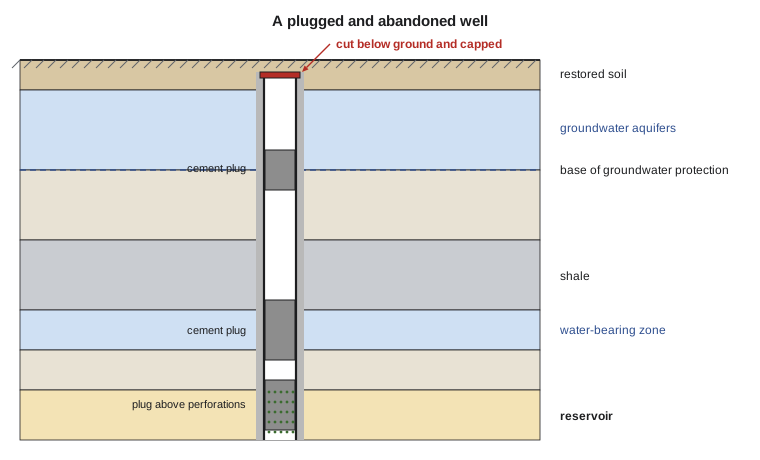
In Alberta, the AER's Directive 020 sets the requirements for well abandonment, including testing for surface casing vent flow and gas migration before the work, the placement and testing of plugs, and cutting and capping the casing at least 1 m below the surface. After the equipment and any contaminated soil are removed, the site is reclaimed: the soil is replaced in its original layers, recontoured and revegetated. When the land is restored to equivalent land capability, the company applies for a reclamation certificate, which ends its surface obligations, although it remains liable for contamination found later.
Worked problem
Closure cost for an inactive inventory
Ethan's list contains 32 inactive wells. He estimates 85,000 dollars per well for downhole abandonment and 45,000 dollars per site for reclamation, plus 600,000 dollars to decommission a small battery and its pipelines. Prairie Crest's share of the industry quota this year is 1.2 million dollars. What is the total closure liability, and how long will the inventory take to clear at the quota rate?
Show solution
- Abandonment: 32 × 85,000 = 2.72 million dollars.
- Reclamation: 32 × 45,000 = 1.44 million dollars.
- Facility: 0.60 million dollars.
- Total: 2.72 + 1.44 + 0.60 = 4.76 million dollars.
- At 1.2 million dollars a year: 4.76 / 1.2 = 4.0 years, if no new wells become inactive.
Answer: About 4.8 million dollars, or four years of quota spending. In practice more wells go inactive every year, so the company must spend faster than its quota or the list will grow.
Closure costs vary widely. Shallow, simple wells may cost tens of thousands of dollars to abandon; deep wells, wells with gas migration or casing leaks, and sour wells can cost many times more. Grouping wells by area, sharing rigs and crews among companies and planning work in good weather all reduce costs. Some operators now design wells from the start for easier abandonment, with better cement and corrosion-resistant materials, and some explore reusing old wells for geothermal energy or monitoring.
Spills, incidents and reporting
Even well-run operations have incidents, and the regulator expects them to be reported quickly, contained and cleaned up. A release of oil or produced water must be reported once it exceeds a threshold volume or reaches a water body, and the company must stop the source, contain the spill, recover what it can and remediate the soil to the applicable standard. Gas releases, fires, well control events and serious injuries also trigger reporting. Regulators investigate significant incidents, publish findings and may order changes across the industry, as happened after pipeline failures and well blowouts in the past.
Enforcement ranges from warnings and orders to fix a problem, through administrative penalties, to prosecution in court for serious or repeated violations. Regulators also use compliance assurance programs, inspections targeted at the highest-risk sites and public reporting of company performance. For engineers, the practical lesson is that compliance is designed in: a facility that meets the rules on the day it starts up, and is maintained properly, rarely produces an enforcement problem. Engineers who discover a safety or environmental problem have a professional duty to report it, even when it is inconvenient for the employer.
Data transparency has grown. Much of the information about wells, production, spills and inspections is now public, searchable by landowners, researchers and journalists. That openness puts pressure on operators to perform well, and it gives engineers a valuable source of data about offset wells, past incidents and the practices that work.
Landowners and nearby communities are part of the regulatory picture too. Companies notify and consult residents before drilling, compensate surface owners for the land they use and respond to complaints about noise, dust, odours and traffic. Good relations reduce objections at hearings and make it easier to develop the next wells, so many operators assign staff to community liaison full time.
Common mistakes
MistakeTreating a suspended well as closed.
InsteadSuspension is temporary; the well must eventually be abandoned and the site reclaimed.
MistakeAssuming abandonment ends all obligations.
InsteadReclamation must follow, and liability for contamination can remain after certification.
MistakePlugging only the producing zone.
InsteadPlugs must also isolate other permeable zones and the base of groundwater protection.
MistakePlanning closure spending only for today's inactive wells.
InsteadNew wells become inactive every year; plans must account for the growing inventory.
Summary and key terms
- In Alberta, the AER licenses, inspects and enforces under its directives; federal bodies regulate interprovincial pipelines and climate rules.
- Regulation pursues safety, environmental protection, resource conservation and fairness among owners.
- Methane leaks, flaring, spills, water handling and land disturbance are the main environmental issues; leak detection and repair, containment and emergency planning manage them.
- Inactive wells are liabilities; regulators require financial assurance and timely closure.
- Directive 088 sets an annual industry closure quota (750 million dollars for 2027) shared among licensees.
- Abandonment isolates all permeable zones and groundwater with tested cement plugs, then the casing is cut and capped and the site reclaimed.
- Directive
- A rule document issued by the Alberta Energy Regulator that sets binding requirements.
- Spacing unit
- An area assigned to a well or set of wells by the regulator, within which owners share production.
- Inactive well
- A well that has not produced or injected for a set period.
- Orphan well
- A well whose responsible owner no longer exists or cannot pay to close it.
- Abandonment
- Permanently sealing a well with tested plugs and cutting and capping the casing.
- Reclamation
- Restoring a well site's soil, contour and vegetation to an equivalent land capability.
- Leak detection and repair
- A program of regular inspections to find and fix methane and other gas leaks.
Practice problems
Work each problem on paper first, then reveal the answer to check.
A company has 50 inactive wells at an average closure cost of 120,000 dollars and spends 1.5 million dollars a year on closure. If no new wells go inactive, how long will it take?
Show answer
Liability 6.0 million dollars; 6.0/1.5 = 4 years.
Why must a well be tested for gas migration and surface casing vent flow before abandonment?
Show answer
Leaks behind the casing must be repaired before the well is sealed; otherwise gas could continue to reach the surface or groundwater after abandonment.
Name three goals of oil and gas regulation.
Show answer
Safety of workers and the public, environmental protection, conservation of resources, fairness among owners, orderly development.
Why is methane a particular concern compared with carbon dioxide?
Show answer
It is a far more potent greenhouse gas over short periods, roughly 80 times stronger than carbon dioxide over twenty years.
Lesson quiz · 5 questions
Score 60% or more to complete this lesson.
Create a free account to save your progress, take quizzes and earn a certificate.