
PET-200 · Lesson 1 of 12 · 20 min
The petroleum industry and the petroleum engineer
Prairie Crest Energy Ltd. is a mid-sized oil producer with its head office in Calgary and a field office in Drayton Valley. Its main asset is the Tamarack Lake field, a light-oil pool in the Cardium Formation about 1,500 m below the farmland of west-central Alberta. The company has drilled about 140 horizontal wells there in the last fifteen years, operates three oil batteries and a gas plant, and is now deciding whether to drill a new section of land to the north. Reservoir engineer Lena Haugen, drilling and completions engineer Marcus Obi, production engineer Sofia Reyes and Ethan Cardinal, an engineer-in-training who joined the company last spring, will appear throughout this course. Every lesson follows one part of their work, from the geology that put oil in the rock to the day the last well is plugged.
Petroleum engineering is the branch of engineering that finds the best way to get oil and natural gas out of the ground and to market, safely and at a profit, and then to leave the land as it was. It borrows from geology, physics, chemistry, mechanical engineering and economics. A petroleum engineer does not usually find oil; geologists and geophysicists do that. The engineer's questions start once a discovery looks possible. How much oil or gas is there? How fast can it flow? How should the wells be drilled and completed? What equipment is needed at the surface? Will the project pay back its cost, and what will it cost to clean up at the end?
Oil and gas in the energy system
Oil and natural gas still supply more than half of the world's primary energy. Oil is mostly refined into transportation fuels such as gasoline, diesel and jet fuel, and into feedstocks for plastics, asphalt and lubricants. Natural gas heats homes, fuels power plants and supplies the hydrogen and carbon for fertilizer and chemicals. Canada is one of the world's largest producers, with oil output of roughly five million barrels a day in recent years, most of it from Alberta. About two thirds of Canadian oil comes from the oil sands, mined or produced through wells with steam; the rest is conventional and tight oil like the Cardium light oil at Tamarack Lake field.
The industry is commonly divided into three segments. Upstream companies explore for, drill and produce oil and gas; this is where most petroleum engineers work and where Prairie Crest sits. Midstream companies gather, process, store and transport the products by pipeline, rail and tanker. Downstream companies refine crude oil and market fuels and petrochemicals. Large integrated companies operate in all three, while most producers in North America are independent upstream companies that sell their oil at a pipeline hub and their gas into a processing plant or a gathering system owned by someone else.
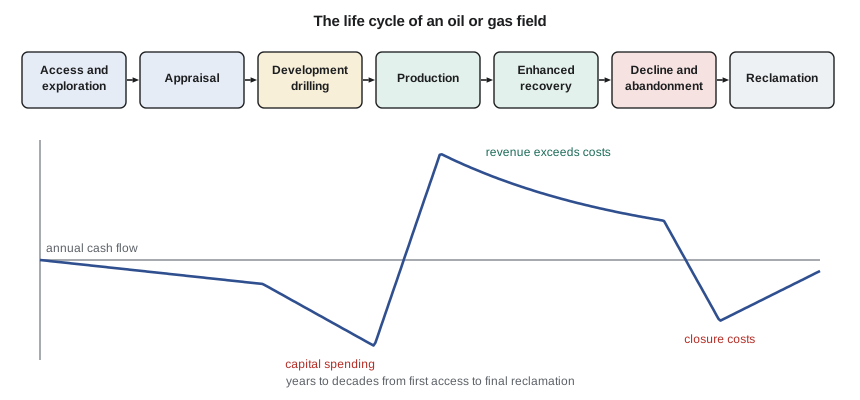
The life of a field
Every oil or gas field passes through the same broad stages. First, a company acquires the right to explore and produce, by buying a lease from the mineral owner. Geologists and geophysicists study rocks, logs and seismic data to identify prospects. An exploration well tests the best prospect. If it finds hydrocarbons, appraisal wells and tests measure how big the accumulation is and how well it flows. Development follows: drilling production wells, building facilities and connecting pipelines. Production then runs for years or decades, usually rising quickly to a peak and declining as reservoir pressure falls. Secondary and enhanced recovery methods such as waterflooding or gas injection can slow the decline. Finally the wells are abandoned, the facilities removed and the land reclaimed.
Ownership of the oil and gas matters at the first stage. In Alberta, about four fifths of the mineral rights belong to the Crown, meaning the province. A company buys the right to explore and produce at a provincial land sale, receives a petroleum and natural gas lease, pays an annual rental and later pays royalties on production. The rest of the minerals, called freehold, are owned privately, often by families whose land titles date from homesteading grants before 1887 or by railway and land companies. Surface rights are separate: a company must also negotiate access with the landowner who farms the surface, and disputes go to the Land and Property Rights Tribunal.
What petroleum engineers do
The profession has several specialties, and most engineers move among them during a career. Reservoir engineers estimate how much oil and gas is in place, how much can be recovered and how fast, using rock and fluid data, pressure tests and computer models. Drilling engineers design wells: the path, the casing, the drilling fluid and the rig program, with safety and cost in balance. Completions engineers design what goes in the well after drilling, including the perforations and hydraulic fracturing that connect the wellbore to the rock. Production engineers keep wells flowing, choose pumps and other artificial lift, and diagnose problems such as scale, sand and water. Facilities engineers design the separators, tanks, compressors and pipelines at the surface.
Other petroleum engineers work in economics and reserves evaluation, preparing the reserve reports that public companies must file and that banks use to set lending limits. Some work for regulators, reviewing well licences and enforcing rules on spacing, flaring and abandonment. Others work for service companies that supply rigs, fracturing crews, logging tools and chemicals, which employ a large share of the industry's engineers. A growing number apply the same skills to geothermal energy, carbon capture and storage, hydrogen storage and lithium extraction from brines, which all involve fluids moving through rock and wells drilled into it. Lesson 12 returns to these.
| Specialty | Typical questions | Key tools |
|---|---|---|
| Reservoir | How much is there? How much can we recover? | Volumetrics, material balance, decline curves, simulation |
| Drilling | How do we reach the target safely and cheaply? | Well design, mud and casing programs, rig scheduling |
| Completions | How do we connect the well to the rock? | Perforating, hydraulic fracturing design, downhole tools |
| Production | How do we keep the well producing? | Inflow performance, artificial lift, chemical treatment |
| Facilities | How do we separate, treat and ship the fluids? | Separators, treaters, compressors, pipelines |
| Economics and reserves | Is it worth doing? What is it worth? | Cash-flow models, reserves definitions, risk analysis |
Units in the oil field
Canadian producers report in SI units. Oil volumes are in cubic metres (m³), gas in thousands of cubic metres (10³m³, often written e³m³), pressure in kilopascals and depth in metres. The rest of the industry, and most oil prices, still use oilfield units: barrels (bbl) of 42 US gallons for liquids, thousand cubic feet (Mcf) for gas, pounds per square inch (psi) for pressure and feet for depth. Engineers in Calgary move between the two all day, so this course gives SI first and oilfield units where they help. One cubic metre is 6.29 barrels, and one thousand cubic metres of gas is 35.3 Mcf. Gas and oil are sometimes added together as barrels of oil equivalent (BOE), counting 6 Mcf of gas as one barrel on an energy basis.
Worked problem
Converting a well test
Ethan reads a test on a new Tamarack Lake field well: 42.0 m³/d of oil, 9.8 10³m³/d of gas and 6.5 m³/d of water. The marketing group in Calgary wants the results in barrels and Mcf per day, and as barrels of oil equivalent per day.
Show solution
- Oil: 42.0 m³/d × 6.29 bbl/m³ = 264 bbl/d.
- Gas: 9.8 10³m³/d × 35.3 Mcf per 10³m³ = 346 Mcf/d.
- Water: 6.5 × 6.29 = 41 bbl/d.
- Oil equivalent: 264 + 346/6 = 264 + 58 = 322 BOE/d.
Answer: About 264 bbl/d of oil, 346 Mcf/d of gas and 322 BOE/d. The 6:1 equivalence is an energy ratio; on a price basis, gas has usually been worth far less than a sixth of a barrel of oil.
# Unit conversions used every day in the oil field
M3_TO_BBL = 6.2898          # barrels per cubic metre
E3M3_TO_MCF = 35.3147       # Mcf per thousand cubic metres
MCF_PER_BOE = 6.0           # energy-equivalent ratio

def si_to_oilfield(oil_m3, gas_e3m3, water_m3):
    return oil_m3 * M3_TO_BBL, gas_e3m3 * E3M3_TO_MCF, water_m3 * M3_TO_BBL

def boe(oil_bbl, gas_mcf):
    return oil_bbl + gas_mcf / MCF_PER_BOE

tests = {'Well 102/06-14 (SI report)': (42.0, 9.8, 6.5),
         'Well 3-21H (SI report)': (18.5, 4.2, 11.0)}
for name, (o, g, w) in tests.items():
    ob, gm, wb = si_to_oilfield(o, g, w)
    print(f"{name}: oil {ob:6.0f} bbl/d  gas {gm:6.0f} Mcf/d  water {wb:5.0f} bbl/d  -> {boe(ob, gm):6.0f} BOE/d")

# The reverse direction: a US-style report in barrels and Mcf
oil_bbl, gas_mcf = 680.0, 940.0
print(f"\n680 bbl/d = {oil_bbl / M3_TO_BBL:.1f} m3/d;  940 Mcf/d = {gas_mcf / E3M3_TO_MCF:.1f} e3m3/d")
print(f"Oil-equivalent rate: {boe(oil_bbl, gas_mcf):.0f} BOE/d")
share = (gas_mcf / MCF_PER_BOE) / boe(oil_bbl, gas_mcf)
print(f"Gas share of the energy: {share:.0%}")Well 102/06-14 (SI report): oil 264 bbl/d gas 346 Mcf/d water 41 bbl/d -> 322 BOE/d Well 3-21H (SI report): oil 116 bbl/d gas 148 Mcf/d water 69 bbl/d -> 141 BOE/d 680 bbl/d = 108.1 m3/d; 940 Mcf/d = 26.6 e3m3/d Oil-equivalent rate: 837 BOE/d Gas share of the energy: 19%
The program shows a habit worth building early: write the unit with every number and convert once, at the start, rather than mixing units in the middle of a calculation. Production reports, reserve reports and regulatory filings all carry units, and a confused unit is one of the most common causes of costly errors in the industry. Spacecraft have been lost to mixed units, and smaller but real losses happen when a pressure in kilopascals is read as psi or a volume in cubic metres is entered as barrels.
Safety, environment and licence to operate
Oil and gas work carries serious hazards: high pressures, flammable fluids, toxic hydrogen sulphide, heavy equipment and remote sites. A loss of well control, called a blowout, can kill workers and spill oil for weeks. The industry's safety systems, from blowout preventers to pressure-relief valves to hazard assessments before every job, exist because of past disasters. Environmental risks include spills, leaks of methane and other gases, groundwater contamination from poorly built wells and disturbance of land and wildlife habitat. Petroleum engineers are responsible for designing wells and facilities that keep fluids where they belong, and their professional licence makes that a legal duty, not just a company policy.
Public acceptance matters as much as technical success. Communities, landowners and Indigenous nations whose treaty and traditional lands overlap oil fields expect to be consulted, to share in benefits and to see the land restored. Alberta Energy Regulator (AER) licenses wells, pipelines and facilities, inspects operations and enforces the rules described in Lesson 11. Engineers who work in Alberta must be registered with APEGA, the provincial association, and follow its code of ethics, which places public safety and the environment ahead of the employer's interests.
Throughout the course, each lesson ends with practice questions, and the quiz checks the key ideas. The worked examples use Prairie Crest's data so that the numbers connect from lesson to lesson: the oil in place estimated in Lesson 7 feeds the economics in Lesson 10, and the wells drilled in Lesson 5 are the ones abandoned in Lesson 11.
Common mistakes
MistakeThinking petroleum engineers find oil.
InsteadGeologists and geophysicists identify prospects. Petroleum engineers decide how to drill, complete, produce and abandon the wells, and whether the project pays.
MistakeAdding gas and oil volumes directly.
InsteadConvert gas to oil equivalent first, using 6 Mcf per barrel, and say so. The ratio is an energy equivalence, not a price equivalence.
MistakeMixing units in the middle of a calculation.
InsteadConvert all inputs to one consistent system at the start and carry units through every step.
MistakeForgetting that a field has costs at the end.
InsteadAbandonment and reclamation come after revenue stops, so they must be planned and funded from the start.
Summary and key terms
- Petroleum engineering decides how to recover oil and gas safely and economically, and how to close wells and restore land afterwards.
- The industry has upstream, midstream and downstream segments; most petroleum engineers work upstream.
- A field passes through access, exploration, appraisal, development, production, enhanced recovery, decline, abandonment and reclamation.
- In Alberta most minerals belong to the Crown and are leased at land sales; freehold minerals are privately owned.
- Specialties include reservoir, drilling, completions, production, facilities, and economics and reserves.
- Canadian reporting uses m³, 10³m³ and kPa; oilfield units remain common; 1 m³ = 6.29 bbl and 6 Mcf = 1 BOE.
- Upstream
- The segment of the industry that explores for, drills and produces oil and gas.
- Midstream
- Gathering, processing, storing and transporting oil and gas between the field and the refinery or market.
- Downstream
- Refining crude oil and marketing fuels and petrochemicals.
- Lease
- A contract that grants the right to explore for and produce oil and gas from a tract in return for payments and royalties.
- Royalty
- The share of production or revenue paid to the mineral owner.
- Barrel of oil equivalent (BOE)
- A unit that adds gas to oil by counting 6 Mcf of gas as one barrel, based on energy content.
- Stock-tank barrel
- A barrel of oil measured at surface conditions, after dissolved gas has come out of solution.
Practice problems
Work each problem on paper first, then reveal the answer to check.
A well tests 18.5 m³/d of oil and 4.2 10³m³/d of gas. Express both in oilfield units and give the total in BOE/d.
Show answer
Oil 116 bbl/d; gas 148 Mcf/d; total 116 + 148/6 = 141 BOE/d.
Name the three segments of the oil and gas industry and give one activity in each.
Show answer
Upstream (drilling and producing wells), midstream (pipelines, gas plants, storage), downstream (refining and marketing).
Why must abandonment costs be planned at the start of a field's life rather than at the end?
Show answer
They come after revenue has stopped, so if they are not funded while the field produces, the owner may be unable to pay and the cost can fall on the public.
Which specialty would answer each question: (a) how much oil can we recover, (b) which pump should go in this well, (c) what casing should we run?
Show answer
(a) Reservoir engineering, (b) production engineering, (c) drilling engineering.
Lesson quiz · 5 questions
Score 60% or more to complete this lesson.
Create a free account to save your progress, take quizzes and earn a certificate.