
MSBA-281 · Lesson 1 of 12 · 18 min
An AI-first sales process
▶ Video coming soon A video version of this lesson is on the way.
Four weeks after Kestrelbay Marine Supply went live on Dynamics 365 Sales, Ottilie Graves-Mendoza put a single number on the whiteboard in the head office meeting room: 312. That was how many new leads had arrived in October from the website, the autumn boat show and the marina newsletter. Her six inside sellers had contacted most of them within three hours, thanks to the sequences Mirela Dragomir-Hale had built in the second stage of the project. But only about one lead in five turned into a real conversation, and the sellers spent most of each morning reading websites to find out whether a yacht club was worth a call. "We fixed speed," Ottilie said. "Now I want the sellers to spend their time on the people who will buy."
Mirela had been waiting for that sentence. The Sales Qualification Agent had already been running in research-only mode for a few weeks, quietly writing notes on new leads. The next stage of the project would decide how far to let agents go: should the agent start writing to leads itself, should another agent watch the open opportunities for risk, and could Ottilie ask questions of her pipeline without waiting for a report? This course follows that stage. It covers the agents Microsoft builds into Dynamics 365 Sales, how to configure and monitor them, how they are billed, and how to tell whether they are helping.
What an AI-first sales process means
An AI-first sales process is one designed on the assumption that some of the work will be done by software agents rather than people, and that people will supervise them. It is not a process in which sellers disappear. It is a process in which each step is assigned deliberately: to a seller, to an agent, or to an agent with a seller checking its work. The question for every step is the same: who does this best, and who is accountable if it goes wrong?
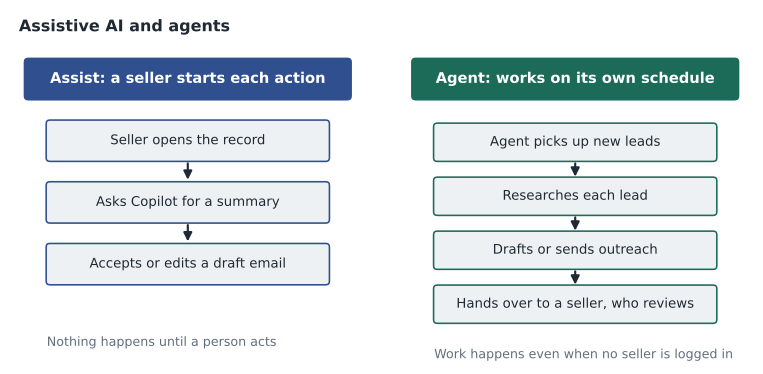
Dynamics 365 Sales has used AI for years in features that help a seller who is already working: predictive lead and opportunity scoring, Copilot summaries of a record, email drafts and meeting preparation. Those features wait for a person to act. Agents are different. An agent is given a goal, a set of records to work on and a set of rules, and then it acts on its own schedule: it researches leads overnight, drafts or sends emails, assigns records to sellers and flags risks. Microsoft calls these autonomous capabilities, and they change the design of the sales process, because work now happens even when no seller has opened a record.
The agents in Dynamics 365 Sales
Microsoft's overview of AI agents in Dynamics 365 Sales, updated in November 2026, describes several built-in agents and agent-like capabilities. This course concentrates on the four that the AB-210 exam and most sales teams care about, plus the change that replaced one of them during 2026.
| Agent | What it works on | What it does |
|---|---|---|
| Sales Qualification Agent | Leads | Researches leads, judges fit, drafts or sends outreach and hands promising leads to sellers |
| Sales Opportunity Agent | Opportunities | Researches open opportunities, flags risks and highlights promising deals |
| Sales Research Agent | Sales data and added files | Answers business questions in natural language with charts and narrative in a research canvas |
| Sales Close Agent (retired in 2026) | Leads, contacts, accounts and opportunities | Ran simple, high-volume deals end to end; replaced by the Sales Development agent |
| Recommended Actions Agent | Opportunities | Suggests prioritized next actions to sellers |
Two other capabilities appear in the same overview. The Sales agent in Microsoft 365 Copilot lets sellers search and act on sales data from Outlook, Teams and other Microsoft 365 apps, and AI-powered data enrichment fills in opportunity details from email conversations. They matter for sellers, but they are configured differently and are covered only briefly here.
Agents are built on Copilot Studio
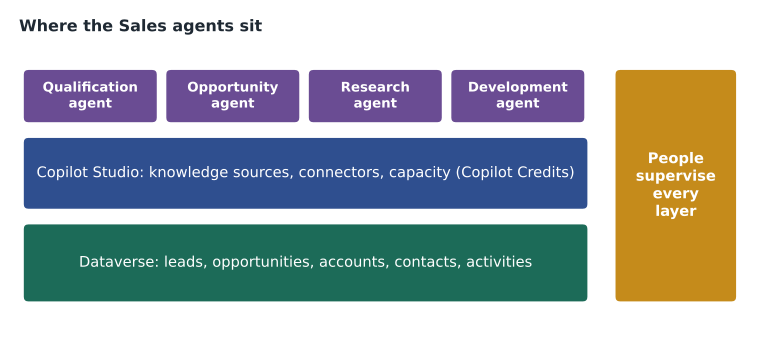
The Sales agents are not separate products bolted on to Dynamics 365. They are built and run on Microsoft Copilot Studio, and they use Dataverse data, Copilot Studio knowledge sources and connectors. That has three practical consequences that run through the whole course. First, setting up an agent needs a Copilot Studio licence for the administrator and data policies that allow the connectors the agent uses. Second, the work an agent does consumes Copilot Credits from the tenant's capacity, so agents have a running cost that grows with the number of records they process. Third, agents follow the same responsible AI controls as other Copilot features, including the rule that data may be processed outside the environment's home region when a local service is not available.
Mirela drew this on the whiteboard as three layers: Dataverse with Kestrelbay's leads and opportunities at the bottom, Copilot Studio and its knowledge base in the middle, and the agents at the top. "Everything an agent knows comes from the bottom two layers," she said. "If the data is wrong, the agent is wrong faster."
Deciding who does each step
Before turning on anything new, Mirela and Ottilie walked through Kestrelbay's sales process one step at a time and gave each step an owner. The result was a simple table they called the work split. It is a useful exercise for any sales team, because it forces a decision about accountability before an agent starts acting.
| Step | Owner before | Owner after | Human check |
|---|---|---|---|
| Research a new web lead | Inside seller | Sales Qualification Agent | Seller reads the agent summary at hand-over |
| First outreach email | Inside seller (sequence) | Agent drafts; seller sends during pilot | Every draft reviewed in the pilot |
| Decide whether a lead is worth a call | Inside seller | Agent proposes fit; seller decides | Supervisor reviews disqualified leads weekly |
| Watch large deals for risk | Ottilie in the Monday meeting | Sales Opportunity Agent on refits and fleet contracts | Owner reviews risk notes weekly |
| Answer "why are refits slipping?" | Analyst with a spreadsheet | Sales Research Agent | Ottilie checks the data behind the answer |
| Quote, negotiate and close | Seller | Seller | Unchanged |
The last row is as important as the others. Kestrelbay sells refit projects worth tens of thousands of dollars to marinas whose owners know their sellers by name. Nobody wanted an agent negotiating those deals. The agents would take over research, triage and watching, and sellers would keep the conversations that build trust.
Principles for agents in sales
Microsoft's documentation and training for the Sales agents return to a handful of principles, and Mirela wrote them on a card for the project team. They also appear, in different words, in the AB-210 exam objectives for configuring and optimizing AI-driven sales.
Start narrow. Microsoft's guidance for the Sales Opportunity Agent is to pilot on one product line with a meaningful volume of opportunities and a small segment, tune the configuration, and only then expand. The same advice applies to every agent, because a broad selection rule processes more records and consumes more credits before anyone has checked the quality.
Test before production. Microsoft recommends deploying agents in a sandbox or test environment first and then moving the configuration, which can be exported as a solution, into production. Kestrelbay already had Kestrelbay-Test from the first project, so every agent was configured and simulated there first.
Keep people accountable. Agents hand over leads to named sellers, supervisors review what agents disqualified, and an owner reads risk notes before acting on them. An agent never becomes the owner of a customer relationship.
Measure from the start. The agent insights pages report what agents processed, handed over and disqualified. Ottilie wanted a baseline from October so that any claim about the agents in December could be compared with something real.
Worked problem
Assigning a step to an agent or a seller
Kestrelbay receives about 40 requests a month from retail sailors asking for a single replacement part, such as a bilge pump. Each is worth under 300 dollars. Should an agent handle these end to end, or should a seller?
Show solution
- Look at value and complexity: small, standard products with published prices and no negotiation.
- Look at the relationship: one-off retail buyers, not marina accounts with a named seller.
- Look at risk: a wrong answer means a return, not a lost refit contract.
- Look at what is available: Kestrelbay's web shop already handles these orders, and the agent that once targeted simple deals has been retired and replaced by a preview agent.
Answer: Point these buyers to the web shop and let the Sales Qualification Agent mark them as poor fit for a seller. Revisit agent handling for simple deals when the Sales Development agent leaves preview and its cost per conversation is known.
Where this course fits
This course is the second of two Dynamics 365 Sales courses for the AB-210 exam, "Accelerating Sales Pipelines with AI in Dynamics 365". The previous course configured the Sales foundations an agent depends on: the data model, business process flows, the product catalogue, scoring, conversation intelligence and Copilot settings. This course builds the agent layer on top. Lessons 2 to 4 cover leads and the Sales Qualification Agent, lessons 5 to 8 cover opportunities and the other agents, lesson 9 covers billing, lessons 10 and 11 cover extending and measuring, and lesson 12 brings everything together in Kestrelbay's plan for the winter.
Roles around the agents
An AI-first process also changes some job descriptions. Kestrelbay did not hire anyone new for the agent stage, but it named four roles, each held by an existing person, and wrote one line for each in the sales handbook. The agent owner decides what an agent is for, approves its selection criteria and answers for its results; for the Sales Qualification Agent that was Ottilie. The agent supervisor reads the agent's work daily or weekly, reassigns wrongly disqualified records and raises patterns; that was Bronagh. The configuration administrator changes settings in the test environment, moves them to production and keeps the runbook; that was Mirela until a sales operations hire. The budget holder approves capacity and reads the monthly usage; that was Ravi.
Naming roles sounds bureaucratic for a 90-person company, but it solved a real problem. In the first fortnight, two sellers had asked Mirela to "make the agent stop sending me boat show leads", while Ottilie wanted it to research all of them. With an owner named, the question had one place to go, and the answer was written down.
| Role | Responsibility | Kestrelbay |
|---|---|---|
| Agent owner | Purpose, scope and results | Ottilie |
| Agent supervisor | Daily review, reassignment, quality notes | Bronagh |
| Configuration administrator | Settings, testing, deployment, runbook | Mirela |
| Budget holder | Capacity purchases and monthly usage | Ravi |
What sellers were told
Ottilie introduced the agent stage to the whole sales team in a fifteen-minute talk at the November sales meeting. She covered three points. The agents would take research and first-touch work, not customers. Every agent output would go to a named person who could disagree with it. And the sellers' own data habits, such as closing deals honestly and recording stakeholders, would decide how useful the agents became. She ended with a promise that made the room relax: no seller would be judged on numbers produced by an agent without a conversation first.
One more principle sat at the bottom of Mirela's card: write it down. Every agent decision, from the scope of a pilot to a change in email wording, went into a runbook with the date, the reason and the person who approved it. When someone later asked why the agent behaved a certain way, the answer was in one place.
Common mistakes
MistakeTreating agents as just another Copilot button.
InsteadPlan agents as workers with assigned records, rules, costs and supervisors.
MistakeTurning an agent on for every lead or opportunity at once.
InsteadStart with a narrow segment, measure, tune and then widen the selection.
MistakeLetting an agent own a customer relationship.
InsteadKeep a named seller accountable for every customer; agents hand work back to people.
MistakeConfiguring agents directly in production.
InsteadConfigure and test in a sandbox, then export the configuration as a solution.
Summary and key terms
- An AI-first sales process assigns each step deliberately to a seller, an agent or an agent supervised by a seller.
- Agents act on their own schedule on assigned records; assistive Copilot features wait for a person.
- The main Sales agents are the Sales Qualification, Sales Opportunity and Sales Research agents; the Sales Close Agent was retired in 2026.
- Sales agents are built on Copilot Studio, use Dataverse data and consume Copilot Credits.
- Start narrow, test in a sandbox, keep people accountable and measure from the start.
- Agent
- Software that works on assigned records toward a goal, following rules, without waiting for a person to start each action.
- AI-first sales process
- A sales process designed so that each step is deliberately assigned to people, agents or both.
- Work split
- A table that assigns each sales step an owner and a human check.
- Copilot Studio
- The Microsoft platform on which the Sales agents are built and run.
- Copilot Credits
- The unit in which agent and Copilot Studio usage is measured and billed.
- Hand-over
- The point at which an agent passes a record to a named seller.
Practice problems
Work each problem on paper first, then reveal the answer to check.
What is the main difference between an assistive Copilot feature and an agent?
Show answer
An assistive feature waits for a person to act; an agent works through assigned records on its own and hands results back.
Name three consequences of the Sales agents being built on Copilot Studio.
Show answer
They need a Copilot Studio licence and connector-friendly data policies to set up, they consume Copilot Credits, and they follow Copilot's data handling rules.
Why did Kestrelbay keep quoting and negotiation with sellers?
Show answer
The deals are large and relationship-based, so the risk and value of human judgement are highest there.
Lesson quiz · 5 questions
Score 60% or more to complete this lesson.
Create a free account to save your progress, take quizzes and earn a certificate.