
MSBA-204 · Lesson 12 of 12 · 20 min
Case study: meeting a privacy regulation
▶ Video coming soon A video version of this lesson is on the way.
This capstone brings the course together. In the last two weeks of November 2026, two events tested Corvallin's new Purview configuration against the law that governs it: the branch manager's laptop left on a bus around November 19, and the family complaint of November 12 about a Copilot summary of a care plan. Neither was a disaster. Both required Corvallin to answer, with evidence, how it protects personal health information and what it does when something goes wrong. The case study follows the privacy officer, Ines and Teodor as they handled them and then turned what they learned into a compliance plan.
The legal framework
Corvallin is a custodian of personal health information under Nova Scotia's Personal Health Information Act (PHIA). The Act expects custodians to protect personal health information with reasonable safeguards, to collect, use and disclose it only as the Act allows, and to respond to privacy breaches. When information is stolen, lost or accessed, used or disclosed without authorization, section 69 generally requires the custodian to notify the individual. Section 70 lets a custodian decide not to notify if it reasonably determines that a breach is unlikely to have occurred or that there is no potential for harm or embarrassment to the individual, but it must then notify the Review Officer, the province's Information and Privacy Commissioner, as soon as possible. Other provinces have similar laws, such as Ontario's Personal Health Information Protection Act, and federal private-sector law (PIPEDA) applies to personal information in commercial activities where no substantially similar provincial law applies.
Microsoft is a service provider in this picture. Microsoft's contractual terms commit it to protect customer data as a processor, and Corvallin's privacy officer had confirmed those terms when Corvallin moved to Microsoft 365. But the law places the duty on Corvallin. Purview is how Corvallin carries out much of that duty inside Microsoft 365 and how it shows that it has.
| Obligation | Purview controls | Evidence |
|---|---|---|
| Know what information is held and where | Data explorer, SITs, classifiers, DSPM assessments | The personal health information inventory in Compliance Manager |
| Protect with reasonable safeguards | Sensitivity labels with encryption, DLP, container labels, oversharing remediation | Label and DLP configurations, test results, DSPM posture reports |
| Limit use and disclosure to what is allowed | Label permissions, DLP for Copilot, communication compliance | Policy descriptions, audit records of access and label changes |
| Keep records and dispose of them properly | Retention labels, event-based retention, disposition review | File plan, proof of disposition |
| Detect and respond to breaches | Audit, alert policies, DLP alerts, insider risk, eDiscovery | Incident records, breach assessments, case histories |
| Demonstrate compliance | Compliance Manager assessments and improvement actions | Evidence attached to actions, board reports |
Event one: the laptop on the bus
The branch manager reported the lost laptop about an hour after leaving it on the bus. The response followed Corvallin's breach procedure.
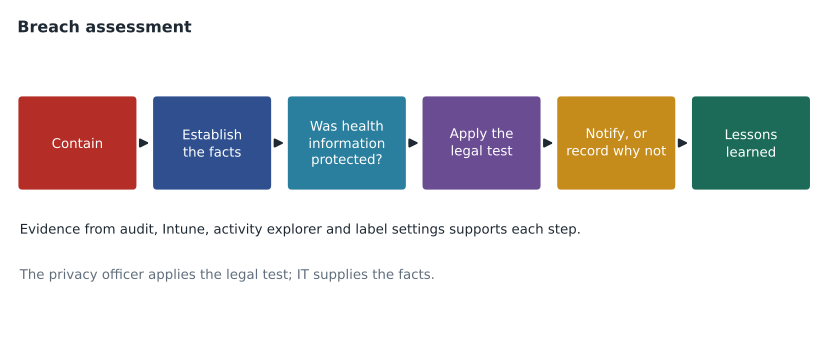
| Step | What happened | Tool |
|---|---|---|
| Contain | Ama issued a remote wipe at 20:05; the manager's sessions were revoked and her password changed | Intune, Microsoft Entra ID |
| Establish facts | Teodor's audit search listed 14 files accessed from the laptop in 30 days; 6 were Confidential / Clinical and encrypted | Audit, activity explorer |
| Check protection | The laptop had BitLocker and Windows Hello; Intune compliance showed encryption on | Intune compliance report |
| Check for misuse | No sign-ins or file access from the device after Thursday evening | Audit, Entra sign-in logs |
| Apply the legal test | The privacy officer assessed the facts against the notification rules | Breach procedure |
| Decide and record | Decision, reasons and evidence recorded in the incident file | Restricted investigation site |
The legal analysis was the privacy officer's, not Teodor's, but it depended entirely on his evidence. Under PHIA she concluded that a breach was unlikely to have occurred and there was no potential for harm or embarrassment: the device was encrypted and protected by Windows Hello, the clinical files were separately encrypted by their label, the device was wiped, and there was no access after it was lost. Section 70 therefore allowed Corvallin not to notify the clients, and she notified the Review Officer as the Act requires, with a summary of the facts and the evidence. The incident record listed the audit search criteria, the Intune report and the label configuration, so anyone reviewing the decision later could see what it rested on.
Worked problem
What if the laptop had not been encrypted?
Suppose the laptop had not had BitLocker enabled, and three of the files were unlabelled scheduling exports with clients' names, addresses and health card numbers. How would the analysis change?
Show solution
- Containment would be the same, but the remote wipe would protect data only if the device reconnected.
- The unlabelled exports would be readable by anyone who could start the laptop.
- The potential for harm or embarrassment would be real, so section 69 notification of the affected clients would be required.
- Lessons learned would include enforcing device encryption with Intune compliance and Conditional Access, and auto-labelling scheduling exports.
Answer: Notification would very likely be required, and the incident would expose gaps in device compliance and labelling that Purview and Intune can close.
Event two: the complaint about a Copilot summary
The family's complaint was not a breach report; it was a question about how their mother's information had been used. Their letter asked whether "an AI" had read her care plan and whether her information had been sent to "the AI company". The privacy officer needed to answer accurately and completely.
| Question | How Corvallin answered it | Evidence |
|---|---|---|
| Who accessed the care plan? | The case manager, as part of the client's care team | Audit records of file access; the case manager's role |
| Did Copilot use it? | Yes: the case manager asked Copilot to summarize medication changes for the family | CopilotInteraction audit record; the interaction collected in eDiscovery |
| Was the summary accurate? | Yes; it matched the care plan and noted pharmacist approval | The interaction content in the review set |
| Did the information leave Corvallin's control? | Copilot processed it within Microsoft 365 under Microsoft's commitments as a service provider; it was not used to train models | Microsoft's data protection commitments; the tenant's configuration |
| Was anything disclosed to the family improperly? | No; the family was the client's authorized representative | Consent and representative records |
The eDiscovery case from lesson 9 provided the evidence in a defensible form, under hold, with a history of every search. The privacy officer's reply explained, in plain language, what Copilot is, that it worked only with information the case manager was already permitted to see, that the summary was checked by the case manager and was accurate, and that Corvallin's policies required staff to review any AI-assisted summary before sharing it. Counsel reviewed the letter before it was sent in the week of November 16. The eDiscovery case stayed open while counsel waited for the family's lawyer to respond, and the clinical director offered the family a meeting to go through the medication change itself.
Turning events into a plan
Ines asked for a compliance plan that would hold up to an external review in 2027. Teodor and the privacy officer built it from the course's solutions, sequenced to fit the readiness plan.
| Area | Action | Owner | Evidence in Compliance Manager |
|---|---|---|---|
| Inventory | Refresh the personal health information inventory quarterly from data explorer and DSPM | Privacy officer | Inventory document and exports |
| Classification | Pilot exact data match for the client list in 2027 | Teodor | EDM configuration and test results |
| Protection | Labels to all staff; auto-label scheduling exports; enforce device encryption in Conditional Access | Teodor, Ama | Label policy, auto-labelling results, compliance policy |
| Use and disclosure | Copilot location DLP enforced; AI-assisted summary review rule in the acceptable use policy | Privacy officer | Policy, DLP configuration |
| Records | Client record retention with discharge events weekly; disposition reviews by Ansel | Ansel | File plan, proof of disposition |
| Detection | Alert policies, DLP alert triage within one business day, insider risk for licensed users | Privacy officer, Teodor | Triage records, alert history |
| Response | Breach procedure updated with the laptop case as a worked example; annual tabletop exercise | Privacy officer | Procedure and exercise record |
| Governance | Quarterly access review of Purview, audit and eDiscovery roles | Ines | Access register |
What the case study shows
Three lessons stood out when the team reviewed the month. First, evidence is a by-product of good configuration. The laptop decision took an afternoon instead of a week because audit was on, labels encrypted clinical files, and Intune reported encryption; nobody had to reconstruct anything. Second, the law asks questions Purview cannot answer by itself. Whether there was potential for harm, or a low probability of compromise, is a judgement for the privacy officer; Purview supplies the facts. Third, people matter more than policies. The family's concern was answered because a case manager had checked an AI summary before using it and the privacy officer could explain clearly what had happened.
Preparing for an external review
Ines expected an external privacy review in 2027, as part of a contract renewal with the provincial health authority. Teodor and the privacy officer prepared a short evidence pack so the review would not become a scramble. It contained the personal health information inventory; the label taxonomy and its permissions; DLP policy descriptions with test results and alert triage statistics; the file plan and proof of disposition for test labels; the access register for Purview, audit and eDiscovery roles; the breach procedure with the laptop case as a worked example; and the Compliance Manager assessment export. Each item named its owner and its date, so the reviewer could see that the controls were maintained, not just configured once.
| Evidence pack item | Source | Owner |
|---|---|---|
| Personal health information inventory | Compliance Manager, data explorer, DSPM | Privacy officer |
| Label taxonomy and permissions | Information Protection export and test results | Teodor |
| DLP policies and alert statistics | DLP policies, alert history | Teodor and privacy officer |
| File plan and disposition records | Records Management | Ansel |
| Access register | Role group reviews, PIM reports | Ines |
| Breach procedure and incident records | Restricted investigation site | Privacy officer |
| Assessment export | Compliance Manager | Privacy officer |
Applying the case study elsewhere
The same approach works for other regulations and other organizations. Start with the obligations in plain language. Map each one to the Purview controls that implement it and to the evidence that shows those controls work. Assign an owner outside IT for every obligation. Use audit and eDiscovery to answer questions with facts. Keep the legal judgement with the people responsible for it, and give them good evidence. A school board under student privacy law, a clinic under a different province's or state's health privacy law or a financial firm under records rules would fill the same table with different rows.
Worked problem
A short exercise
A new client asks Corvallin for a copy of all the personal health information it holds about her. Which Purview tools help the privacy officer respond, and what is outside Purview?
Show solution
- eDiscovery can search mailboxes, Teams, SharePoint, OneDrive and Copilot interactions for the client's name and client ID, with results reviewed before anything is released.
- Data explorer and the inventory show which sites hold client records, narrowing the search.
- Retention settings confirm whether older records still exist or were disposed of with proof of disposition.
- The scheduling vendor's system and paper records are outside Purview and must be searched separately.
- The privacy officer decides what is released, applying any exceptions the law allows.
Answer: eDiscovery, data explorer, the inventory and retention records support the search; other systems and the legal decision sit outside Purview.
The privacy officer closed the review of the month with a note in the incident file: each event had been handled within its legal timelines, the evidence was preserved, and every lesson learned had an owner and a date in Compliance Manager.
Common mistakes
MistakeLetting IT decide whether an incident is a notifiable breach.
InsteadIT supplies evidence; the privacy officer applies the legal test and decides.
MistakeAssuming encryption of a device alone settles every question.
InsteadCheck device encryption, label encryption, containment and evidence of access together.
MistakeAnswering a complaint about AI with generalities.
InsteadUse audit and eDiscovery to show exactly what was accessed, by whom and how.
MistakeTreating the compliance plan as an IT project.
InsteadAssign owners across privacy, records, HR, clinical and IT, with evidence for each action.
Summary and key terms
- Privacy law places duties on the organization; Purview is how it carries out and demonstrates many of them in Microsoft 365.
- Each obligation maps to Purview controls and to evidence that they work.
- Breach response moves from containment and facts to the legal test, the notification decision and lessons learned.
- Audit, Intune and label configuration provided the facts that made the laptop decision quick and defensible.
- eDiscovery and audit answered the family's questions about Copilot with evidence rather than assurances.
- Custodian
- An organization responsible for personal health information under health privacy law.
- Breach assessment
- The documented analysis of an incident against the legal test for notification.
- Containment
- Steps that stop further exposure, such as remote wipe and session revocation.
- Notification decision
- The documented choice to notify individuals and regulators, or the reasons notification is not required.
- Compliance plan
- A set of owned actions and evidence that show how an organization meets its obligations.
- Lessons learned
- Changes to controls and procedures identified after an incident.
Practice problems
Work each problem on paper first, then reveal the answer to check.
Who decides whether an incident must be notified: IT or the privacy officer?
Show answer
The privacy officer, using evidence from IT.
Which Purview tools supplied the facts for the laptop decision?
Show answer
Audit and activity explorer, together with label encryption settings; Intune supplied device encryption status.
Which solution preserved the evidence for the complaint in a defensible form?
Show answer
eDiscovery, through a case with holds.
Lesson quiz · 5 questions
Score 60% or more to complete this lesson.
Create a free account to save your progress, take quizzes and earn a certificate.