
MEC-210 · Lesson 4 of 12 · 28 min
Force and acceleration: Newton's second law for particles
The first three lessons described motion without asking what causes it. This lesson connects motion to force. The connection is Newton's second law, which is short enough to fit on a coffee mug and powerful enough to design almost every machine you will ever work on. Used carefully, with clean free-body diagrams and consistent signs, it answers questions such as how hard a conveyor can accelerate before the load slips, what force a side guide must take on a curve, how much tension a hoist cable carries while it lifts, and how fast a parcel settles after a transfer. Used carelessly, it produces answers that are wrong by a factor of two or have the wrong sign, and nobody notices until something slides off a belt.
Newton's laws
Newton's first law says that a particle at rest stays at rest, and a particle in motion keeps moving in a straight line at constant speed, unless an unbalanced force acts on it. The second law makes this quantitative: the resultant force on a particle equals its mass times its acceleration,
The third law says that forces come in equal and opposite pairs: if body \(A\) pushes on body \(B\), then \(B\) pushes back on \(A\) with a force of the same size in the opposite direction. The third law matters most when a problem involves several bodies in contact. Each force in a pair acts on a different body, so they never appear on the same free-body diagram.
The second law holds in an inertial frame, one that is not accelerating or rotating. As Lesson 1 noted, a frame fixed to the ground is inertial enough for machine and vehicle problems. A frame fixed to an accelerating shuttle is not: an observer riding on it sees loose objects slide backward with no visible force pushing them. Engineers sometimes work in such frames by adding fictitious inertia forces, a method called D'Alembert's principle, but in this course we always write the second law in a ground frame, where it needs no correction.
Mass, weight and units
Mass measures how much a body resists acceleration. Weight is the gravitational force on it, \(W = mg\). The two are easy to confuse because everyday language uses kilograms for both. In SI, mass is in kilograms and force is in newtons, where one newton accelerates one kilogram at one metre per second squared. A 30 kg tote weighs \(30 \times 9.81 = 294 \text{ N}\).
Canadian machine design works almost entirely in SI. You will still meet US customary units on imported equipment, on some older drawings and in American catalogues, so it is worth knowing that in that system force is in pounds (lb) and mass is in slugs, where one pound accelerates one slug at one foot per second squared. A body that weighs \(W\) pounds has a mass of \(W/32.2\) slugs.
Free-body and kinetic diagrams
Every second-law problem starts with two pictures side by side. The free-body diagram shows the particle isolated from its surroundings, with every external force acting on it: weight, normal forces at contacts, friction, cable tensions, spring forces, applied loads. The kinetic diagram shows the same particle with the vector \(m\mathbf{a}\). The second law says the two diagrams are equivalent: the resultant of the forces on the left equals \(m\mathbf{a}\) on the right. Drawing the \(m\mathbf{a}\) vector separately, instead of mixing it in with the forces, keeps the bookkeeping honest.
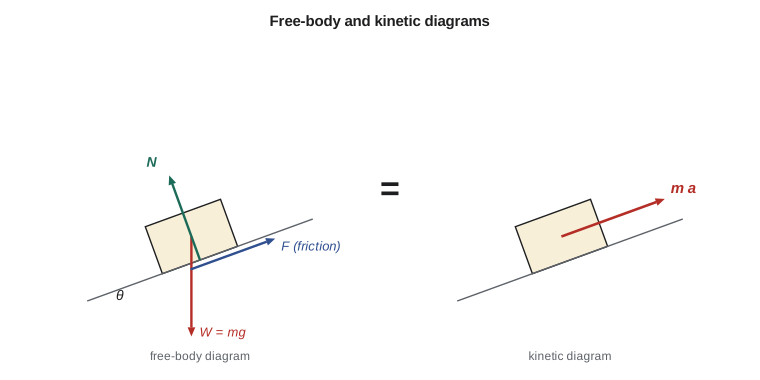
A reliable procedure for any particle problem:
- Choose a coordinate system suited to the motion: rectangular, normal-tangential or polar.
- Draw the free-body diagram and the kinetic diagram.
- If the direction of an unknown force, such as friction, is not obvious, assume one and let the sign of the answer correct it.
- Write the second law in each coordinate direction: \(\sum F_x = m a_x\) and so on.
- Add kinematic relations or constraint equations if there are more unknowns than equations.
- Solve, then check units, signs and whether the answer makes physical sense, for example whether a normal force has come out positive.
Friction
Dry friction between surfaces in contact resists relative sliding. If the surfaces do not slide, the friction force is whatever is needed to prevent sliding, up to a maximum of \(\mu_s N\), where \(\mu_s\) is the coefficient of static friction and \(N\) the normal force. Once sliding starts, the friction force is \(\mu_k N\), where \(\mu_k\), the coefficient of kinetic friction, is usually somewhat smaller than \(\mu_s\). Kinetic friction always acts opposite to the velocity of sliding relative to the other surface, which, as Lesson 3 showed, is not always the absolute velocity.
Coefficients of friction are rough numbers. A cardboard carton on a rubber belt might have \(\mu_s\) between 0.4 and 0.8 depending on the belt cover, the carton surface, humidity and dust. Designers use conservative values, check sensitivity and, for anything critical, test with the real materials. A calculation that depends on the third significant figure of a friction coefficient is a calculation to distrust.
Rectangular coordinates
Worked problem
How hard can an inclined belt accelerate?
An 18 kg tote sits on a belt conveyor inclined at 12° to the horizontal. The coefficient of static friction between tote and belt is 0.45. What is the largest acceleration up the incline the belt can have without the tote slipping, and what friction force does the belt then exert?
Show solution
- Take \(x\) up the slope and \(y\) perpendicular to the belt. Forces: weight \(mg\) down, normal force \(N\), friction \(F\) up the slope (it must pull the tote along).
- \[\sum F_y = N - mg\cos 12^\circ = 0 \;\Rightarrow\; N = 18(9.81)(0.9781) = 172.7 \text{ N}\]
- At the point of slipping, \(F = \mu_s N = 0.45(172.7) = 77.7 \text{ N}\).
- \[\sum F_x = F - mg\sin 12^\circ = m a \;\Rightarrow\; 77.7 - 36.7 = 18a \;\Rightarrow\; a = 2.28 \text{ m/s}^2\]
- In general, \(a_{max} = g(\mu_s\cos\theta - \sin\theta)\), which does not depend on the mass.
Answer: The belt can accelerate at up to 2.28 m/s² before the tote slips, with the belt then pushing on it with 77.7 N of friction. Kestrel would set the drive ramp well below this, perhaps at half, to allow for wet or dusty totes.
The general result is worth reading closely. The allowable acceleration falls as the incline steepens and reaches zero when \(\tan\theta = \mu_s\), the angle at which the tote would slide back even with the belt stopped. Braking the belt while it carries totes uphill is less demanding, because gravity helps decelerate the tote; braking a belt that carries totes downhill is the critical case, and the same analysis with the acceleration reversed shows why. Steep incline conveyors use cleats or textured belts so that the design does not rely on friction alone.
Worked problem
Settling time at a transfer
In Lesson 3, a parcel crossing onto a cross belt slid relative to it at 2.50 m/s. If the coefficient of kinetic friction is 0.35, how long does the slip last and how far does the parcel travel across the cross belt before it moves with the belt?
Show solution
- Friction has magnitude \(\mu_k mg\) and acts opposite to the slip velocity. The slip velocity is the parcel's velocity minus the belt's, and the belt velocity is constant, so the rate of change of the slip velocity equals the parcel's acceleration.
- The friction force is constant in size and stays opposite to the slip, which therefore shrinks along a fixed line at the rate \(\mu_k g = 3.43 \text{ m/s}^2\).
- \[t_s = \frac{2.50}{3.43} = 0.728 \text{ s} \qquad d_{rel} = \frac{2.50^2}{2(3.43)} = 0.910 \text{ m}\]
- The relative slide is along the direction \((0.8, -0.6)\) of the original slip, so its component across the cross belt is \(0.8 \times 0.910 = 0.728 \text{ m}\).
Answer: The slip lasts 0.73 s and the parcel moves 0.73 m across the cross belt before it settles. The cross belt must be wider than this, plus the parcel's own length, or the parcel will hit the far guide while still sliding.
The program below checks this by integrating the parcel's motion step by step in ground coordinates, with the friction direction recalculated at every step from the current slip velocity. It reaches the same answer and, unlike the closed form, would still work if the belt were accelerating or if the friction coefficient changed with speed.
# Parcel crossing onto a cross belt (Lesson 3 transfer), now with kinetics.
# Kinetic friction mu_k*m*g acts opposite to the slip velocity until the
# parcel moves with the belt. Track the parcel in ground coordinates.
import math

g, mu_k = 9.81, 0.35
vb = (0.0, 1.5)                 # belt velocity, m/s
x, y = 0.0, 0.0                 # parcel position, m (x = infeed direction)
vx, vy = 2.0, 0.0               # parcel velocity, m/s
t, dt = 0.0, 1e-5
while True:
    rx, ry = vx - vb[0], vy - vb[1]          # slip velocity
    slip = math.hypot(rx, ry)
    if slip < mu_k * g * dt:                 # slip has (numerically) stopped
        break
    ax, ay = -mu_k * g * rx / slip, -mu_k * g * ry / slip
    vx, vy = vx + ax * dt, vy + ay * dt
    x, y, t = x + vx * dt, y + vy * dt, t + dt

print(f"slip lasts {t:.3f} s")
print(f"parcel travels {x:.3f} m across the cross belt and {y:.3f} m along it")
print(f"final velocity ({vx:.3f}, {vy:.3f}) m/s")

# Check against the closed form: slip decays at mu_k*g along a fixed line.
s0 = math.hypot(2.0, -1.5)
t_s = s0 / (mu_k * g)
d_rel = s0**2 / (2 * mu_k * g)
print(f"closed form: slip time {t_s:.3f} s, relative slide {d_rel:.3f} m")slip lasts 0.728 s parcel travels 0.728 m across the cross belt and 0.546 m along it final velocity (0.000, 1.500) m/s closed form: slip time 0.728 s, relative slide 0.910 m
Normal and tangential coordinates
For motion along a curved path, the second law is written along the tangent and the normal:
The normal equation is the important one. It says that a resultant force of \(m v^2/\rho\) must act toward the centre of curvature for a particle to follow the curve. This force is not a new kind of force; it is supplied by friction, normal forces from guides or banked surfaces, cable tension or gravity. If the available force is less than \(m v^2/\rho\), the particle cannot follow the curve and moves outward. The phrase centrifugal force describes how this feels to someone riding along, but in a ground frame there is no outward force, only an inward force that is too small.
Worked problem
Does a curved conveyor need a side guide?
The 18 kg tote travels round a horizontal curve of radius 1.50 m at 1.20 m/s, as in Lesson 2. The coefficient of static friction between tote and rollers is 0.30. Is friction enough to keep the tote on the curve, and at what speed would it slide outward?
Show solution
- Required inward force: \(m v^2/\rho = 18(1.20)^2/1.50 = 17.3 \text{ N}\).
- Available friction: \(\mu_s mg = 0.30(18)(9.81) = 53.0 \text{ N}\). Friction is ample.
- Sliding begins when \(m v^2/\rho = \mu_s m g\), so \(v = \sqrt{\mu_s g \rho} = \sqrt{0.30(9.81)(1.50)} = 2.10 \text{ m/s}\).
Answer: At 1.20 m/s friction holds the tote with a margin of about three. Above about 2.1 m/s it would slide outward, and the outer guide rail would have to supply the extra force.
Real curved roller conveyors use tapered rollers or differential speeds so that the outer edge of the tote travels farther than the inner edge, and they always have guide rails, because totes vary in mass, friction and position. The calculation above tells the designer how hard those guides will be loaded. Banking the curve works the same way as banking a road: tilting the surface inward lets a component of the normal force supply some or all of the inward force, so less friction is needed.
Polar coordinates
In polar coordinates the second law becomes
For the pick robot of Lesson 2, slewing at 1.5 rad/s with the gripper 0.60 m out and extending at 0.40 m/s, a 2.0 kg payload needs a radial force of \(2.0 \times 1.35 = 2.7 \text{ N}\) inward and a transverse force of \(2.0 \times 1.20 = 2.4 \text{ N}\) sideways. The gripper must provide both by friction on the item, on top of supporting its weight. Checking these numbers against the grip force is how robot programmers decide how fast a delicate item can be moved.
Connected particles
When several particles are linked by cables, links or contact, draw a separate free-body diagram for each, write the second law for each, and add the constraint equations from Lesson 3. Internal forces, such as the tension in a cable between two bodies, appear on both diagrams in opposite directions, by the third law. A common shortcut is to treat the whole connected system as one body to find the acceleration, then isolate one part to find an internal force. That works only when every part has the same acceleration magnitude along the motion, as with bodies joined by a taut cable over a frictionless pulley.
For a counterweighted lift, for example, a car of mass \(m_1\) and a counterweight of mass \(m_2\) hang on either side of a sheave. With the car rising, the second law for the car gives \(T - m_1 g = m_1 a\) and for the counterweight \(m_2 g - T = m_2 a\). Adding eliminates the tension: \(a = (m_2 - m_1) g / (m_1 + m_2)\), which shows why counterweights are chosen close to the car mass. The drive only has to make up the difference and overcome friction.
Common mistakes
MistakePutting the m a vector on the free-body diagram as if it were a force.
InsteadDraw a separate kinetic diagram and set the two diagrams equivalent.
MistakeAssuming friction always equals μN.
InsteadWithout slipping, friction is whatever is needed, up to μ_s N.
MistakeIncluding a centrifugal force in a ground-frame analysis.
InsteadWrite ΣF_n = m v²/ρ toward the centre; there is no outward force on the body.
MistakeUsing the absolute velocity to set the direction of kinetic friction.
InsteadUse the velocity relative to the contact surface.
MistakeMixing pound-mass and pound-force in F = ma.
InsteadConvert weights to slugs with m = W/g.
Summary and key terms
- ΣF = ma holds in an inertial frame; a ground frame is inertial enough for machines.
- Draw a free-body diagram and a kinetic diagram for every particle.
- Static friction is up to μ_s N; kinetic friction is μ_k N opposite to relative sliding.
- On an incline belt, a_max = g(μ_s cos θ - sin θ).
- On a curve, a net inward force of m v²/ρ is needed; friction, guides or banking must supply it.
- In polar coordinates, the Coriolis term adds a sideways force on radially moving loads.
- For connected bodies, write the second law for each body and add the constraints.
- Free-body diagram
- A sketch of a body isolated from its surroundings showing every external force on it.
- Kinetic diagram
- A sketch showing the m a vector equivalent to the resultant force.
- Inertial frame
- A frame that does not accelerate or rotate, in which Newton's laws hold directly.
- Coefficient of static friction
- The ratio of maximum friction to normal force before sliding.
- Coefficient of kinetic friction
- The ratio of friction to normal force during sliding.
- Newton
- The force that accelerates 1 kg at 1 m/s².
- Slug
- The US customary unit of mass, equal to 1 lb·s²/ft.
- D'Alembert's principle
- Treating -ma as a fictitious force so that dynamics problems look like statics.
Practice problems
Work each problem on paper first, then reveal the answer to check.
A 25 kg crate is pushed across a floor with μ_k = 0.30 by a horizontal force of 120 N. What is its acceleration?
Show answer
a = (120 - 0.30 x 25 x 9.81)/25 = 1.86 m/s².
At what incline angle can the belt in the first example no longer accelerate the tote uphill at all?
Show answer
When tan θ = 0.45, about 24.2°.
If the cross belt in the transfer example ran at 2.0 m/s, how long would the slip last?
Show answer
Slip speed 2.83 m/s, so t = 2.83/3.43 = 0.825 s.
A 1,200 kg car and a 1,100 kg counterweight hang on a frictionless sheave. What is the acceleration if the brake is released?
Show answer
a = 100 x 9.81 / 2,300 = 0.427 m/s², car moving down.
Change the program so μ_k = 0.5. What happens to the slip time and the travel across the belt?
Show answer
Both fall by the ratio 0.35/0.5, to about 0.51 s and 0.51 m.
A curve on a conveyor is banked so totes need no friction at 1.5 m/s on a 2.0 m radius. What is the bank angle?
Show answer
tan θ = v²/(gρ) = 2.25/19.62, so θ = 6.5°.
Lesson quiz · 5 questions
Score 60% or more to complete this lesson.
Create a free account to save your progress, take quizzes and earn a certificate.